
Richard Hakluyt (1553–1616)
Author of Voyages and Discoveries: Principal Navigations, Voyages, Traffiques & Discoveries of the English Nation
About the Author
Born in Herfordshire, English geographer and clergyman Richard Hakluyt devoted much of his life to preserving the records of all English voyages of discovery and promoting the advantages of exploring and settling North America. While still a schoolboy, Hakluyt visited the law offices of his cousin show more and saw a large display of geographical materials. He immediately became fascinated with geography. In time he pursued this interest at Oxford University, where later he lectured on geography. Hakluyt was also ordained in the ministry, which enabled him to earn a living while indulging his passion for geography. In 1582 Hakluyt published the first of his four major works, Divers Voyages Touching the Discovery of America and the Islands Adjacent. This work was, in part, propaganda for the English explorer Sir Humphrey Gilbert's doomed voyage to America the following year. Hakluyt next wrote an outline for colonial policy in America, stating some of the advantages of settlement and who should go. Ironically, this work, The Discourse of Western Planting, was not published until 1877. Nonetheless, Hakluyt was instrumental in reviving interest in the settlement of Virginia after the disappearance of the ill-fated Roanoke colony. He was one of the petitioners for the Virginia Company's 1606 grant that resulted in the Jamestown settlement. He also helped plan the East India Company, which colonized India. Hakluyt's best-known work, Principal Navigations, Voyages, Traffiques, and Discoveries of the English Nation, first appeared in 1589, with a second edition published in 1599 and 1600. In 1846, the Hakluyt Society was founded, and it still continues today to publish narratives of early explorations, perpetuating his labors as well as his memory. (Bowker Author Biography) show less
Series
Works by Richard Hakluyt
Voyages and Discoveries: Principal Navigations, Voyages, Traffiques & Discoveries of the English Nation (1972) 305 copies, 3 reviews
The Principal Navigations, Voyages, Traffiques, and Discoveries of the English Nation (1600) 116 copies, 5 reviews
Piracy, Slavery, and Redemption: Barbary Captivity Narratives from Early Modern England (2001) — Contributor — 30 copies
A selection of the principal voyages, traffiques and discoveries of the English nation (1927) 9 copies
The Discovery of Muscovy with The Voyages of Ohthere and Wulfstan from King Alfred's Orosius (2012) 6 copies
The Principal Navigations, Voyages, Traffiques and Discoveries of the English Nation - Volume 01 (2004) 4 copies
The Principal Navigations, Voyages, Traffiques and Discoveries of the English Nation - Volume 07 England's Naval Exploits Against Spain (2012) 4 copies
The Principal Navigations, Voyages, Traffiques And Discoveries Of The English Nation, V. 5: Central and Southern Europe (2010) 4 copies
The Principal Navigations, Voyages, Traffiques and Discoveries of the English Nation - vol VIII Asia Part 1 (2012) 3 copies
Virginia richly valued 3 copies
Voyages of Hawkins, Frobisher & Drake: Select narrations from the 'Principal navigations' of Hakluyt 3 copies
The Principal Navigations, Voyages, Traffiques and Discoveries of the English Nation - vol X1 Africa (2012) 3 copies
Stories from Hakluyt 3 copies
Hakluyt's English voyages 2 copies
The Principal Navigations, Voyages, Traffiques and Discoveries of the English Nation - vol IX Asia Part 11 (2012) 2 copies
The Principal Navigations, Voyages, Traffiques and Discoveries of the English Nation - Volume 04 (2012) 2 copies
The Principal Navigations, Voyages, Traffiques and Discoveries of the English Nation — Volume 03 (2012) 2 copies
The Principal Navigations, Voyages, Traffiques and Discoveries of the English Nation - vol x111 America Part 11 (2011) 2 copies
The Principal Navigations, Voyages, Traffiques and Discoveries of the English Nation - vol X Asia part III (2012) 2 copies
The Principal Navigations, Voyages, Traffiques and Discoveries of the English Nation - vol X11 America Part 1 (2012) 2 copies
Hakluyt's Voyages, Volume X. 2 copies
Hakluyt's Voyages, Volume IX. 2 copies
Voyages of the Elizabethan Seamen to America: Thirteen Original Narratives from the Collection of Hakluyt (1880) 2 copies
The Principal Navigations, Voyages, Traffiques and Discoveries of the English Nation - vol xiv America Part 111 (2012) 2 copies
Early English and French Voyages, Chiefly from Hakluyt, 1534-1608. With maps and a facsimile reproduction (1967) 2 copies
The Principle Navigations, Voyages, Traffiques and Discoveries of the English Nation. (Hakluyt's Voyages) (10 volume set) (1927) 1 copy
Tudor Venturors, The 1 copy
Voyages. Vol.4 1 copy
Principal Navigations, Voyages, Traffiques, and Discoveries of the English Nation (Volume 10, Asia, Part III) (2004) 1 copy
Voyages. Vol.3 1 copy
The Principle Navigations, Voyages, Traffiques and Discoveries of the English Nation Vol. 2 (1913) 1 copy
Hakluyt's collection of the early voyages, travels, and discoveries, of the English nation. Volume 4 1 copy, 1 review
Hakluyt's Voyages The Principal Navigations Voyages Traffiques & Discoveries of the English Nation 1 copy
Hakluyt's collection of the early voyages, travels, and discoveries, of the English nation. Volume 3 1 copy, 1 review
Hakluyt's collection of the early voyages, travels, and discoveries, of the English nation. Volume 5 1 copy, 1 review
Voyages of the English Nation to America: Collected by Richard Hakluyt, Preacher, and Ed. By Edmund Goldsmid (V.2 - 8) (2009) 1 copy
North-West Passage 1 copy
Voyages Of The Elizabethan Seamen To America: Select Narratives From The "principal Navigations" Of Hakluyt, Volume 1... (2012) 1 copy
Associated Works
The First Colonists: Documents on the Planting of the First English Settlements in North America, 1584-1590 (1973) — Contributor — 58 copies
Tagged
Common Knowledge
- Canonical name
- Hakluyt, Richard
- Birthdate
- 1553
- Date of death
- 1616-11-23
- Gender
- male
- Education
- Christ Church College, Oxford University (BA|1574|MA|1577)
Westminster School - Occupations
- adventurer
Colonial Promoter
priest (Church of England)
secretary
editor
translator (show all 7)
author - Organizations
- Charter of the Virginia Company of London
Northwest Passage Company
Church of England (ordained 1578) - Awards and honors
- Hakluyt Society
- Nationality
- England
- Birthplace
- Hereford, Herefordshire, England, UK
- Places of residence
- London, England
Paris, France
Oxford, England - Place of death
- London, England
- Burial location
- Westminster Abbey, London, England, UK
- Associated Place (for map)
- England
Members
Reviews

Two short-and-sweet travelogues from the Tudor propagandist Richard Hakluyt. Each is about 25 pages, one following a voyage led by Sir Francis Drake and another that of Thomas Candish, as they tear about the waters and islands of the New World looting Spaniards, burning towns, treating the natives with a high hand and commenting on the diverse natural wealth of the land and the animals (before shooting them). In short, having a jolly good old colonialist time.
The writing is very dry by show more modern standards; more an action report (we did this, then this, then this…) than an evocative piece of writing. Nevertheless, it does prove fascinating, not only to see the New World as it was when it was truly new and unknown, but because Hakluyt's style becomes unintentionally amusing. From the matter-of-fact way he deals with the violent death of a crewman, or an encounter with the native tribesmen each having "a nail of tin thrust quite through the head of his privy part" (pg. 43), to the nakedly propagandistic inducements to readers back home to come and enjoy the arable land and abundance of animals, such as the "ducks of a marvellous bigness" (pg. 34), we are drawn into an imperial fugue state that no doubt understates the hardship and the viciousness of early colonialism, but is very remarkable to read nonetheless. show less
The writing is very dry by show more modern standards; more an action report (we did this, then this, then this…) than an evocative piece of writing. Nevertheless, it does prove fascinating, not only to see the New World as it was when it was truly new and unknown, but because Hakluyt's style becomes unintentionally amusing. From the matter-of-fact way he deals with the violent death of a crewman, or an encounter with the native tribesmen each having "a nail of tin thrust quite through the head of his privy part" (pg. 43), to the nakedly propagandistic inducements to readers back home to come and enjoy the arable land and abundance of animals, such as the "ducks of a marvellous bigness" (pg. 34), we are drawn into an imperial fugue state that no doubt understates the hardship and the viciousness of early colonialism, but is very remarkable to read nonetheless. show less

In Hakluyt's Virginia Voyages, the following accounts are included: Arthur Barlowe's 1584 Narrative; Ralph Lane's Roanoke Settlement; Thomas Harriot's 1588 Report; Walter Bigges 1589 Summarie; and John White's 1587, 1588, and 1590 Narratives. Despite being printed with the original text, the editor's did an excellent job making it pretty easy to follow. Certain words do look misspelled, but this is Elizabeth English. It's actually entertaining to see how language has evolved even if some show more terms are now obsolete. Many of the original Algonquin names for rivers and villages are included, such as Chipanum, Weopomiok, Muscamunge, and Mattaquen. These names have largely disappeared or have been completely repurposed. I love the Algonquin language family, so pronouncing these words as written is as close to a shred experience as one can get with these Englishmen. Proper pronunciation and spelling is in the editor's notes of course.
The reader must keep in mind that at this time "Virginia" was a territory that stretched from modern-day southwestern PA down to Spanish territory in the South and stretched west to the Mississippi. Thus Roanoke at the time was located in "Virginia," not North Carolina. The Jamestown settlement has not yet occurred. In 1585, according to Ralph Lane, the "greatest province" was Choanoke, capable of "putting 700 fighting men into the fielde." But while some describe their relations with natives as peaceful and with friendly intent, the purpose was absolute colonization. Thomas Harriot especially makes the effort to "sell" the prospect of Virginia to his readers. American wildlife and plants are praised as superior when compared to those already known in Asia and Europe: Pagatowr, Okingier, Wickonzowr, Wapeih, Kaishucpenauk and Sassafras. But it doesn't take the English long to embroil themselves in tribal warfare, stirring the pot to their benefit.
It's a fascinating resource, and gives a better insight into early Virginian history without the burden of modern author erasure or bias. It avoids the fame and politics that can often be found surrounding figures like Walter Raleigh an Sir Francis Drake. It's a part of history that's often ignored in favor of larger world events. show less
The reader must keep in mind that at this time "Virginia" was a territory that stretched from modern-day southwestern PA down to Spanish territory in the South and stretched west to the Mississippi. Thus Roanoke at the time was located in "Virginia," not North Carolina. The Jamestown settlement has not yet occurred. In 1585, according to Ralph Lane, the "greatest province" was Choanoke, capable of "putting 700 fighting men into the fielde." But while some describe their relations with natives as peaceful and with friendly intent, the purpose was absolute colonization. Thomas Harriot especially makes the effort to "sell" the prospect of Virginia to his readers. American wildlife and plants are praised as superior when compared to those already known in Asia and Europe: Pagatowr, Okingier, Wickonzowr, Wapeih, Kaishucpenauk and Sassafras. But it doesn't take the English long to embroil themselves in tribal warfare, stirring the pot to their benefit.
It's a fascinating resource, and gives a better insight into early Virginian history without the burden of modern author erasure or bias. It avoids the fame and politics that can often be found surrounding figures like Walter Raleigh an Sir Francis Drake. It's a part of history that's often ignored in favor of larger world events. show less
Read this for the history. And to gain an understanding of the colonial attitude. But if you find it too long here is a summary of how to travel the world 1500's style:
1. If it is spanish steal it or, failing that, burn it.
2. If it is Spanish but the Spaniards aren't there fool the natives into thinking you are Spanish and steal all the Spanish stuff then tell the natives who you are: If the natives are friendly pay them; if not, burn them out.
3. If it is an animal; kill it, even if you show more don't need the food. Because animals are there for killing, right?
4. Plan on losing at least half your crew.
5. Be sure to only trade worthless bits of lead or iron to the natives for your vital supplies. If they want more chase them off and then steal it, and finish by burning down their town.
6. If in doubt; burn stuff. show less
1. If it is spanish steal it or, failing that, burn it.
2. If it is Spanish but the Spaniards aren't there fool the natives into thinking you are Spanish and steal all the Spanish stuff then tell the natives who you are: If the natives are friendly pay them; if not, burn them out.
3. If it is an animal; kill it, even if you show more don't need the food. Because animals are there for killing, right?
4. Plan on losing at least half your crew.
5. Be sure to only trade worthless bits of lead or iron to the natives for your vital supplies. If they want more chase them off and then steal it, and finish by burning down their town.
6. If in doubt; burn stuff. show less
Voyages and Discoveries: Principal Navigations, Voyages, Traffiques & Discoveries ofthe English Nat (Penguin Classics) by Richard Hakluyt
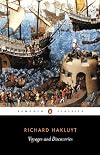
This is an extract from a longer work entitled [Principal Navigations, Voyages, Traffiques and Discoveries of the English nation], which was a collection of documents made in the sixteenth century by Richard Hakluyt: a man whose gratuitous pursuit of knowledge for its own sake was to him life’s most important end. This penguin edition is about one tenth of the whole collection. He could lay claim to be Englands first geographer. The authors of these documents were mostly hard headed show more practical men who were a distinctive break from the tradition of renaissance cosmology writing weighed down by references to classical texts.
England in the late sixteenth century lagged behind other European powers in exploration and colonisation of the rest of the world. The Portuguese were the leaders in Exploration, the Spanish controlled much of the shipping routes to South America in their search for gold and precious stones, while the French were already establishing colonies on the continent of North America. The English were late to the party, but were determined to grab something for themselves and so a mixture of a genuine desire to establish trade and business relations sat uneasily with a need to indulge in piracy on the high seas. The documents detail the voyages of traders and pirates desperate not to lose out on the riches of exotic goods, slavery, and precious metals. There is very little in the way of new discoveries, these seamen were largely going where others had gone before.
From the documents collected here it would seem that England had three options: one was to find the mythical North West passage, the sea route that would link the Atlantic ocean to the Pacific ocean through the North American land mass. The other was to approach the exotic east of China and Japan through a sort of North East passage that took traders through the Caspian sea into Russia and on through Persia. The final option was to muscle in on the lucrative slave and mineral trade already established by the Spanish, French and Portuguese; taking in Africa and the Americas. The documents (there are 76) which were written by those who had first hand knowledge of the voyages are of course a mixed bag: containing practical accounts by traders such as Anthony Jenkins of a voyage to the city of Bokhara in Bactria in 1558, to a letter in verse written by the poet George Tuberville out of Moscovy in 1568 and finally the very eloquent account by Sir Walter Raleigh of the beautiful Empire of Guiana and the search for the Spanish Eldorado.
This is an extract from George Turbeville’s letter in verse concerning the Russians:
A people passing rude, to vices vile inclined,
Folk fit to be of Bacchus trained, so quaffing is their kind.
Drink is their whole desire, the pot is all their pride,
The soberest head doth once a day stand needful of a guide….
The house that hath no god, or painted saint within,
Is not to be resorted to, that the roof is full of sin.
Many of these despatches from Russia talk of traders being well received in Moscow and then taking the Volga river down to Astrakhan on the Caspian sea, where the travelling gets more difficult and finally into Persia where it is bandit country. The would be traders and business men arm themselves to fight their way from one caravanserai to another in a search for exotic goods from the east.
The search for the North West passage claimed many lives: Martin Frobisher undertook more than one voyage in artic conditions as did John Davis and their accounts of their battles with ice and extreme weather would make most people think twice about attempting the voyage. The details of the voyages are probably taken from the ships log; in Frobisher’s case they were written by somebody on board his ship, but it would appear that John Davis wrote his own account in the first person.
The first document that contains details of the English acting as slave traders and pirates is “The voyage made by Mr John Hawkins to the coast of Guinea and the Indies of Nova Hispania 1564” The casual business of buying negro slaves from the Portuguese colonists makes horrific reading today as does the pillaging and burning of settlements. From the African coast Hawkins and his ships voyaged to the West Indies where they did business with the Spaniards, always ready to use force where necessary and then onto French settlements on the Florida coast. There follows a discourse by Miles Philips (Englishman) who was put on shore in the West Indies by John Hawkins when an expedition was dangerously low on food; half the ships company were left with a promise that they would be picked up next year. Miles Philips was one of the few survivors finally getting back to England 16 years later.
The documents are arranged in date order and over half of the book deals with expeditions from 1580 to 1596. Sir Francis Drake, Thomas Cavendish voyaged around the world pirating and plundering as they went, while England was officially and unofficially at war with Spain. Amongst the pirating and plundering other voyages are described including one for the relief of colonists in Virginia, who are castigated by a representative of Sir Walter Raleigh for their bad treatment of the Indian natives. There is a report on the defeat of the Spanish armada and the mystery of the colonists at Roanoak.
If these documents demonstrate anything it is the English captains desire to do business, whether that is by making trading agreements, finding new routes or plundering the ships of other nations. There was an appalling loss of life amongst the ordinary seamen, through starvation, disease, hypothermia, or in skirmishes, some of which is recorded in grim details in these despatches. There are a few documents that seem little more than travellers tales, but mostly they are realistic with some communicating a tremendous sense of adventure and hardship. The penguin edition has some useful biographical notes of the major characters as well as some brief notes on the text. The sentences and word order of Hakluyt’s original edition has been largely unaltered, but the spelling has been modernised. There are no maps or bibliography and so it is useful to have access to more information while reading. This book serves as an excellent introduction for the interested reader and so 4 stars. show less
England in the late sixteenth century lagged behind other European powers in exploration and colonisation of the rest of the world. The Portuguese were the leaders in Exploration, the Spanish controlled much of the shipping routes to South America in their search for gold and precious stones, while the French were already establishing colonies on the continent of North America. The English were late to the party, but were determined to grab something for themselves and so a mixture of a genuine desire to establish trade and business relations sat uneasily with a need to indulge in piracy on the high seas. The documents detail the voyages of traders and pirates desperate not to lose out on the riches of exotic goods, slavery, and precious metals. There is very little in the way of new discoveries, these seamen were largely going where others had gone before.
From the documents collected here it would seem that England had three options: one was to find the mythical North West passage, the sea route that would link the Atlantic ocean to the Pacific ocean through the North American land mass. The other was to approach the exotic east of China and Japan through a sort of North East passage that took traders through the Caspian sea into Russia and on through Persia. The final option was to muscle in on the lucrative slave and mineral trade already established by the Spanish, French and Portuguese; taking in Africa and the Americas. The documents (there are 76) which were written by those who had first hand knowledge of the voyages are of course a mixed bag: containing practical accounts by traders such as Anthony Jenkins of a voyage to the city of Bokhara in Bactria in 1558, to a letter in verse written by the poet George Tuberville out of Moscovy in 1568 and finally the very eloquent account by Sir Walter Raleigh of the beautiful Empire of Guiana and the search for the Spanish Eldorado.
This is an extract from George Turbeville’s letter in verse concerning the Russians:
A people passing rude, to vices vile inclined,
Folk fit to be of Bacchus trained, so quaffing is their kind.
Drink is their whole desire, the pot is all their pride,
The soberest head doth once a day stand needful of a guide….
The house that hath no god, or painted saint within,
Is not to be resorted to, that the roof is full of sin.
Many of these despatches from Russia talk of traders being well received in Moscow and then taking the Volga river down to Astrakhan on the Caspian sea, where the travelling gets more difficult and finally into Persia where it is bandit country. The would be traders and business men arm themselves to fight their way from one caravanserai to another in a search for exotic goods from the east.
The search for the North West passage claimed many lives: Martin Frobisher undertook more than one voyage in artic conditions as did John Davis and their accounts of their battles with ice and extreme weather would make most people think twice about attempting the voyage. The details of the voyages are probably taken from the ships log; in Frobisher’s case they were written by somebody on board his ship, but it would appear that John Davis wrote his own account in the first person.
The first document that contains details of the English acting as slave traders and pirates is “The voyage made by Mr John Hawkins to the coast of Guinea and the Indies of Nova Hispania 1564” The casual business of buying negro slaves from the Portuguese colonists makes horrific reading today as does the pillaging and burning of settlements. From the African coast Hawkins and his ships voyaged to the West Indies where they did business with the Spaniards, always ready to use force where necessary and then onto French settlements on the Florida coast. There follows a discourse by Miles Philips (Englishman) who was put on shore in the West Indies by John Hawkins when an expedition was dangerously low on food; half the ships company were left with a promise that they would be picked up next year. Miles Philips was one of the few survivors finally getting back to England 16 years later.
The documents are arranged in date order and over half of the book deals with expeditions from 1580 to 1596. Sir Francis Drake, Thomas Cavendish voyaged around the world pirating and plundering as they went, while England was officially and unofficially at war with Spain. Amongst the pirating and plundering other voyages are described including one for the relief of colonists in Virginia, who are castigated by a representative of Sir Walter Raleigh for their bad treatment of the Indian natives. There is a report on the defeat of the Spanish armada and the mystery of the colonists at Roanoak.
If these documents demonstrate anything it is the English captains desire to do business, whether that is by making trading agreements, finding new routes or plundering the ships of other nations. There was an appalling loss of life amongst the ordinary seamen, through starvation, disease, hypothermia, or in skirmishes, some of which is recorded in grim details in these despatches. There are a few documents that seem little more than travellers tales, but mostly they are realistic with some communicating a tremendous sense of adventure and hardship. The penguin edition has some useful biographical notes of the major characters as well as some brief notes on the text. The sentences and word order of Hakluyt’s original edition has been largely unaltered, but the spelling has been modernised. There are no maps or bibliography and so it is useful to have access to more information while reading. This book serves as an excellent introduction for the interested reader and so 4 stars. show less
Lists
Awards

You May Also Like


Associated Authors
Statistics
- Works
- 112
- Also by
- 6
- Members
- 1,317
- Popularity
- #19,514
- Rating
- 3.5
- Reviews
- 22
- ISBNs
- 108