
Timothy Morton
Author of Hyperobjects: Philosophy and Ecology after the End of the World
About the Author
Timothy Morton is Rita Shea Guffey Chair in English at Rice University. He is the author of Dark Ecology. For a Logic of Future Coexistence: Nothing, Three Inquiries in Buddhism (with Marcus Boon and Eric Cazdyn); Hyperobjects; Philosophy and Ecology after the End of the World, and other books.
Works by Timothy Morton
Mary Shelley's Frankenstein: A Routledge Study Guide and Sourcebook (Routledge Guides to Literature) (2002) 17 copies
Connectedness: An Incomplete Encyclopedia of the Anthropocene (STRANDBERG PUBL) (2020) 11 copies, 1 review
Associated Works
Ghost Nature — Contributor — 1 copy
Tagged
Common Knowledge
- Legal name
- Morton, Timothy Bloxam
- Other names
- MORTON, Timothy Bloxam
MORTON, Timothy - Birthdate
- 1968-06-19
- Gender
- male
- Education
- University of Oxford (English)
- Occupations
- academic philosopher
English professor, Rice University
librettist - Organizations
- Rice University
- Nationality
- UK
- Birthplace
- London, England, UK
- Map Location
- UK
Members
Reviews
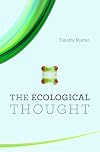
"The position of hunting for anthropocentrism is anthropocentrism. To claim that someone's distinction of animals and humans is anthropocentric, because she privileges reason over passion, is to deny reason to nonhumans. We can't in good faith cancel the difference between humans and nonhumans. Nor can we preserve it" (76)
A nonsystematic, brisk, aphoristic "prequel" to [b:Ecology without Nature|514780|Ecology without Nature Rethinking Environmental Aesthetics|Timothy show more Morton|http://photo.goodreads.com/books/1175445605s/514780.jpg|502744].
Morton's been adopted by the object-oriented ontologists, for good reason, although it's hard to tell whether his ecological thought allows for the withdrawn "for itself" and the "interplay of real and sensual objects" of Graham Harman. Compare:
Some favorite bits follow:
A nonsystematic, brisk, aphoristic "prequel" to [b:Ecology without Nature|514780|Ecology without Nature Rethinking Environmental Aesthetics|Timothy show more Morton|http://photo.goodreads.com/books/1175445605s/514780.jpg|502744].
Morton's been adopted by the object-oriented ontologists, for good reason, although it's hard to tell whether his ecological thought allows for the withdrawn "for itself" and the "interplay of real and sensual objects" of Graham Harman. Compare:
"I hold that one billiard ball hides from another no less than the ball-in-itself hides from humans" (188) and "Real objects are incapable of direct contract, and indeed many have no effect on one another at all. Even the law of universal gravitation only applies among a narrow class of physical objects, and even then concerns a limited portion of their reality....objects confront each other only by proxy" ("Vicarious Causation" 200)to Morton's
"Nothing is complete in itself" (33); "nothing is self-identical" (83); BUT, perhaps more harmonious with Harman, "'interconnection implies separateness and difference. There would be no mesh is there were no strange strangers. The mesh isn't a background against which the strange stranger appears" (47)I'm delighted to do without "nature" without abandoning materiality or real acting objects (which, per Harman and Latour, may be ideas just as much as they might be so-called realia); and I'm delighted with this book, which, if it weren't so obnoxiously priced, would be a welcome addition to my graduate seminar.
Some favorite bits follow:
"Really thinking the mesh means letting go an idea that it has a center. there is no being in the 'middle'--what would 'middle' mean anyway?" (38)show less
"A dog might look cute until it bites into a partridge's neck" (38)
excellent readings of Rhyme of the Ancient Mariner, where "we witness the Mariner ignoring the ethical entanglement with the other, then restarting it (or letting it restart) from an imaginably nightmarish ground. The disturbing, inert passivity of life forms is the zero level of this encounter" (47)
Morton sets himself against against the "earthbound" Heidegger, whose "environmentalism is a sad, fascist, stunted bonsai version, forced to grow in a tiny iron flowerpot by a cottage in the German Black Forest. We can do better" (27); although he doesn't do without Heidegger altogether, of course: "Heidegger poetically said that you never hear the wind in itself, only the storm whistling in the chimney, the wind in the trees. The same is true of the mesh itself. You never perceive it directly. But you can detect it in the snails, the sea thrift [sic?] and the smell of the garbage can. The mesh is known through the being of the strange stranger" (57)
Morton sets himself against uncritical conceptions of life, "There's something slightly sizeist about viewing life as squishy, palpable substances, as if all life forms shared our kinds of tisue. This prejudice breaks down at high resolutions. Viruses are large crystals. The common cold virus is a short string of code packages as a twenty-sides crystals; it tells DNA to make copies of itself. Is the rhinovirus 'alive'? If you say yes, you ought to consider a computer virus alive. RNA-based beings such as viruses requires hosts in order to replicate [so too, I say, do humans]" (67)
Humans are "fairly uniquely good at throwing and sweating: not much of a portfolio" (71)
Without citing Derrida's discussion, via Benthem, of 'not-being-able,' Morton says something similar: "We could categorize life forms according to weakness and vulnerability, rather than strength and mastery, and thus build platforms for finding solidarity in our shared incompetence" (71)
"Rugged, bleak, masculine Nature defines itself through extreme contrasts. It's outdoorsy, not 'shut in.' It's extraverted, not introverted. It's heterosexual, not homosexual. It's able-bodied--'disability' is nowhere to be seen, and physical 'wholeness' and 'coordination' are valued over the spontaneous body" (81) "Masculine Nature is unrealistic. In the mesh, sexuality is all over the map. Our cells reproduce asexually, like their single-celled ancestors or the blastocyst that attaches to the uterus wall at the beginning of pregnancy. Plants and animals are hermaphrodites before they are bisexual and bisexual before they are heterosexual. Most plants and half of animals are either sequentially or simultaneously hermaphorditic; many live with constant transgrender switching. A statistically significant proportion of white-tailed deer (10 percent plus) are intersex" (84) "The ecological thought is also friendly to disability. There are plentiful maladaptions and functionless phenomena at the organism level" (85)
"We need something like a 'no-self' description of states of mind--'anger has arisen here' says enough of what is meanginful about 'I am angry,' without fixing emotions in the amber of identity" (119) [but] "By not holding an objectlike picture of myself in mind, by being true to my inability to pin myself down, I'm being more honest. The ecological thought includes the subject, as our trip through dark ecology showed. The subject isn't an optional extra. Subjectivity is like a waterbed: push it down in one place, it pops up in another. Thinking that personhood is the enemy of ecology is a big mistake" (120)
Very good when jettisoning the "infinite" (despite invocation of the theist Levinas), where he speaks, for example, of "the shock of very large finitude" (118): thus, it's "harder to imagine four and a half billion years than abstract eternity. It might be harder to imagine evolution than to imagine abstract infinity. It's a little humiliating" (5); however, he still uses the word infinite "the [evolutionary/ecological] mesh consists of infinite connections and infinitesimal differences" (30)
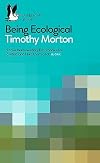
"Don't care about ecology? You think you don't, but you might all the same. Don't read ecology books? This book is for you.
Ecology books can be confusing information dumps that are out of date by the time they hit you. Slapping you upside the head to make you feel bad. Grabbing you by the lapels while yelling disturbing facts. Handwringing in agony about “What are we going to do?” This book has none of that. Being Ecological doesn't preach to the eco-choir. It's for you—even, Timothy show more Morton explains, if you're not in the choir, even if you have no idea what choirs are. You might already be ecological.
After establishing the approach of the book (no facts allowed!), Morton draws on Kant and Heidegger to help us understand living in an age of mass extinction caused by global warming. He considers the object of ecological awareness and ecological thinking: the biosphere and its interconnections. He discusses what sorts of actions count as ecological—starting a revolution? going to the garden center to smell the plants? And finally, in “Not a Grand Tour of Ecological Thought,” he explores a variety of current styles of being ecological—a range of overlapping orientations rather than preformatted self-labeling.
Caught up in the us-versus-them (or you-versus-everything else) urgency of ecological crisis, Morton suggests, it's easy to forget that you are a symbiotic being entangled with other symbiotic beings. Isn't that being ecological?" show less
Ecology books can be confusing information dumps that are out of date by the time they hit you. Slapping you upside the head to make you feel bad. Grabbing you by the lapels while yelling disturbing facts. Handwringing in agony about “What are we going to do?” This book has none of that. Being Ecological doesn't preach to the eco-choir. It's for you—even, Timothy show more Morton explains, if you're not in the choir, even if you have no idea what choirs are. You might already be ecological.
After establishing the approach of the book (no facts allowed!), Morton draws on Kant and Heidegger to help us understand living in an age of mass extinction caused by global warming. He considers the object of ecological awareness and ecological thinking: the biosphere and its interconnections. He discusses what sorts of actions count as ecological—starting a revolution? going to the garden center to smell the plants? And finally, in “Not a Grand Tour of Ecological Thought,” he explores a variety of current styles of being ecological—a range of overlapping orientations rather than preformatted self-labeling.
Caught up in the us-versus-them (or you-versus-everything else) urgency of ecological crisis, Morton suggests, it's easy to forget that you are a symbiotic being entangled with other symbiotic beings. Isn't that being ecological?" show less
I was inspired to look for Timothy Morton’s books in the library catalogue after reading this interview with him. ‘The Ecological Thought’ is very different to the usual sort of books I read about environmental disaster; much more abstract and philosophical. In it, Morton presents a number of new concepts, including the Mesh (an interconnectedness of all things, essentially), the Strange Stranger (a personification of the Other, I think), and hyperobjects (human creations that will show more vastly outlive us, like polystyrene and plutonium). His writing style is more conversational and clearer than I expected, given past experience of obscurantist philosopher-theorists (COUGH Žižek COUGH). Nonetheless, he brings in a variety of literary and pop culture references that at times seem to elide rather than elucidating his arguments. The book gave me a lot to think about, though, and there were a number of points I found especially useful. The first was this, on data destroying illusions:
I also appreciated this sensible comment about literature and the environment, which recalled [b:The Great Derangement: Climate Change and the Unthinkable|29362082|The Great Derangement Climate Change and the Unthinkable|Amitav Ghosh|https://images.gr-assets.com/books/1462497923s/29362082.jpg|49607520]:
Morton has a great deal to say about evolution, DNA, and consciousness, which I found interesting albeit not directly relevant to climate change. As a social scientist, I’m accustomed to a very anthropocentric view of environmental problems. It was rather refreshing to come across a new angle, even if I wasn’t always convinced of its helpfulness. At other moments, though, Morton is very on the nose:
A further highlight Morton’s analysis of the Tragedy of the Commons, a much abused and over-simplified concept. It’s amazing how often the centuries during which the commons were communally managed prior to enclosure are ignored. Like Morton, I find the idea of resources being unmanageable unless individually owned ‘grates on my left ecologist nerves’. At the end, he marshals his ideas neatly into synthesis, producing some especially quotable phrases:
I enjoyed ‘The Ecological Thought’ and will look for more of Morton’s work. He has a unique and appealing angle on the environment, although I’ll reserve judgement on whether its value is greater than as a curiosity. show less
Learning about global warming serves to make us feel something much worse than an existential threat to our lifeworld. It forces us to realise that there never was a lifeworld in the first place, that in a sense ‘lifeworld’ was an optical illusion that depended on our not seeing the extra dimension that NASA, Google Earth, and global warming mapping open up. The more information we acquire in the greedy pursuit of seeing everything, the more our sense of a deep, rich, coherent world will appear unavailable: it will seem to have faded into the past (nostalgia) or to belong only to others (primitivism).
I also appreciated this sensible comment about literature and the environment, which recalled [b:The Great Derangement: Climate Change and the Unthinkable|29362082|The Great Derangement Climate Change and the Unthinkable|Amitav Ghosh|https://images.gr-assets.com/books/1462497923s/29362082.jpg|49607520]:
Art’s ambiguous, vague qualities will help us think things that remain difficult to put into words. Reading poetry won’t save the planet. Sound science and progressive social policies will do that. But art can allow us to glimpse beings that exist beyond our normal categories.
Morton has a great deal to say about evolution, DNA, and consciousness, which I found interesting albeit not directly relevant to climate change. As a social scientist, I’m accustomed to a very anthropocentric view of environmental problems. It was rather refreshing to come across a new angle, even if I wasn’t always convinced of its helpfulness. At other moments, though, Morton is very on the nose:
There is global warming; there is an ecological emergency; I’m not a nihilist; the big picture view undermines right-wing ideology, which is why the right is so afraid of it. However, the melting world induces panic. This is a problem, philosophically and otherwise. Again, it’s a paradox. While we absolutely have complete responsibility for global warming and must act now to curb emissions, we are also faced with various fantasies about ‘acting now’, many of which are toxic to the kind of job humanists do. There is an ideological injunction to act ‘Now!’ while humanists are tasked with slowing down, using our minds to find out what this all means.
A further highlight Morton’s analysis of the Tragedy of the Commons, a much abused and over-simplified concept. It’s amazing how often the centuries during which the commons were communally managed prior to enclosure are ignored. Like Morton, I find the idea of resources being unmanageable unless individually owned ‘grates on my left ecologist nerves’. At the end, he marshals his ideas neatly into synthesis, producing some especially quotable phrases:
DNA has no flavor. Nor is DNA a ‘blueprint’ as the common prejudice believes - it’s a set of algorithmic instructions, like a recipe book. There is no picture of me in my DNA.
[...]
Society isn’t like a bunch of molecules randomly jostling each other with Brownian motion. As Darwin argued, even butterflies value choice. It’s one of the abiding curiosities of capitalist ideology that it accords a gigantic value to choice in one sense, and none whatsoever in another.
I enjoyed ‘The Ecological Thought’ and will look for more of Morton’s work. He has a unique and appealing angle on the environment, although I’ll reserve judgement on whether its value is greater than as a curiosity. show less
I think one may need to look at this book through the lens of someone really trying, if only experimentally, to reduce if not totally excise anthropocentric bias from philosophy. Morton is claiming reason's right to imagine objects that don't need us to exist. This runs counter to twentieth century relativism and its preference to analyze things from various exclusively human perspectives. You can almost sense in Morton an active aversion to what he finds to be human chauvinism. Why do we show more imagine that only we humans have the power to create credible slices of space-time reference by virtue of individual points of view? After all, doesn't everything in a universe affect everything else? What makes us so special?
Anthropocentrism has long since been the exclusive norm in consciousness studies. Thomas Nagel's celebrated essay, "What Is It Like to Be a Bat," is routinely quoted for its notion that we shouldn't attribute consciousness to anything unless we can know "what it's like" to be that thing. But this stricture runs the risk of ruling out imagination and the possibility of other sympathetic connections that could be metaphysically real.
I believe Morton is entertaining the idea that there are many ways of knowing. Anthropocentrism may be a rather poor way to get to know many of the objects, small and large and very large, that we routinely encounter in the business of living. (Morton focuses on the very large, the things that we don't see because they exceed our customary, if not blinkered, visual range).
What Morton doesn't do much of is look at how different types of people who are not philosophers -- such as artists and shamans, to name two -- look at or interact with objects in and out of nature. I'm reminded of Don Juan, the Yaqui shaman of Carlos Castaneda's books, who explained that seeing life in supposedly inanimate objects makes sense because doing so makes his life not only more interesting, but ultimately more true. Don Juan's kind of reasoning may fall outside the dominant modern Western philosophy, but perhaps not outside of philosophy itself as more creatively and expansively conceived. show less
Anthropocentrism has long since been the exclusive norm in consciousness studies. Thomas Nagel's celebrated essay, "What Is It Like to Be a Bat," is routinely quoted for its notion that we shouldn't attribute consciousness to anything unless we can know "what it's like" to be that thing. But this stricture runs the risk of ruling out imagination and the possibility of other sympathetic connections that could be metaphysically real.
I believe Morton is entertaining the idea that there are many ways of knowing. Anthropocentrism may be a rather poor way to get to know many of the objects, small and large and very large, that we routinely encounter in the business of living. (Morton focuses on the very large, the things that we don't see because they exceed our customary, if not blinkered, visual range).
What Morton doesn't do much of is look at how different types of people who are not philosophers -- such as artists and shamans, to name two -- look at or interact with objects in and out of nature. I'm reminded of Don Juan, the Yaqui shaman of Carlos Castaneda's books, who explained that seeing life in supposedly inanimate objects makes sense because doing so makes his life not only more interesting, but ultimately more true. Don Juan's kind of reasoning may fall outside the dominant modern Western philosophy, but perhaps not outside of philosophy itself as more creatively and expansively conceived. show less
Lists
Awards


You May Also Like


Associated Authors
Statistics
- Works
- 35
- Also by
- 5
- Members
- 1,432
- Popularity
- #17,967
- Rating
- 3.8
- Reviews
- 27
- ISBNs
- 91
- Languages
- 10
- Favorited
- 1