
Paul C. Nagel (1926–2011)
Author of John Quincy Adams: A Public Life, A Private Life
About the Author
Paul C. Nagel has been a university professor, a college dean, and, for a time, Director of the Virginia Historical Society
Image credit: sdate
Works by Paul C. Nagel
Associated Works
I Wish I'd Been There: Twenty Historians Bring to Life Dramatic Events That Changed America (2006) — Contributor — 303 copies, 3 reviews
Tagged
Common Knowledge
- Canonical name
- Nagel, Paul C.
- Birthdate
- 1926-08-14
- Date of death
- 2011-05-22
- Gender
- male
- Education
- University of Minnesota (PhD|History|1952)
- Occupations
- historian
- Organizations
- Southern Historical Association (president | 1985)
- Nationality
- USA
- Birthplace
- Independence, Missouri, USA
- Associated Place (for map)
- Missouri, USA
Members
Reviews
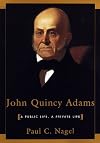
I want to be John Quincy Adams when I grow up. He was a curmudgeon, plain and simple, and I've always aspired to be one. At least, that's been his reputation - not wholly undeserved. Nagel's portrait of him in Johns Quincy Adams: A Public Life, A Private Life, shows that there's much more to the man than his reputation for snarkiness and a failed presidency.
Nagel had the advantage of access to all of JQA's extensive diaries and private writings, which if the introduction is accurate, hadn't show more been fully available before. The picture that comes out of this extra material is of a man that had a love of fine living and a deep desire or a life of literature and learning, a husband devoted to his wife and agonizing over his family, and a son that had a seriously rocky relationship with his parents yet managed to make them proud. What really hit home for me was how much of his later life was driven by the very high expectations John and Abigail Adams had for him and the early push into a public life that he really didn't want. One wonders what JQA would have been like if he had been freer to pursue his own way.
Nagel doesn't spend a lot of time talking about historical events or the political issues that characterized JQA's career. Instead, the book is more about his relationships and his internal life as seen through his diaries. So in the end, I was left more with a sense of who he was rather than a recitation of the events of his life, which was what I was looking for. There's an obvious comparison here to David McCullough's John Adams, concerning JQA's father and mother. Frankly, Nagel doesn't have nearly the high opinion of them that McCullough does - Abigail in particular suffers from fairly severe criticism. I suspect the real truth is somewhere between the extremes in the two books, but Nagel's picture is at least partly correct, I think.
Recommended as a good biography of an often neglected figure in American history. show less
Nagel had the advantage of access to all of JQA's extensive diaries and private writings, which if the introduction is accurate, hadn't show more been fully available before. The picture that comes out of this extra material is of a man that had a love of fine living and a deep desire or a life of literature and learning, a husband devoted to his wife and agonizing over his family, and a son that had a seriously rocky relationship with his parents yet managed to make them proud. What really hit home for me was how much of his later life was driven by the very high expectations John and Abigail Adams had for him and the early push into a public life that he really didn't want. One wonders what JQA would have been like if he had been freer to pursue his own way.
Nagel doesn't spend a lot of time talking about historical events or the political issues that characterized JQA's career. Instead, the book is more about his relationships and his internal life as seen through his diaries. So in the end, I was left more with a sense of who he was rather than a recitation of the events of his life, which was what I was looking for. There's an obvious comparison here to David McCullough's John Adams, concerning JQA's father and mother. Frankly, Nagel doesn't have nearly the high opinion of them that McCullough does - Abigail in particular suffers from fairly severe criticism. I suspect the real truth is somewhere between the extremes in the two books, but Nagel's picture is at least partly correct, I think.
Recommended as a good biography of an often neglected figure in American history. show less
As John Quincy Adams made many appearances throughout David McCullough's life of John Adams, I was intrigued to learn more about his journey from a highly educated childhood, to diplomat, to President. Having read this excellent book, I am saddened to learn that JQA seems to add up to less than the sum of his parts. His well-traveled childhood and mastery of multiple languages did not open his mind to an understanding and appreciation of humanity: his eye was always turned inward, to his own show more achievements, failures, and anxieties. A great leader needs to look past the self to the world, but JQA seemed to look at the world only as a stage for himself. Worse, he saw his children only as reflections on himself, and not as humans deserving of love in their own right. Although I am interested in this time in history and the diplomatic crises in which JQA participated, I don't think I will read any more books centered on him, since I think his biographies by their very nature may overstate his influence on events. show less
This biography proved be a real treat. It focuses on our 6th President's personal life rather than his political one and is both introspective and poignant.
JQA aspired to be a writer. Largely educated in Europe while his father was envoy to France and the Netherlands, Adams strived throughout his life to improve himself and was never satisfied. Which was the tragedy of his life. No matter what he accomplished, it was never enough. Being an Adams destroyed his brothers and two of his sons, so show more it should have been enough just to survive, but he always thought that he should be doing more.
Fortunately, he was lucky in love and after his failed presidency Adams returned to Congress and spent the rest of his life as point man in the crusade against slavery, finally earning himself the honor and fame (after a 100 years of misinformation by confederate apologists) that he truly deserves. show less
JQA aspired to be a writer. Largely educated in Europe while his father was envoy to France and the Netherlands, Adams strived throughout his life to improve himself and was never satisfied. Which was the tragedy of his life. No matter what he accomplished, it was never enough. Being an Adams destroyed his brothers and two of his sons, so show more it should have been enough just to survive, but he always thought that he should be doing more.
Fortunately, he was lucky in love and after his failed presidency Adams returned to Congress and spent the rest of his life as point man in the crusade against slavery, finally earning himself the honor and fame (after a 100 years of misinformation by confederate apologists) that he truly deserves. show less
Drawing on John Quincy Adams’s voluminous diaries, this narrative non-fiction provides insight into the character and actions of the sixth President of the US. The primary strength of this book is portraying what Adams was like as a person. As an extremely intelligent young man, he traveled and was educated in Europe, accompanying his father, John Adams, in his service as a US Ambassador. He comes across as complex, self-critical, stubborn, disciplined, religious, and honorable. He show more experienced episodes of depression, which occurred periodically throughout his life (at a time when very little could be done for it).
This work follows his entire life. It is written in a chronological, straight-forward manner. At a time when few Americans had the chance to travel extensively, JQA visited France, Spain, the Netherlands, Great Britain, Germany, and Russia. He learned many languages and was fluent in French. The narrative covers his education at Harvard and his legal practice, which he viewed as a rather boring occupation. It covers his marriage to Englishwoman Louisa Johnson, children, and the death of his infant daughter in Russia. Two of his sons died in their thirties, one from an apparent suicide and the other from alcohol abuse.
It follows his service as a diplomat and political career, serving as Secretary of State under James Monroe. His presidency was one of the most difficult periods of his life, facing Congressional opposition and making several rather naïve mistakes. Afterward, he became a member of the House of Representatives and served in this capacity until his death at age 81.
I particularly enjoyed reading about his role in defending the slaves of the Amistad, his lifelong opposition to slavery, his poetry writings, and relationship with his mother, Abigail Adams. It lacks footnotes, but it is obvious that the majority of content came from JQA’s journals. As I continue my project of reading US presidential biographies in order, I am glad to have discovered this one. show less
This work follows his entire life. It is written in a chronological, straight-forward manner. At a time when few Americans had the chance to travel extensively, JQA visited France, Spain, the Netherlands, Great Britain, Germany, and Russia. He learned many languages and was fluent in French. The narrative covers his education at Harvard and his legal practice, which he viewed as a rather boring occupation. It covers his marriage to Englishwoman Louisa Johnson, children, and the death of his infant daughter in Russia. Two of his sons died in their thirties, one from an apparent suicide and the other from alcohol abuse.
It follows his service as a diplomat and political career, serving as Secretary of State under James Monroe. His presidency was one of the most difficult periods of his life, facing Congressional opposition and making several rather naïve mistakes. Afterward, he became a member of the House of Representatives and served in this capacity until his death at age 81.
I particularly enjoyed reading about his role in defending the slaves of the Amistad, his lifelong opposition to slavery, his poetry writings, and relationship with his mother, Abigail Adams. It lacks footnotes, but it is obvious that the majority of content came from JQA’s journals. As I continue my project of reading US presidential biographies in order, I am glad to have discovered this one. show less
Lists
Awards


You May Also Like


Associated Authors
Statistics
- Works
- 10
- Also by
- 1
- Members
- 1,165
- Popularity
- #22,061
- Rating
- 3.9
- Reviews
- 16
- ISBNs
- 40