
Michael Shaara (1928–1988)
Author of The Killer Angels
About the Author
Michael Shaara was a novelist, short story writer, and educator. He was born in Jersey City, New Jersey on June 23, 1928. Shaara earned a B.S. from Rutgers University and did graduate work at Columbia University and the University of Vermont. Shaara spent two years in the service, worked as a show more policeman and a sailor, and became associate professor at Florida State University in 1961. From 1961 to 1965 he wrote, produced, and performed in a show for educational television. Shaara published a novel in 1974 titled, The Killer Angels. The novel told the story of the Battle of Gettysburg from the point of view of the men fighting it. It received the Pulitzer Prize in 1975. In 1993, the novel was the basis for the motion picture Gettysburg. Shaara also published more than 70 short stories that appeared in several U.S. and foreign publications and wrote several more novels. Shaara died on May 5, 1988. (Bowker Author Biography) show less
Series
Works by Michael Shaara
The Civil War Trilogy: Gods and Generals / The Killer Angels / The Last Full Measure (1999) 206 copies, 1 review
Three Great Novels of the Civil War: The Killer Angels / Andersonville / The Red Badge of Courage (1994) 102 copies, 1 review
Soldier Boy [short story] 4 copies
Grenville's Planet 3 copies
"Galaxy" 2 copies
Cool Neighbor 2 copies
The Killer Angels.[Novel about the Battle of Gettysburg(4 days) from the viewpoints of Robert E.Lee & James Longstreet]. (1979) 2 copies
Lighthouse 2 copies
"Potential Enemy" 2 copies
Citizen Jell 2 copies
The Sling and the Stone 1 copy
The Vanisher 1 copy
Time Payment 1 copy
Death Of A Hunter 1 copy
Associated Works
Isaac Asimov's Wonderful Worlds of Science Fiction, Volume 9: Robots (1989) — Contributor — 117 copies, 2 reviews
Isaac Asimov's Wonderful Worlds of Science Fiction, Volume 8: Monsters (1988) — Author, some editions — 75 copies, 2 reviews
The Best Science Fiction Stories and Novels: Ninth Series (2024) — Contributor — 39 copies, 1 review
The Greatest War Stories Ever Told: Twenty-Four Incredible War Tales (2001) — Contributor — 31 copies, 1 review
Tagged
Common Knowledge
- Legal name
- Sciarra, Michael Joseph, Jr.
- Birthdate
- 1928-06-23
- Date of death
- 1988-05-05
- Gender
- male
- Education
- Rutgers University
- Occupations
- police officer
novelist - Organizations
- United States Army
- Relationships
- Shaara, Jeffrey (son)
Shaara, Lila (daughter) - Nationality
- USA
- Birthplace
- Jersey City, New Jersey, USA
- Places of residence
- Jersey City, New Jersey, USA (birth)
Tallahassee, Florida, USA - Burial location
- Culley's MeadowWood Memorial Park, Tallahassee, Florida, USA
- Map Location
- New Jersey, USA
Members
Reviews
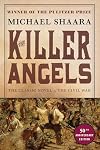
One of two books read in my entire lifetime that I consider a masterpiece.
This book's language is sweet, smooth-flowing, stunning in its simplicity and focus. The Battle of Gettysburg is well documented and has been written about since July 4, 1863..... but to someone unversed in warfare and battlefields, it brought home the bravery, certainty and uncertainty, fear, foolishness, conflicts, nobility, and humanity of the men struggling to survive the 3 days in Pennsylvania that turned the show more tide of the war.
I loved the structure of the novel - alternating chapters among the key figures of the war - Lee, Chamberlain, Longstreet, Buford, Armistead, The Spy, Freemantle. I appreciated the maps, the brief biographical notes at the beginning of the novel and the afterward describing the principal characters lives after the war.
I want to learn more about Longstreet and Chamberlain particularly and want to see Gettysburg.
I'm not sure I could have appreciated this book at any earlier time in my life so am grateful that I've read it now. show less
This book's language is sweet, smooth-flowing, stunning in its simplicity and focus. The Battle of Gettysburg is well documented and has been written about since July 4, 1863..... but to someone unversed in warfare and battlefields, it brought home the bravery, certainty and uncertainty, fear, foolishness, conflicts, nobility, and humanity of the men struggling to survive the 3 days in Pennsylvania that turned the show more tide of the war.
I loved the structure of the novel - alternating chapters among the key figures of the war - Lee, Chamberlain, Longstreet, Buford, Armistead, The Spy, Freemantle. I appreciated the maps, the brief biographical notes at the beginning of the novel and the afterward describing the principal characters lives after the war.
I want to learn more about Longstreet and Chamberlain particularly and want to see Gettysburg.
I'm not sure I could have appreciated this book at any earlier time in my life so am grateful that I've read it now. show less
The Killer Angels: The Classic Novel of the Civil War (The Civil War: 1861-1865 Book 2) by Michael Shaara
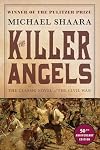
This Pulitzer Prize-winning novel is THE novel of the American Civil war and the battle of Gettysburg. It is meticulously researched, and there are no fictional storylines or fictional characters, other than a few NCOs and enlisted men in small supporting roles. (Shaara based the thoughts and conversations of the officers who are the primary characters primarily on their letters and diaries, and other than for officers, such relics are hard to come by.) The chapters are written from the show more perspective of various officers from both sides, including Robert E. Lee, but the primary perspectives are Joshua L. Chamberlain for the Union, and James Longstreet for the Confederacy. Chamberlain was not a professional soldier, but a Maine native, a college professor from Bowdoin College who ended up as a Colonel leading the 20th Maine infantry regiment. Longstreet was a professional soldier, who was forced to lead an offensive effort at Gettysburg designed by Lee that he felt was doomed to failure due to the overwhelming numbers and superior position of the Union forces. He did indeed prove correct.
The contrast of the two differing perspectives is excellently done. Chamberlain was an intellectual, viewing the situation philosophically and ethically, yet rose to the occasion to become a leader of men and a Medal of Honor winner at Little Round Top. The title actually references the title of a speech Chamberlain gave in his school days: "Man, The Killer Angel".
Particularly poignant to me was the dilemma of the professional soldiers on the Confederate side. With the exception of J. E. B. Stuart and George Pickett, they are shown as conflicted men who had sworn allegiance to the U.S. when serving in the regular Army and who had no particular love for the Southern "Cause" that led to secession, but felt they could not bear arms against the people of their home states, and could not leave them undefended when under a state of war. They were in a no-win position. Longstreet in particular believed that the war was unwinnable for the South, and that taking a defensive position was their best option, which did NOT make his popular among his fellow Southerners who did not serve in the Army.
It's a great book, and very readable for a story that deals solely with a battle that spread out over four days. It does not glorify warm, but does make the reader understand how some people can rise to meet a horrific situation with a certain greatness. show less
The contrast of the two differing perspectives is excellently done. Chamberlain was an intellectual, viewing the situation philosophically and ethically, yet rose to the occasion to become a leader of men and a Medal of Honor winner at Little Round Top. The title actually references the title of a speech Chamberlain gave in his school days: "Man, The Killer Angel".
Particularly poignant to me was the dilemma of the professional soldiers on the Confederate side. With the exception of J. E. B. Stuart and George Pickett, they are shown as conflicted men who had sworn allegiance to the U.S. when serving in the regular Army and who had no particular love for the Southern "Cause" that led to secession, but felt they could not bear arms against the people of their home states, and could not leave them undefended when under a state of war. They were in a no-win position. Longstreet in particular believed that the war was unwinnable for the South, and that taking a defensive position was their best option, which did NOT make his popular among his fellow Southerners who did not serve in the Army.
It's a great book, and very readable for a story that deals solely with a battle that spread out over four days. It does not glorify warm, but does make the reader understand how some people can rise to meet a horrific situation with a certain greatness. show less
Just a damn good book. After reading Michael Shaara’s critically acclaimed Killer Angels I came away quite happy that I had read it. Not that it is a happy story or that it is/was an earth shattering revelation, but this was just a rock solid, old fashioned well written and researched book. I thoroughly enjoyed getting inside the heads of each of the cast of characters Shaara uses to lead the reader through the Battle of Gettysburg. Even though this is a work of fiction, the research was show more accurate as far as I know (I am not an expert on Gettysburg by any stretch), and the fictional story woven in between the fibers of truth. The language is accessible for anyone, though violent (it is a three day battle you know), it is easily digestible, and whole-heartedly engrossing once you get into it. There really is nothing fancy about the work; it is just a damn good book to read. I highly recommended this to anyone. show less
Michael Shaara’s son, Jeff, says that his father had a hard time convincing a publisher that a novel about the Civil War would sell to a Vietnam-wearied public. Shaara was shocked when The Killer Angels won the 1975 Pulitzer Prize without a major marketing campaign. Ken Burns says reading it in 1984 inspired him to do his Civil War documentary series (1990). Indeed, the book did not find its largest audience until it served as the basis for the more than four-hour movie Gettysburg in 1988. show more
If you look up The Battle of Gettysburg on Wikipedia, you find maps and links to photographs of officers standing rigidly in their dress uniforms, their faces usually concealed by the full beards of the time. The Killer Angels brings those pictures to life, letting us eavesdrop on their imagined inner lives as they plan, politic, and improvise their way through what they know is the defining event in their lives and American history, North and South.
We experience most of the drama through the eyes of Confederate General James Longstreet and Joshua Lawrence Chamberlain, a Union Colonel who won the Medal of Honor for his actions at Little Round Top. Chamberlain was a professor of rhetoric before he took command of a volunteer unit from Maine. He is our everyman hero, who is unaware of his own competence and heroism. He is by far the most fully developed of Shaara’s characters.
Shaara portrays Longstreet as a professional soldier who gave Lee good tactical advice he would not or could not take. He agrees to lead a doomed assault from a sense of duty. His encounter with Lee after the failure of Pickett’s Charge is one of the most moving scenes in the novel.
History is always a blend of imagination and documentation. Shaara makes us feel the value of historical imagination. show less
If you look up The Battle of Gettysburg on Wikipedia, you find maps and links to photographs of officers standing rigidly in their dress uniforms, their faces usually concealed by the full beards of the time. The Killer Angels brings those pictures to life, letting us eavesdrop on their imagined inner lives as they plan, politic, and improvise their way through what they know is the defining event in their lives and American history, North and South.
We experience most of the drama through the eyes of Confederate General James Longstreet and Joshua Lawrence Chamberlain, a Union Colonel who won the Medal of Honor for his actions at Little Round Top. Chamberlain was a professor of rhetoric before he took command of a volunteer unit from Maine. He is our everyman hero, who is unaware of his own competence and heroism. He is by far the most fully developed of Shaara’s characters.
Shaara portrays Longstreet as a professional soldier who gave Lee good tactical advice he would not or could not take. He agrees to lead a doomed assault from a sense of duty. His encounter with Lee after the failure of Pickett’s Charge is one of the most moving scenes in the novel.
History is always a blend of imagination and documentation. Shaara makes us feel the value of historical imagination. show less
Lists
Awards


You May Also Like


Associated Authors
Statistics
- Works
- 32
- Also by
- 22
- Members
- 10,538
- Popularity
- #2,259
- Rating
- 4.2
- Reviews
- 213
- ISBNs
- 107
- Languages
- 4
- Favorited
- 21

