
Thomas F. Madden
Author of The New Concise History of the Crusades
About the Author
Thomas F. Madden is professor of history and director of the Center for Medieval and Renaissance Studies at Saint Louis University.
Works by Thomas F. Madden
Empires of Trust: How Rome Built—and America is Building—a New World (2008) — Author — 130 copies, 3 reviews
The Concise History of the Crusades (Critical Issues in World and International History) (2013) 107 copies
Sword and Cross: Medieval Europe's Crusades Against the Armies of the Levant (Portable Professor) (2005) 20 copies, 2 reviews
One, holy, Catholic, and apostolic : a history of the Church in the Middle Ages (2006) 11 copies, 1 review
The Modern Scholar: The Medieval World, Part II: Society, Economy, and Culture (The Modern Scholar) (2009) 10 copies, 1 review
Understanding the Crusades 9 copies
Christianity at the Crossroads: The Reformations of the Sixteenth and Seventeenth Centuries (2007) 8 copies, 1 review
The Modern Scholar: The Lost Warriors of God: The True History of the Knights Templar (2014) 6 copies
Father of the Bride: Fathers, Daughters, and Dowries in Late Medieval and Early Renaissance Venice 2 copies
The Coming of the Friars 1 copy
Heresy and Inquisition 1 copy
The Rise of Islam 1 copy
Monasticism 1 copy
The Reformation 1 copy
Gothic Architecture 1 copy
The Rise of the Universities 1 copy
Daily Life and the Family 1 copy
The Modern Scholar: One Holy Catholic and Apostolic: A History of the Church in the Middle Ages 1 copy
The Carolingian Renaissance 1 copy
The Hundred Years War 1 copy
Christianity Triumphant 1 copy
Monks and Monasteries 1 copy
Tagged
Common Knowledge
- Birthdate
- 1960-06-10
- Gender
- male
- Nationality
- USA
- Associated Place (for map)
- USA
Members
Reviews
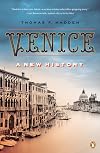
I have fallen in love with ancient Venice thanks to this book. It was the oldest republic in the world, for 1300 years its people opposed a strong central government. The author destroys old myths about its “all-powerful” doges who were nothing of the sort. Doges were chosen by a process so complex no one of power could possibly influence it “other than God,” and were replaced easily. Not until Napoleon—who “forced” liberty on it (another myth because according to the author show more they were the most free people through antiquity)—did one man force the Venetians to erect a statue to one man in St Mark’s Square. Napoleon. It didn’t last long. Venice was formed when Romans escaped to its islands fleeing Attila the Hun. Because land was scarce, there was no landed gentry, and thus no nobility, unlike everywhere else in the ancient world. And yet the people were and are noble. An excellent book!!
By the way, the narrator was fantastic as well. I just don’t have enough praise for this book. While I’m not as enamored with Venice’s modern history (no fault of the author’s of course), I now cannot wait to see it in a few weeks!! show less
By the way, the narrator was fantastic as well. I just don’t have enough praise for this book. While I’m not as enamored with Venice’s modern history (no fault of the author’s of course), I now cannot wait to see it in a few weeks!! show less

A very good and engaging set of lectures about the medieval world that debunks a lot of common misconceptions about the era, about christianity, the inquisition. Madden goes over the religious issues that will continue to fracture the church down the ages (uneducated priests, heretical views), as well as the many monastic orders that it will draw from. You also get insights into the legal and economic changes toward a more distributed power system, a lot of it an unintended consequence from show more kingly abuses (the nobles open a door to regulating power that will continue to be built upon later), or the power vacuum of the plague opening the door for mobile peasants in a world screaming for workforce to renegotiate their position. I liked the discussion of the nebulous concept of feudalism as well. Lots to like here. show less

Venice is a city that I would love to visit someday. However, before I get around to doing that (if ever), I want to take some time and really study the history of it. We see Venice all the time in movies and occasionally in video games like Assassin’s Creed II, but why did it come to be built on a lagoon? Why does it have no cars? What sort of people live in a city where canals are the streets? And finally, what role did it play in the history of the Mediterranean for over a thousand show more years and how does it define itself today? Thomas Madden attempts to answer all of these questions and more in under 500 pages.
Overall, I would say that the book is a well-written treatment on the city of Venice, Italy. Admittedly, it must be difficult choosing what to write about on a city that is so uniquely geographically positioned, built, and with such a massive history. Madden’s writing is accessible to the layperson and does not bog down too much in stuffy scholarship. He offers a sweeping narrative of the city taking care to highlight key figures and emphasizing its growth in the Middle Ages, the expansion of its maritime empire, and its close economic connections with the Byzantine Empire and Constantinople. In short, Madden succeeds in writing a reasonably detailed history that goes far broader and deeper than your Lonely Planet travel guide to Venice.
Speaking of travel guides, the final chapter is a somewhat depressing look at the effects of tourism on the city since the mid-20th Century. Venice has since been derided as Disneyland for adults; a place that is overcrowded with obnoxious foreigners who only show up for a day to snap photos of its architectural beauty but have little understanding of its true history. Indeed, during the peak tourism season in the summer, the tourists outnumber the Venetians of which only about 60,000 remain while the rest have moved to the mainland to escape the astronomical housing prices and tons of trash left behind by the daytrippers. Since the 1980s, tourism has become the main economic reason that Venice hasn’t completely sunk into the Adriatic. Thankfully, Madden’s book gives you a better appreciation of the city’s history.
In terms of criticisms of the book, there are no footnotes or endnotes and only a bibliography. This makes it very difficult for other historians or the detail-oriented reader to track down specific pieces of evidence. This is understandable because Madden’s book is very broad in focus and seems to be written for a more popular (read: casual) audience and not academics or professional historians. Another criticism is that the narrative is very pro-Venetian in a sense that Madden largely paints Venice and its people as the victim. For example, he seems to downplay the role that Venice had in the Fourth Crusade, and particularly in the sacking of Constantinople in 1204. Finally, the majority of the book’s content is on Venice during the Middle Ages and the Renaissance. Once the narrative gets into the 19th Century and beyond, it seems to lose focus much in the way that Venice itself, lacking a maritime empire, struggled to redefine its raison d’etre.
While I still want to see the famous City of Canals on top of a lagoon in Italy, after speaking with some of my friends who have been there and reading this book, I am left with a somewhat melancholy impression. Much like some of my students who have no appreciation for history, Venice seems to be a city that has succumbed to the pressures of tourism and only maintain the pretty buildings in order to stay afloat. Still, there are historians and the historically-minded out there who find their way across the Piazza San Marco from the Doge’s Palace and into the Biblioteca Marciana to study the manuscripts and archives of Venice. Perhaps I will someday, too. show less
Overall, I would say that the book is a well-written treatment on the city of Venice, Italy. Admittedly, it must be difficult choosing what to write about on a city that is so uniquely geographically positioned, built, and with such a massive history. Madden’s writing is accessible to the layperson and does not bog down too much in stuffy scholarship. He offers a sweeping narrative of the city taking care to highlight key figures and emphasizing its growth in the Middle Ages, the expansion of its maritime empire, and its close economic connections with the Byzantine Empire and Constantinople. In short, Madden succeeds in writing a reasonably detailed history that goes far broader and deeper than your Lonely Planet travel guide to Venice.
Speaking of travel guides, the final chapter is a somewhat depressing look at the effects of tourism on the city since the mid-20th Century. Venice has since been derided as Disneyland for adults; a place that is overcrowded with obnoxious foreigners who only show up for a day to snap photos of its architectural beauty but have little understanding of its true history. Indeed, during the peak tourism season in the summer, the tourists outnumber the Venetians of which only about 60,000 remain while the rest have moved to the mainland to escape the astronomical housing prices and tons of trash left behind by the daytrippers. Since the 1980s, tourism has become the main economic reason that Venice hasn’t completely sunk into the Adriatic. Thankfully, Madden’s book gives you a better appreciation of the city’s history.
In terms of criticisms of the book, there are no footnotes or endnotes and only a bibliography. This makes it very difficult for other historians or the detail-oriented reader to track down specific pieces of evidence. This is understandable because Madden’s book is very broad in focus and seems to be written for a more popular (read: casual) audience and not academics or professional historians. Another criticism is that the narrative is very pro-Venetian in a sense that Madden largely paints Venice and its people as the victim. For example, he seems to downplay the role that Venice had in the Fourth Crusade, and particularly in the sacking of Constantinople in 1204. Finally, the majority of the book’s content is on Venice during the Middle Ages and the Renaissance. Once the narrative gets into the 19th Century and beyond, it seems to lose focus much in the way that Venice itself, lacking a maritime empire, struggled to redefine its raison d’etre.
While I still want to see the famous City of Canals on top of a lagoon in Italy, after speaking with some of my friends who have been there and reading this book, I am left with a somewhat melancholy impression. Much like some of my students who have no appreciation for history, Venice seems to be a city that has succumbed to the pressures of tourism and only maintain the pretty buildings in order to stay afloat. Still, there are historians and the historically-minded out there who find their way across the Piazza San Marco from the Doge’s Palace and into the Biblioteca Marciana to study the manuscripts and archives of Venice. Perhaps I will someday, too. show less
A very well written narrative history, from the formation of the first lagoon communities in the fifth century right up to today (well, up to 2012, the year of publication). The Late Medieval period (11th to 15th centuries) takes up over half the book - the lesser focus on the early centuries is inevitable given the sparser historical record, but I might have liked if early modern Venice (up to Napoleon's abolition of the republic in 1797) had been given more attention.
Something I found a show more bit disturbing is the strength of Madden's sympathy for the Venetian Republic's politcal model. Now, it obviously had significant strengths - in particular, among Italian city-states, Venice was a beacon of internal stability. But while Madden may be right that making membership of the Great Council hereditary in the 13th century was necessary for domestic tranquility, it's hard to see how he construes it as a victory for representative government.
Madden clearly thinks represenative government is both morally desirable and pragmatically efficient, and sees Venice as having exemplified it to a degree that his actual narrative makes it difficult to entirely agree with. Historical judgement aside, one just wishes one got a stronger sense he cared whether anyone but the rich gets represented.
But as said, it's well written, and evaluations of political systems is of course a small part of the book. show less
Something I found a show more bit disturbing is the strength of Madden's sympathy for the Venetian Republic's politcal model. Now, it obviously had significant strengths - in particular, among Italian city-states, Venice was a beacon of internal stability. But while Madden may be right that making membership of the Great Council hereditary in the 13th century was necessary for domestic tranquility, it's hard to see how he construes it as a victory for representative government.
Madden clearly thinks represenative government is both morally desirable and pragmatically efficient, and sees Venice as having exemplified it to a degree that his actual narrative makes it difficult to entirely agree with. Historical judgement aside, one just wishes one got a stronger sense he cared whether anyone but the rich gets represented.
But as said, it's well written, and evaluations of political systems is of course a small part of the book. show less
Lists
Awards

You May Also Like


Associated Authors
Statistics
- Works
- 69
- Members
- 2,098
- Popularity
- #12,269
- Rating
- 3.9
- Reviews
- 50
- ISBNs
- 147
- Languages
- 7
- Favorited
- 4