

K. W. Jeter
Author of The Mandalorian Armor
About the Author
Image credit: Infrogmation of New Orleans
Series
Works by K. W. Jeter
True Love [short fiction] 4 copies
Riding Bitch 3 copies
The First Time [short fiction] 3 copies
Mister E 2 copies
Dr. Roder 1 copy
Mantis 1 copy
Associated Works
Alien Sex: 19 Tales by the Masters of Science Fiction and Dark Fantasy (1990) — Contributor — 529 copies, 6 reviews
Clockwork Fairy Tales: A Collection of Steampunk Fables (2013) — Contributor — 191 copies, 5 reviews
Tagged
Common Knowledge
- Canonical name
- Jeter, K. W.
- Legal name
- Jeter, Kevin Wayne
- Birthdate
- 1950-03-26
- Gender
- male
- Education
- California State University, Fullerton
San Francisco State University (BA)
San Francisco State University (MA) - Occupations
- writing instructor
AIDS researcher
probation officer - Relationships
- Jeter, Geri (wife)
- Nationality
- USA
- Birthplace
- Los Angeles, California, USA
- Places of residence
- Las Vegas, Nevada, USA
Cuenca, Ecuador - Associated Place (for map)
- USA
Members
Reviews
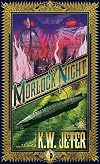
This is a jolly old romp, written in 1979, but it doesn’t deserve the praise heaped on it by Tim Powers in his introduction and implicitly in the intelligent backgrounder by Adam Roberts at the end.
Powers’ own ‘Anubis Gates’ (1983) is vastly superior as one of the originating texts of ‘steampunk’
‘Morlock Night’ quite simply does not stand up to scrutiny as the equivalent of, say, ‘Neuromancer’, the genuinely well written founding novel of Cyberpunk.
Roberts does, show more however, usefully point out the equal debt that the book pays to a very different American classic, Twain’s ‘Connecticut Yankee at the Court of King Arthur’.
In fact, the book is quite poorly written with a version of late-Imperial Britain that reminds one of similar American failures to capture the authentic voice of England.
I was reminded of the lamentable performance of Dick Van Dyke in ‘Mary Poppins’ which caused every Brit to cringe in their cinema seat – in this case, mangling English literature through youthful enthusiasm.
The premise is that Jeter picks up where HG Wells left off in 'The Time Machine’ but he misses the point that Wells was writing a novella of science.
'The Time Machine' was a just-on-the-edge-of-believable tale of space and time as it might be accepted by a moderately educated European of the late nineteenth century.
Eighty or so years on, Jeter’s version has no credible science in it at all, not even within the late nineteenth century context it purports to represent.
With its simple prose and hackneyed representations of the English gentleman, it has little literary merit.
It is, however, maniacally fun. The book does have an insane energy, more like a comic book or Hollywood blockbuster than a novel.
H.G. Wells’ novel, the psycho-geography of London’s sewers, Arthurian myth, the legend of Atlantis and the trope of the ‘bad Hun’ (a hint of Wewelsberg) give us a rollicking mish-mash that certainly entertains.
Once our heroes go down into the London sewers, the book becomes an extended dream sequence masquerading as a novel. Indeed, one has to suspend belief because there is nowhere else to turn.
One suspects that the opiate pleasures of Coleridge and De Quincey might well be cited as sources!
The geeky post-adolescence of it all is epitomised in the portrayal of a female side-kick. Mr. Jeter clearly had no interest in mere girls.
We are given a tight-lipped cipher, Tafe, as if the author was at a total loss as to how to give reality to some fantasy that was in his head but was unable or unwilling to have translated on to the page.
This book is thus either of historical interest to genre historians or a way to lose oneself in nonsense for a day or so but it is not really much more than that.
My recommendation, since life is short, is that, if you want to see how modern science fiction writers have taken Wells and developed his story intelligently, you should go straight to two other books.
Try Steve Baxter’s ‘The Time Ships’ or to Christopher Priest’s ‘The Space Machine’. Both are masterpieces of genre fiction.
Having said all that, I did enjoy myself reading it and so might you. Just don’t allow anyone to tell you to take it seriously.
(The cover design of this edition by John Coulthart, who has an excellent blog on design called ‘{Feuilleton}’, is perfect and it certainly seduced me into the book. This will keep it in the library.) show less
Powers’ own ‘Anubis Gates’ (1983) is vastly superior as one of the originating texts of ‘steampunk’
‘Morlock Night’ quite simply does not stand up to scrutiny as the equivalent of, say, ‘Neuromancer’, the genuinely well written founding novel of Cyberpunk.
Roberts does, show more however, usefully point out the equal debt that the book pays to a very different American classic, Twain’s ‘Connecticut Yankee at the Court of King Arthur’.
In fact, the book is quite poorly written with a version of late-Imperial Britain that reminds one of similar American failures to capture the authentic voice of England.
I was reminded of the lamentable performance of Dick Van Dyke in ‘Mary Poppins’ which caused every Brit to cringe in their cinema seat – in this case, mangling English literature through youthful enthusiasm.
The premise is that Jeter picks up where HG Wells left off in 'The Time Machine’ but he misses the point that Wells was writing a novella of science.
'The Time Machine' was a just-on-the-edge-of-believable tale of space and time as it might be accepted by a moderately educated European of the late nineteenth century.
Eighty or so years on, Jeter’s version has no credible science in it at all, not even within the late nineteenth century context it purports to represent.
With its simple prose and hackneyed representations of the English gentleman, it has little literary merit.
It is, however, maniacally fun. The book does have an insane energy, more like a comic book or Hollywood blockbuster than a novel.
H.G. Wells’ novel, the psycho-geography of London’s sewers, Arthurian myth, the legend of Atlantis and the trope of the ‘bad Hun’ (a hint of Wewelsberg) give us a rollicking mish-mash that certainly entertains.
Once our heroes go down into the London sewers, the book becomes an extended dream sequence masquerading as a novel. Indeed, one has to suspend belief because there is nowhere else to turn.
One suspects that the opiate pleasures of Coleridge and De Quincey might well be cited as sources!
The geeky post-adolescence of it all is epitomised in the portrayal of a female side-kick. Mr. Jeter clearly had no interest in mere girls.
We are given a tight-lipped cipher, Tafe, as if the author was at a total loss as to how to give reality to some fantasy that was in his head but was unable or unwilling to have translated on to the page.
This book is thus either of historical interest to genre historians or a way to lose oneself in nonsense for a day or so but it is not really much more than that.
My recommendation, since life is short, is that, if you want to see how modern science fiction writers have taken Wells and developed his story intelligently, you should go straight to two other books.
Try Steve Baxter’s ‘The Time Ships’ or to Christopher Priest’s ‘The Space Machine’. Both are masterpieces of genre fiction.
Having said all that, I did enjoy myself reading it and so might you. Just don’t allow anyone to tell you to take it seriously.
(The cover design of this edition by John Coulthart, who has an excellent blog on design called ‘{Feuilleton}’, is perfect and it certainly seduced me into the book. This will keep it in the library.) show less

'Soul Eater' (1983) was a great improvement on Jeter's previous romp, 'Morlock Night' (1979), which we have already reviewed but it is a very different book. Instead of outrageous fantasy, Jeter offers us a form of horror naturalism grounded in early 1980s Los Angeles.
When reading a horror novel, it is often useful to distinguish the underlying real fears and anxieties that provoke what is necessarily either fantastic or extreme or both (the covert agenda) from the overt narrative - the tale show more placed before our eyes intended to excite or unnerve.
The overt narrative is a tale of soul possession by the ultimate evil, a clearly unstable mummy/wife who has sought immortality through the 'left hand path' and returns to try to possess any in her bloodline, including her young daughter, to meet her needs.
The key to the story is that she is in coma after her experimentation goes wrong. She possesses as a form of living corpse so we are close here to having an unusual variant of the zombie genre - she is supposed to have died and returned from somewhere that she has no intention of returning to.
Jeter writes (except in one area) exceptionally well as he tells his story from the point of view of the husband and father left behind, Braemar, struggling with life in any case but committed to his daughter and, so we would like to think but this is not so clear, his new partner, Sarah.
He resists the fantastic reality that faces him which allows a great deal of tension to build up, leading to a cataclysmic finale that genuinely grips the reader and which is almost cinematic in potential. There are twists and turns that do surprise (though perhaps they should not in retrospect).
The 'covert' horror (repeated through references throughout the story) is about male anxiety. We are not entirely sure what is going on here but the general sense is of fathers and husbands left adrift and depressed by the collapse of relationships and the effects on their children.
The presumption that women are best fitted to raise a child (the cultural assumption then even more than now) is undermined by this narrative, not entirely but enough to allow a man to write of the possibility, at least, of the evil and manipulative female.
This 'evil mummy' back from the dead (maybe the clue is in the word 'mummy') seems to hold all the cards once she has reached a certain level of power and this too adds to the tension. Right until the very end, we are not sure whether she will win or not. I shall not tell you if she does.
Jeter does not seem to be writing personally (he is a very private man) since he seems to have been happily married since the 1970s until his wife's death relatively recently. It seems, as an imaginative writer, he was just picking up on a male anxiety of the period or perhaps some private 'if' fear.
There is one very clever bit of writing that creates a very different sort of discomfort. Braemar attempts to escape the evil by going on a road trip that echoes Nabokov's 'Lolita'. The evil Renee shows that such an escape is not possible and offers something that makes the skin crawl.
Already having turned a hated sister into a prostituted sex object by inhabiting her body, Renee offers a possessed child-daughter to Braemar as sex-object under her control, This is evil beyond evil and triggers Braemar into an existential self-sacrificing decision to deal with the monster.
The naturalism of Jeter's narrative shifts the slow burn of horror we develop around Humbert Humbert into a short sharp understanding of the depravity of an evil returned from the grave that exists as the potential for an immortal malevolence. You do not get darker than that!
And the literary weakness - only that, when he ceases to offer us a naturalist account of the complex and deranged family dynamic, we have passages which (although clearly comprehensible once the whole story is known) are a little too obscure but this is a minor misjudgement.
Overall, if you stick with it, an accomplished horror novel that manages to be claustrophobic and yet hint at the cosmic. The malevolence of the evil soul at the heart of the story especially in relation to the young daughter genuinely unnerves the reader. show less
When reading a horror novel, it is often useful to distinguish the underlying real fears and anxieties that provoke what is necessarily either fantastic or extreme or both (the covert agenda) from the overt narrative - the tale show more placed before our eyes intended to excite or unnerve.
The overt narrative is a tale of soul possession by the ultimate evil, a clearly unstable mummy/wife who has sought immortality through the 'left hand path' and returns to try to possess any in her bloodline, including her young daughter, to meet her needs.
The key to the story is that she is in coma after her experimentation goes wrong. She possesses as a form of living corpse so we are close here to having an unusual variant of the zombie genre - she is supposed to have died and returned from somewhere that she has no intention of returning to.
Jeter writes (except in one area) exceptionally well as he tells his story from the point of view of the husband and father left behind, Braemar, struggling with life in any case but committed to his daughter and, so we would like to think but this is not so clear, his new partner, Sarah.
He resists the fantastic reality that faces him which allows a great deal of tension to build up, leading to a cataclysmic finale that genuinely grips the reader and which is almost cinematic in potential. There are twists and turns that do surprise (though perhaps they should not in retrospect).
The 'covert' horror (repeated through references throughout the story) is about male anxiety. We are not entirely sure what is going on here but the general sense is of fathers and husbands left adrift and depressed by the collapse of relationships and the effects on their children.
The presumption that women are best fitted to raise a child (the cultural assumption then even more than now) is undermined by this narrative, not entirely but enough to allow a man to write of the possibility, at least, of the evil and manipulative female.
This 'evil mummy' back from the dead (maybe the clue is in the word 'mummy') seems to hold all the cards once she has reached a certain level of power and this too adds to the tension. Right until the very end, we are not sure whether she will win or not. I shall not tell you if she does.
Jeter does not seem to be writing personally (he is a very private man) since he seems to have been happily married since the 1970s until his wife's death relatively recently. It seems, as an imaginative writer, he was just picking up on a male anxiety of the period or perhaps some private 'if' fear.
There is one very clever bit of writing that creates a very different sort of discomfort. Braemar attempts to escape the evil by going on a road trip that echoes Nabokov's 'Lolita'. The evil Renee shows that such an escape is not possible and offers something that makes the skin crawl.
Already having turned a hated sister into a prostituted sex object by inhabiting her body, Renee offers a possessed child-daughter to Braemar as sex-object under her control, This is evil beyond evil and triggers Braemar into an existential self-sacrificing decision to deal with the monster.
The naturalism of Jeter's narrative shifts the slow burn of horror we develop around Humbert Humbert into a short sharp understanding of the depravity of an evil returned from the grave that exists as the potential for an immortal malevolence. You do not get darker than that!
And the literary weakness - only that, when he ceases to offer us a naturalist account of the complex and deranged family dynamic, we have passages which (although clearly comprehensible once the whole story is known) are a little too obscure but this is a minor misjudgement.
Overall, if you stick with it, an accomplished horror novel that manages to be claustrophobic and yet hint at the cosmic. The malevolence of the evil soul at the heart of the story especially in relation to the young daughter genuinely unnerves the reader. show less

Kim and her brother, Donnie, are hiding out in the desert with a pack of elderly misfits, while her associates straighten out some "issues" in LA. But Kim can't stay out of trouble, so when the local crime lord starts bothering her fellow campers, Kim takes things in hand.
God, I love Kim. I think I have said that before. In this one she has a broken arm on top of everything else. But Kim is as durable as she is inventive. There was never a more lovable assassin.
God, I love Kim. I think I have said that before. In this one she has a broken arm on top of everything else. But Kim is as durable as she is inventive. There was never a more lovable assassin.

Dr. Adder is trashy, stupid, and fun.
Perhaps Dr. Adder's importance as an early cyberpunk dystopia exceeds its entertainment value. K.W. Jeter wrote it in 1972 while attending college, but it wouldn't be published until the cyberpunk explosion in '84. Because of this, the obsession with technology, the casual violence, the Interface-as-Sprawl et al., are all prescient forebears of some of the themes dominating contemporary sci-fi.*
But is it a great novel? Not really.
E. Allen Limmit is a show more naive, dumb kid with big dreams. The abandoned son of a brilliant scientist, he hopes to use his heritage as a means of conning millions from the titular doctor, an amoral J.C. for the slums of L.A. He leaves behind his shallow life taking care of a desert brothel, a perverted place dedicated to the quirkiest quirks of sexual desire: Giant, genetically-modified chickens. What he takes with him, and what he hopes will make his millions, is a broken cyber-weapon invented by his deadbeat dad, a laser-firing 'flash glove' (straight out of '70s camp) capable of turning its agent into a weapon of mass destruction.
The self-serving, obnoxious Dr. Adder is a brilliant surgeon specializing in body modification for the prostitutes across L.A.'s slums -- a precursor to Gibson's Sprawl known as the Interface. Adder's a callously evil, uncaring, misogynistic bucket of amorality start to finish, and Limmit's con doesn't quite go as planned, pulling both characters into a battle over the souls (and money) of the Interface with John Mox, Adder's rival and CEO-slash-religious leader of the world's moral authority.
The ultra-violence and gross sexuality still hold up as over-the-top, but it's more quirky cartoon than outright obscene. (Sam Delany also beat these extremes by a few years, writing Hogg -- possibly the most shocking novel of the 20th century -- in 1969. Hogg was similarly held up by its violence and sexuality, unpublished until 1994.) Characters are seemingly driven by a young writer's snark and sadism more-so than individual goals: Limmit is -- much like the hero of Hogg -- an unfeeling, dumb vehicle being pushed around by the plot, barely stopping to form a single thought; Mox is a shadow of evil in religion and capitalism; Adder's, frankly, boring and nearly as dumb as Limmit; all the women are walking sex organs (sometimes quite literally) and vehicles for kinky sleaze.
So Dr. Adder isn't driven by its depth of character, it's not driven by its attacks on consumerism and religion; it's driven, to some degree, by a handful of clever technological ideas (like uploading human consciousness to early computers long before it was passe), but mostly it's driven by its extremes -- and that it shouted those extremes first. Excessive drug use, sex, violence, and misanthropy fill every page (again, much like Hogg), and under all that the snark and self-importance of a young writer. Despite the mountain of excesses, the dystopian streets and sewers of L.A.'s Interface provide a wildly entertaining ride. As the laser-glove is unleashed and a corporate war between Adder and Mox's church heat up, the Interface is hit with a deluge of corpses and gore.
Dr. Adder isn't the great piece of fiction that Neuromancer or Green Eyes would be in 1984, but if you can look past its faults, past the sleaze and ultra-violence, you'll find a fun ride that holds up pretty dang well after 40 years.
One odd note on current (c. 2017) Kindle editions: Many of Jeter's self-published books, despite being cult classics in sci-fi and horror, feature some of the *worst* stock photo cover art I've ever seen. Random models -- always women -- eyeing the camera sexily, with minimal background art. Sometimes just a stock photo of a motorcycle that isn't even the right dimensions for a book cover. His cover art is wild. Dr. Adder is no exception. Perhaps only W.T. Quick or Thomas T. Thomas compare. show less
Perhaps Dr. Adder's importance as an early cyberpunk dystopia exceeds its entertainment value. K.W. Jeter wrote it in 1972 while attending college, but it wouldn't be published until the cyberpunk explosion in '84. Because of this, the obsession with technology, the casual violence, the Interface-as-Sprawl et al., are all prescient forebears of some of the themes dominating contemporary sci-fi.*
But is it a great novel? Not really.
E. Allen Limmit is a show more naive, dumb kid with big dreams. The abandoned son of a brilliant scientist, he hopes to use his heritage as a means of conning millions from the titular doctor, an amoral J.C. for the slums of L.A. He leaves behind his shallow life taking care of a desert brothel, a perverted place dedicated to the quirkiest quirks of sexual desire: Giant, genetically-modified chickens. What he takes with him, and what he hopes will make his millions, is a broken cyber-weapon invented by his deadbeat dad, a laser-firing 'flash glove' (straight out of '70s camp) capable of turning its agent into a weapon of mass destruction.
The self-serving, obnoxious Dr. Adder is a brilliant surgeon specializing in body modification for the prostitutes across L.A.'s slums -- a precursor to Gibson's Sprawl known as the Interface. Adder's a callously evil, uncaring, misogynistic bucket of amorality start to finish, and Limmit's con doesn't quite go as planned, pulling both characters into a battle over the souls (and money) of the Interface with John Mox, Adder's rival and CEO-slash-religious leader of the world's moral authority.
The ultra-violence and gross sexuality still hold up as over-the-top, but it's more quirky cartoon than outright obscene. (Sam Delany also beat these extremes by a few years, writing Hogg -- possibly the most shocking novel of the 20th century -- in 1969. Hogg was similarly held up by its violence and sexuality, unpublished until 1994.) Characters are seemingly driven by a young writer's snark and sadism more-so than individual goals: Limmit is -- much like the hero of Hogg -- an unfeeling, dumb vehicle being pushed around by the plot, barely stopping to form a single thought; Mox is a shadow of evil in religion and capitalism; Adder's, frankly, boring and nearly as dumb as Limmit; all the women are walking sex organs (sometimes quite literally) and vehicles for kinky sleaze.
So Dr. Adder isn't driven by its depth of character, it's not driven by its attacks on consumerism and religion; it's driven, to some degree, by a handful of clever technological ideas (like uploading human consciousness to early computers long before it was passe), but mostly it's driven by its extremes -- and that it shouted those extremes first. Excessive drug use, sex, violence, and misanthropy fill every page (again, much like Hogg), and under all that the snark and self-importance of a young writer. Despite the mountain of excesses, the dystopian streets and sewers of L.A.'s Interface provide a wildly entertaining ride. As the laser-glove is unleashed and a corporate war between Adder and Mox's church heat up, the Interface is hit with a deluge of corpses and gore.
Dr. Adder isn't the great piece of fiction that Neuromancer or Green Eyes would be in 1984, but if you can look past its faults, past the sleaze and ultra-violence, you'll find a fun ride that holds up pretty dang well after 40 years.
One odd note on current (c. 2017) Kindle editions: Many of Jeter's self-published books, despite being cult classics in sci-fi and horror, feature some of the *worst* stock photo cover art I've ever seen. Random models -- always women -- eyeing the camera sexily, with minimal background art. Sometimes just a stock photo of a motorcycle that isn't even the right dimensions for a book cover. His cover art is wild. Dr. Adder is no exception. Perhaps only W.T. Quick or Thomas T. Thomas compare. show less
Lists
Awards


You May Also Like


Associated Authors
Statistics
- Works
- 61
- Also by
- 15
- Members
- 9,706
- Popularity
- #2,461
- Rating
- 3.3
- Reviews
- 107
- ISBNs
- 219
- Languages
- 11
- Favorited
- 10