
Leonie Frieda
Author of Catherine de Medici: Renaissance Queen of France
About the Author
Swedish by birth and educated in Britain, Germany, and France, Leonie Frieda speaks five languages. Her research on Catherine de Medici has taken her to Paris, Florence, and Rome, as well as the chateaux of the Loire
Image credit: Leonie Frieda
Works by Leonie Frieda
Tagged
Common Knowledge
- Birthdate
- 1956
- Gender
- female
- Occupations
- translator
writer - Nationality
- Sweden
- Birthplace
- Sweden
- Places of residence
- London, England, UK
- Associated Place (for map)
- England, UK
Members
Reviews
The Deadly Sisterhood: A Story of Women, Power, and Intrigue in the Italian Renaissance, 1427-1527 by Leonie Frieda
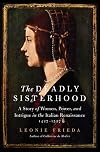
An unwieldy cast of characters drifts in and out of this book's chapters making it hard to keep track of them all, but that didn't stop me from enjoying the book once I adopted a more relaxed attitude. It's packed with 100 years of turbulent history told through up close and personal accounts of several prominent families, making the book as entertaining as a well written gossip magazine. I didn't know much about the Italian Renaissance before so the book was an eye opener for me. Italy at show more this time was a collection of independent kingdoms each with its own distinct culture and set of wealthy nobles who schemed among themselves for power.
Women are the focus of the book and though they didn't officially have a lot of political clout they managed to influence events anyway. One of the most dramatic examples came near the beginning of the book when Caterina Sforza, Countess of Forli, tricked her husband's assassins into allowing her to take refuge in a strategically placed fortress, giving her the means to run them off. When the mob threatened to kill her son if she didn't surrender Caterina stood on a high balcony and lifted her skirts to show them in the most graphic way that murdering her older children would be futile because she already had another on the way. The mob that hoped to overthrow her family fled. While all the women profiled had fascinating lives, that story stuck in my mind and every time Caterina came back into the narrative I sat up and paid special attention. show less
Women are the focus of the book and though they didn't officially have a lot of political clout they managed to influence events anyway. One of the most dramatic examples came near the beginning of the book when Caterina Sforza, Countess of Forli, tricked her husband's assassins into allowing her to take refuge in a strategically placed fortress, giving her the means to run them off. When the mob threatened to kill her son if she didn't surrender Caterina stood on a high balcony and lifted her skirts to show them in the most graphic way that murdering her older children would be futile because she already had another on the way. The mob that hoped to overthrow her family fled. While all the women profiled had fascinating lives, that story stuck in my mind and every time Caterina came back into the narrative I sat up and paid special attention. show less
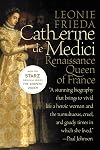
It's hard to like this woman. Admire, her, yes, fear her, definitely, but she is not necessarily in the likeable" category. The author does an incredible job, though, into historical research: Catherine's early life was full of pomp and glory, and when she was found marriageable to the Dauphin, later Henri II, she is very well portrayed as a scared, uncertain young woman. Her marital relations are not helped by the fact that she cannot conceive (shades of Marie Antoinette and Louis XIV), nor show more that Henri II still has active relations with his mistress, Diane de Poitiers. She is in the court of Francois I, and his various adventures, including turning two of his sons over as hostages to live as prisoners in several regions of Spain, are very well detailed.
Leonie Frieda does an excellent job of bringing the times and main influences in Catherine's life to the printed page. There are endnotes as well as asterisks that detail some immediate knowledge. Ms. Frieda discusses some of the rumors of the time (did Catherine really create a peephole in the floor of her bedroom to find out what her husband and his mistress were doing? Was the St. Bartholomew's Day massacre really as bloody as thought, and how much did Catherine have to do with it?) and where their truths really lie. Catherine de Medici was a very, very powerful woman brought up to be her husband's Queen. When that plan falls, she creates a Plan B that includes a mistress, 10 pregnancies, and later her husband's gruesome death. Her ability to rule through her sons, since being able to rule in her own right was denied her, was remarkable for its time.
The conclusion of this book states that one cannot judge her by the morals and standards of the 21st century, and discusses her faults and her blinders. Which is all fair and good judgment; it is simply hard to fathom the mind-set that allows the planned assassination of one's religious rivals, now in modern Western civilization. But in wartime, which encompassed much of "her" reign, many niceties go out the window such as the respect for human life. And in so many ways, our culture of dangerous "war zones" in US cities is a bit of a reflection on the Renaissance; how she managed to live past her husband's death and arrange for the next kings of France is a tribute. Would I have liked her? Probably not. Would I have shared a glass of wine and some delicious dessert with her, to discuss art and spectacles and the needs of a ruler? You bet your sweet bippie I would. show less
Leonie Frieda does an excellent job of bringing the times and main influences in Catherine's life to the printed page. There are endnotes as well as asterisks that detail some immediate knowledge. Ms. Frieda discusses some of the rumors of the time (did Catherine really create a peephole in the floor of her bedroom to find out what her husband and his mistress were doing? Was the St. Bartholomew's Day massacre really as bloody as thought, and how much did Catherine have to do with it?) and where their truths really lie. Catherine de Medici was a very, very powerful woman brought up to be her husband's Queen. When that plan falls, she creates a Plan B that includes a mistress, 10 pregnancies, and later her husband's gruesome death. Her ability to rule through her sons, since being able to rule in her own right was denied her, was remarkable for its time.
The conclusion of this book states that one cannot judge her by the morals and standards of the 21st century, and discusses her faults and her blinders. Which is all fair and good judgment; it is simply hard to fathom the mind-set that allows the planned assassination of one's religious rivals, now in modern Western civilization. But in wartime, which encompassed much of "her" reign, many niceties go out the window such as the respect for human life. And in so many ways, our culture of dangerous "war zones" in US cities is a bit of a reflection on the Renaissance; how she managed to live past her husband's death and arrange for the next kings of France is a tribute. Would I have liked her? Probably not. Would I have shared a glass of wine and some delicious dessert with her, to discuss art and spectacles and the needs of a ruler? You bet your sweet bippie I would. show less
no mother in history has done more to prom ote her children at whatever cost to herself, themselves & their times'
By sally tarbox on 24 Nov. 2011
Format: Paperback
Brilliantly researched yet always readable biography, Frieda takes us from Catherine's inauspicious start as 'orphan of Florence' to a marriage where she always played second fiddle to her husband's mistress, Diane de Poitiers.
The story really takes off after Catherine becomes a widow comparatively early. With the heir still a show more child, Catherine assumes regency...and from then on her life seems to be composed largely of coping with the endless and complex discord of 16th century Europe. Wars between principalities; the lead up to (and horrible consequences of) the Wars of Religion; efforts to keep the papacy on side; dynastic marriages; political factions and towards the end her sons (an unpromising lot) plotting against each other. Frieda's skill here lies in keeping it all (relatively) comprehensible and readable.
I was left feeling that Catherine was a most pragmatic and unsentimental woman; notably when she sent her daughter Margot to her marital chamber as the St Bartholomew's Day Massacre was beginning ('My mother replied that, God willing, I would come to no harm, but in any case I must go for fear of wakening their suspicions') and yet in her impossible situation could she have done much better?
Very interesting read show less
By sally tarbox on 24 Nov. 2011
Format: Paperback
Brilliantly researched yet always readable biography, Frieda takes us from Catherine's inauspicious start as 'orphan of Florence' to a marriage where she always played second fiddle to her husband's mistress, Diane de Poitiers.
The story really takes off after Catherine becomes a widow comparatively early. With the heir still a show more child, Catherine assumes regency...and from then on her life seems to be composed largely of coping with the endless and complex discord of 16th century Europe. Wars between principalities; the lead up to (and horrible consequences of) the Wars of Religion; efforts to keep the papacy on side; dynastic marriages; political factions and towards the end her sons (an unpromising lot) plotting against each other. Frieda's skill here lies in keeping it all (relatively) comprehensible and readable.
I was left feeling that Catherine was a most pragmatic and unsentimental woman; notably when she sent her daughter Margot to her marital chamber as the St Bartholomew's Day Massacre was beginning ('My mother replied that, God willing, I would come to no harm, but in any case I must go for fear of wakening their suspicions') and yet in her impossible situation could she have done much better?
Very interesting read show less
One thing I can say after reading this - Catherine had seen a LOT of shit. Like so many women in her time - and before that time, and after that time - she was seen as a power-hungry bitch, and so on and so forth. Any history buff is well aware how women with power often got the shaft in history due to a patriarchal/macho mind-set.
I do not claim that Catherine did nothing wrong. Back then, sometimes you just had to stab someone in the back or get stabbed yourself, or have to do something show more questionable to satisfy the political majority. I do not envy Catherine or her life, but this was nonetheless a fascinating biography with plenty of history factoids which should please any history/biography buff. show less
I do not claim that Catherine did nothing wrong. Back then, sometimes you just had to stab someone in the back or get stabbed yourself, or have to do something show more questionable to satisfy the political majority. I do not envy Catherine or her life, but this was nonetheless a fascinating biography with plenty of history factoids which should please any history/biography buff. show less
Lists
You May Also Like


Statistics
- Works
- 4
- Members
- 1,333
- Popularity
- #19,311
- Rating
- 3.6
- Reviews
- 32
- ISBNs
- 31
- Languages
- 5
