
W. Edwards Deming (1900–1993)
Author of Out of the Crisis
About the Author
W. Edwards Deming (1900-1993) was an international consultant in management and quality. In 1987, he was awarded the National Medal of Technology and Innovation by President Ronald Reagan.
Works by W. Edwards Deming
A nova econonomia 1 copy
Associated Works
Statistical Method from the Viewpoint of Quality Control (Dover Books on Mathematics) (1986) — Preface — 48 copies
Tagged
Common Knowledge
- Birthdate
- 1900-10-14
- Date of death
- 1993-12-20
- Gender
- male
- Education
- University of Wyoming at Laramie (BS | electrical engineering | 1921)
University of Colorado (MS | mathematics | physics | 1925)
Yale University (PhD | mathematics | physics | 1928) - Occupations
- statistician
professor
author
consultant - Awards and honors
- Japan’s Order of the Sacred Treasure, Second Class (1960)
Japan's Deming Prize named for him
National Medal of Technology:
Distinguished Career in Science award, National Academy of Sciences. - Nationality
- USA
- Birthplace
- Sioux City, Iowa, USA
- Places of residence
- Japan
- Place of death
- Washington, D.C., USA
- Associated Place (for map)
- USA
Members
Reviews
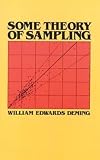
...In this upcoming election year, polls begin to come at us with growing frequency, a Doppler Effect of ever shrill pronouncements. A core thread of real-world examples and experience detailed in Some Theory is a grounds-up methodology for polls and surveys from interview techniques to data analysis. It is a good time to consider polls, their planning, and their preparation. Deming lays out how it is done and how it works for the interested. The cover image is from a post-WWII survey of show more Greek households, which is a particularly enlightening example of meeting real-world goals by applying sampling theory in a difficult, imposing field situation. Another government project, referred to throughout, is getting an accurate survey of utility pole conditions at minimum cost but required accuracy.
The structure of the book is somewhat like a textbook, in that each chapter concludes with exercises. Many of these exercises have hints or guided solutions present on the same page. Future social scientists, quality managers, and others can independently read this work to obtain a sound basis for their craft. College algebra is enough to gain entry into Deming’s insight in what the American Statistical Association Journal called "The 'bible' of sampling statisticians."
see my full review at MAA's MathDL site: http://mathdl.maa.org/mathDL/19/ show less
The structure of the book is somewhat like a textbook, in that each chapter concludes with exercises. Many of these exercises have hints or guided solutions present on the same page. Future social scientists, quality managers, and others can independently read this work to obtain a sound basis for their craft. College algebra is enough to gain entry into Deming’s insight in what the American Statistical Association Journal called "The 'bible' of sampling statisticians."
see my full review at MAA's MathDL site: http://mathdl.maa.org/mathDL/19/ show less
The New Economics is a series of flashcards, carrying telegraphic versions of Deming's Big Ideas. Deming, of course, was an American economist who helped trained the Japanese in a new style of quality management that arguably lead to decades of Japanese dominance in high technology. His ideas lay behind the Toyota Production System, and the maligned TPS reports of Office Space. He also passed away in 1993, just as Japan entered its lost decade. The New Economics was his last book.
The center show more of his ideas holds up. Think of a company as a system, with management's role being to organize the system for quality. Understanding that there is natural variation in a system, and don't go chasing randomness. Treat workers as humans beings and approach their psychology as high-morale team members, rather than creating self-defeating 'meritocratic' ranking systems.
But this book is scattered, organized anecdotally rather than thematically. It's one thing to proclaim that 'the firm is a system', but Deming lacks the theoretical tools to describe how systems self-organize and can be governed. It's a little unfair to argue that a dead man should be current with the latest research, but this book would be so much better in conversation with the Sante Fe Institute (see Mitchell's Complexity: A Guided Tour, John Boyd's OODA loop (Richard's Certain to Win, or even the intersection of epistemology and ecology (Miller et al. 2006. Epistemological Pluralism: Reorganizing Interdisciplinary Research, particularly the figure on the adaptive cycle from Reorganization, Growth, Conservation, and Release).
Deming is still a name to conjure with, but there are likely better books on the area. show less
The center show more of his ideas holds up. Think of a company as a system, with management's role being to organize the system for quality. Understanding that there is natural variation in a system, and don't go chasing randomness. Treat workers as humans beings and approach their psychology as high-morale team members, rather than creating self-defeating 'meritocratic' ranking systems.
But this book is scattered, organized anecdotally rather than thematically. It's one thing to proclaim that 'the firm is a system', but Deming lacks the theoretical tools to describe how systems self-organize and can be governed. It's a little unfair to argue that a dead man should be current with the latest research, but this book would be so much better in conversation with the Sante Fe Institute (see Mitchell's Complexity: A Guided Tour, John Boyd's OODA loop (Richard's Certain to Win, or even the intersection of epistemology and ecology (Miller et al. 2006. Epistemological Pluralism: Reorganizing Interdisciplinary Research, particularly the figure on the adaptive cycle from Reorganization, Growth, Conservation, and Release).
Deming is still a name to conjure with, but there are likely better books on the area. show less
Deming's fourteen points were famous in the 1980s when they were imported in Japan. Deming helped to lead the Japanese in an economic surge that was felt worldwide. The Japanese were outdoing the United States, especially in engineering. Deming's fourteen points were given as a way to elucidate steps to proceed in the U.S.
What strikes me is that pride in one's work is central to the whole gambit. Without the worker taking pride in her/his work, then there is nothing to be gained. This, not show more economic incentives, is the core of Deming's work. Do not rob the worker of his pride, or you risk causing quality of production to decline. This simple observation - of what one takes pride in - is helpful whenever I analyze how to deal with others' work.
Also prominent within this treatise is the idea of statistical control. When one's work reaches the bounds within the upper limit and lower limit of control, then one can work freely towards decreasing variability and increasing reliability of one's product. This, in essence, is work. This is how to improve one's work each day.
Deming's work was probably revolutionary back in his day (the 1980s). Today, however, most of his lessons have been absorbed by management of enterprises worldwide. They are commonly observed among many product-oriented companies. It is nice to read about them within their historical context. Most of his ideas are still useful in business today. show less
What strikes me is that pride in one's work is central to the whole gambit. Without the worker taking pride in her/his work, then there is nothing to be gained. This, not show more economic incentives, is the core of Deming's work. Do not rob the worker of his pride, or you risk causing quality of production to decline. This simple observation - of what one takes pride in - is helpful whenever I analyze how to deal with others' work.
Also prominent within this treatise is the idea of statistical control. When one's work reaches the bounds within the upper limit and lower limit of control, then one can work freely towards decreasing variability and increasing reliability of one's product. This, in essence, is work. This is how to improve one's work each day.
Deming's work was probably revolutionary back in his day (the 1980s). Today, however, most of his lessons have been absorbed by management of enterprises worldwide. They are commonly observed among many product-oriented companies. It is nice to read about them within their historical context. Most of his ideas are still useful in business today. show less
. Demings tells American management what they are doing wrong and what they can do fix it. That sounds like a lot of hubris, except that Deming is the guy credited with turning around the Japanese manufacturing industry after World War 2, so he knows what he's talking about. Demings emphasizes the importance of statistical process control, and how manufacturing problems are almost always attributable to the system, and not the workers. He speaks out against short-term objectives that end up show more being harmful in the long term (e.g. quotas, management by objective, increasing stock value in short term). If you are interested in "quality", this is a book to read. show less
Awards

You May Also Like


Associated Authors
Statistics
- Works
- 31
- Also by
- 1
- Members
- 1,101
- Popularity
- #23,343
- Rating
- 4.0
- Reviews
- 12
- ISBNs
- 43
- Languages
- 4
- Favorited
- 1