
Robert Scheer (1) (1936–)
Author of Eldridge Cleaver: Post-Prison Writings and Speeches
For other authors named Robert Scheer, see the disambiguation page.
About the Author
Robert Scheer is the editor-in-chief of Truthdig, a professor at the University of Southern California's Annenberg School for Communication and Journalism, and the co-host of Left, Right Center and host of Scheer Intelligence, both broadcast from NPR's west coast affiliate KCRW. Scheer is the show more author of nine books, including The Great American Stickup. He lives in Los Angeles. show less
Works by Robert Scheer
The Great American Stickup: How Reagan Republicans and Clinton Democrats Enriched Wall Street While Mugging Main Street (2010) 95 copies, 3 reviews
The Pornography of Power: How Defense Hawks Hijacked 9/11 and Weakened America (2008) 62 copies, 1 review
Playing President: My Close Ecounters with Nixon, Carter, Bush I, Reagan, and Clinton—and How They Did Not Prepare Me for George W. Bush (2006) 59 copies, 3 reviews
Associated Works
On the Firing Line: The Public Life of Our Public Figures (1989) — Contributor — 126 copies, 1 review
Shaking the Foundations: 200 Years of Investigative Journalism in America (Nation Books) (2003) — Contributor — 45 copies
Tagged
Common Knowledge
- Birthdate
- 1936-04-04
- Gender
- male
- Education
- City College of New York
- Occupations
- journalist
columnist
editor - Organizations
- Ramparts
Los Angeles Times
Creators Syndicate
The Nation
Truthdig
City Lights Books - Awards and honors
- Distinguished Work in New Media Award (Society of Professional Journalists ∙ 2010)
Izzy Award (2011)
Los Amigos Award
James Aronson Award for Social Justice Journalism - Relationships
- Scheer, Christopher (son)
- Nationality
- USA
- Birthplace
- The Bronx, New York, USA
- Places of residence
- New York, New York, USA
Berkeley, California, USA - Associated Place (for map)
- New York, USA
Members
Reviews
The Great American Stickup: How Reagan Republicans and Clinton Democrats Enriched Wall Street While Mugging Main Street by Robert Scheer
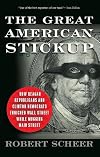
While some people deride Robert Scheer for continually harping on the banks, he also tends to be right about them and the stranglehold they have on American and world societies. He does not go into much detail about the derivatives that led to the current financial crisis themselves, but rather how they were created and, more importantly, what legislation allowed their creation and trading.
One thing that was particularly refreshing about this book is how he does not favor one end of the show more political spectrum over the other. He places the blame squarely on the shoulders of both the Republicans AND the Democrats. In fact, he hammers the Clinton administration much more savagely than the Reagan administration. But not without good cause, as is detailed in the book. And he quite rightly expresses his extreme disappointment with the lack of financial reform under the current Obama administration.
Overall, it is a good book to read if you do not know much about how the current financial crisis came into being, and the answers are much simpler and straightforward than most of the financial regulators make it out to be. This book will get your blood boiling and make you want to start taking action to enact real regulatory reform. show less
One thing that was particularly refreshing about this book is how he does not favor one end of the show more political spectrum over the other. He places the blame squarely on the shoulders of both the Republicans AND the Democrats. In fact, he hammers the Clinton administration much more savagely than the Reagan administration. But not without good cause, as is detailed in the book. And he quite rightly expresses his extreme disappointment with the lack of financial reform under the current Obama administration.
Overall, it is a good book to read if you do not know much about how the current financial crisis came into being, and the answers are much simpler and straightforward than most of the financial regulators make it out to be. This book will get your blood boiling and make you want to start taking action to enact real regulatory reform. show less
The Great American Stickup: How Reagan Republicans and Clinton Democrats Enriched Wall Street While Mugging Main Street by Robert Scheer
Robert Scheer does a great job of tracing the roots of the current financial crisis. He starts during the Reagan administration, but this isn't a book that blames one party or the other. He spends a great deal of time castigating Clinton's cozy relationship with Wall Street, as well. Along the way, the author also draws attention to the few who predicted that deregulation would end in disaster. There's no doubt that it was the makers of the mess who benefited from the bailouts, while those show more who suffered because of their decisions were allowed to wallow in joblessness and looming foreclosure. It's a very sobering read, especially since, effectively, nothing has changed. show less
Playing President: My Close Ecounters with Nixon, Carter, Bush I, Reagan, and Clinton and How They Did Not Prepare Me for George W. Bush by Robert Scheer
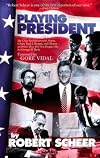
This is a collection of Scheer's interviews with and columns about presidents from Playboy and Los Angeles Times. Nixon & Reagan come across to me as wise and manipulative in the latter and gentler and more manipulated in the latter. More of a surprise to me as I recall a Reagan myth of goofy cowboy actor and drawing a straight line to senile befuddlement. Apparently, a shrewd operator acted betwixt. Nixon comes across more as Dubya to Kissinger's Karl Rove ... and who do we still have? show more Well, it is all thought-provoking these early, in-depth interviews with candidates campaigning for office. Carter squirming in his Playboy interview comes across as authentic and brave while Schneer commonly comes across as persnickety and needling. Clinton seems gracious to fawning and trying to get close to this left-wing scribe who seems coy and awed, both Bushes have the least revealing material and especially columns criticizing Bush (rightly in retrospect) for ignoring The Taliban, etc. seems to add nothing and only be here to move books. show less

By early 1965, the Vietnam War had begun to escalate. That was the year that US President Lyndon Johnson began deploying large numbers of troops, and initiated the bombing campaign of North Vietnam. These actions set the stage for a war that continued for the next ten years, devastated three Asian countries, and led to the first serious military defeat in US history.
At the cusp of the 1965 escalation, journalist Robert Scheer recounts the series of events that led to US involvement in show more Vietnam. His is a dispassionate and non-ideological account; he sought to document two decades of US involvement without taking strong stands on the growing political questions of the day. Scheer’s account begins following World War II, with France’s attempt to hold on to her Indochinese colonies, with military and economic support from the US. He outlines the 1954 Geneva Convention accords under which the country was partitioned pending free elections, and how such elections were refused by South Vietnam and the US. He then traces the installation of Ngo Diem as President; the growing economic and military commitment to his corrupt regime by the US (including the significant and surprising role played by Michigan State University); the futile land reform project; Diem’s assassination and the unstable military regimes that followed; and the “strategic hamlet project” (under which South Vietnamese villagers were required to build and live in barbed wire enclosures).
Scheer’s source material consists chiefly of public documents and news media accounts. Like fellow journalist I.F. Stone (whom he does not cite), he concluded that the indigenous National Liberation Front mainly fought with weapons of US and South Vietnamese origin -- in contradiction to claims that they were primarily armed by the USSR and/ or China. Critics who have claimed that the Geneva accords had no official status will find no support from Scheer’s quotations from the actual documents, nor will those who speculate that JF Kennedy would not have continued US military involvement beyond the 1964 elections.
Certain gaps in Scheer’s account are understandable, given the time frame of his analysis. In 1965, the full story of US involvement was not known, as illustrated by two key events. One was the assassination of President Diem, which we now know occurred with CIA approval. Second was the 1964 Gulf of Tonkin incident, which Johnson used as a pretext for extensive military action. We now know that an attack on US ships probably never occurred, as revealed in a report declassified by the NSA in 2005. Other reports have revealed that the US ships were engaged in covert military operations, in contradiction to official claims at the time.
In his conclusion, Scheer raises serious questions about the rationale for US involvement in Vietnam, including how such involvement contradicted democratic principles of self- determination. He also challenged claims that US actions were not ideologically - based. His criticisms seem muted from today’s perspective, and with three decades of hindsight. Certainly, more extensive analyses of the history of the Indochinese War have since been published. However, Robert Scheer’s analysis can be viewed as a historical document, written when US citizenry and the press were beginning to question and challenge the military actions and foreign policy of their government. show less
At the cusp of the 1965 escalation, journalist Robert Scheer recounts the series of events that led to US involvement in show more Vietnam. His is a dispassionate and non-ideological account; he sought to document two decades of US involvement without taking strong stands on the growing political questions of the day. Scheer’s account begins following World War II, with France’s attempt to hold on to her Indochinese colonies, with military and economic support from the US. He outlines the 1954 Geneva Convention accords under which the country was partitioned pending free elections, and how such elections were refused by South Vietnam and the US. He then traces the installation of Ngo Diem as President; the growing economic and military commitment to his corrupt regime by the US (including the significant and surprising role played by Michigan State University); the futile land reform project; Diem’s assassination and the unstable military regimes that followed; and the “strategic hamlet project” (under which South Vietnamese villagers were required to build and live in barbed wire enclosures).
Scheer’s source material consists chiefly of public documents and news media accounts. Like fellow journalist I.F. Stone (whom he does not cite), he concluded that the indigenous National Liberation Front mainly fought with weapons of US and South Vietnamese origin -- in contradiction to claims that they were primarily armed by the USSR and/ or China. Critics who have claimed that the Geneva accords had no official status will find no support from Scheer’s quotations from the actual documents, nor will those who speculate that JF Kennedy would not have continued US military involvement beyond the 1964 elections.
Certain gaps in Scheer’s account are understandable, given the time frame of his analysis. In 1965, the full story of US involvement was not known, as illustrated by two key events. One was the assassination of President Diem, which we now know occurred with CIA approval. Second was the 1964 Gulf of Tonkin incident, which Johnson used as a pretext for extensive military action. We now know that an attack on US ships probably never occurred, as revealed in a report declassified by the NSA in 2005. Other reports have revealed that the US ships were engaged in covert military operations, in contradiction to official claims at the time.
In his conclusion, Scheer raises serious questions about the rationale for US involvement in Vietnam, including how such involvement contradicted democratic principles of self- determination. He also challenged claims that US actions were not ideologically - based. His criticisms seem muted from today’s perspective, and with three decades of hindsight. Certainly, more extensive analyses of the history of the Indochinese War have since been published. However, Robert Scheer’s analysis can be viewed as a historical document, written when US citizenry and the press were beginning to question and challenge the military actions and foreign policy of their government. show less
Lists
You May Also Like


Associated Authors
Statistics
- Works
- 13
- Also by
- 3
- Members
- 748
- Popularity
- #33,982
- Rating
- 3.7
- Reviews
- 11
- ISBNs
- 38
- Languages
- 4