
Katherine Neville
Author of The Eight
About the Author
Image credit: Photo by Dr. Dian Fetter
Series
Works by Katherine Neville
EL OCHO (I) 1 copy
El OCHO (II) 1 copy
Vatra 1 copy
Oito Volume I 1 copy
SEKRETI I MIJVJEÇARIT 1 copy
Associated Works
I Should Have Stayed Home: The Worst Trips of the Great Writers (1994) — Contributor — 187 copies, 5 reviews
Tagged
Common Knowledge
- Canonical name
- Neville, Katherine
- Other names
- NEVILLE, Katherine
- Birthdate
- 1945-08-04
- Gender
- female
- Education
- University of Denver
- Occupations
- novelist
banker
commercial artist
model
painter - Organizations
- Bank of America (VP)
- Awards and honors
- Silver Nautilus Book Award (2009)
- Relationships
- Pribram, Karl H. (husband)
- Short biography
- Katherine Neville (born April 4, 1945) is an American author who writes adventure novels. Her novels include The Eight, A Calculated Risk, and The Magic Circle. In 2008, she released The Fire, the sequel to The Eight.
- Nationality
- USA
- Birthplace
- St. Louis, Missouri, USA
- Places of residence
- St. Louis, Missouri, USA
Washington, D.C., USA
New York, New York, USA
San Francisco, California, USA
Warrenton, Virginia, USA - Associated Place (for map)
- USA
Members
Discussions
Has anyone ever read [Katherine Neville] The Eight? in Historical Mysteries (October 2008)
Reviews

I have a rule that if a book doesn't grab me after 60 pages, I put it down. Its very rare for me to put a book down after that point, as normally I know by then if its for me. To put a book down at page 317 is therefore very odd. But the simple truth was that I had stopped caring altogether. This book promised a lot, and was occasionally very exciting, but its flaws massively overshadow the good bits. So here are my two main problems with it. Spoilers may exist.
Firstly, it relies on too many show more coincidences. I never got to find why the narrator has been chosen to go and search for the magic chess set, but isn't it useful that she just happens to be friends with both a chess champion and a chess -obsessed cryptologist who can fill in all the details for her. That sort of thing.
Secondly, it relies on so many ethnic caricatures that it is utterly tiresome. Jewish people are grasping and over-dramatic, Arabs are either mystical sons of the desert or hook-nosed grand vizier types, the Soviets are all either authoritarian grey clones or secret capitalists running rings around the dull commies. As for the various peoples depicted in the 1790s plot, well, the French and the Corsicans should have cause to be offended too.
In the end it was too much for me and I tossed the book aside, utterly frustrated. show less
Firstly, it relies on too many show more coincidences. I never got to find why the narrator has been chosen to go and search for the magic chess set, but isn't it useful that she just happens to be friends with both a chess champion and a chess -obsessed cryptologist who can fill in all the details for her. That sort of thing.
Secondly, it relies on so many ethnic caricatures that it is utterly tiresome. Jewish people are grasping and over-dramatic, Arabs are either mystical sons of the desert or hook-nosed grand vizier types, the Soviets are all either authoritarian grey clones or secret capitalists running rings around the dull commies. As for the various peoples depicted in the 1790s plot, well, the French and the Corsicans should have cause to be offended too.
In the end it was too much for me and I tossed the book aside, utterly frustrated. show less

A very dense book, traveling between the French Revolution and its aftermath, and during the early 70's in the nascent OPEC coalition. The basis for the mystery is a chess set, the Montglane Service, given to Charlemagne by Moorish allies, that contained a formula and a power of raising and destroying great kingdoms. The Service is hidden for a thousand years in the Montglane Abbey until events leading up to the French Revolution cause it to be scattered throughout France, Algeria, Russia, show more and England.
The book opens with two young nuns at Montglane Abbey, Valentine and Mireille, who are called upon to be a conduit for the pieces as the Abbey is broken up and the pieces are scattered in 1792. These two young women are sent to live with the painter David as his wards and are later to get caught up in the September Massacres. Notable figures who have an interest in this chess set include the Bishop d'Autun (Charles-Maurice Talleyrand), Maras, Charlotte Corday, and Catherine the Great of Russia.
Fast forward to early 1970's New York, where a young computer programmer is given the task of creating a program to chart the oil output of the Middle Eastern countries that are becoming OPEC. Catherine (the narrator) is brought into events, all unwittingly, through the chess prowess of the Russian chess master Solarin, her cousin Lily and Lily's wealthy family, a mysterious friend named Nim who seems to have an understanding of the forces at work, and her contacts in Algeria, Dr. Kamel and Sharrif.
Both time periods have action that takes them from their native countries to Algeria with trusted guides, and both Mireille and Catherine grow to realize the burden of the tasks they are called upon: to find and guard the chessboard, its embroidered cover, and the fantastically wrought chess pieces. Because hidden within the formula carved on the pieces, the board, and embroidered in the cloth is the secret to their use and their power. The burden lies in discovering what piece they themselves represent on the board and how to keep the pieces from falling into the wrong hands.
It's been compared to "Raiders of the Lost Ark" and I tend to agree: once the reader suspends belief and becomes involved in the story, it becomes a rousing adventure. But the denseness of the narrative and the meandering nature of the events cause the readability to be difficult and its non-linear writing at times distracting. show less
The book opens with two young nuns at Montglane Abbey, Valentine and Mireille, who are called upon to be a conduit for the pieces as the Abbey is broken up and the pieces are scattered in 1792. These two young women are sent to live with the painter David as his wards and are later to get caught up in the September Massacres. Notable figures who have an interest in this chess set include the Bishop d'Autun (Charles-Maurice Talleyrand), Maras, Charlotte Corday, and Catherine the Great of Russia.
Fast forward to early 1970's New York, where a young computer programmer is given the task of creating a program to chart the oil output of the Middle Eastern countries that are becoming OPEC. Catherine (the narrator) is brought into events, all unwittingly, through the chess prowess of the Russian chess master Solarin, her cousin Lily and Lily's wealthy family, a mysterious friend named Nim who seems to have an understanding of the forces at work, and her contacts in Algeria, Dr. Kamel and Sharrif.
Both time periods have action that takes them from their native countries to Algeria with trusted guides, and both Mireille and Catherine grow to realize the burden of the tasks they are called upon: to find and guard the chessboard, its embroidered cover, and the fantastically wrought chess pieces. Because hidden within the formula carved on the pieces, the board, and embroidered in the cloth is the secret to their use and their power. The burden lies in discovering what piece they themselves represent on the board and how to keep the pieces from falling into the wrong hands.
It's been compared to "Raiders of the Lost Ark" and I tend to agree: once the reader suspends belief and becomes involved in the story, it becomes a rousing adventure. But the denseness of the narrative and the meandering nature of the events cause the readability to be difficult and its non-linear writing at times distracting. show less
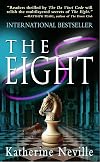
My book club likes to choose different genres throughout the year in order to push each of us out of our reading ruts. Katherine Neville's The Eight was a push for me since I neither read thrillers nor play chess. I don't love mysteries and I haven't found a book that does slight of hand (eyes?) that I've liked since I was young and reading Ellen Raskin's masterful The Westing Game. I might have grumbled over the group's choice but I was a dutiful member and read it. And it was fine. It show more didn't really change my perceptions of the genre but since I didn't hate it, I consider the whole thing generally a success.
Opening at the end of the eighteenth century at Montglane Abbey in the south of France, two young novices are told of the existence of the Montglane Service, a chess set imbued with dangerous powers, given to Charlemagne and crafted by the Moors. The one who possesses all of the pieces will be immensely powerful, invincible and immortal. The nuns of the Abbey have guarded the service faithfully but now the political climate in France and the aspirations and cold intelligence of those on the rise have endangered its hiding place. The service must be scattered to the four winds in order to keep it from coming together as a set and granting the wrong person its strength. Mireille and her cousin Valentine are to take a piece of the service and flee to Paris to their guardian. They will risk everything to keep their piece and those of others safe even in the face of the Reign of Terror. And their opponents are some of the brightest, most calculating minds of their time.
Meanwhile, in 1972, Catherine (Cat) Velis is about to leave for Algeria for work when she is warned about the danger to her there. She is a computer expert for IBM being sent to work with the Algerian government where she will come into contact with the newly formed OPEC. Not long before she is to leave, she is approached by an antiques collector who wants her to negotiate for a very old chess service there. Her work and her search for the chess pieces will collide and make for a thrilling, cat-and-mouse game through Northern Africa as she learns more about this chess service that people will even kill to posses.
The novel is certainly rife with intrigue as this dangerous game plays out across Europe, Africa, and America and across history, touching many of the most famous people of the day. The characters are fairly typical for this genre and it is pretty easy to guess who is on the side of good and who is evil, even without putting them mentally on a chess board, although a knowledge of chess moves certainly helps a reader appreciate the novel and the characters who people it better. The double narratives are equally interesting and they do eventually intertwine in an unexpected way. They are always connected by the chess service but the way that the late eighteenth century directly touches the middle twentieth century is unexpected and mystical. Both parallel stories gallop along at a pretty decent clip with danger, close calls, mystery, and revelations around every corner. But the writing itself isn't outstanding and has the potential to bog the reader down although some of the ideas contained here are smart: Fibonacci numbers, chess strategy, music, and their connections to and mirrors of each other. Suspense and thriller fans who want a roller coaster ride will certainly appreciate this more than I, the non-mathematical, non-chess playing, tone deaf me, did. But over all, even for me, it was a quick and decent read. show less
Opening at the end of the eighteenth century at Montglane Abbey in the south of France, two young novices are told of the existence of the Montglane Service, a chess set imbued with dangerous powers, given to Charlemagne and crafted by the Moors. The one who possesses all of the pieces will be immensely powerful, invincible and immortal. The nuns of the Abbey have guarded the service faithfully but now the political climate in France and the aspirations and cold intelligence of those on the rise have endangered its hiding place. The service must be scattered to the four winds in order to keep it from coming together as a set and granting the wrong person its strength. Mireille and her cousin Valentine are to take a piece of the service and flee to Paris to their guardian. They will risk everything to keep their piece and those of others safe even in the face of the Reign of Terror. And their opponents are some of the brightest, most calculating minds of their time.
Meanwhile, in 1972, Catherine (Cat) Velis is about to leave for Algeria for work when she is warned about the danger to her there. She is a computer expert for IBM being sent to work with the Algerian government where she will come into contact with the newly formed OPEC. Not long before she is to leave, she is approached by an antiques collector who wants her to negotiate for a very old chess service there. Her work and her search for the chess pieces will collide and make for a thrilling, cat-and-mouse game through Northern Africa as she learns more about this chess service that people will even kill to posses.
The novel is certainly rife with intrigue as this dangerous game plays out across Europe, Africa, and America and across history, touching many of the most famous people of the day. The characters are fairly typical for this genre and it is pretty easy to guess who is on the side of good and who is evil, even without putting them mentally on a chess board, although a knowledge of chess moves certainly helps a reader appreciate the novel and the characters who people it better. The double narratives are equally interesting and they do eventually intertwine in an unexpected way. They are always connected by the chess service but the way that the late eighteenth century directly touches the middle twentieth century is unexpected and mystical. Both parallel stories gallop along at a pretty decent clip with danger, close calls, mystery, and revelations around every corner. But the writing itself isn't outstanding and has the potential to bog the reader down although some of the ideas contained here are smart: Fibonacci numbers, chess strategy, music, and their connections to and mirrors of each other. Suspense and thriller fans who want a roller coaster ride will certainly appreciate this more than I, the non-mathematical, non-chess playing, tone deaf me, did. But over all, even for me, it was a quick and decent read. show less
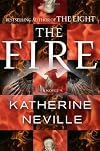
When I snagged The Fire as an Early Review book, I bought The Eight and read it first in order to become acquainted with the context. I did not enjoy The Eight, and found it to be cumbersome, ridiculous, and hard to read. But I got through it because I had already committed to reading and reviewing The Fire.
The Fire was even worse than The EIght. I could not even persuade myself to finish the last third of the book. Not only was it cumbersome and ridiculous, but there were just no characters show more that I found to be believable or sympathetic. As in The Eight, the characters would experience extreme emotions like rage or terror (or so the author said), and I'd have no idea why.
And then there's the puzzle quotient. Every time two or more characters are in a room together, there's a puzzle to solve, with ridiculously esoteric clues--but the brilliant main character always knows the inner workings of the puzzler's mind, and figures it out in mere minutes. The whole thing lacked credibility.
The story about a mysterious chess set with supernatural powers was told in parallel historic and modern settings. I didn't buy either of them. I like fantasy as much as the next girl--but I was never convinced that the characters had any reason at all to believe in The Game or the magical chess set.
I wondered if Neville actually had an editor, and if so, why didn't she red-ink the cliches that took the place of actual creativity.
I think Neville actually has an interesting story idea and a potentially fantastic historical-modern connection. It just wasn't executed well enough to be worth reading. show less
The Fire was even worse than The EIght. I could not even persuade myself to finish the last third of the book. Not only was it cumbersome and ridiculous, but there were just no characters show more that I found to be believable or sympathetic. As in The Eight, the characters would experience extreme emotions like rage or terror (or so the author said), and I'd have no idea why.
And then there's the puzzle quotient. Every time two or more characters are in a room together, there's a puzzle to solve, with ridiculously esoteric clues--but the brilliant main character always knows the inner workings of the puzzler's mind, and figures it out in mere minutes. The whole thing lacked credibility.
The story about a mysterious chess set with supernatural powers was told in parallel historic and modern settings. I didn't buy either of them. I like fantasy as much as the next girl--but I was never convinced that the characters had any reason at all to believe in The Game or the magical chess set.
I wondered if Neville actually had an editor, and if so, why didn't she red-ink the cliches that took the place of actual creativity.
I think Neville actually has an interesting story idea and a potentially fantastic historical-modern connection. It just wasn't executed well enough to be worth reading. show less
 This review was written for LibraryThing Early Reviewers.
Lists
Female Author (1)
Off on a Quest (1)
Awards


You May Also Like


Associated Authors
Statistics
- Works
- 16
- Also by
- 7
- Members
- 8,825
- Popularity
- #2,711
- Rating
- 3.5
- Reviews
- 401
- ISBNs
- 213
- Languages
- 19
- Favorited
- 29
