
John Warner (1) (1970–)
Author of Created in Darkness by Troubled Americans: The Best of McSweeney's Humor Category
For other authors named John Warner, see the disambiguation page.
Works by John Warner
Created in Darkness by Troubled Americans: The Best of McSweeney's Humor Category (2004) — Editor — 888 copies, 16 reviews
Fondling Your Muse : Infallible Advice from a Published Author to the Writerly Aspirant (2005) 153 copies, 6 reviews
Why They Can't Write: Killing the Five-Paragraph Essay and Other Necessities (2018) 122 copies, 1 review
A Love Story [Short Story] 1 copy
Associated Works
Tagged
Common Knowledge
Members
Reviews
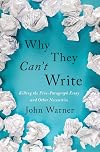
As someone who teaches in a writing-intensive discipline at the college level, and who has taught writing seminars in the past, I found myself nodding along with so much of what John Warner has to say here. The billions that have been pumped into standardised testing, private charter schools, ed-tech, etc., over the past thirty years or so haven't just been wasted—they've caused actual harm. In this, we are in absolute agreement.
I'm also not the person who needs to read this book. Why They show more Can't Write needs to find its way into the hands of the politicians who defund public education, the college administrators who pay comp/rhetoric instructors a pittance for a crushing workload, and my senior colleagues who sniff about "kids these days." The kids are all right; it's the system that's an unholy mess. show less
I'm also not the person who needs to read this book. Why They show more Can't Write needs to find its way into the hands of the politicians who defund public education, the college administrators who pay comp/rhetoric instructors a pittance for a crushing workload, and my senior colleagues who sniff about "kids these days." The kids are all right; it's the system that's an unholy mess. show less
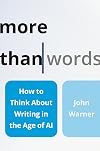
I'm surprised at the glowing reviews of this book. As a lifelong lover of human-generated textual content from novels to essays to marketing to technical content, I've been thinking about writing (and reading like a writer) for most of my life. I enjoy reading 19th century literature, I can keep up my side of the conversation with any English major, and I'm (just) old enough to remember the pre-digital age vividly. However, I've also been an enthusiastic user of personal computers for 35 show more years, and have been employed by several of the big tech companies that are now part of the AI revolution. Maybe my background makes me less impressed by Warner's jeremiad against the "automation" of writing. He's not wrong about the value of human thought and feeling and about the ability of written words to both communicate and generate thought and feeling. But his points, though important, are also well worn, and not fresher for being stated strongly. And he spends a great deal of time trying to support his points by making technical arguments he's simply not qualified to make.
To be more specific, Warner spends several chapters insisting on the "toaster" interpretation of artificial intelligence: that artificial intelligence is no more intelligent than any appliance, so that any interpretation of its output as smart, conscious, or perceptive in any way is flawed at its core. I concede the point — for now. But I believe this viewpoint will quickly become dated, and it's a dangerous base to rest an argument on. The fact is that the capabilities of AI are expanding so fast that the very scientists and engineers who are working on it are often surprised and often cannot explain its accomplishments. And although there are many qualified scientists who agree with Warner that AI merely simulates intelligence and cannot be thought of as the product of some sort of cybernetic mind, others disagree, and believe that AI will soon become truly intelligent and impossible for human beings to predict and control. For the moment, it's easy to take an AI-generated text and point out its shortcomings - the blandness, the clichés, the not-quite-rightness, and contrast that with the comparative richness of a human production. But regardless of whether AI ever becomes literally intelligent, it is improving so fast that the differences will no longer be apparent. Critics of AI need to take this into account and not assume, as Warner does, that the flaws of current AI are so inherent that they will always exist. I do not believe they will. Every example Warner provides of inadequate AI output will be corrected and improved in future systems. Warner will disagree, but he does so not because of an argument but because of his axioms: that artificial intelligence is not real intelligence, and that human intelligence can never be simulated. He cannot prove these things, and I am unwilling to consider them proven.
The result of Warner's approach is a book that is sometimes tedious to read, as the first 60 pages of the book are the equivalent of the author buttonholing you and insisting over and over that AI isn't what you supposedly think it is. Better are the sections that come from Warner's own experience as a teacher. But unfortunately, the book doesn't live up to its subtitle How to Think About Writing in the Age of AI. Warner simply argues that we need to think about writing the way we always have, and not believe that AI can replace the human obligation to be creative, as a student, a teacher, or any other writer. He's right, of course, but anyone except a tech bro would surely agree. And his arguments about the nature of AI and his complaints about ChatGPT? If recent history is any indication, they'll be obsolete in two to five years. show less
To be more specific, Warner spends several chapters insisting on the "toaster" interpretation of artificial intelligence: that artificial intelligence is no more intelligent than any appliance, so that any interpretation of its output as smart, conscious, or perceptive in any way is flawed at its core. I concede the point — for now. But I believe this viewpoint will quickly become dated, and it's a dangerous base to rest an argument on. The fact is that the capabilities of AI are expanding so fast that the very scientists and engineers who are working on it are often surprised and often cannot explain its accomplishments. And although there are many qualified scientists who agree with Warner that AI merely simulates intelligence and cannot be thought of as the product of some sort of cybernetic mind, others disagree, and believe that AI will soon become truly intelligent and impossible for human beings to predict and control. For the moment, it's easy to take an AI-generated text and point out its shortcomings - the blandness, the clichés, the not-quite-rightness, and contrast that with the comparative richness of a human production. But regardless of whether AI ever becomes literally intelligent, it is improving so fast that the differences will no longer be apparent. Critics of AI need to take this into account and not assume, as Warner does, that the flaws of current AI are so inherent that they will always exist. I do not believe they will. Every example Warner provides of inadequate AI output will be corrected and improved in future systems. Warner will disagree, but he does so not because of an argument but because of his axioms: that artificial intelligence is not real intelligence, and that human intelligence can never be simulated. He cannot prove these things, and I am unwilling to consider them proven.
The result of Warner's approach is a book that is sometimes tedious to read, as the first 60 pages of the book are the equivalent of the author buttonholing you and insisting over and over that AI isn't what you supposedly think it is. Better are the sections that come from Warner's own experience as a teacher. But unfortunately, the book doesn't live up to its subtitle How to Think About Writing in the Age of AI. Warner simply argues that we need to think about writing the way we always have, and not believe that AI can replace the human obligation to be creative, as a student, a teacher, or any other writer. He's right, of course, but anyone except a tech bro would surely agree. And his arguments about the nature of AI and his complaints about ChatGPT? If recent history is any indication, they'll be obsolete in two to five years. show less
One might draw parentheses around "in the Age of AI" when it comes to John Warner's excellent book. If there is one thing that is certain, generative AI has made it necessary to think about writing in general, as the assumed ubiquity of AI has implied definitions of writing that are certainly unsatisfactory from a pedagogical standpoint, and stand as evidence of the marketplace's power to (try to) shape our destiny. But this isn't just another example of capitalism's dominion. Many uses of show more AI ask us how much of our humanity we are willing to relinquish? The answer is demoralizing for many of us, yet Warner does provide a framework which he details in the last section of the book: Resist. Renew. Explore.
Warner starts, however, at the "beginning". He eschews "intelligence" as a synonym for "automation" --the real function of AI. I'll admit to a strong confirmation bias, but Warner puts AI through its paces to offer a well-considered and informative critique that I found incredibly helpful in quieting the bile that rises in my throat when it seems everyone has just obeyed our AI overlords in advance. He begins with an accessible explanation of what ChatGPT is and what it is doing when activated. While it is informative, it also serves to remind us that, at some level, we must understand how technology works rather than just allow ourselves to be uniformly awed (or galled) by its "magic." He is openly critical of the propaganda put forth by AI advocates who stand to gain financially (e.g. Sam Altman), but carefully debunks their claims rather than resorting to panicked invective.
Some of the chapter titles read like tongue-in-cheek clickbait, but it adds to Warner's overall sense of humor, which pops up throughout the narrative. To be sure, we are reading a very human writer.
Chapters 3 to 9 offer a more personalized view--almost a mini-memoir of Warner's own life as a writer-- but peppered with rather significant points about semiotics and rhetoric that are a heckuva lot more reader-friendly than most of what is written about semiotics and rhetoric. On a personal level, Chapter 6, "Writing is Feeling" touched me the most, and I think mileage will vary on that depending on the life experiences of the reader. I wasn't quite prepared for tears in encountering one of the most perfect meditations on grief I've ever read. I won't quote it here, but it is on p. 84 (hardcover). It underscores that this is very much a book about being human.
Chapter 7, "Writing as a Practice" felt a bit less useful and more of a (gentle) mouthing-off against the "one key thing" mentality that prompts us to enthusiastically adopt the shiny thing du jour. His diplomatic takedown of Gladwell and Duckworth's themes felt more gratuitous than other parts of the book, but that may be because I needed no convincing at the outset.
Writing teachers (and teachers that use writing) will find chapters 11 to 14 particularly useful, especially if they are interested in having conversations with their students about AI--or rather, about writing. The title for Chapter 16 privileges an anecdote that Warner uses to address one of the most important points of all: writing as intention.
Importantly, Warner encourages constant education, but measured by our own specialities and areas of focus. We cannot possibly read all the things about AI (my Substack feed overwhelms me every day), but it is important to push back at our own confirmation bias as well. I appreciated that Warner notes that he is almost "more obligated to read [Ethan Mollick] because I disagree with him.' (275). There's hope if we engage with thoughtful voices like Mollick, Marc Watkins, and others. Warner says we must foster community:
"Our communities inevitably must contain both those with whom we agree and those with whom we differ. As long as they are willing to see themselves as a member of the community with the well-being of the community in mind, they should be welcome." (275).
I'd like to print that out banner-size and hang it in a few places...
From the morally questionable beginnings of the founding of AI, the degradation of labor (and human-ness), to the careless implementation of automated grading, Warner is clear that we are leaning toward a Faustian bargain when it comes to AI. As a teacher, I was particularly struck by this:
"Writing is meant to be read. Having something that cannot read [AI] generate responses to writing is wrong. It is a moral betrayal of our responsibilities to students." (240) Far too often in discussions of AI I have heard "efficiency" used as a synonym for "pedagogy" and they are certainly not the same thing.
But Warner is also pragmatic: "There is no wishing away AI at this point, meaning it must be grappled with and done so in a way that preserves our humanity." (128) He allows for the limited use of LLMs in processing text (not reading, not writing): "Only humans can read. Only humans can write. Don't let anyone tell you otherwise.." (123)
AI has made it necessary (possible?) to critique our values when it comes to a lot of things, but especially writing. Most educational systems are founded on valuing product over process, so we can't be that surprised when we find that students are using ChatGPT to "cheat." Efficiency is key in the systems we uphold. If we want to truly have our students embrace the "messiness of learning", we have to stop honoring that which privileges standardization and the mechanization of education. The second part of Warner's framework is "renew" and he makes a more-than-convincing case that we can refuse to assimilate into some sort of algorithmic Borg, and instead embrace the human processes of reacting, observing, analyzing, and synthesizing as cause for celebration, rather than erasing them in the name of efficiency. show less
Warner starts, however, at the "beginning". He eschews "intelligence" as a synonym for "automation" --the real function of AI. I'll admit to a strong confirmation bias, but Warner puts AI through its paces to offer a well-considered and informative critique that I found incredibly helpful in quieting the bile that rises in my throat when it seems everyone has just obeyed our AI overlords in advance. He begins with an accessible explanation of what ChatGPT is and what it is doing when activated. While it is informative, it also serves to remind us that, at some level, we must understand how technology works rather than just allow ourselves to be uniformly awed (or galled) by its "magic." He is openly critical of the propaganda put forth by AI advocates who stand to gain financially (e.g. Sam Altman), but carefully debunks their claims rather than resorting to panicked invective.
Some of the chapter titles read like tongue-in-cheek clickbait, but it adds to Warner's overall sense of humor, which pops up throughout the narrative. To be sure, we are reading a very human writer.
Chapters 3 to 9 offer a more personalized view--almost a mini-memoir of Warner's own life as a writer-- but peppered with rather significant points about semiotics and rhetoric that are a heckuva lot more reader-friendly than most of what is written about semiotics and rhetoric. On a personal level, Chapter 6, "Writing is Feeling" touched me the most, and I think mileage will vary on that depending on the life experiences of the reader. I wasn't quite prepared for tears in encountering one of the most perfect meditations on grief I've ever read. I won't quote it here, but it is on p. 84 (hardcover). It underscores that this is very much a book about being human.
Chapter 7, "Writing as a Practice" felt a bit less useful and more of a (gentle) mouthing-off against the "one key thing" mentality that prompts us to enthusiastically adopt the shiny thing du jour. His diplomatic takedown of Gladwell and Duckworth's themes felt more gratuitous than other parts of the book, but that may be because I needed no convincing at the outset.
Writing teachers (and teachers that use writing) will find chapters 11 to 14 particularly useful, especially if they are interested in having conversations with their students about AI--or rather, about writing. The title for Chapter 16 privileges an anecdote that Warner uses to address one of the most important points of all: writing as intention.
Importantly, Warner encourages constant education, but measured by our own specialities and areas of focus. We cannot possibly read all the things about AI (my Substack feed overwhelms me every day), but it is important to push back at our own confirmation bias as well. I appreciated that Warner notes that he is almost "more obligated to read [Ethan Mollick] because I disagree with him.' (275). There's hope if we engage with thoughtful voices like Mollick, Marc Watkins, and others. Warner says we must foster community:
"Our communities inevitably must contain both those with whom we agree and those with whom we differ. As long as they are willing to see themselves as a member of the community with the well-being of the community in mind, they should be welcome." (275).
I'd like to print that out banner-size and hang it in a few places...
From the morally questionable beginnings of the founding of AI, the degradation of labor (and human-ness), to the careless implementation of automated grading, Warner is clear that we are leaning toward a Faustian bargain when it comes to AI. As a teacher, I was particularly struck by this:
"Writing is meant to be read. Having something that cannot read [AI] generate responses to writing is wrong. It is a moral betrayal of our responsibilities to students." (240) Far too often in discussions of AI I have heard "efficiency" used as a synonym for "pedagogy" and they are certainly not the same thing.
But Warner is also pragmatic: "There is no wishing away AI at this point, meaning it must be grappled with and done so in a way that preserves our humanity." (128) He allows for the limited use of LLMs in processing text (not reading, not writing): "Only humans can read. Only humans can write. Don't let anyone tell you otherwise.." (123)
AI has made it necessary (possible?) to critique our values when it comes to a lot of things, but especially writing. Most educational systems are founded on valuing product over process, so we can't be that surprised when we find that students are using ChatGPT to "cheat." Efficiency is key in the systems we uphold. If we want to truly have our students embrace the "messiness of learning", we have to stop honoring that which privileges standardization and the mechanization of education. The second part of Warner's framework is "renew" and he makes a more-than-convincing case that we can refuse to assimilate into some sort of algorithmic Borg, and instead embrace the human processes of reacting, observing, analyzing, and synthesizing as cause for celebration, rather than erasing them in the name of efficiency. show less

Not what I expected. If you know me based only on the reviews I've written then you can be forgiven for not knowing that I'm a big admirer of comedy generally and stand up comedians specifically. Carlin, Hicks, Hedberg, Kinison, Seinfeld, Rock, Dangerfield, CK, Williams, they are all, to me, and when they're at their best, a close approximation to true modern philosophers. They make it all bearable by making it ridiculous. And I'm reminded as I write this of Umberto Eco's The Name of the show more Rose and its use of Aristotle's Book on Comedy, that stolid truth and the human capacity for levity need not always be mutually exclusive.
But unfortunately, the profession of comedian isn't something that's gone into in any real depth in this novel. A few vague statements here and there about 'the hierarchy' and a few generally popular names thrown around that anyone with an internet connection or half an ear to pop culture will know about. Hardly a 'from the trenches' account.
However (and this took me most of the book's length to realize) this book is a parable, even an allegory, though sadly a somewhat failed one. It's a cultural indictment of the modern American moment. Of the crassness and vulgarity that has replaced true wit and sharp writing with excess and pathetic pandering to the lowest common denominator, gleefully smirking and bandying about the title of 'satire' as if it's means something. Think the high priest of this movement, think Seth MacFarlane and most of his output in the last few years and you'll understand. The book is a calling out of the kind of immature nihilism that says nothing, attempts nothing, and wonders why the culture is at its tipping point. On that score, the book is well executed. Modern American culture, as depicted here, really seems as though it's on its last legs, and maybe, just maybe, that's not necessarily a bad thing, if we can elevate ourselves from the detritus.
But as for the story itself and not just the statement it's trying to make, it is, I'm sorry to say, clunky, and not that conducive to the message it's trying to convey. There were a handful of moments here and there where I almost wanted to call the book 'Kafkaesque' but the book lacked Kafka's grace and subtlety, not to mention his descriptive powers regarding the highs and lows of humanity. Yes, Warner gives us a shallow media and image obsessed culture with hints of 'true love' scattered throughout with the main character's first wife and (spoiler) later love interest. But none of it is done convincingly.
And that is the major failing of the novel. Warner goes to great pains to detail his protagonist's fall and, concurrently, the state of modern American culture and it's gradual descent into moral and qualitative decrepitude. But when it comes to his character's ascent and his, we're told, eventual redemption or even potential for said redemption, the book comes off trite and frankly a bit rushed. Maybe had Warner devoted more pages to his protagonist's struggle to evolve it would've made this a true Sisyphean struggle in the vein of Camus, Absurdist even.
But he doesn't. And what we the readers are left with is a sinking culture and an unlikable protagonist that's difficult to even empathize with. This book is not mindless though, it's not even heartless. There's more than meets the eye here and it's certainly deserving of a read if only to know that underneath the waste of modern culture there is still something worth knowing and even worth saving. show less
But unfortunately, the profession of comedian isn't something that's gone into in any real depth in this novel. A few vague statements here and there about 'the hierarchy' and a few generally popular names thrown around that anyone with an internet connection or half an ear to pop culture will know about. Hardly a 'from the trenches' account.
However (and this took me most of the book's length to realize) this book is a parable, even an allegory, though sadly a somewhat failed one. It's a cultural indictment of the modern American moment. Of the crassness and vulgarity that has replaced true wit and sharp writing with excess and pathetic pandering to the lowest common denominator, gleefully smirking and bandying about the title of 'satire' as if it's means something. Think the high priest of this movement, think Seth MacFarlane and most of his output in the last few years and you'll understand. The book is a calling out of the kind of immature nihilism that says nothing, attempts nothing, and wonders why the culture is at its tipping point. On that score, the book is well executed. Modern American culture, as depicted here, really seems as though it's on its last legs, and maybe, just maybe, that's not necessarily a bad thing, if we can elevate ourselves from the detritus.
But as for the story itself and not just the statement it's trying to make, it is, I'm sorry to say, clunky, and not that conducive to the message it's trying to convey. There were a handful of moments here and there where I almost wanted to call the book 'Kafkaesque' but the book lacked Kafka's grace and subtlety, not to mention his descriptive powers regarding the highs and lows of humanity. Yes, Warner gives us a shallow media and image obsessed culture with hints of 'true love' scattered throughout with the main character's first wife and (spoiler) later love interest. But none of it is done convincingly.
And that is the major failing of the novel. Warner goes to great pains to detail his protagonist's fall and, concurrently, the state of modern American culture and it's gradual descent into moral and qualitative decrepitude. But when it comes to his character's ascent and his, we're told, eventual redemption or even potential for said redemption, the book comes off trite and frankly a bit rushed. Maybe had Warner devoted more pages to his protagonist's struggle to evolve it would've made this a true Sisyphean struggle in the vein of Camus, Absurdist even.
But he doesn't. And what we the readers are left with is a sinking culture and an unlikable protagonist that's difficult to even empathize with. This book is not mindless though, it's not even heartless. There's more than meets the eye here and it's certainly deserving of a read if only to know that underneath the waste of modern culture there is still something worth knowing and even worth saving. show less
Lists
You May Also Like


Associated Authors
Statistics
- Works
- 16
- Also by
- 6
- Members
- 1,467
- Popularity
- #17,513
- Rating
- 3.7
- Reviews
- 38
- ISBNs
- 54