
Daniil Kharms (1905–1942)
Author of Today I wrote nothing: the selected writing of Daniil Kharms
About the Author
Works by Daniil Kharms
Ik zat op het dak proza, toneel, gedichten, dagboekaantekeningen, brieven (1999) 56 copies, 1 review
The Fire Horse: Children's Poems by Vladimir Mayakovsky, Osip Mandelstam and Daniil Kharms (2003) — Author — 13 copies, 1 review
Brieven aan Claudia 5 copies
The Blue Notebook 4 copies
I Had Raised Dust: Selected Works 3 copies
Onverwacht drinkgelag en ander proza 3 copies
Povest', rasskazy, molitvy, poemy, stseny, vodevili, dramy, stat'i, traktaty, kvazitraktaty (2000) 2 copies
Tigr na Ulitse 2 copies
Миниатюры 2 copies
Čtyřnohá vrána 2 copies
50 verhalen 2 copies
Čtyřnohá vrána 1 copy
Горло бредит бритвой 1 copy
Горло бредит бритвою 1 copy
Плих и плюх 1 copy
A grlo luta britvom 1 copy
Летят по небу шарики Стихи. Песенки. Сказки. Рассказы : [Для мл. и сред. шк. возраста] (1990) 1 copy
Кто кого перехитрил 1 copy
[Сочинения]. Т. 2 1 copy
Prosa 1 copy
Slutsai 1 copy
Rehabilitatie 1 copy
Elizaveta Bam 1 copy
Literatura rusa del absurdo 1 copy
Três Horas Esquecidas 1 copy
Skazka 1 copy
Stories 1 copy
Fälle 1 copy
Das blaue Heft Nr. 10 1 copy
Комедия города Петербурга 1 copy
Нашествие смыслов 1 copy
Le Chevalier 1 copy
Gdje ste vi Puškine 1 copy
Di come Nicolino Punk volò in Brasile e Pierino Spazzoletta non ci ha creduto neanche un po'. Ediz. illustrata (Le piume) (2011) 1 copy
Racconti 1 copy
Daniil Charms, 18 verhalen 1 copy
Erstens und Zweitens 1 copy
Иван Иваныч Самовар 1 copy
Associated Works
Against Forgetting: Twentieth-Century Poetry of Witness (1993) — Contributor — 377 copies, 2 reviews
A Very Russian Christmas: The Greatest Russian Holiday Stories of All Time (2016) — Contributor — 46 copies, 1 review
Firefly in a Box: An Anthology of Soviet Kid Lit (Cultures of Childhood) (2025) — Contributor — 1 copy
Tagged
Common Knowledge
- Canonical name
- Kharms, Daniil
- Legal name
- Yuvachov, Daniil Ivanovich
Ювачёв, Даниил Иванович - Other names
- Charms, Daniil
- Birthdate
- 1905-12-30
- Date of death
- 1942-02-02
- Gender
- male
- Education
- Leningrad Electrotechnicum (expelled)
St Peter's School, St Petersburg, Russian Empire - Occupations
- poet
children's book author
playwright - Organizations
- OBERIU (Association for Real Art)
- Short biography
- Married first to Esther Rusakova, then to Marina Malich.
- Cause of death
- conditions of imprisonment (forgotten in prison, he died of hunger)
malnourishment - Nationality
- Russia
USSR - Birthplace
- St. Petersburg, Russian Empire
- Places of residence
- Saint Petersburg, Russia
- Place of death
- Leningrad, Russia, USSR
- Map Location
- Russia
Members
Reviews

I can see why some people would hate Kharms' work but personally I am convinced that he is a genius. It's probably better to read it slowly over a longer period of time though. I wouldn't recommend trying to read it all in one sitting. Some of the stuff in this collection is better than others but overall I thought it was really good and got a lot out of it I think. These "stories" (they're more like poems a lot of the time are like nothing else I've ever read.
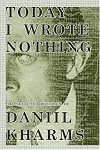
I have absolutely no memory of how ‘Today I Wrote Nothing’ came to be on my to-read list. I added it in 2013, possibly after coming across Kharms some other early Soviet era fiction? Or a review of it? Or some Russian history? Who knows, but I trust past-me to choose books for future-me. It has taken me this long to locate a copy because only last week I realised I could get borrowing rights for an additional academic library. Combined with the magic of www.worldcat.org, another recent show more joyous discovery, I now have access to various obscure volumes I’ve been meaning to read for many years. As the National Library of Scotland sadly does not allow borrowing, this is a wonderful development.
You will notice the digressive tone of this review. I allow myself this latitude in tribute to Kharms, who wrote with spectacular disdain for narrative or coherence. In the excellent introduction, his translator seeks to avoid pigeonholing Kharms’ work as absurdism or political satire. Indeed, the translator appears exasperated by the tendency to assume everything written in 1930s Russia was implicit critique of Stalin. As he puts it: ‘After all, it wasn’t all Stalin all the time’, despite Stalin’s best efforts to the contrary. Kharms appears to have had greater ambitions to undermine core precepts of literary endeavour. His coterie seem in retrospect to be precursors of the surrealists. Delightfully, they couldn’t make a living writing for adults, as Soviet Realism was de rigueur, so wrote bizarre children’s books. Life for an avant garde writer in Stalinist Russia was certainly no picnic and Kharms died in prison during the siege of Leningrad. Nonetheless, a lot of his writing has survived for us to puzzle over today.
It is most certainly a puzzle. As with other Russian fiction I’ve read, such as [b:The Slynx|310722|The Slynx|Tatyana Tolstaya|https://images.gr-assets.com/books/1320532928s/310722.jpg|3535], [b:The Gray House|32703696|The Gray House|Mariam Petrosyan|https://images.gr-assets.com/books/1476844394s/32703696.jpg|11258864], and [b:The Foundation Pit|715995|The Foundation Pit|Andrei Platonov|https://images.gr-assets.com/books/1418363439s/715995.jpg|702247], I felt a lot of meaning was going straight over my head due to lack of linguistic and cultural awareness. Translating short pieces of intentional nonsense is obviously very challenging. The results reminded me, if anything, of internet memes and particularly so-called tumblr shitposts. I mean no insult to Kharms by this comparison! The surreal, deconstructed, and recursively referential nature of the humour assumes a lot of contextual knowledge from the reader. Can you imagine trying to comprehend currently popular memes 80 years later in translated form? Kharms was not composing his snippets to be skimmed and re-posted on social media, yet this sort of thing sounds eerily akin to @dril tweets:
I regret to say, however, that I found most of the pieces in the book baffling without being amusing. I lacked the reference points to appreciate Kharms arbitrary humour, despite the endnotes attempting to explain where possible. Almost all of the collected writings are very short, little notes and snippets, so I was reminded slightly of the time I read the first volume of Kafka’s diaries (over Christmas, foolishly). Still, Kharms did make me laugh several times. The echoes of his humour in current memes tempt me to speculate about popular humour when there is no privacy, be it under Stalinism or surveillance capitalism. In [b:Nothing Is True and Everything Is Possible: The Surreal Heart of the New Russia|21413849|Nothing Is True and Everything Is Possible The Surreal Heart of the New Russia|Peter Pomerantsev|https://images.gr-assets.com/books/1407196452s/21413849.jpg|40714614], Pomerantsev observes that when all coherent political ideas have been co-opted by the ruling class, the resistance fall back on surreal nonsense. Comfort and distraction from existential anxiety and powerlessness can come from the ridiculous. The surreal and absurd are more difficult to co-opt and monetise, not that brands aren’t trying very hard to, because they deliberately evade meaning. In other words, Kharms definitely still has something to tell us, although I can’t tell you what exactly. The longest and most conventional piece in the book, a short story titled ‘The Old Woman’, is also by far the most terrifying. Imagine Kafka writing about disposing of a corpse. While Kharms clearly could write a suitably horrifying short story, it’s his very brief pieces that convey the full force of his subversive and proto-surreal style. show less
You will notice the digressive tone of this review. I allow myself this latitude in tribute to Kharms, who wrote with spectacular disdain for narrative or coherence. In the excellent introduction, his translator seeks to avoid pigeonholing Kharms’ work as absurdism or political satire. Indeed, the translator appears exasperated by the tendency to assume everything written in 1930s Russia was implicit critique of Stalin. As he puts it: ‘After all, it wasn’t all Stalin all the time’, despite Stalin’s best efforts to the contrary. Kharms appears to have had greater ambitions to undermine core precepts of literary endeavour. His coterie seem in retrospect to be precursors of the surrealists. Delightfully, they couldn’t make a living writing for adults, as Soviet Realism was de rigueur, so wrote bizarre children’s books. Life for an avant garde writer in Stalinist Russia was certainly no picnic and Kharms died in prison during the siege of Leningrad. Nonetheless, a lot of his writing has survived for us to puzzle over today.
It is most certainly a puzzle. As with other Russian fiction I’ve read, such as [b:The Slynx|310722|The Slynx|Tatyana Tolstaya|https://images.gr-assets.com/books/1320532928s/310722.jpg|3535], [b:The Gray House|32703696|The Gray House|Mariam Petrosyan|https://images.gr-assets.com/books/1476844394s/32703696.jpg|11258864], and [b:The Foundation Pit|715995|The Foundation Pit|Andrei Platonov|https://images.gr-assets.com/books/1418363439s/715995.jpg|702247], I felt a lot of meaning was going straight over my head due to lack of linguistic and cultural awareness. Translating short pieces of intentional nonsense is obviously very challenging. The results reminded me, if anything, of internet memes and particularly so-called tumblr shitposts. I mean no insult to Kharms by this comparison! The surreal, deconstructed, and recursively referential nature of the humour assumes a lot of contextual knowledge from the reader. Can you imagine trying to comprehend currently popular memes 80 years later in translated form? Kharms was not composing his snippets to be skimmed and re-posted on social media, yet this sort of thing sounds eerily akin to @dril tweets:
"They say all the good babes are wide-bottomed. Oh, I just love big-bosomed babes. I like the way they smell.” Saying this he began to grow taller and, reaching the ceiling, he fell apart into a thousand little spheres. [‘How One Man Fell To Pieces’, page 231.]
Poisoning children is cruel. But something has to be done about them!
What’s all the fuss about flowers? It smells way better between a woman’s legs. That’s nature for you, and that’s why no-one dares find my words distasteful. [Untitled, page 252]
I regret to say, however, that I found most of the pieces in the book baffling without being amusing. I lacked the reference points to appreciate Kharms arbitrary humour, despite the endnotes attempting to explain where possible. Almost all of the collected writings are very short, little notes and snippets, so I was reminded slightly of the time I read the first volume of Kafka’s diaries (over Christmas, foolishly). Still, Kharms did make me laugh several times. The echoes of his humour in current memes tempt me to speculate about popular humour when there is no privacy, be it under Stalinism or surveillance capitalism. In [b:Nothing Is True and Everything Is Possible: The Surreal Heart of the New Russia|21413849|Nothing Is True and Everything Is Possible The Surreal Heart of the New Russia|Peter Pomerantsev|https://images.gr-assets.com/books/1407196452s/21413849.jpg|40714614], Pomerantsev observes that when all coherent political ideas have been co-opted by the ruling class, the resistance fall back on surreal nonsense. Comfort and distraction from existential anxiety and powerlessness can come from the ridiculous. The surreal and absurd are more difficult to co-opt and monetise, not that brands aren’t trying very hard to, because they deliberately evade meaning. In other words, Kharms definitely still has something to tell us, although I can’t tell you what exactly. The longest and most conventional piece in the book, a short story titled ‘The Old Woman’, is also by far the most terrifying. Imagine Kafka writing about disposing of a corpse. While Kharms clearly could write a suitably horrifying short story, it’s his very brief pieces that convey the full force of his subversive and proto-surreal style. show less
WINDOW:
I opened suddenly.
I'm a hole in the walls of buildings.
The soul spills out through me.
I'm the air vent of enlightened minds.
I read this collection of Kharms' poetry and short prose in less than a day. His voice just seemed to be clicking with me so I went with it. And where I went was a wacked-out world where people suddenly die a lot in very matter-of-fact ways and stories often end abruptly with the words THAT'S ALL, making me think of Looney Tunes cartoons, which in some cases show more are not that far off the mark from Kharms' brand of humor. [Note: Yankelevich, the translator, uses THAT'S ALL as a sign-off for later works and enough for earlier ones as a way to compensate for how the actual word Kharms used in Russian, 'vse', does not translate well into English—Yankelevich describes the word as "a kind of flippant version of "The End" that became one of Kharms' peculiar trademarks.)
Children, old people, and the dead should perhaps steer clear of this book, for there may be a bias against you:
"I just can't stand dead people and children."
"Yeah, children are disgusting," Sakerdon Mikhailovich agreed.
"In your opinion, what's worse—dead people or children?" I asked.
"Children, I'd say, are worse. They get in the way more often. You have to admit, dead people don't barge into our lives like that," said Sakerdon Mikhailovich.
Later, he gets even more specific:
I hate children, old men and old women, and reasonable older individuals.
Poisoning children is cruel. But something has to be done about them!
(I have to agree with him about reasonable older individuals...ugh, they are the worst.)
I really think Kharms might have hated children. I mean, I know this is fiction, but I sensed a fixation (and Yankelevich does note in the introduction that even his diaries reflected his extreme dislike of children):
From the street I can hear the unpleasant screams of little boys. I lie there dreaming up tortures for them. Most of all I like the idea of afflicting them with tetanus so that they'd suddenly stop moving. Their parents drag them back to their respective homes. They lie in their little beds and can't even eat, because their mouths don't open. They are nourished artificially. After a week the tetanus goes away, but the children are so weak that they still have to be confined to their beds for a whole month more. Then, bit by bit, they begin to recover, but I afflict them with a second bout of tetanus and they all expire.
Clearly Kharms had thought this out in extreme detail. It makes me think of the signs in my neighborhood that say, "No Ball Playing," but much, much worse, like if those signs had existed outside Kharms' house, I mean Kharms' character's house, maybe the whole tetanus fantasy never would have materialized.
The funny thing about all of this is that Kharms made a living from writing children's books.
I sort of love him. I sort of love anyone who admits to having "consciously renounced contemporary reality." We probably would have been friends. It sounds like he was a lot of fun. From the introduction:
He was prone to interrupt the flow of foot traffic on Nevsky Prospect by suddenly taking a prostrate position on the pavement, then, after a crowd had gathered around to see what was the matter, getting up and walking away as though nothing had happened. He kept a large machine at home, which he made of found scrap. When asked what it did, Kharms would retort, "Nothing. It's just a machine."
Yes. It is just a machine.
Kharms' diaries also reflected struggles with depression. I saw familiar evidence of this in one of his poems, which is kind of long to type here, but to hell with it...
I looked long at the green trees.
Peace filled my soul.
Still, as before, big and united thoughts elude me.
Just the same shreds, clumps, tatters and tails.
Then an earthly desire might flare up.
Or my arm reaches out toward an entertaining book,
Or suddenly I might grab a sheet of paper,
But right then a sweet dream knocks on the mind's door.
I sit down by the window in the deepest armchair,
I look at my watch, I light my pipe,
But then I jump up and cross over to the table,
I sit down on a hard chair and roll myself a cigarette.
I see: a spider running cross the wall,
I watch him closely, I cannot tear myself away.
He keeps me from picking up the pen.
Kill the spider!
Too lazy to get up.
Now I look within myself,
But inside I'm empty, monotonous, boring,
The beating of intense living is nowhere to be found,
Everything is limp and drowsy, like damp straw.
Now I've been inside myself
And now I stand before you.
You expect me to tell you of my travels,
But I am silent, for I have seen nothing.
Leave me be and let me look calmly—upon the green trees.
And then, perhaps, peace will fill my soul,
And then, perhaps, my soul will wake,
And I will wake, and intense living will beat again inside me.
What I find so poignant about this poem is the narrator's humor in the face of his despondency. I don't pretend to know Kharms' state of mind when he was writing this poem, but if he was in fact depressed, then the humor that flares up briefly midway through the poem seems so much braver here. And he also captures the restless distraction that can so often come with depression, this drifting from one activity to the next, never settling, and the oppressive lassitude, the involuntary shuttering of the interior, the inability to communicate, to tell what has been seen, for nothing has indeed been seen.
One other curiosity: Kharms mentions 'spheres' a lot. He was interested in the occult, so maybe there is a connection there...
It seems that these verses have become a thing, and one can take them off the page and throw them at a window, and the window would break. That's what words can do!
THAT'S ALL show less
I opened suddenly.
I'm a hole in the walls of buildings.
The soul spills out through me.
I'm the air vent of enlightened minds.
I read this collection of Kharms' poetry and short prose in less than a day. His voice just seemed to be clicking with me so I went with it. And where I went was a wacked-out world where people suddenly die a lot in very matter-of-fact ways and stories often end abruptly with the words THAT'S ALL, making me think of Looney Tunes cartoons, which in some cases show more are not that far off the mark from Kharms' brand of humor. [Note: Yankelevich, the translator, uses THAT'S ALL as a sign-off for later works and enough for earlier ones as a way to compensate for how the actual word Kharms used in Russian, 'vse', does not translate well into English—Yankelevich describes the word as "a kind of flippant version of "The End" that became one of Kharms' peculiar trademarks.)
Children, old people, and the dead should perhaps steer clear of this book, for there may be a bias against you:
"I just can't stand dead people and children."
"Yeah, children are disgusting," Sakerdon Mikhailovich agreed.
"In your opinion, what's worse—dead people or children?" I asked.
"Children, I'd say, are worse. They get in the way more often. You have to admit, dead people don't barge into our lives like that," said Sakerdon Mikhailovich.
Later, he gets even more specific:
I hate children, old men and old women, and reasonable older individuals.
Poisoning children is cruel. But something has to be done about them!
(I have to agree with him about reasonable older individuals...ugh, they are the worst.)
I really think Kharms might have hated children. I mean, I know this is fiction, but I sensed a fixation (and Yankelevich does note in the introduction that even his diaries reflected his extreme dislike of children):
From the street I can hear the unpleasant screams of little boys. I lie there dreaming up tortures for them. Most of all I like the idea of afflicting them with tetanus so that they'd suddenly stop moving. Their parents drag them back to their respective homes. They lie in their little beds and can't even eat, because their mouths don't open. They are nourished artificially. After a week the tetanus goes away, but the children are so weak that they still have to be confined to their beds for a whole month more. Then, bit by bit, they begin to recover, but I afflict them with a second bout of tetanus and they all expire.
Clearly Kharms had thought this out in extreme detail. It makes me think of the signs in my neighborhood that say, "No Ball Playing," but much, much worse, like if those signs had existed outside Kharms' house, I mean Kharms' character's house, maybe the whole tetanus fantasy never would have materialized.
The funny thing about all of this is that Kharms made a living from writing children's books.
I sort of love him. I sort of love anyone who admits to having "consciously renounced contemporary reality." We probably would have been friends. It sounds like he was a lot of fun. From the introduction:
He was prone to interrupt the flow of foot traffic on Nevsky Prospect by suddenly taking a prostrate position on the pavement, then, after a crowd had gathered around to see what was the matter, getting up and walking away as though nothing had happened. He kept a large machine at home, which he made of found scrap. When asked what it did, Kharms would retort, "Nothing. It's just a machine."
Yes. It is just a machine.
Kharms' diaries also reflected struggles with depression. I saw familiar evidence of this in one of his poems, which is kind of long to type here, but to hell with it...
I looked long at the green trees.
Peace filled my soul.
Still, as before, big and united thoughts elude me.
Just the same shreds, clumps, tatters and tails.
Then an earthly desire might flare up.
Or my arm reaches out toward an entertaining book,
Or suddenly I might grab a sheet of paper,
But right then a sweet dream knocks on the mind's door.
I sit down by the window in the deepest armchair,
I look at my watch, I light my pipe,
But then I jump up and cross over to the table,
I sit down on a hard chair and roll myself a cigarette.
I see: a spider running cross the wall,
I watch him closely, I cannot tear myself away.
He keeps me from picking up the pen.
Kill the spider!
Too lazy to get up.
Now I look within myself,
But inside I'm empty, monotonous, boring,
The beating of intense living is nowhere to be found,
Everything is limp and drowsy, like damp straw.
Now I've been inside myself
And now I stand before you.
You expect me to tell you of my travels,
But I am silent, for I have seen nothing.
Leave me be and let me look calmly—upon the green trees.
And then, perhaps, peace will fill my soul,
And then, perhaps, my soul will wake,
And I will wake, and intense living will beat again inside me.
What I find so poignant about this poem is the narrator's humor in the face of his despondency. I don't pretend to know Kharms' state of mind when he was writing this poem, but if he was in fact depressed, then the humor that flares up briefly midway through the poem seems so much braver here. And he also captures the restless distraction that can so often come with depression, this drifting from one activity to the next, never settling, and the oppressive lassitude, the involuntary shuttering of the interior, the inability to communicate, to tell what has been seen, for nothing has indeed been seen.
One other curiosity: Kharms mentions 'spheres' a lot. He was interested in the occult, so maybe there is a connection there...
It seems that these verses have become a thing, and one can take them off the page and throw them at a window, and the window would break. That's what words can do!
THAT'S ALL show less
Picture a tall, thin man with blazing light blue eyes parading down the main pedestrian boulevard in a city wearing a tweed suit, Sherlock Holmes double-brimmed hat and smoking a curved ivory Sherlock Holmes pipe, putting himself on display as if he were a perfectly balanced combination of Oscar Wilde and that famous London detective. And, as the crowning moment of his performance, the tall, thin man halts in the middle of a gaping crowd of onlookers and theatrically lies down in the middle show more of the sidewalk, and then, after several minutes, nonchalantly rises to his feet and continues his stroll.
Quite a sight; quite a man. Are we among artists in gay-Paris in 1868 or among Greenwich Village hippies in 1968? No, indeed, we are not -- we are in a totalitarian state, more specifically, we are in 1931 Stalinist Russia. Meet our one-of-a-kind author, Daniil Kharms. Considering the communist ideal of every healthy man and woman seeing themselves as a productive, hard-working citizen of the state, taking their place elbow to elbow with their comrades in the field or the factory, it is something of a miracle Daniil Kharms's short life (the state locked him in a mental institution at age 38 where he died of starvation) wasn't even shorter.
So, how, you may ask, does this one-of-a-kind writer tell a story? Before making more general comments on several stories and plays, here is a story entitled Events in its entirety: "One day Orlov stuffed himself with mashed peas and died. Krylov, having heard the news, also died. And Spiridonov died regardless. And Spiridonov's wife fell from the cupboard and also died. And the Spiridonov children drowned in a pond. Spiridonov's grandmother took to the bottle and wandered the highways. And Mikhailov stopped combing his hair and came down with mange. And Kruglov sketched a lady holding a whip and went mad. And Perekhryostov received four hundred rubles wired over the telegraph and was so uppity about it that he was forced to leave his job.
All good people but they don't know how to hold their ground."
Quite a story in the tradition of great Russian literature: multiple deaths, a case of alcoholism, disease, madness, forced unemployment. And, of course, some moral philosophy thrown in at the end. Of course, I'm being ironic, but only partially. This is vintage Kharms, a literary vision and expression that is nothing less than piercing. After all, how should an artist and poet create when living in a society that is cruel, oppressive and repressive? Write conventional, familiar narrative? It is as if those penetrating light blue eyes of Kharms could see through all the pretense, sham, invention, deceit, and façade in both life and art and he would have none of it.
This collection contains well over one hundred pieces, mostly one-page stories, but also some poems and micro-plays along with several longer works, including a twenty-two page tale involving an old woman mysteriously sitting in the narrator's favorite armchair. Again, we have another one-page story of a fight where a man mutilates his opponent's face and nose with his dentures, another one-pager about a man who not only loses his handkerchief, hat, jacket and boots but also himself, another one-pager where an artist goes to a canal to buy rubber so he can make a rubber band to stretch but meanwhile an old woman gets burned up in a stove, and still another one pager where an engineer builds a wall across all of Petersburg but never knows what the wall is good for.
Also included is a one page play where Pushkin and Gogol do nothing but repeatedly trip and fall over one another and another play where a single actor takes the stage only to vomit and is followed by three more solo appearances of vomiting actors followed by a little girl who tells the audience to go home since all the actors are sick. Weird? Absolutely. Bizarre, strange, outlandish, crazy, nutty, kooky, wild? Again, yes, absolutely.
There is an excellent twenty-five page introduction by Matvei Yankelevich giving the reader new to Daniil Kharms the cultural and literary context as well as biographical information of the author. Anything more than this introduction might be too much since the uniqueness of Kharms demands (and I don't think demands is too strong a word here) freshness. Rather than reading Kharms and being reminded of Kafka, Sartre, Camus, Beckett or Dada, keep it fresh - read Kharms and read Kharms slowly and carefully, as if you were reading literature for the first time. Be open for miracles. And you will witness miracles, lots of them. show less
Lists
Awards


You May Also Like


Associated Authors
Statistics
- Works
- 193
- Also by
- 14
- Members
- 1,677
- Popularity
- #15,324
- Rating
- 4.1
- Reviews
- 37
- ISBNs
- 216
- Languages
- 29
- Favorited
- 35
