
Adam Kotsko
Author of Neoliberalism's Demons: On the Political Theology of Late Capital
About the Author
Adam Kotsko is Assistant Professor of Humanities at Shimer College in Chicago. His books include Why We Love Sociopaths (2012) and Politics of Redemption (2010).
Image credit: By Shimer College, 2011, licensed CC-BY: http://www.flickr.com/photos/shimercollege/6095409360/in/set-72157627550762528
Works by Adam Kotsko
Associated Works
The Sacrament of Language: An Archaeology of the Oath (2008) — Translator, some editions — 139 copies, 3 reviews
Creation and anarchy: the work of art and the religion of capitalism (2014) — Translator, some editions — 97 copies
Pinocchio: The Adventures of a Puppet, Doubly Commented Upon and Triply Illustrated (2021) — Translator, some editions — 32 copies
Tagged
Common Knowledge
- Canonical name
- Kotsko, Adam
- Birthdate
- 1980-07-19
- Gender
- male
- Education
- Olivet Nazarene University (BA|2002)
Chicago Theological Seminary (MA|2005|Ph.D|2009) - Occupations
- professor
theologian
religion scholar
cultural critic
translator - Organizations
- North Central College
Shimer College
Kalamazoo College - Short biography
- Adam Kotsko (b. 1980) is an American writer on theology, philosophy and popular culture, also known for his contributions to the blogosphere. His printed works include Why We Love Sociopaths (2012), Awkwardness (2010), and the authoritative Žižek and Theology (2008). Kotsko joined the faculty of Shimer College in Chicago in 2011, teaching the humanities component of Shimer's Great Books curriculum. Kotsko earned his BA at Olivet Nazarene University, and his MA and Ph.D. at the Chicago Theological Seminary. (from Shimer College Wiki)
- Nationality
- USA
- Birthplace
- Flint, Michigan, USA
- Associated Place (for map)
- Michigan, USA
Members
Reviews

Adam Kotsko is a philosopher of, I guess, at least some repute, but I know him best for two things. One, he wrote a really sharp piece about the college literacy crisis, one that I actually assign in my 101 classes and students tend to respond to really well. Second, he is a prolific poster on Reddit, usually on the "Daystrom Insitute" subreddit, which is devoted to highly detailed analysis of Star Trek. (You might think this would be my jam, but after about a year of subscribing I left the show more sub because 1) they are too much focused on producing convoluted in-universe theories, and 2) they don't allow jokes!)
Thus he is the kind of person some call an "aca-fan." As an academic and a fan myself, I have read a lot of aca-fan work and seen a lot of aca-fan presentations at conferences... and to be honest, I mostly hate it. In my experience, there are largely two kinds of bad aca-fan work. The first are ones who are good fans but bad academics. Lots of enthusiasm for, say, Doctor Who, but little academic rigor; their fannish instincts overwhelm the analysis. Too many fandom comments or jokes, a lack of real engagement with the text in question. I once saw a presentation at a conference and when I asked a question applying one thing the presenter had said to a different aspect of the text, the answer was basically, "Well, it's just a tv show. It's for fun!" I mean, if that's your attitude, why are you here to begin with. (Literally while I was writing this post a friend texted me to complain she was at a talk that was "just heart eyes as a talk.")
But there's another type of bad aca-fan in my opinion, the one who is not actually a very good fan. They've watched some Doctor Who, but they seem unaware that there's a whole rich universe of fan discourse, they are unfamiliar with the production history or whatever; they just bring their academic framework of choice to the text but don't really engage with its nuances because they don't know it. To me, this one is almost worst, because why are you even doing this if you don't really know the thing you're analyzing? (A good example of both of these problems is the book Doctor Who in Time and Space, which I read and reviewed about a decade ago.)
I am pleased to say that Kotsko has produced a book that is characteristic of neither approach. Late Star Trek is a monograph about Star Trek that takes inventively as its unit of analysis the period from 2001 to the present: Enterprise, the novels produced while there were no shows on the air, the reboot film trilogy, and the streaming shows from Paramount+. Kotsko's argument is that this is the era where the people making Star Trek "made Star Trek that is about its status as Star Trek, rather than simply doing what people like about Star Trek" (27). The shows (and books and comics) became self-conscious in a way that sometimes paid off... but often did not.
Kotsko's approach is a careful one overall; he is attentive to both the details of the texts themselves and the nuances of their production. He knows his stuff as a fan (for the most part), but he also is never blinded by his fanboyism. I thought his analysis was overall quite strong—which might be to say, he usually says things that I agreed with! I was struck by his observation that basically every post-2001 incarnation of Star Trek has been about terrorism to some degree, a choice that made sense in 2001 but maybe not so much that we should still be making it twenty years later. I felt like there is probably more for some future writer to dig into here—is it an expression of our contemporary lack of belief in utopian futures? or an expression of the old Jameson canard about the end of the world vs. the end of capitalism? or frustration with the continuation of the surveillance state long past its supposed rationale?
His consideration of Enterprise is a good one, pointing out the ways in which the show was kind of misconceived, but kind of worked sometimes, and ultimately had to be reinvented two times across its four-year run. Many people think that the fourth season redeemed the show, and though he kinds of leans in this direction, he also points out its failings, such as the fact that it basically stopped pretending to even care about its characters, just turning them into observers for moments of fan service.
I did find the weakest part was his analysis of the so-called "novelverse," the interconnected web of novels that ran from 2001 to the debut of Picard in 2020 continuing the twenty-fourth-century shows beyond their screen end point. This is probably because he clearly is a fan of what they did, whereas I (as I have chronicled exhaustively in a series of posts on my blog) have largely been skeptical, if not exhausted, by many of the choices the so-called "Destiny-era novels" have made; I would argue they commit many of the same mistakes he later identifies in Picard, just differently. In particular, it seems to me that the novels are just as suffused by the un-Star Trekky cynicism he criticizes Picard for (I write this in the middle of reading Available Light, where far too many characters seem to think carrying out coups against democratically elected leaders is just one of those things), but he doesn't discuss that.
I think probably Kotsko just has a different register of enjoyment than me when it comes to storyworlds—I think he's more into the building of continuity as an end in itself. Not to the extent of some fans, but you can definitely see it in the three "novelverse" authors he singles out for praise: Kirsten Beyer, Christopher L. Bennett, and David Mack. Beyer I can't really comment on (I only read the first of her "Voyager relaunch" novels and decided it wasn't for me, and it does seem like Kotsko considers it the weakest), but Bennett and Mack are probably my least favorite of the regular writers of the Destiny-era books, both having in my opinion a poor command of characterization. Still, though, I appreciate his detailed attention to the novels, and that it comes from a place of consideration and love; it was this part of the book that made me wonder what kind of "aca-fan" work I might pitch if I were to build a glass house for others to throw stones at.
He makes good points about the so-called "Kelvin timeline" films, especially their weirdly repetitive structure and self-referentiality (each one is about Starfleet needing to get back to doing Starfleet things... instead, you know, just making a movie about doing Starfleet things), and he rightly explains why Star Trek Beyond is the best one. I really liked his analysis of how the Kelvin comics (which I haven't gotten to yet except for Countdown, Nero, and Spock: Reflections) tried to make the flawed conception of the reboot films work as a basis for ongoing stories. I am doubtful there are more invested academic analyses of Star Trek comics out there than this!
I liked the whole book, as you can tell, but I found Kotsko's takes on Discovery and Picard particularly potent. Like me, he sees the first season of Discovery as its strongest despite its missteps; he sees the third season onward as competent but ultimately boring. Similarly, he thinks the original premise of Picard was its most interesting even though the way the first season ended was disastrous, and though everyone likes to dump on season two of Picard, I was gratified for his detailed takedown of the flaws of season three. As he says, each season of Picard is basically a new show that seemingly demonstrates contempt for the previous seasons of the show.
There are some small flaws, such as details gotten wrong: he calls Pocket editor Marco Palmieri "Mark," says there were three cancelled Kelvin timeline novels but there were actually four. The most egregious factual error is that the timeline in appendix 2 is completely useless because it gives all the twenty-fourth-century shows twenty-third-century dates and thus intermixes them with the original series.
Probably the thing that bothered me most is that Kotsko's experience of Star Trek fandom is primarily based on Reddit, and reflects some of its idiosyncrasies seemingly without recognizing that they are idiosyncrasies, such as his use of the terms "alpha canon" and "beta canon," terms that really aren't used elsewhere, and which are misleading, since "beta canon" is definitionally actually not canonical! Obviously I'm biased, but the TrekBBS is mentioned/cited only a couple times (including a thread I myself participated in), but I think it has a more production-focused user base that would have counterbalanced the more lore-focused user base of Reddit. (And given him more insight into some areas he is interested in, such the reception of Enterprise season three. That said, I appreciate that a detailed discussion of Enterprise's famous season three episode "The Interregnum" is included in a scholarly work!)
Overall, this is an incisive piece of criticism; Kotsko is an academic and a fan, and in the best sense of both words. It gave me some good stuff to chew on, I zipped through it in just a day and a half, and I'm curious to check out some of the work he cites as well. show less
Thus he is the kind of person some call an "aca-fan." As an academic and a fan myself, I have read a lot of aca-fan work and seen a lot of aca-fan presentations at conferences... and to be honest, I mostly hate it. In my experience, there are largely two kinds of bad aca-fan work. The first are ones who are good fans but bad academics. Lots of enthusiasm for, say, Doctor Who, but little academic rigor; their fannish instincts overwhelm the analysis. Too many fandom comments or jokes, a lack of real engagement with the text in question. I once saw a presentation at a conference and when I asked a question applying one thing the presenter had said to a different aspect of the text, the answer was basically, "Well, it's just a tv show. It's for fun!" I mean, if that's your attitude, why are you here to begin with. (Literally while I was writing this post a friend texted me to complain she was at a talk that was "just heart eyes as a talk.")
But there's another type of bad aca-fan in my opinion, the one who is not actually a very good fan. They've watched some Doctor Who, but they seem unaware that there's a whole rich universe of fan discourse, they are unfamiliar with the production history or whatever; they just bring their academic framework of choice to the text but don't really engage with its nuances because they don't know it. To me, this one is almost worst, because why are you even doing this if you don't really know the thing you're analyzing? (A good example of both of these problems is the book Doctor Who in Time and Space, which I read and reviewed about a decade ago.)
I am pleased to say that Kotsko has produced a book that is characteristic of neither approach. Late Star Trek is a monograph about Star Trek that takes inventively as its unit of analysis the period from 2001 to the present: Enterprise, the novels produced while there were no shows on the air, the reboot film trilogy, and the streaming shows from Paramount+. Kotsko's argument is that this is the era where the people making Star Trek "made Star Trek that is about its status as Star Trek, rather than simply doing what people like about Star Trek" (27). The shows (and books and comics) became self-conscious in a way that sometimes paid off... but often did not.
Kotsko's approach is a careful one overall; he is attentive to both the details of the texts themselves and the nuances of their production. He knows his stuff as a fan (for the most part), but he also is never blinded by his fanboyism. I thought his analysis was overall quite strong—which might be to say, he usually says things that I agreed with! I was struck by his observation that basically every post-2001 incarnation of Star Trek has been about terrorism to some degree, a choice that made sense in 2001 but maybe not so much that we should still be making it twenty years later. I felt like there is probably more for some future writer to dig into here—is it an expression of our contemporary lack of belief in utopian futures? or an expression of the old Jameson canard about the end of the world vs. the end of capitalism? or frustration with the continuation of the surveillance state long past its supposed rationale?
His consideration of Enterprise is a good one, pointing out the ways in which the show was kind of misconceived, but kind of worked sometimes, and ultimately had to be reinvented two times across its four-year run. Many people think that the fourth season redeemed the show, and though he kinds of leans in this direction, he also points out its failings, such as the fact that it basically stopped pretending to even care about its characters, just turning them into observers for moments of fan service.
I did find the weakest part was his analysis of the so-called "novelverse," the interconnected web of novels that ran from 2001 to the debut of Picard in 2020 continuing the twenty-fourth-century shows beyond their screen end point. This is probably because he clearly is a fan of what they did, whereas I (as I have chronicled exhaustively in a series of posts on my blog) have largely been skeptical, if not exhausted, by many of the choices the so-called "Destiny-era novels" have made; I would argue they commit many of the same mistakes he later identifies in Picard, just differently. In particular, it seems to me that the novels are just as suffused by the un-Star Trekky cynicism he criticizes Picard for (I write this in the middle of reading Available Light, where far too many characters seem to think carrying out coups against democratically elected leaders is just one of those things), but he doesn't discuss that.
I think probably Kotsko just has a different register of enjoyment than me when it comes to storyworlds—I think he's more into the building of continuity as an end in itself. Not to the extent of some fans, but you can definitely see it in the three "novelverse" authors he singles out for praise: Kirsten Beyer, Christopher L. Bennett, and David Mack. Beyer I can't really comment on (I only read the first of her "Voyager relaunch" novels and decided it wasn't for me, and it does seem like Kotsko considers it the weakest), but Bennett and Mack are probably my least favorite of the regular writers of the Destiny-era books, both having in my opinion a poor command of characterization. Still, though, I appreciate his detailed attention to the novels, and that it comes from a place of consideration and love; it was this part of the book that made me wonder what kind of "aca-fan" work I might pitch if I were to build a glass house for others to throw stones at.
He makes good points about the so-called "Kelvin timeline" films, especially their weirdly repetitive structure and self-referentiality (each one is about Starfleet needing to get back to doing Starfleet things... instead, you know, just making a movie about doing Starfleet things), and he rightly explains why Star Trek Beyond is the best one. I really liked his analysis of how the Kelvin comics (which I haven't gotten to yet except for Countdown, Nero, and Spock: Reflections) tried to make the flawed conception of the reboot films work as a basis for ongoing stories. I am doubtful there are more invested academic analyses of Star Trek comics out there than this!
I liked the whole book, as you can tell, but I found Kotsko's takes on Discovery and Picard particularly potent. Like me, he sees the first season of Discovery as its strongest despite its missteps; he sees the third season onward as competent but ultimately boring. Similarly, he thinks the original premise of Picard was its most interesting even though the way the first season ended was disastrous, and though everyone likes to dump on season two of Picard, I was gratified for his detailed takedown of the flaws of season three. As he says, each season of Picard is basically a new show that seemingly demonstrates contempt for the previous seasons of the show.
There are some small flaws, such as details gotten wrong: he calls Pocket editor Marco Palmieri "Mark," says there were three cancelled Kelvin timeline novels but there were actually four. The most egregious factual error is that the timeline in appendix 2 is completely useless because it gives all the twenty-fourth-century shows twenty-third-century dates and thus intermixes them with the original series.
Probably the thing that bothered me most is that Kotsko's experience of Star Trek fandom is primarily based on Reddit, and reflects some of its idiosyncrasies seemingly without recognizing that they are idiosyncrasies, such as his use of the terms "alpha canon" and "beta canon," terms that really aren't used elsewhere, and which are misleading, since "beta canon" is definitionally actually not canonical! Obviously I'm biased, but the TrekBBS is mentioned/cited only a couple times (including a thread I myself participated in), but I think it has a more production-focused user base that would have counterbalanced the more lore-focused user base of Reddit. (And given him more insight into some areas he is interested in, such the reception of Enterprise season three. That said, I appreciate that a detailed discussion of Enterprise's famous season three episode "The Interregnum" is included in a scholarly work!)
Overall, this is an incisive piece of criticism; Kotsko is an academic and a fan, and in the best sense of both words. It gave me some good stuff to chew on, I zipped through it in just a day and a half, and I'm curious to check out some of the work he cites as well. show less
White male hegemony may turn out to be finite, but white male creepiness is eternal.
Unfortunately this slim but entertaining book doesn't meet this lofty tagline. While there is an introductory Freudian reading of the concept of creepiness, Kotsko feels it might be a modern English translation of Unheimlich as opposed to the standard Uncanny. Soon after the introduction this phenomenon is explored through cinematic and TV examples. I have a cursory knowledge of most of the examples cited but show more felt this an inchoate or simply flawed pursuit.
This book belongs to a trilogy of works where the author confronts Awkwardness, our riveting interest in sociopaths and now this. Is there a solution? The author advises white straight males to move out of the spotlight.
As if.
It is intriguing that he wrote this book during the Obama years when Secretary Clinton was certainly going to be next president. Who could have anticipated the backlash -- first to the election of DJT but then the climate change which is #MeToo? The final event/movement made the discussion of the show Louis more than a little unsettling. Kotsko looks forward to a future of hysteria but only as an illumination.
As I age I find myself present in the world and do as little as possible to present myself as creepy. I harbor doubts about the effectiveness of such. A friend asked me yesterday if I was too preoccupied with The Holocaust. I wasn't sure and asked around: my friend Tim said, that for a gentile, perhaps--but he gave me a pass since "I was woke." show less
Unfortunately this slim but entertaining book doesn't meet this lofty tagline. While there is an introductory Freudian reading of the concept of creepiness, Kotsko feels it might be a modern English translation of Unheimlich as opposed to the standard Uncanny. Soon after the introduction this phenomenon is explored through cinematic and TV examples. I have a cursory knowledge of most of the examples cited but show more felt this an inchoate or simply flawed pursuit.
This book belongs to a trilogy of works where the author confronts Awkwardness, our riveting interest in sociopaths and now this. Is there a solution? The author advises white straight males to move out of the spotlight.
As if.
It is intriguing that he wrote this book during the Obama years when Secretary Clinton was certainly going to be next president. Who could have anticipated the backlash -- first to the election of DJT but then the climate change which is #MeToo? The final event/movement made the discussion of the show Louis more than a little unsettling. Kotsko looks forward to a future of hysteria but only as an illumination.
As I age I find myself present in the world and do as little as possible to present myself as creepy. I harbor doubts about the effectiveness of such. A friend asked me yesterday if I was too preoccupied with The Holocaust. I wasn't sure and asked around: my friend Tim said, that for a gentile, perhaps--but he gave me a pass since "I was woke." show less
I’ve read Adam’s other books and they all seem to run into the same problem — he’s a little too in love with his own ideas. Everything seems hammered and bent out of shape in order to fit into his extremely narrow conceptual structure, and there’s little to no deviation.
His books, and many in the Zero Books family, feel more like thought exercises or essays than books as such.
His books, and many in the Zero Books family, feel more like thought exercises or essays than books as such.
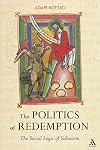
Adam Kotsko's aim is to express the answer to the Church's oldest question, Why Did God Become Human (Cur Deus Homo)?, in today's philosophical language.
He reviews the patristic and medieval attempts to understand the atonement, majoring on Irenaeus, Gregory of Nyssa, Anselm and Abelard. His review highlights the growing trend over the centuries towards a view of humanity as the individual soul and God.
Kotsko uses Bonhoeffer and Dorothee Solle, among the theologians, and Jean-Luc Nancy, show more among the philosophers, to show that a social-relationship understanding of human beings better explains the atonement.
For example, Jesus can be seen as the representative of the human race with whom God deals, and human beings together are saved in unity with Jesus. Following Solle, he also sees the Church as the representative of human beings, encouraging God not to give up on the world, but opening the gift of eternal life wider and wider.
The obstacle to redemption, the devil in patristic thought, becomes for Kotsko the political world. His thought here is reminiscent of the Powers and Principailities described by Walter Wink.
As the human race responds to the saving work of Christ, our ability to enjoy freedom (from coercion) in our relatinships becomes greater and greater.
"Politics of Redemption" lays out clearly the different ways the Church has talked about why God become human and points forward to new dimensions of the discussion.
I would recommend Kotsko's book to those who have read some theology: while its language is clear, it strides quickly through basic Christology and soteriology and may not be easily accessible to the lay-reader. show less
He reviews the patristic and medieval attempts to understand the atonement, majoring on Irenaeus, Gregory of Nyssa, Anselm and Abelard. His review highlights the growing trend over the centuries towards a view of humanity as the individual soul and God.
Kotsko uses Bonhoeffer and Dorothee Solle, among the theologians, and Jean-Luc Nancy, show more among the philosophers, to show that a social-relationship understanding of human beings better explains the atonement.
For example, Jesus can be seen as the representative of the human race with whom God deals, and human beings together are saved in unity with Jesus. Following Solle, he also sees the Church as the representative of human beings, encouraging God not to give up on the world, but opening the gift of eternal life wider and wider.
The obstacle to redemption, the devil in patristic thought, becomes for Kotsko the political world. His thought here is reminiscent of the Powers and Principailities described by Walter Wink.
As the human race responds to the saving work of Christ, our ability to enjoy freedom (from coercion) in our relatinships becomes greater and greater.
"Politics of Redemption" lays out clearly the different ways the Church has talked about why God become human and points forward to new dimensions of the discussion.
I would recommend Kotsko's book to those who have read some theology: while its language is clear, it strides quickly through basic Christology and soteriology and may not be easily accessible to the lay-reader. show less
Lists
You May Also Like


Statistics
- Works
- 14
- Also by
- 6
- Members
- 416
- Popularity
- #58,579
- Rating
- 3.8
- Reviews
- 4
- ISBNs
- 38
- Languages
- 1
- Favorited
- 1