
About the Author
Tyler Cowen is Professor of Economics at George Mason University, where he directs the Mercatus Center and the James M. Buchanan Center for Political Economy
Image credit: Mason Gazette
Works by Tyler Cowen
Discover Your Inner Economist: Use Incentives to Fall in Love, Survive Your Next Meeting, and Motivate Your Dentist (2007) 487 copies, 9 reviews
The Great Stagnation: How America Ate All the Low-Hanging Fruit of Modern History, Got Sick, and Will [Eventually] Feel Better (2011) 339 copies, 16 reviews
Average Is Over: Powering America Beyond the Age of the Great Stagnation (2013) 322 copies, 9 reviews
Stubborn Attachments: A Vision for a Society of Free, Prosperous, and Responsible Individuals (2018) 140 copies, 2 reviews
Thinking Differently: Two Brilliant Minds Discuss What It Means to Analyze Information and Produce Solutions Outside the Mainstream (2009) 13 copies
Markets and Cultural Voices: Liberty vs. Power in the Lives of Mexican Amate Painters (2005) 6 copies
The Eurozone Crisis 1 copy
Development Economics 1 copy
Associated Works
Tagged
Common Knowledge
- Canonical name
- Cowen, Tyler
- Birthdate
- 1962-01-21
- Gender
- male
- Education
- George Mason University (BS | Economics | 1983)
Harvard University (PhD | Economics | 1987) - Occupations
- Professor of Economics, George Mason University
- Organizations
- The James M. Buchanan Center for Political Economy
Mercatus Center - Nationality
- USA
- Associated Place (for map)
- USA
Members
Reviews

Poor misunderstood corporations
For whatever reason, I never expected economist Tyler Cowen to show up as a bleeding-heart apologist for Big Business. His book of that very name is a fawning, treacly adoration of corporations and extremely highly-compensated CEOs. The syrup fairly drips from the pages.
He loves to compare corporations’ behavior to individuals, with all their deficiencies (but then gives an entire chapter to how corporations are not people). His diversions include: “Just show more look at the individual lies and misrepresentations in online dating profiles,” and, “We moralize about companies instead of trying to understand them.”
Cowen:
-deals with sexual harassment at work by announcing women are better off than staying home with an abusive spouse.
-is against raising taxes from the rich: “We should not tax CEO salaries into oblivion,” he says. (Not to put too fine a point on it, Cowen considers modern CEOs to be philosophers.)
-spends a great deal of effort showing that work is better for you mentally and physically. It is a stress-reducer, and provides satisfaction. He doesn’t touch on the fact that more than 40% of jobs pay minimum wage or less, while the CEO makes an average $18.7 million, or that workers have stress just making it to the end of the month. Nor does he mention work suicides, nervous breakdowns, burn out or mental health issues.
-says online companies post so much content, that maybe we shouldn’t “be surprised that some of their take-down decisions turn out to be mistaken.”
-thinks the mainstream media are unfair in their coverage of Facebook and Google because they are competitors. (Which shows only that he has never been a journalist.)
-says Americans’ pathetic savings rate (4-5%) “reflects too little engagement with financial intermediaries, not too much.” (No, what it shows is the total lack of disposable income.)
Cowen can find a heart-warming excuse for every abusive corporate practice. His method is to name the practice without showing how damaging, penetrating or pervasive it is, and turn right back to how wonderful corporations are. This was particularly evident in the chapter on lobbyists, who he made out to be tiny, ineffective, and dismissed by their own clients. (As I write this, Donald Trump has nominated a lobbyist for Secretary of the Interior. He already has one running the EPA.)
Cowen completely ignores lobbies writing the very legislation that electeds present for passage (which is why laws are becoming identical from state to state), that they spend virtually every night in the company of lobbyists, and that lobbyists are the backbone of fundraising, either directly or by holding events for the member.
He says companies have little or no effect on state governments and that most state actions are at voters’ behest. He ignores the “right to work” legislation, anti-organizing laws, cutbacks at schools, privatizing prisons and endless other issues that allow companies to step in and take over. Lobbyists will work a state over until it passes some repressive law (or a giveaway to companies), then threaten adjoining states with loss of business if they don’t at least match it. Please don’t tell us companies don’t operate at the state level.
His rah-rah, gosh golly fandom gets cloying. In apologizing for Facebook, he says Russian fake news ads were “at the time about 0.1% of Facebook’s daily (his emphasis) advertising revenue at the time.” (So imagine the ill effects of the other 99.9% on unwary users.)
He says of Android that Google promoted it to “the most commonly used cell phone software in the entire world.” (He likes saying entire world) and “The United States has been proven to be one of the most significant financial havens in the entire world.” He never mentions that Google buys up small innovators before they can become familiar brands, helping stifle innovation. Or how many trillions have been squirreled away in secret tax havens by innocent CEOs and their innocent companies. He likes to think it’s after-tax money.
Incredibly, Cowen assumes right from the first page that the reader is anti-business, presumably because “everybody” is. This is rather ironic, as precious few people who think corporations are too big and heartless and bad will plunk for a polemic telling them corporations are wonderful, generous and misunderstood. So I don’t know who Cowen wrote this for. Maybe billionaire CEOs will hand it out as Christmas gifts.
He concludes with “The social responsibility of business is to come up with new and better conceptions of the social responsibility of business (His italics).” In other words, total, hands-off, self-regulation.
At least he’s consistent.
David Wineberg show less
For whatever reason, I never expected economist Tyler Cowen to show up as a bleeding-heart apologist for Big Business. His book of that very name is a fawning, treacly adoration of corporations and extremely highly-compensated CEOs. The syrup fairly drips from the pages.
He loves to compare corporations’ behavior to individuals, with all their deficiencies (but then gives an entire chapter to how corporations are not people). His diversions include: “Just show more look at the individual lies and misrepresentations in online dating profiles,” and, “We moralize about companies instead of trying to understand them.”
Cowen:
-deals with sexual harassment at work by announcing women are better off than staying home with an abusive spouse.
-is against raising taxes from the rich: “We should not tax CEO salaries into oblivion,” he says. (Not to put too fine a point on it, Cowen considers modern CEOs to be philosophers.)
-spends a great deal of effort showing that work is better for you mentally and physically. It is a stress-reducer, and provides satisfaction. He doesn’t touch on the fact that more than 40% of jobs pay minimum wage or less, while the CEO makes an average $18.7 million, or that workers have stress just making it to the end of the month. Nor does he mention work suicides, nervous breakdowns, burn out or mental health issues.
-says online companies post so much content, that maybe we shouldn’t “be surprised that some of their take-down decisions turn out to be mistaken.”
-thinks the mainstream media are unfair in their coverage of Facebook and Google because they are competitors. (Which shows only that he has never been a journalist.)
-says Americans’ pathetic savings rate (4-5%) “reflects too little engagement with financial intermediaries, not too much.” (No, what it shows is the total lack of disposable income.)
Cowen can find a heart-warming excuse for every abusive corporate practice. His method is to name the practice without showing how damaging, penetrating or pervasive it is, and turn right back to how wonderful corporations are. This was particularly evident in the chapter on lobbyists, who he made out to be tiny, ineffective, and dismissed by their own clients. (As I write this, Donald Trump has nominated a lobbyist for Secretary of the Interior. He already has one running the EPA.)
Cowen completely ignores lobbies writing the very legislation that electeds present for passage (which is why laws are becoming identical from state to state), that they spend virtually every night in the company of lobbyists, and that lobbyists are the backbone of fundraising, either directly or by holding events for the member.
He says companies have little or no effect on state governments and that most state actions are at voters’ behest. He ignores the “right to work” legislation, anti-organizing laws, cutbacks at schools, privatizing prisons and endless other issues that allow companies to step in and take over. Lobbyists will work a state over until it passes some repressive law (or a giveaway to companies), then threaten adjoining states with loss of business if they don’t at least match it. Please don’t tell us companies don’t operate at the state level.
His rah-rah, gosh golly fandom gets cloying. In apologizing for Facebook, he says Russian fake news ads were “at the time about 0.1% of Facebook’s daily (his emphasis) advertising revenue at the time.” (So imagine the ill effects of the other 99.9% on unwary users.)
He says of Android that Google promoted it to “the most commonly used cell phone software in the entire world.” (He likes saying entire world) and “The United States has been proven to be one of the most significant financial havens in the entire world.” He never mentions that Google buys up small innovators before they can become familiar brands, helping stifle innovation. Or how many trillions have been squirreled away in secret tax havens by innocent CEOs and their innocent companies. He likes to think it’s after-tax money.
Incredibly, Cowen assumes right from the first page that the reader is anti-business, presumably because “everybody” is. This is rather ironic, as precious few people who think corporations are too big and heartless and bad will plunk for a polemic telling them corporations are wonderful, generous and misunderstood. So I don’t know who Cowen wrote this for. Maybe billionaire CEOs will hand it out as Christmas gifts.
He concludes with “The social responsibility of business is to come up with new and better conceptions of the social responsibility of business (His italics).” In other words, total, hands-off, self-regulation.
At least he’s consistent.
David Wineberg show less
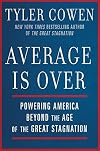
Whether you agree or disagree with him, Cowen is always worth a read. He's widely read, eclectic in taste, and although a libertarian conservative, he has an admirable willingness to at least listen to opposing points of view (he doesn't always refrain from strawmanning, but more on that later). This is his followup to his 2011 conversation-starter The Great Stagnation, and it's both a look at the trends that will drive America's emergence from our current period of economic malaise and an show more engagement with technology writers like Erik Brynjolfsson and Andrew McAfee, whose Race Against the Machine is the single greatest influence. I don't disagree with much of his basic analysis about trends in automation, but I have major problems with his analysis of the political shifts in response to those trends, as well as his attitude towards those shifts. Much of the beginning of the book can be thought of as the outlines for a sci-fi short story set in the year 2035, while the end resembles a Wall Street Journal op-ed set in that future dystopia.
Cowen's main guide for thinking through how automation will transform America's economy (and to a lesser extent, the world's), is Freestyle chess, where teams of a few humans guide one or several chess engines through games, competing against other teams of humans and computers. While the famous Deep Blue v. Kasparov match seemingly proved once and for all that computers were "superior" at chess, it turns out that the combination of human intuition and judgment, backed by the powerful number-crunching abilities of modern engines, is even better. Cowen used to be a champion chess player, so he's understandably excited about what the introduction of unprecedented analytic abilities means for the game; instead of seeing computers as a threat, he sees them as an opportunity to take the game to levels undreamed of a few decades ago. Humans and machines, working in harmony to push the chess production possibility frontier outwards.
To be uncharitable, when all you have is a chess metaphor, every problem looks like a rook. Cowen mentions several other fields where automation could be transformative. Online dating is one - I know several people who have met and married through online dating sites, and as those sites continue to crunch more numbers and improve their ability to find compatible matches, it's reasonable to think that they could someday become as indispensable to the future romantic market as things like church socials or fraternity/sorority mixers used to be. Automation can help people "solve" the problem of romance, because in the end it's still up to people to decide how far they want to use whatever suggestion the computer spits out. That computers don't necessarily do a perfect job isn't that big of a deal; after all, people have to dodge the advice of "helpful" relatives trying to get their still-single cousins hooked up all the time today. The benefits of automation sound reasonable, possibly even desirable, and it's easy to think of plenty of other areas of human activity that can be and are being transformed by Big Data. Cowen is much less radical than hardcore techno-enthusiasts like Ray Kurzweil, calling Singularity visions "religion for computer nerds", which seems fair. However, there are a number of areas where his analysis falls flat, particularly with regard to the macro implications of this trend.
It's become apparent in the past few years that the US has seen a sort of hollowing-out of employment opportunities: both low-wage and high-wage jobs are doing more or less fine, but middle-wage jobs like factory work are disappearing or stagnating. This could be for many reasons, but a corollary of the idea that automation is the main culprit behind the loss of middle-wage jobs (granting this for the sake of argument) is that the returns to the people who assist in automation by designing, maintaining, or utilizing it should be going up. This is certainly true; tech centers like Silicon Valley are some of the richest places on the planet. Some of the implications of this transformation that Cowen wants to draw seem true, for example the gender effects of what qualities will be most sought-after in new employers:
"The growing value of conscientiousness in the workplace helps women do better than men at work and in colleges and universities. At my daughter's recent college graduation ceremony the awards for the top achievers in all of the school's programs and departments went almost entirely to women, including awards in science and mathematics.
It is well known from personality psychology, and confirmed by experience, that women are on average more conscientious than men. They are more likely to follow instructions and orders with exactness and without resentment. That means better jobs and higher wages for a lot of women in this new world of work, without a comparable upgrade for a lot of the men. There is plenty of evidence that women are less interested in direct workplace competition and more likely to work well in teams and more likely to seek work in teams. You can think of men as the "higher variance" performers at work. That means some men are more likely to be the very highest earners and also to exhibit extreme dedication to the task, perhaps to the point of being monomaniacal. At the very top there will be a disproportionate share of men as CEOs, top chefs, and also chess players, among many other avocations. Other men, in greater numbers, will be more irresponsible, more likely to show up drunk, more likely to end up in prison, and more likely to become irreparably unemployable."
Indeed, in the tech industry, despite the fact that women are often less prevalent and more likely to favor different types of jobs within companies, within each job type the male-female salary gap has all but disappeared. Companies in many cases can't afford to discriminate against perfectly capable workers, and new social norms are evolving to keep up with the shift. It's certainly possible that that same situation prevails in many other fields as well. However, median wages as a whole economy-wide are nonetheless flat, and this trend began in the 1970s, long before IT was a common or even an uncommon profession. While we may perhaps be entering the "second half of the chessboard", in Brynjolfsson/McAfee's phrase for where the effects of automation are increasing quickly, Cowen is far too dismissive of political causes for widening inequality, as shown in, for example, Jacob Hacker's Winner-Take-All Politics. Completely absent is any hint that an entire literature on the sources of inequality in contemporary conservative political movements exists; to Cowen, robots are much more interesting to talk about.
This same tendency shows up in his discussion of the future of education. Cowen is a big fan of Massively Open Online Courses (and indeed runs one himself, which he admirably does not plug for here). MOOCs are cheap, flexible, profitable, and easy to measure, so he allows himself to rhapsodize about their impact while grumbling about educational bureaucracies standing in their way for all sorts of base reasons. I'm always interested in why many older people, who had the benefit of being educated in the pre-stagnation era where college was cheap, credentialization was low, and a bachelor's degree from a state college was perfectly sufficient for the majority of jobs, are actively cheering for the destruction of that kind of environment. What until very recently seemed like adequate educational systems (e.g. the three-tier California higher ed system, the University of Virginia's traditional focus, the established tenure process) seems to no longer deliver value to students, and rather than attempt to roll back some of the destructive trends of tuition inflation, the spread of parasitic administrators, or new fads in corporatizing the process of learning, people like Cowen actually want to speed them up. Cowen himself went to a public university (George Mason, where he now teaches) and seems to be none the worse for it; why exactly do we need to upend everything about universities as they've been known for decades if not centuries in favor of replacing real professors with poorly-paid adjuncts and classrooms with iPad labs? I get that automation is something that should be embraced and not blindly fought, but he's awfully eager to throw a lot of professors out of a job without a lot of thought as to the merit of opposing arguments.
There are two science fiction stories that really should have been mentioned in his ending. The first is Neal Stephenson's The Diamond Age, which directly bears on his suggestion that "Neo-Victorian social ideals" should be more prominent in the educational process (though, interestingly, the schools in that book resemble nothing so much as classical academies with the quadrivium and everything, with nary an iPad in sight). Once we've gotten used to the idea that economic change will reward high-skill individuals while not doing much for middle- or low-skill peons, what happens? Cowen thinks politics will look much more like Florida, with a critical mass of extremely reactionary old people fighting further redistribution false tooth and nail, while economically we'll resemble my native Texas, with a few bright spots of high-tech and high earners amid large swaths of bland, almost Latin American poverty. He literally advises the losers to suck it up and get used to cheap diets (let them eat beans?) and lifestyles reminiscent of the proletarian thetes in Stephenson's novel, while hilariously strawmanning liberals who want to alleviate or avoid this two-tier society:
"A lot of commentators, most of all from the progressive Left, object strenuously to rising wealth and income inequality. Even if they are correct in their moral stance, they too quickly conclude that rising inequality has to cause other bad results, such as revolution, expropriation, or a breakdown in social order. That does not follow, and I sometimes wonder if it isn't an internal psychological mechanism operating in some of these commentators, almost as if they were wishing for the wealthy to be punished for their sins."
My not-so-polite reaction to this unsourced tirade aside, it's fascinating to see an obviously bright guy try to head off his ideological opponents at the pass by resorting to cheap "some people say..." rhetorical tactics like that. He also makes the correct observation that many of the parts of the country that have been hit hardest by inequality are also the most conservative, but while the Republican Party might be able to ride its control of many of those areas to a majority of the House for a while yet, he doesn't engage with the broader demographic trends which indicate that young people are far more liberal, both socially and economically, as the traditional division goes, than the elderly, and far more receptive to measures that benefit them by decreasing inequality. Much of politics can be explained by the simple theory that old people want to hang to their nice things while not giving any nice things to younger generations - just look at cries of "Keep your government hands off my Medicare" by the exact same people fanatically opposed to Obamacare. This point of view is unengaged with, to put it mildly. Additionally, Cowen seems weirdly uninterested in broader possibilities in his analysis of the effects of inequality within the elite, not just between the elite and everyone else:
"If you think about it, we really shouldn't expect rising income and wealth inequality to lead to revolution and revolt. That is for a very simple psychological reason: Most envy is local. At least in the United States, most economic resentment is not directed toward billionaires or high-roller financiers - not even corrupt ones. It's directed at the guy down the hall who got a bigger raise. It’s directed at the husband of your wife's sister, because he earns 20 percent more than you do. It's directed at the people you went to high school with. And that's why a lot of people aren’t so bothered by income or wealth inequality at the macro level: Most of us don’t compare ourselves to billionaires."
Many of the new elite, including the majority of tech zillionaires, are famously liberal. I certainly expect rich people to be more economically conservative, ceteris paribus, than non-rich, but the kinds of people who will be the decision-makers in the future won't necessarily resemble the decision-makers of the past, and indeed might have a lot of the same resentment towards Koch brother-types that Cowen diagnoses the rest of us as having. It's far from unprecedented for the political system to ignore large swathes of the country, so it's entirely possible for big chunks of the electorate to become even more extreme at their place in a changing world (call them the Eye Tea Party?) while the rest of the political system figures out a way to move along regardless. Allow me to point out that the Mercatus Center that Cowen works at has gotten a lot of Koch brother money and leave it at that.
Speaking of decision-makers, the second sci-fi story which should have been mentioned is Isaac Asimov's The Evitable Conflict, the final story in I, Robot. In it, it's discovered that the benevolent computers which help manage the world economy have been deliberately marginalizing criticism of their work from anti-robot activists through subtle economic economic sabotage. They've circumvented the Three Laws by rationalizing that they can best help humans by continuing to stay in power, so causing small harm to a few specific humans by making their jobs redundant or causing them to be reassigned is an acceptable bending of the rules. The affected individuals get tolerable replacement jobs, and humanity continues to enjoy the benefit of the robots, so it's win-win,really. Since this isn't a book about AI, the idea that automation on its own could impact human quality of life in that way isn't really relevant; the most likely consequence of this hyper-automation trend is simply that the people who run the world economy will have such specialized and arcane knowledge that they'll effectively be beyond criticism or reproof from voters. Also speaking of voting, Cowen does mention another Asimov story:
"We will start to see just how well some of these machines can predict our behavior. One of Isaac Asimov's most profound works is his neglected short story Franchise. In this tale democratic elections have become nearly obsolete. Intelligent machines absorb most of the current information about economic and political conditions and estimate which candidate is going to win. (In fact a small number of variables, such as the change in GDP, the unemployment rate, the inflation rate, and the presence of a major war, predict presidential elections pretty well.) In the story, however, the machines can't quite do the job on their own, as there are some ineffable social influences the machines cannot measure and evaluate. The American government thus picks out one "typical" person from the electorate and asks him or her some questions about moods. The answers, combined with the initial computer diagnosis, suffice to settle the election. No one needs to actually vote."
It goes without saying that Asimov did not necessarily intend the story to be utopian, and that one need not accept Cowen's prognostications of what automation will do to our ability to have a political system that resists the Gilded Age/Latin American-style dysfunction he envisions. This book contains a lot of thought-provoking insight about some areas where the IT revolution could have a profound impact, particularly for people who already work in Big Data-ish fields; however I can't recommend his political conclusions at all. show less
Cowen's main guide for thinking through how automation will transform America's economy (and to a lesser extent, the world's), is Freestyle chess, where teams of a few humans guide one or several chess engines through games, competing against other teams of humans and computers. While the famous Deep Blue v. Kasparov match seemingly proved once and for all that computers were "superior" at chess, it turns out that the combination of human intuition and judgment, backed by the powerful number-crunching abilities of modern engines, is even better. Cowen used to be a champion chess player, so he's understandably excited about what the introduction of unprecedented analytic abilities means for the game; instead of seeing computers as a threat, he sees them as an opportunity to take the game to levels undreamed of a few decades ago. Humans and machines, working in harmony to push the chess production possibility frontier outwards.
To be uncharitable, when all you have is a chess metaphor, every problem looks like a rook. Cowen mentions several other fields where automation could be transformative. Online dating is one - I know several people who have met and married through online dating sites, and as those sites continue to crunch more numbers and improve their ability to find compatible matches, it's reasonable to think that they could someday become as indispensable to the future romantic market as things like church socials or fraternity/sorority mixers used to be. Automation can help people "solve" the problem of romance, because in the end it's still up to people to decide how far they want to use whatever suggestion the computer spits out. That computers don't necessarily do a perfect job isn't that big of a deal; after all, people have to dodge the advice of "helpful" relatives trying to get their still-single cousins hooked up all the time today. The benefits of automation sound reasonable, possibly even desirable, and it's easy to think of plenty of other areas of human activity that can be and are being transformed by Big Data. Cowen is much less radical than hardcore techno-enthusiasts like Ray Kurzweil, calling Singularity visions "religion for computer nerds", which seems fair. However, there are a number of areas where his analysis falls flat, particularly with regard to the macro implications of this trend.
It's become apparent in the past few years that the US has seen a sort of hollowing-out of employment opportunities: both low-wage and high-wage jobs are doing more or less fine, but middle-wage jobs like factory work are disappearing or stagnating. This could be for many reasons, but a corollary of the idea that automation is the main culprit behind the loss of middle-wage jobs (granting this for the sake of argument) is that the returns to the people who assist in automation by designing, maintaining, or utilizing it should be going up. This is certainly true; tech centers like Silicon Valley are some of the richest places on the planet. Some of the implications of this transformation that Cowen wants to draw seem true, for example the gender effects of what qualities will be most sought-after in new employers:
"The growing value of conscientiousness in the workplace helps women do better than men at work and in colleges and universities. At my daughter's recent college graduation ceremony the awards for the top achievers in all of the school's programs and departments went almost entirely to women, including awards in science and mathematics.
It is well known from personality psychology, and confirmed by experience, that women are on average more conscientious than men. They are more likely to follow instructions and orders with exactness and without resentment. That means better jobs and higher wages for a lot of women in this new world of work, without a comparable upgrade for a lot of the men. There is plenty of evidence that women are less interested in direct workplace competition and more likely to work well in teams and more likely to seek work in teams. You can think of men as the "higher variance" performers at work. That means some men are more likely to be the very highest earners and also to exhibit extreme dedication to the task, perhaps to the point of being monomaniacal. At the very top there will be a disproportionate share of men as CEOs, top chefs, and also chess players, among many other avocations. Other men, in greater numbers, will be more irresponsible, more likely to show up drunk, more likely to end up in prison, and more likely to become irreparably unemployable."
Indeed, in the tech industry, despite the fact that women are often less prevalent and more likely to favor different types of jobs within companies, within each job type the male-female salary gap has all but disappeared. Companies in many cases can't afford to discriminate against perfectly capable workers, and new social norms are evolving to keep up with the shift. It's certainly possible that that same situation prevails in many other fields as well. However, median wages as a whole economy-wide are nonetheless flat, and this trend began in the 1970s, long before IT was a common or even an uncommon profession. While we may perhaps be entering the "second half of the chessboard", in Brynjolfsson/McAfee's phrase for where the effects of automation are increasing quickly, Cowen is far too dismissive of political causes for widening inequality, as shown in, for example, Jacob Hacker's Winner-Take-All Politics. Completely absent is any hint that an entire literature on the sources of inequality in contemporary conservative political movements exists; to Cowen, robots are much more interesting to talk about.
This same tendency shows up in his discussion of the future of education. Cowen is a big fan of Massively Open Online Courses (and indeed runs one himself, which he admirably does not plug for here). MOOCs are cheap, flexible, profitable, and easy to measure, so he allows himself to rhapsodize about their impact while grumbling about educational bureaucracies standing in their way for all sorts of base reasons. I'm always interested in why many older people, who had the benefit of being educated in the pre-stagnation era where college was cheap, credentialization was low, and a bachelor's degree from a state college was perfectly sufficient for the majority of jobs, are actively cheering for the destruction of that kind of environment. What until very recently seemed like adequate educational systems (e.g. the three-tier California higher ed system, the University of Virginia's traditional focus, the established tenure process) seems to no longer deliver value to students, and rather than attempt to roll back some of the destructive trends of tuition inflation, the spread of parasitic administrators, or new fads in corporatizing the process of learning, people like Cowen actually want to speed them up. Cowen himself went to a public university (George Mason, where he now teaches) and seems to be none the worse for it; why exactly do we need to upend everything about universities as they've been known for decades if not centuries in favor of replacing real professors with poorly-paid adjuncts and classrooms with iPad labs? I get that automation is something that should be embraced and not blindly fought, but he's awfully eager to throw a lot of professors out of a job without a lot of thought as to the merit of opposing arguments.
There are two science fiction stories that really should have been mentioned in his ending. The first is Neal Stephenson's The Diamond Age, which directly bears on his suggestion that "Neo-Victorian social ideals" should be more prominent in the educational process (though, interestingly, the schools in that book resemble nothing so much as classical academies with the quadrivium and everything, with nary an iPad in sight). Once we've gotten used to the idea that economic change will reward high-skill individuals while not doing much for middle- or low-skill peons, what happens? Cowen thinks politics will look much more like Florida, with a critical mass of extremely reactionary old people fighting further redistribution false tooth and nail, while economically we'll resemble my native Texas, with a few bright spots of high-tech and high earners amid large swaths of bland, almost Latin American poverty. He literally advises the losers to suck it up and get used to cheap diets (let them eat beans?) and lifestyles reminiscent of the proletarian thetes in Stephenson's novel, while hilariously strawmanning liberals who want to alleviate or avoid this two-tier society:
"A lot of commentators, most of all from the progressive Left, object strenuously to rising wealth and income inequality. Even if they are correct in their moral stance, they too quickly conclude that rising inequality has to cause other bad results, such as revolution, expropriation, or a breakdown in social order. That does not follow, and I sometimes wonder if it isn't an internal psychological mechanism operating in some of these commentators, almost as if they were wishing for the wealthy to be punished for their sins."
My not-so-polite reaction to this unsourced tirade aside, it's fascinating to see an obviously bright guy try to head off his ideological opponents at the pass by resorting to cheap "some people say..." rhetorical tactics like that. He also makes the correct observation that many of the parts of the country that have been hit hardest by inequality are also the most conservative, but while the Republican Party might be able to ride its control of many of those areas to a majority of the House for a while yet, he doesn't engage with the broader demographic trends which indicate that young people are far more liberal, both socially and economically, as the traditional division goes, than the elderly, and far more receptive to measures that benefit them by decreasing inequality. Much of politics can be explained by the simple theory that old people want to hang to their nice things while not giving any nice things to younger generations - just look at cries of "Keep your government hands off my Medicare" by the exact same people fanatically opposed to Obamacare. This point of view is unengaged with, to put it mildly. Additionally, Cowen seems weirdly uninterested in broader possibilities in his analysis of the effects of inequality within the elite, not just between the elite and everyone else:
"If you think about it, we really shouldn't expect rising income and wealth inequality to lead to revolution and revolt. That is for a very simple psychological reason: Most envy is local. At least in the United States, most economic resentment is not directed toward billionaires or high-roller financiers - not even corrupt ones. It's directed at the guy down the hall who got a bigger raise. It’s directed at the husband of your wife's sister, because he earns 20 percent more than you do. It's directed at the people you went to high school with. And that's why a lot of people aren’t so bothered by income or wealth inequality at the macro level: Most of us don’t compare ourselves to billionaires."
Many of the new elite, including the majority of tech zillionaires, are famously liberal. I certainly expect rich people to be more economically conservative, ceteris paribus, than non-rich, but the kinds of people who will be the decision-makers in the future won't necessarily resemble the decision-makers of the past, and indeed might have a lot of the same resentment towards Koch brother-types that Cowen diagnoses the rest of us as having. It's far from unprecedented for the political system to ignore large swathes of the country, so it's entirely possible for big chunks of the electorate to become even more extreme at their place in a changing world (call them the Eye Tea Party?) while the rest of the political system figures out a way to move along regardless. Allow me to point out that the Mercatus Center that Cowen works at has gotten a lot of Koch brother money and leave it at that.
Speaking of decision-makers, the second sci-fi story which should have been mentioned is Isaac Asimov's The Evitable Conflict, the final story in I, Robot. In it, it's discovered that the benevolent computers which help manage the world economy have been deliberately marginalizing criticism of their work from anti-robot activists through subtle economic economic sabotage. They've circumvented the Three Laws by rationalizing that they can best help humans by continuing to stay in power, so causing small harm to a few specific humans by making their jobs redundant or causing them to be reassigned is an acceptable bending of the rules. The affected individuals get tolerable replacement jobs, and humanity continues to enjoy the benefit of the robots, so it's win-win,really. Since this isn't a book about AI, the idea that automation on its own could impact human quality of life in that way isn't really relevant; the most likely consequence of this hyper-automation trend is simply that the people who run the world economy will have such specialized and arcane knowledge that they'll effectively be beyond criticism or reproof from voters. Also speaking of voting, Cowen does mention another Asimov story:
"We will start to see just how well some of these machines can predict our behavior. One of Isaac Asimov's most profound works is his neglected short story Franchise. In this tale democratic elections have become nearly obsolete. Intelligent machines absorb most of the current information about economic and political conditions and estimate which candidate is going to win. (In fact a small number of variables, such as the change in GDP, the unemployment rate, the inflation rate, and the presence of a major war, predict presidential elections pretty well.) In the story, however, the machines can't quite do the job on their own, as there are some ineffable social influences the machines cannot measure and evaluate. The American government thus picks out one "typical" person from the electorate and asks him or her some questions about moods. The answers, combined with the initial computer diagnosis, suffice to settle the election. No one needs to actually vote."
It goes without saying that Asimov did not necessarily intend the story to be utopian, and that one need not accept Cowen's prognostications of what automation will do to our ability to have a political system that resists the Gilded Age/Latin American-style dysfunction he envisions. This book contains a lot of thought-provoking insight about some areas where the IT revolution could have a profound impact, particularly for people who already work in Big Data-ish fields; however I can't recommend his political conclusions at all. show less
The Great Stagnation: How America Ate All The Low-Hanging Fruit of Modern History, Got Sick, and Will (Eventually) Feel Better: A Penguin eSpecial from Dutton by Tyler Cowen
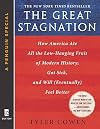
Very rarely do I read an essay where I agree so strongly with the overall premise, yet disagree so strongly with so many of the supporting arguments. Cowen is a fairly libertarian economist best-known for his blog, but even though I'm much more liberal than he is I still keep up with him just because he's one of the more intellectually ecumenical economists out there, and one of the few who seems truly comfortable with the rapidly changing technological landscape we live in (indeed, this show more extended essay is being published Kindle-only - try to imagine John Nash or Joe Stiglitz doing that!) There's a lot packed in this short work, and I feel bad oversimplifying, but the basic premise is that America has reached a point where the steady year-after-year increase in living standards that we've become accustomed to is obsolete - in other words, the second derivative of GDP might be getting close to zero or even negative from here on out. Looking at the past decade you'll find a great deal to support his thesis: skyrocketing tuition costs and medical expenses, literally no net gain in jobs since the end of the Clinton administration, the worst decade ever for the Dow, soaring inequality, important societal institutions increasingly devoted to bubble-chasing... it's tough to argue with that stuff.
Last year I read a really interesting book by Joseph Tainter called the Collapse of Complex Societies whose basic argument was that societies are problem-solving systems, and eventually a society will get too complex (read: use too many resources) to be sustainable, and eventually collapse. The marginal benefit of adding more problem-solvers decreases over time and eventually turns negative, and society has no choice but to keep growing ever-faster or simply disintegrate a la the Romans or the Mayans. While very abstract, and seemingly refuted by most of American history, I think the overall argument fits neatly with the very recent story Cowen presents here, of a country which has run out of low-hanging fruit to pluck (not only has the rate of innovation slowed, new innovations are simply harder to get to) and must now work harder just to stay full, let alone collect a surplus. I do disagree with many of the specific examples he picks, though: the Affordable Care Act was not that large relative to total health spending, and even if it was a big marginal cost for the health care system, which it wasn't, surely it was a large marginal gain for the people affected?
Additionally, during his discussion of how the Internet creates a lot of consumer surplus without necessarily creating wealth, when I read that Facebook or Twitter is worth billions without actually employing many people or directly adding much value to the economy, I don't think "wow, the economy has certainly changed", I think "man, this reminds me of the dotcom bubble". It's perfectly possible for new businesses to replace old ones without employing many people (in fact, performing the same service for a lower cost is almost the definition of progress), but something about social media companies in particular makes it seem unlikely that they're the foundation of a new, more prosperous future. I also think his dismissal of Paul Krugman's calls for a revival of New Deal institutions (see Krugman's excellent The Conscience of a Liberal) are taking Mancur Olson's warnings about special interests a bit too far and relying too much on Brink Lindsey's flawed defenses of skill-biased technological change as the main driver of inequality. His jabs at the Recovery Act are too flip and not supported by data, marring an otherwise great section on the financial crisis and its aftermath. However, the final chapter on how to approach potential solutions to this slowdown challenge is great, if somewhat devoid of specifics, and ultimately, like I said, many of my disagreements could be worked into the book without altering his overall point. Rarely do you see a work so small with so many big ideas in it. show less
Last year I read a really interesting book by Joseph Tainter called the Collapse of Complex Societies whose basic argument was that societies are problem-solving systems, and eventually a society will get too complex (read: use too many resources) to be sustainable, and eventually collapse. The marginal benefit of adding more problem-solvers decreases over time and eventually turns negative, and society has no choice but to keep growing ever-faster or simply disintegrate a la the Romans or the Mayans. While very abstract, and seemingly refuted by most of American history, I think the overall argument fits neatly with the very recent story Cowen presents here, of a country which has run out of low-hanging fruit to pluck (not only has the rate of innovation slowed, new innovations are simply harder to get to) and must now work harder just to stay full, let alone collect a surplus. I do disagree with many of the specific examples he picks, though: the Affordable Care Act was not that large relative to total health spending, and even if it was a big marginal cost for the health care system, which it wasn't, surely it was a large marginal gain for the people affected?
Additionally, during his discussion of how the Internet creates a lot of consumer surplus without necessarily creating wealth, when I read that Facebook or Twitter is worth billions without actually employing many people or directly adding much value to the economy, I don't think "wow, the economy has certainly changed", I think "man, this reminds me of the dotcom bubble". It's perfectly possible for new businesses to replace old ones without employing many people (in fact, performing the same service for a lower cost is almost the definition of progress), but something about social media companies in particular makes it seem unlikely that they're the foundation of a new, more prosperous future. I also think his dismissal of Paul Krugman's calls for a revival of New Deal institutions (see Krugman's excellent The Conscience of a Liberal) are taking Mancur Olson's warnings about special interests a bit too far and relying too much on Brink Lindsey's flawed defenses of skill-biased technological change as the main driver of inequality. His jabs at the Recovery Act are too flip and not supported by data, marring an otherwise great section on the financial crisis and its aftermath. However, the final chapter on how to approach potential solutions to this slowdown challenge is great, if somewhat devoid of specifics, and ultimately, like I said, many of my disagreements could be worked into the book without altering his overall point. Rarely do you see a work so small with so many big ideas in it. show less
The Great Stagnation: How America Ate All The Low-Hanging Fruit of Modern History, Got Sick, and Will (Eventually) Feel Better: A Penguin eSpecial from Dutton by Tyler Cowen
If you have time to read only 70 odd-pages today and yet you want to understand what lies at the root of the seemingly endless (and often frustrating) debate of re-distributionists vs fiscal conservatives in United States, you must read this lucid book written in the kind of accessible language that Tyler Cowen prefers on his marvelous blog 'Marginal Revolution' (which I must admit I have followed for years). Tyler, one the sharpest heterodox thinkers of our times postulates that the United show more States has entered a period of 'Great Stagnation' since the 1970s, wherein despite superficial and marginal improvements in living standards, wide-ranging availability of free/cheap online pleasure and accessibility to information on the internet- technological progress has largely plateaued because the national economy has already picked the 'low hanging fruits' to their fullest, and as a consequence median incomes remain stagnant. He further clarifies that the fiscal-stimulus driven minimal growth that has accompanied the post-financial crisis recovery has also largely been 'jobless' and the country is looking toward a future where the most dynamic sectors of its economy are employing historically minuscule numbers of people (i.e digital companies) while at the same time the sectors of the US economy where government spending is increasing the most are displaying worse-than expected levels of productivity/ return on investment. If any of you follow Eric Weinstein's Portal you would know that what Tyler is essentially articulating in this book is what Weinstein calls the EGO (Embedded Growth Obligations) of institutions that were designed and premised to function in a world where growth is endless, and so is technological progress. Every line of this book is a cold hard wake-up call for an obsolete gamut of politics that surrounds the kind of wishful thinking surrounding 'economic growth'. show less
Lists
Awards


You May Also Like


Associated Authors
Statistics
- Works
- 35
- Also by
- 1
- Members
- 2,624
- Popularity
- #9,783
- Rating
- 3.4
- Reviews
- 51
- ISBNs
- 130
- Languages
- 6
- Favorited
- 1