
Lawrence Freedman
Author of Strategy: A History
About the Author
Lawrence Freedman is an emeritus professor of war studies at King's College London. He is the author of Strategy, a Financial Times Best Book of 2013, and A Choice of Enemies, winner of the 2009 Lionel Gelber Prize.
Series
Works by Lawrence Freedman
The Official History of the Falklands Campaign, Volume 2: War and Diplomacy (Government Official History Series) (2005) 40 copies, 1 review
The Official History of the Falklands Campaign, Volume 1: The Origins of the Falklands War (Government Official History Series) (2005) 35 copies, 1 review
Associated Works
Makers of Modern Strategy from Machiavelli to the Nuclear Age (1986) — Contributor — 775 copies, 4 reviews
Tagged
Common Knowledge
- Canonical name
- Freedman, Lawrence
- Legal name
- Freedman, Lawrence David
- Birthdate
- 1948-12-07
- Gender
- male
- Education
- Victoria University of Manchester
University of York
University of Oxford (Nuffield College)
Whitley Bay Grammar School - Occupations
- Emeritus Professor of War Studies
- Organizations
- King's College London
- Awards and honors
- Order of the British Empire (Commander, 1996)
Order of St Michael and St George (Knight Commander, 2003)
Privy Councillor
British Academy (Fellow) - Relationships
- Freedman, Judith (wife)
- Nationality
- UK
- Associated Place (for map)
- UK
Members
Reviews
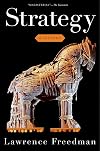
“The Economist” magazine referred to Lawrence Freedman’s book, “Strategy,” as ‘magisterial’ and, for once, I agree with something the publication wrote.
This book is heavy, not for the faint-hearted, and I recommend only a chapter a day if you wish to digest the material. Unlike many authors who do not justify their Western focus, Sir Lawrence started by explaining his rationale for focusing on Western literature: his choice made his job easy.
This book’s scope is show more mind-boggling. He starts in the distant past, when humans began organizing themselves into tribes and when strategy first evolved to win wars and battles. During this evolution, the strategy became a catch-all phrase for achieving any aim, with applications in politics, religion, business, and social movements.
The book has a few central themes. First, that strategy is not a plan, and I concur after having interacted with many ‘strategic planners’ in corporations. Strategy is a way of dealing with conflict and uncertainty.
Second, politics is always integral to strategy, and you cannot always separate means from ends. Obviously, this applies to war as well, as Clausewitz said: politics by other means.
Three, strategy is about power creation and thus goes much beyond the scope of war. What happens after the war? You attempt to seize and hold power.
The myth of the master strategist is just that: a myth. No single person, strategic planner, or leader can control events; it is about how a team perceives events and forces, and how it copes with them to achieve its objectives.
The section on storytelling and narrative is fascinating. Storytelling is not a strategy, but it can sell a strategic objective to people and get them to rally around the flag.
I also found the section on corporate strategy intriguing, especially as the ‘gurus’ do not actually shed light but use narrative, the stage, and their personalities to market poorly conceived and poorly researched ideas and concepts–Taylor, Friedman, Prahlad, etc.
There are sections when you wonder if the connection to strategy is tenuous but, a re-reading of this book will always be helpful. show less
This book is heavy, not for the faint-hearted, and I recommend only a chapter a day if you wish to digest the material. Unlike many authors who do not justify their Western focus, Sir Lawrence started by explaining his rationale for focusing on Western literature: his choice made his job easy.
This book’s scope is show more mind-boggling. He starts in the distant past, when humans began organizing themselves into tribes and when strategy first evolved to win wars and battles. During this evolution, the strategy became a catch-all phrase for achieving any aim, with applications in politics, religion, business, and social movements.
The book has a few central themes. First, that strategy is not a plan, and I concur after having interacted with many ‘strategic planners’ in corporations. Strategy is a way of dealing with conflict and uncertainty.
Second, politics is always integral to strategy, and you cannot always separate means from ends. Obviously, this applies to war as well, as Clausewitz said: politics by other means.
Three, strategy is about power creation and thus goes much beyond the scope of war. What happens after the war? You attempt to seize and hold power.
The myth of the master strategist is just that: a myth. No single person, strategic planner, or leader can control events; it is about how a team perceives events and forces, and how it copes with them to achieve its objectives.
The section on storytelling and narrative is fascinating. Storytelling is not a strategy, but it can sell a strategic objective to people and get them to rally around the flag.
I also found the section on corporate strategy intriguing, especially as the ‘gurus’ do not actually shed light but use narrative, the stage, and their personalities to market poorly conceived and poorly researched ideas and concepts–Taylor, Friedman, Prahlad, etc.
There are sections when you wonder if the connection to strategy is tenuous but, a re-reading of this book will always be helpful. show less
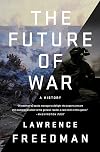
The Future of War is a magisterial synthesis of conflict studies by one of the field's leading practitioners. I'll admit I was half hoping for a review of weird military futurism, but this is a serious study of how people have thought about war, from Victorian invasion literature such as The Battle of Dorking through the 2017 US Department of Defense Quadrennial Review.
It's a good question. Why don't we have baby assault tanks?
Freedman identifies three major periods in conflict studies. The show more first is that of traditional industrial warfare. German victories against Austria and France in the 19th century demonstrated the potential of the strategic surprise offensive to rapidly achieve political ends. A county that was unprepared or slow to mobilize could find its army destroyed as it gathered and its capitol occupied. The cult of the offensive lead to the slaughter of the First World War, and the fearful reaction that future wars would be slow, bloody, and exhausting. Airpower, fortification lines, and blitzkrieg were reactions to the First World War, which proved in the Second World War that in total war there were no limits, that the entire population was a valid military objective. Nuclear weapons provided the ultimate example of the cult of the offensive by finally offering the ability to completely annihilate an enemy in a matter of minutes, at the expense of poisoning the planet and potentially inviting an omnicidal retaliation.
Mutually assured destruction was one keystone of the lack of superpower conflict after World War 2. The other, in Freedman's estimation, was a strong respect for the norm of national sovereignty. With some significant asterisks, like countries that had been partitioned in the wake of the Second World War, or minor countries without allies who found themselves on the wrong side of a superpower like Afghanistan or Panama, war was not seen as a practical matter of achieving political ends.
This international consensus shifted in the wake of the collapse of the Soviet Union, and bloody civil wars in Africa and the Balkans. Perhaps national sovereignty had to be balanced against human rights, and the international community had a duty to prevent civil wars from escalating. Freedman is skeptical of humanitarian interventions. While they may save lives, there is a little clarity about why civil wars start or end, and these conflicts can become frozen without any chance of political resolution.
9/11 and the War on Terror provided a third shift, as the United States embarked on a globe spanning war not against nations, but against shifting groups of terrorists. As an aside, I enjoyed the back to back chapters "From Counter-Insurgency to Counter-Terrorism" and "From Counter-Terrorism to Counter-Insurgency" describing the failures of the 2003 invasion of Iraq and the subsequent surge. It seems that war will continue to be a feature of the human experience, even as the frequency and intensity of conflicts on many measures has declined.
Since this book came out in 2017, it can't cover the lurching uncertainty of Trump's Actual Madman Presidency, China's increased naval aggressiveness, or the major conflicts such as the Russian invasion of Ukraine and the drone heavy Second Nagorno-Karabakh War between Armenia and Azerbaijan. Overall, this is a masterful synthesis of a complex topic, and well worth the read. show less
It's a good question. Why don't we have baby assault tanks?
Freedman identifies three major periods in conflict studies. The show more first is that of traditional industrial warfare. German victories against Austria and France in the 19th century demonstrated the potential of the strategic surprise offensive to rapidly achieve political ends. A county that was unprepared or slow to mobilize could find its army destroyed as it gathered and its capitol occupied. The cult of the offensive lead to the slaughter of the First World War, and the fearful reaction that future wars would be slow, bloody, and exhausting. Airpower, fortification lines, and blitzkrieg were reactions to the First World War, which proved in the Second World War that in total war there were no limits, that the entire population was a valid military objective. Nuclear weapons provided the ultimate example of the cult of the offensive by finally offering the ability to completely annihilate an enemy in a matter of minutes, at the expense of poisoning the planet and potentially inviting an omnicidal retaliation.
Mutually assured destruction was one keystone of the lack of superpower conflict after World War 2. The other, in Freedman's estimation, was a strong respect for the norm of national sovereignty. With some significant asterisks, like countries that had been partitioned in the wake of the Second World War, or minor countries without allies who found themselves on the wrong side of a superpower like Afghanistan or Panama, war was not seen as a practical matter of achieving political ends.
This international consensus shifted in the wake of the collapse of the Soviet Union, and bloody civil wars in Africa and the Balkans. Perhaps national sovereignty had to be balanced against human rights, and the international community had a duty to prevent civil wars from escalating. Freedman is skeptical of humanitarian interventions. While they may save lives, there is a little clarity about why civil wars start or end, and these conflicts can become frozen without any chance of political resolution.
9/11 and the War on Terror provided a third shift, as the United States embarked on a globe spanning war not against nations, but against shifting groups of terrorists. As an aside, I enjoyed the back to back chapters "From Counter-Insurgency to Counter-Terrorism" and "From Counter-Terrorism to Counter-Insurgency" describing the failures of the 2003 invasion of Iraq and the subsequent surge. It seems that war will continue to be a feature of the human experience, even as the frequency and intensity of conflicts on many measures has declined.
Since this book came out in 2017, it can't cover the lurching uncertainty of Trump's Actual Madman Presidency, China's increased naval aggressiveness, or the major conflicts such as the Russian invasion of Ukraine and the drone heavy Second Nagorno-Karabakh War between Armenia and Azerbaijan. Overall, this is a masterful synthesis of a complex topic, and well worth the read. show less
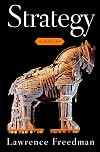
This is a wise and highly intelligent, if very long, attempt to come to grips with the slippery term 'strategy' by a prominent British academic distilling at least two decades of thinking on the subject.
Although a Professor of War Studies, Freedman does not restrict himself to the conduct of war but reviews revolutionary and dissident stategy on the one hand and business strategy on the other.
He is highly critical of some of the nonsense (he is too kind to call it that) from business gurus show more and I can only be pleased that I smelled the rat throughout the 1980s and 1990s and read few of them.
Where he gets to is a sceptical view of what we can possibly know about our own futures or control them.
He outlines, in the final section, the role of narratives and scripts in giving us the illusion of control.
This is not a counsel of despair. There is no fatalism in Freedman's approach but he does suggest that 'real life' requires a degree of detachment from scripts and narratives while making use of them as tools.
Educated readers will probably not be surprised by the general thrust of the section on war where there is a sort of master in Clausewitz (and the influence of Jomini) but it will bring you up to date.
As we write, a rather odd crisis between the 'West' (whatever that is) and Russia, after some egregious blundering by the European Union, has allowed all sorts of absurd 'narratives' free rein.
Trying to rein in historic stories about fascism and appeasement as well as more recent tales of humanitarian intervention and self determination has been part of the problem for intelligent diplomats.
The Ukraine remains unresolved as we write but the undoubted strategic skills of Putin and Lavrov on the one hand and Obama and Kerry might be enhanced by having this text at their sides.
The second section on the strategic attempts to overturn elites and systems gives due weight to the role of Marxism but is perhaps too easily seduced into a highly US-centred picture of political struggle.
This provides us with one of the few 'strategic' criticisms of the book - the elephant in the room that Freedman assiduously dances around: the State.
Military strategy is the expression of the force of the State, revolutionary strategies seek to overturn or capture the State and business strategies compete with the State ... but what of the State?
The State, emergent out of warlordism and dynasticism (or small trading communities), is the thing that should interest us most because we are most stuck inside its narratives and scripts.
Perhaps it was simply a matter of space (the book is over 600 pages long) but one senses sometimes that the broader academic community is always nervous of telling us the truth about what feeds it.
But this may be unfair. The book is mostly easy reading (though the idiocies of academic social scientists often cause one to lose patience) and the assessments are honest and fair to all parties.
Indeed, it is good to find a book that both gives due to the troubled struggle by educated revolutionaries to speak for the masses and to the games businessmen play to try to control what cannot be controlled.
A book which treats Rockefeller of Standard Oil and Karl Marx fairly, let alone Tom Hayden, has a lot going for it though maybe Freedman should throw up his hands at Sun Tzu as perpetual strategic cliche.
Will this book make you a better 'strategist'? Well, it will do a service if it makes you sceptical about books that claim to offer that particular pot of gold.
Strategists are probably born rather than made but many of the skills can be learned - or rather 'bad' unstrategic narratives might be unlearned and 'scripts' recognised.
His story of continuous failures to 'get it right' becomes a bit cheerier when rationalist progressives begin to be challenged by the behaviourial economists.
Though I remain unconvinced by this particular discipline - and consider political science to be an utterly absurd concept - cognitive psychology has helped us here.
Increasingly, we are beginning to stop whining that we are not 'rational' (or rather autistic academics are) and beginning to see our mentalities as extremely good survival machines for uncertainty.
Freedman is persuasive that we have a sort of double action mind where intuition and 'art' working in real time gets things right most of the time under most conditions (his System 1 strategic thinking).
Habit and narratives and scripts can get in our way in a crisis and the reasoning abilities of his System 2 thinking enable us analytically and critically correct our own biases and errors.
However, we can only do this in real time, constantly adjusting to realities that are, in themselves, way beyond any form of reasonable long term analysis because of so many variables and unknowns.
Perhaps the thinking started with John Boyd's simple but productive concept of OODA (observation, orientation, decision, action) but Freedman here develops a more interesting model of struggle.
In essence, the only strategy is the intuitive positioning of oneself to win each battle as it comes within a general vision of where one wants to be - and this is not a matter for mathematicians. show less
Although a Professor of War Studies, Freedman does not restrict himself to the conduct of war but reviews revolutionary and dissident stategy on the one hand and business strategy on the other.
He is highly critical of some of the nonsense (he is too kind to call it that) from business gurus show more and I can only be pleased that I smelled the rat throughout the 1980s and 1990s and read few of them.
Where he gets to is a sceptical view of what we can possibly know about our own futures or control them.
He outlines, in the final section, the role of narratives and scripts in giving us the illusion of control.
This is not a counsel of despair. There is no fatalism in Freedman's approach but he does suggest that 'real life' requires a degree of detachment from scripts and narratives while making use of them as tools.
Educated readers will probably not be surprised by the general thrust of the section on war where there is a sort of master in Clausewitz (and the influence of Jomini) but it will bring you up to date.
As we write, a rather odd crisis between the 'West' (whatever that is) and Russia, after some egregious blundering by the European Union, has allowed all sorts of absurd 'narratives' free rein.
Trying to rein in historic stories about fascism and appeasement as well as more recent tales of humanitarian intervention and self determination has been part of the problem for intelligent diplomats.
The Ukraine remains unresolved as we write but the undoubted strategic skills of Putin and Lavrov on the one hand and Obama and Kerry might be enhanced by having this text at their sides.
The second section on the strategic attempts to overturn elites and systems gives due weight to the role of Marxism but is perhaps too easily seduced into a highly US-centred picture of political struggle.
This provides us with one of the few 'strategic' criticisms of the book - the elephant in the room that Freedman assiduously dances around: the State.
Military strategy is the expression of the force of the State, revolutionary strategies seek to overturn or capture the State and business strategies compete with the State ... but what of the State?
The State, emergent out of warlordism and dynasticism (or small trading communities), is the thing that should interest us most because we are most stuck inside its narratives and scripts.
Perhaps it was simply a matter of space (the book is over 600 pages long) but one senses sometimes that the broader academic community is always nervous of telling us the truth about what feeds it.
But this may be unfair. The book is mostly easy reading (though the idiocies of academic social scientists often cause one to lose patience) and the assessments are honest and fair to all parties.
Indeed, it is good to find a book that both gives due to the troubled struggle by educated revolutionaries to speak for the masses and to the games businessmen play to try to control what cannot be controlled.
A book which treats Rockefeller of Standard Oil and Karl Marx fairly, let alone Tom Hayden, has a lot going for it though maybe Freedman should throw up his hands at Sun Tzu as perpetual strategic cliche.
Will this book make you a better 'strategist'? Well, it will do a service if it makes you sceptical about books that claim to offer that particular pot of gold.
Strategists are probably born rather than made but many of the skills can be learned - or rather 'bad' unstrategic narratives might be unlearned and 'scripts' recognised.
His story of continuous failures to 'get it right' becomes a bit cheerier when rationalist progressives begin to be challenged by the behaviourial economists.
Though I remain unconvinced by this particular discipline - and consider political science to be an utterly absurd concept - cognitive psychology has helped us here.
Increasingly, we are beginning to stop whining that we are not 'rational' (or rather autistic academics are) and beginning to see our mentalities as extremely good survival machines for uncertainty.
Freedman is persuasive that we have a sort of double action mind where intuition and 'art' working in real time gets things right most of the time under most conditions (his System 1 strategic thinking).
Habit and narratives and scripts can get in our way in a crisis and the reasoning abilities of his System 2 thinking enable us analytically and critically correct our own biases and errors.
However, we can only do this in real time, constantly adjusting to realities that are, in themselves, way beyond any form of reasonable long term analysis because of so many variables and unknowns.
Perhaps the thinking started with John Boyd's simple but productive concept of OODA (observation, orientation, decision, action) but Freedman here develops a more interesting model of struggle.
In essence, the only strategy is the intuitive positioning of oneself to win each battle as it comes within a general vision of where one wants to be - and this is not a matter for mathematicians. show less
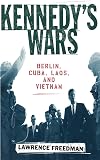
Kennedy's Wars: Berlin, Cuba, Laos, and Vietnam by Lawrence Freedman
JFK was assassinated six years before I was born. I have been fascinated by JFK since I don't know when. One of my interests in JFK was his foreign policy agenda. Kennedy came to power at the height of the Cold War when nuclear armageddon seemed imminent. Freedman tells a story of how JFK and his closest advisers kept the world intact for future generations.
Berlin had been a problem for many years for many presidents. Cuba show more had recently become more of an issue for the United States. Laos and Vietnam were related concerns for the United States in their conflict in Southeast Asia. Freedman uses exiting scholarship and newly released government documents o draw a detailed picture of a very complex puzzle. Every step the US made was carefully scrutinized to ensure they did nor misstep and cause more problems than they already had.
This book does get into some heavy details which a general reader might find tiring; a reader with more than a passing fancy would appreciate the finer details included from some of the most important documents to come out of that era. Also including personalities such as McNamara, Rusk, Rostow, Bobby Kennedy, and Acheson, helps the reader understand what Kennedy was faced with in regards to his advisers. I think this information adds so much more to the story.
I liked this book because the reader gets wrapped up in the issues of the day and is made to feel like they are part of the situation they are reading about. Freedman does a great job in getting the reader interested in the topic material.
Happy Reading, show less
JFK was assassinated six years before I was born. I have been fascinated by JFK since I don't know when. One of my interests in JFK was his foreign policy agenda. Kennedy came to power at the height of the Cold War when nuclear armageddon seemed imminent. Freedman tells a story of how JFK and his closest advisers kept the world intact for future generations.
Berlin had been a problem for many years for many presidents. Cuba show more had recently become more of an issue for the United States. Laos and Vietnam were related concerns for the United States in their conflict in Southeast Asia. Freedman uses exiting scholarship and newly released government documents o draw a detailed picture of a very complex puzzle. Every step the US made was carefully scrutinized to ensure they did nor misstep and cause more problems than they already had.
This book does get into some heavy details which a general reader might find tiring; a reader with more than a passing fancy would appreciate the finer details included from some of the most important documents to come out of that era. Also including personalities such as McNamara, Rusk, Rostow, Bobby Kennedy, and Acheson, helps the reader understand what Kennedy was faced with in regards to his advisers. I think this information adds so much more to the story.
I liked this book because the reader gets wrapped up in the issues of the day and is made to feel like they are part of the situation they are reading about. Freedman does a great job in getting the reader interested in the topic material.
Happy Reading, show less
Lists
Awards


Command: The Politics of Military Operations from Korea to Ukraine (Thematic Reading Lists – General Geopolitics and Warfare – 2024)
Command: The Politics of Military Operations from Korea to Ukraine (Thematic Reading Lists – General Geopolitics and Warfare – 2023)


You May Also Like


Associated Authors
Statistics
- Works
- 45
- Also by
- 3
- Members
- 2,051
- Popularity
- #12,539
- Rating
- 3.8
- Reviews
- 25
- ISBNs
- 165
- Languages
- 5
- Favorited
- 1