
Eric Drooker
Author of Flood! A Novel In Pictures
Works by Eric Drooker
Illuminated Poems 1 copy
Home 1 copy
Associated Works
World War 3 Illustrated #51: The World We are Fighting For (2020) — Illustrator — 15 copies, 1 review
Tagged
Common Knowledge
- Birthdate
- 1958
- Gender
- male
- Education
- Cooper Union (Fine Arts)
- Occupations
- painter
graphic novelist
illustrator - Nationality
- USA
- Birthplace
- New York, New York, USA
- Places of residence
- New York, New York, USA
Berkeley, California, USA - Associated Place (for map)
- USA
Members
Reviews
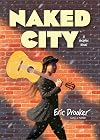
AN EPIC ODYSSEY OF ART! NAKED CITY is a melodic, graphic narrative of moral mayhem for the arts. This book has the power to throw the reader into existential crisis in asking the question: What is the purpose of art? What is the whole point? Especially if we can't eat art... or dollars... for dinner.
We are witnessing the journeys of three struggling city dwellers--a musician, a painter, and a dancer--who attempt to pursue their dreams and achieve some socially-constructed, fiscal version of show more "success." But we end up finding ourselves curled up in cringe, while watching all three artists being subjected to and attempting to overcome various systems of "artistic selection," or dejection-to-exploitation in the arts and entertainment industries. It seems like Isabel the musician and the nameless Painter are long-lost mutual muses at their core; two mystic ships passing in the dark, who faltered to genuinely connect due to the playful shenanigans of Alex the dancer, and mostly the gross interferences of commercialization of their crafts, leading to paths of further alienation.
Like many other industries, NAKED CITY exposes the cautionary, archetypal tale of being cornered into making an unknowing deal with the corporate devil, which entails sacrificing one's morals, or even one's humanity, in exchange for the hokey holy grail of "red carpet" success in the arts. And in the end, we are all scratching our heads as to whether that pursuit is even worth it?
This is where the mysterious fourth character appears--the nearly invisible window washer of Mr. Nobody, who restores the heart of the arts. While the elite power brokers in entertainment are so blind in treating their talent as cash cow tools, it is Mr. Nobody who shows that art bears so much meaning, that it holds the inherent value of life itself; of being able to see and accept and embrace one another for who we inherently are. And to connect with each other in spite of whatever horrors of circumstance have happened to us, that had previously alienated us from one another. In this epic odyssey of art, Eric Drooker has found the true holy grail: the beautiful, melodic beacon of human connection in the dark and chaotic bowels of the city's capitalist beast.
When I close my eyes after reading NAKED CITY, I see Isabel the musician as an endangered species of bird with a dual resonance: a lone yet loving dove incessantly cooing for her parents and longing for her tribe, as well as a canary in a coal mine, warning us of the dangers of bearing the naked bedrock of one's soul into a fleeting crowd of city-slicking strangers. And the proverbial Blind Ego may have just met his perceptual match: I see the Painter and Eric Drooker himself stripping the City Naked into this fluid canvas of comipoetic Truth....
Where Fight Club meets Asterios Polyp, NAKED CITY is a graphic call-to-action for an emerging generation of artists who are exposing the wrongs of the commercial arts, and changing the game of their industries, by calling the beasts by their names, and forging their own unique entrepreneurial paths without compromise. show less
We are witnessing the journeys of three struggling city dwellers--a musician, a painter, and a dancer--who attempt to pursue their dreams and achieve some socially-constructed, fiscal version of show more "success." But we end up finding ourselves curled up in cringe, while watching all three artists being subjected to and attempting to overcome various systems of "artistic selection," or dejection-to-exploitation in the arts and entertainment industries. It seems like Isabel the musician and the nameless Painter are long-lost mutual muses at their core; two mystic ships passing in the dark, who faltered to genuinely connect due to the playful shenanigans of Alex the dancer, and mostly the gross interferences of commercialization of their crafts, leading to paths of further alienation.
Like many other industries, NAKED CITY exposes the cautionary, archetypal tale of being cornered into making an unknowing deal with the corporate devil, which entails sacrificing one's morals, or even one's humanity, in exchange for the hokey holy grail of "red carpet" success in the arts. And in the end, we are all scratching our heads as to whether that pursuit is even worth it?
This is where the mysterious fourth character appears--the nearly invisible window washer of Mr. Nobody, who restores the heart of the arts. While the elite power brokers in entertainment are so blind in treating their talent as cash cow tools, it is Mr. Nobody who shows that art bears so much meaning, that it holds the inherent value of life itself; of being able to see and accept and embrace one another for who we inherently are. And to connect with each other in spite of whatever horrors of circumstance have happened to us, that had previously alienated us from one another. In this epic odyssey of art, Eric Drooker has found the true holy grail: the beautiful, melodic beacon of human connection in the dark and chaotic bowels of the city's capitalist beast.
When I close my eyes after reading NAKED CITY, I see Isabel the musician as an endangered species of bird with a dual resonance: a lone yet loving dove incessantly cooing for her parents and longing for her tribe, as well as a canary in a coal mine, warning us of the dangers of bearing the naked bedrock of one's soul into a fleeting crowd of city-slicking strangers. And the proverbial Blind Ego may have just met his perceptual match: I see the Painter and Eric Drooker himself stripping the City Naked into this fluid canvas of comipoetic Truth....
Where Fight Club meets Asterios Polyp, NAKED CITY is a graphic call-to-action for an emerging generation of artists who are exposing the wrongs of the commercial arts, and changing the game of their industries, by calling the beasts by their names, and forging their own unique entrepreneurial paths without compromise. show less
I wanted so much to like this! Drooker is a brilliant illustrator, his wordless comics and political art in the '90s were very important to me, I'd been sad about him having more or less quit comics in the last decade-plus, and I was curious to see what he would do in a longer form that included text. But, except in very brief bits, this book just doesn't work for me at all on multiple levels. The writing very badly needed an editor, it's very redundant, but it's also kind of trite and show more chatty and obvious to a degree that shocked me—wildly different in tone from the haunting, primal, dreamlike quality that I love in Drooker's art. Unfortunately I'm also not too crazy about his art in this book either; the way he's adapted his style when it comes to human characters is very awkward to my eye, aiming for friendly but coming off more as corny, while the cityscape stuff is more like his glory days but also fairly repetitive. I really don't like saying all these negative things... and there are some good and surprising bits in this, mostly right at the end, and (probably not coincidentally) in the parts that don't have any words. And I'll always read anything he does, but I just hope that he tries a very different approach next time. show less
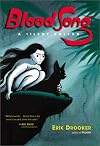
One does not read Eric Drooker’s Blood Song any more than one listens to a silent movie. Yes, it’s a graphic novel—that fusion of art and literature which some less-enlightened folks might call a “comic bookâÂ?âÂÂbut even most other graphic novels have some amount of dialogue or text guiding you through the pages.
Apart from an epigraph by Herman Melville, Blood Song is entirely free of the encumbrance of words. And so, not held down by the shackles of written language, show more it soars to places that other talkative tomes cannot.
Using not one shred of vowel or consonantâÂÂjust DrookerâÂÂs dark, surreal artworkâÂÂBlood Song depends entirely on facial expressions, linear perspective and a cinematic editing of images to deliver a story which speaks volumes about brutality, oppression, hope and love. But the greatest of these is love, which brings the book to a triumphant, symphonic finish.
Blood Song begins in outer space as we spiral down through the Milky Way to a planet, to a jungle, to a man fishing off a wooden dock. We follow the man home to his grass-hut village and learn he is happily married with seven adoring children and one tail-wagging black dog. The oldest daughter, along with the family hound, is sent to the river to fetch water. When she returns, she finds her village under attack by soldiers who descend from the sky in helicopters like a scene out of Apocalypse Now. The girl is spotted and she flees into the jungle, running for her life on a journey which will eventually lead her across an ocean to an urban jungle where sheâÂÂll encounter even more violence and brutality, as well as love and beauty.
ThatâÂÂs all IâÂÂm willing to tell you of Blood SongâÂÂs story (and perhaps IâÂÂve already said too much) because this is one book which sounds pale and bland in summary, but comes to life when experienced. And everyone should experience Blood Song. It will cost you less than the price of admission to a movie (with popcorn and drink) and will take you less than an hour to âÂÂread.âÂ? What youâÂÂll get in return for your time and money is immeasurable.
At this point in an earlier draft of this review, I started to write a list of my favorite moments in the book, the images which most moved me and made me flip back and forth between pages in admiration of DrookerâÂÂs clever juxtaposition. Then, when looking from my words on my computer screen to the illustrations in the bookâÂÂthe starving dog chomping down on a albatrossâ neck, for instanceâÂÂI realized that nothing I could write would do Drooker justice. So, I hit the Delete button.
The same is true when trying to tell you how much I liked other excellent graphic novelsâÂÂChris WareâÂÂs Jimmy Corrigan or Art SpiegelmanâÂÂs Maus, for instance. Words are almost inappropriate. TheyâÂÂre certainly inadequate.
Drooker, whose artwork has been seen on the covers of The New Yorker and The Village Voice, is a master at creating both apocalypse and paradise with just a few strokes of the pen. His framesâÂÂoften spanning both pagesâÂÂare cast in noirish tones of black, slate blue and gray. The occasional burst of colorâÂÂa butterfly, a toucan, a plume of music rising from a saxophoneâÂÂstartle and delight. There is great, muscular energy at work here on these pages and as we move through them, Blood Song unfolds like a movie told in hieroglyphics. Drooker has tapped into the roots of pure storytelling hereâÂÂthe way all great tales were once told: on the walls of caves by flickering firelight before they were bogged down with words.
*Examples of DrookerâÂÂs artwork and animated sequences can be found on his website www.drooker.com show less
Apart from an epigraph by Herman Melville, Blood Song is entirely free of the encumbrance of words. And so, not held down by the shackles of written language, show more it soars to places that other talkative tomes cannot.
Using not one shred of vowel or consonantâÂÂjust DrookerâÂÂs dark, surreal artworkâÂÂBlood Song depends entirely on facial expressions, linear perspective and a cinematic editing of images to deliver a story which speaks volumes about brutality, oppression, hope and love. But the greatest of these is love, which brings the book to a triumphant, symphonic finish.
Blood Song begins in outer space as we spiral down through the Milky Way to a planet, to a jungle, to a man fishing off a wooden dock. We follow the man home to his grass-hut village and learn he is happily married with seven adoring children and one tail-wagging black dog. The oldest daughter, along with the family hound, is sent to the river to fetch water. When she returns, she finds her village under attack by soldiers who descend from the sky in helicopters like a scene out of Apocalypse Now. The girl is spotted and she flees into the jungle, running for her life on a journey which will eventually lead her across an ocean to an urban jungle where sheâÂÂll encounter even more violence and brutality, as well as love and beauty.
ThatâÂÂs all IâÂÂm willing to tell you of Blood SongâÂÂs story (and perhaps IâÂÂve already said too much) because this is one book which sounds pale and bland in summary, but comes to life when experienced. And everyone should experience Blood Song. It will cost you less than the price of admission to a movie (with popcorn and drink) and will take you less than an hour to âÂÂread.âÂ? What youâÂÂll get in return for your time and money is immeasurable.
At this point in an earlier draft of this review, I started to write a list of my favorite moments in the book, the images which most moved me and made me flip back and forth between pages in admiration of DrookerâÂÂs clever juxtaposition. Then, when looking from my words on my computer screen to the illustrations in the bookâÂÂthe starving dog chomping down on a albatrossâ neck, for instanceâÂÂI realized that nothing I could write would do Drooker justice. So, I hit the Delete button.
The same is true when trying to tell you how much I liked other excellent graphic novelsâÂÂChris WareâÂÂs Jimmy Corrigan or Art SpiegelmanâÂÂs Maus, for instance. Words are almost inappropriate. TheyâÂÂre certainly inadequate.
Drooker, whose artwork has been seen on the covers of The New Yorker and The Village Voice, is a master at creating both apocalypse and paradise with just a few strokes of the pen. His framesâÂÂoften spanning both pagesâÂÂare cast in noirish tones of black, slate blue and gray. The occasional burst of colorâÂÂa butterfly, a toucan, a plume of music rising from a saxophoneâÂÂstartle and delight. There is great, muscular energy at work here on these pages and as we move through them, Blood Song unfolds like a movie told in hieroglyphics. Drooker has tapped into the roots of pure storytelling hereâÂÂthe way all great tales were once told: on the walls of caves by flickering firelight before they were bogged down with words.
*Examples of DrookerâÂÂs artwork and animated sequences can be found on his website www.drooker.com show less
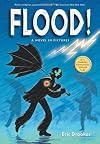
Eric Drooker's woodcut-like drawings create a moving and dark graphic novel completely devoid of words but rich and powerful in story and emotion. In it, we have the loneliness of being in a city teaming with people while both a single life and the lives of strangers crumble for reasons unknown while no one seems to care to ask or know why these soul suffer. It is sheer elegance in the honesty found in its silence. The titular flood is a literal thing from the sky and in a figurative show more emotional upheaval. I find it hard to explain why this is so moving, but it is in a way that proves that graphic novels are more than just simple words slapped on a few pictures. Drooker demonstrates in no uncertain terms that the art is not just an enhancement, but a fully functioning element capable of telling a story on its own. show less
Lists
Awards


You May Also Like


Associated Authors
Statistics
- Works
- 13
- Also by
- 10
- Members
- 469
- Popularity
- #52,470
- Rating
- 4.1
- Reviews
- 15
- ISBNs
- 19
- Languages
- 2