
Henry Lincoln (1930–2022)
Author of Holy Blood, Holy Grail
About the Author
Henry Lincoln is a noted documentary filmmaker. In addition to Holy Blood, Holy Grail, he is coauthor of The Messianic Legacy, Key to the Sacred Pattern, and The Templars' Secret Island.
Series
Works by Henry Lincoln
Chronicle: Essays from Ten Years of Television Archaeology (1978) — Contributor — 14 copies, 1 review
Exploring the Da Vinci code: Henry Lincoln's guide to Rennes-le-Château. (Videorecording: DVD). (2005) 2 copies
Origins of the Da Vinci Code [2005 film] — Screenwriter — 2 copies
Tagged
Common Knowledge
- Legal name
- Soskin, Henry
- Birthdate
- 1930-02-12
- Date of death
- 2022-02-24
- Gender
- male
- Education
- Royal Academy of Dramatic Art
- Occupations
- actor
screenwriter
TV presenter - Organizations
- Militi Templi Scotia (MTS)(SKT)
- Relationships
- Leigh, Richard (co-author)
Baigent, Michael (co-author) - Nationality
- UK
- Birthplace
- London, England, UK
- Places of residence
- London, England, UK (birth)
Rennes-le-Bains, France
Rennes-le-Château, France - Associated Place (for map)
- London, England, UK
Members
Reviews
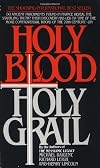
When I bought and read this book in the 1980s I was younger, more gullible, and less cynical; I lapped it up, couldn't put it down, felt myself gasping at each new 'revelation', each new historical link that seemed to show that Christianity (or what we know of it now) was based on a Big Lie, each unfolding of a centuries' old "secret society".
It has had two legacies. One, the birth of a sadder, more cynical me when I discovered through BBC documentary that the so-called 'secret' Prieuré Du show more Sion - supposedly the guardians of the knowledge of Jesus's "descendants" : the "Holy Blood" of the title - was nothing more than a scam dreamed up by French con-men in the 1950s, fed to and swallowed whole by British researchers in the 70s. This was later picked up by Dan Brown and woven into The Da Vinci Code, though he was cleared of plagiarism by British courts (presumably only because a lie cannot be plagiarised!).
And yet... there is another legacy too. The role of the Emperor Constantine in shaping what we now recognise as "The Church", was never so sharply brought into focus before this book, and has never receded since. Some of the book rehashes popular myth, other parts breathe new life into long-forgotten historical eras (the Merovingian dynasty, the Cathars), and for the latter we should be grateful.
The way to approach this book is complex : it is a highly captivating semi-fictional detective story; it is a vivid document of historical phases of the Christian era; it deals in shams that have now been exposed. What it never fails to do is to make you question 'inherited certainties', and for that, we owe it a vote of thanks. And Dan Brown owes it a far bigger vote of thanks as without it, The Da Vinci Code could never have been written. show less
It has had two legacies. One, the birth of a sadder, more cynical me when I discovered through BBC documentary that the so-called 'secret' Prieuré Du show more Sion - supposedly the guardians of the knowledge of Jesus's "descendants" : the "Holy Blood" of the title - was nothing more than a scam dreamed up by French con-men in the 1950s, fed to and swallowed whole by British researchers in the 70s. This was later picked up by Dan Brown and woven into The Da Vinci Code, though he was cleared of plagiarism by British courts (presumably only because a lie cannot be plagiarised!).
And yet... there is another legacy too. The role of the Emperor Constantine in shaping what we now recognise as "The Church", was never so sharply brought into focus before this book, and has never receded since. Some of the book rehashes popular myth, other parts breathe new life into long-forgotten historical eras (the Merovingian dynasty, the Cathars), and for the latter we should be grateful.
The way to approach this book is complex : it is a highly captivating semi-fictional detective story; it is a vivid document of historical phases of the Christian era; it deals in shams that have now been exposed. What it never fails to do is to make you question 'inherited certainties', and for that, we owe it a vote of thanks. And Dan Brown owes it a far bigger vote of thanks as without it, The Da Vinci Code could never have been written. show less
A relative sent me a copy of the book several years ago (before The Da Vinci Code, which plays off this book's claims). It's utterly ludicrous, but a textbook example of how to play a con game with the public using little-known or half-remembered episodes and characters from ancient and medieval history.
The trick is to come up with a fictional past that people will want to believe in (in this case: Jesus married Mary Magdalene, and just as you always suspected, the whole church show more establishment is a fraud). Then write a tedious narrative full of mystifying language about how we, the authors, were inexorably drawn to believe this theory in despite of all our dry-as-dust scholarly colleagues with their timorous reliance on careful sourcing.
All this padding is essential; it adds heft to your book, which increases its air of authority. But be sure to spice it up here and there with quick-moving passages that assert really wild and sexy claims (like, a lineal descendant of Jesus will someday assert a claim to rule all of Europe). These will be the only parts most readers will absorb, so give them arresting subheadings.
Readers will underline these passages and email their friends, then ask their ministers about them. Soon one or two scandalized churchmen can be counted on to rail against your book on TV. You'll be invited to appear as well, for the sake of balance, and all you have to do is act the role of a maverick but dedicated scholar.
Then the paperback comes out, graced with a lengthy introduction in which you express, with cherubic innocence, your shock at all the uproar about your humble and sincere efforts to uncover the truth. History Channel, here we come. show less
The trick is to come up with a fictional past that people will want to believe in (in this case: Jesus married Mary Magdalene, and just as you always suspected, the whole church show more establishment is a fraud). Then write a tedious narrative full of mystifying language about how we, the authors, were inexorably drawn to believe this theory in despite of all our dry-as-dust scholarly colleagues with their timorous reliance on careful sourcing.
All this padding is essential; it adds heft to your book, which increases its air of authority. But be sure to spice it up here and there with quick-moving passages that assert really wild and sexy claims (like, a lineal descendant of Jesus will someday assert a claim to rule all of Europe). These will be the only parts most readers will absorb, so give them arresting subheadings.
Readers will underline these passages and email their friends, then ask their ministers about them. Soon one or two scandalized churchmen can be counted on to rail against your book on TV. You'll be invited to appear as well, for the sake of balance, and all you have to do is act the role of a maverick but dedicated scholar.
Then the paperback comes out, graced with a lengthy introduction in which you express, with cherubic innocence, your shock at all the uproar about your humble and sincere efforts to uncover the truth. History Channel, here we come. show less

I'm only about a third of the way through, so I suppose it gets better - but this is dense, plodding, (very small type), and it manages to include *every single one* of the fallacies commonly employed by writers of crank paperbacks, all at once. (seriously - somewhere I have an essay catagorizing them all with examples from *one chapter* of this book.)
The occcasional tidbits of fact slipped in (such as the mystery of what Sauniere found and the cutting of the Elm) are fascinating, though. show more Too bad they're weighted down with tons of unreliable speculation, so I have no idea what I can believe without checking the sources. Instead of playing on the reader's idiocy to try to convince them it's all God's honest truth, somebody should write this (admittedly fascinating) story as fiction.
Only, you know, do it well. show less
The occcasional tidbits of fact slipped in (such as the mystery of what Sauniere found and the cutting of the Elm) are fascinating, though. show more Too bad they're weighted down with tons of unreliable speculation, so I have no idea what I can believe without checking the sources. Instead of playing on the reader's idiocy to try to convince them it's all God's honest truth, somebody should write this (admittedly fascinating) story as fiction.
Only, you know, do it well. show less
Lists
Awards


You May Also Like


Associated Authors
Statistics
- Works
- 15
- Members
- 6,210
- Popularity
- #3,949
- Rating
- 3.2
- Reviews
- 103
- ISBNs
- 147
- Languages
- 19
- Favorited
- 3