

Harry G. Summers (1932–1999)
Author of On Strategy: A Critical Analysis of the Vietnam War
About the Author
Colonel Harry G. Summers, Jr., USA (Ret.) is a syndicated columnist for the Los Angeles Times specializing in national security and current defense affairs and the editor of Vietnam Magazine.
Works by Harry G. Summers
Tagged
Common Knowledge
- Birthdate
- 1932-05-06
- Date of death
- 1999-11-14
- Gender
- male
- Occupations
- soldier
military analyst - Organizations
- United States Army
- Nationality
- USA
- Place of death
- Washington, D.C., USA
- Associated Place (for map)
- D.C., USA
Members
Reviews
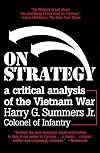
On Strategy is the cornerstone of the 'revisionist school' of Vietnam War historiography-those who argue that the war was ultimately winnable with a greater degree of military commitment. Summers uses Clausewitz to castigate the civilians responsible for Vietnam, President Johnson and Secretary McNamara's systems analysts, for failing to set objectives with a chance of victory. Army senior leadership is close behind, for failing for the siren lure of counter-insurgency and failing to hold to show more traditional strategic arts in a nuclear era.
Summers' argument is dressed up in a lot of Clausewitzian jargon, but the core is fairly simply. Vietnam was a war fought in 'cold blood' without a mobilization of the population, which separated the American people from the military mission, as color TV brought the savagery of war to everyone's living rooms for the first time. American posture was a strategic defensive, which require endurance and the hope that the situation of the war will turn in your favor. Tactical successes at Ia Drang, in the Tet Offensive, and the Christmas Bombings were rendered irrelevant by a refusal to bring the war to North Vietnam, and strike directly at their political leadership, their military logistics, or their alliances with China and Russia. American leaders took counsels of their fears of turning the Cold War atomic hot, and bought into North Vietnamese propaganda of a people's war.
In the one sense, Summers isn't wrong. Vietnam was fought without clear objectives beyond the continued existence of the Republic of South Vietnam. But he misses some key points. If War Comes to Long An is accurate, Viet Cong terror and assassinations had decimated the South Vietnamese government long before the main introduction of US troops. As a battalion level officer in Vietnam, Summers should have something to say about the tool of ambush and mines, and the difficulty in bringing communist guerrillas to battle. The American people were not comprehensively mobilized, but it's hard to think of a strategic US interest at issue in Indochina, both in terms of contemporary superpower politics and with the benefit of historical hindsight.
Finally, for the "well if you're so smart, you do it" question, Summers' suggestion for how to fight the war involves a cordon of US troops stretching across Laos from the Vietnamese DMZ through to the border with Thailand, and heavy ongoing air strikes against Hanoi and Haiphong. I can't see this being easy, or avoiding a massive escalation of the Cold War.
My final assessment is that Summers wants to have his cake and eat it to. If Vietnam demanded full American mobilization, it was definitely part of the Cold War and must be seen in terms of DEFCON levels and nuclear risk. If Vietnam is a limited war, then the relatively paucity of American interests in the region against the absolute interests of the North Vietnamese leadership to reunify their country must be accepted. Either way, Summers isn't wrong but he isn't yet right. This is an important book on the Vietnam War, but one that must be read carefully and in context. show less
Summers' argument is dressed up in a lot of Clausewitzian jargon, but the core is fairly simply. Vietnam was a war fought in 'cold blood' without a mobilization of the population, which separated the American people from the military mission, as color TV brought the savagery of war to everyone's living rooms for the first time. American posture was a strategic defensive, which require endurance and the hope that the situation of the war will turn in your favor. Tactical successes at Ia Drang, in the Tet Offensive, and the Christmas Bombings were rendered irrelevant by a refusal to bring the war to North Vietnam, and strike directly at their political leadership, their military logistics, or their alliances with China and Russia. American leaders took counsels of their fears of turning the Cold War atomic hot, and bought into North Vietnamese propaganda of a people's war.
In the one sense, Summers isn't wrong. Vietnam was fought without clear objectives beyond the continued existence of the Republic of South Vietnam. But he misses some key points. If War Comes to Long An is accurate, Viet Cong terror and assassinations had decimated the South Vietnamese government long before the main introduction of US troops. As a battalion level officer in Vietnam, Summers should have something to say about the tool of ambush and mines, and the difficulty in bringing communist guerrillas to battle. The American people were not comprehensively mobilized, but it's hard to think of a strategic US interest at issue in Indochina, both in terms of contemporary superpower politics and with the benefit of historical hindsight.
Finally, for the "well if you're so smart, you do it" question, Summers' suggestion for how to fight the war involves a cordon of US troops stretching across Laos from the Vietnamese DMZ through to the border with Thailand, and heavy ongoing air strikes against Hanoi and Haiphong. I can't see this being easy, or avoiding a massive escalation of the Cold War.
My final assessment is that Summers wants to have his cake and eat it to. If Vietnam demanded full American mobilization, it was definitely part of the Cold War and must be seen in terms of DEFCON levels and nuclear risk. If Vietnam is a limited war, then the relatively paucity of American interests in the region against the absolute interests of the North Vietnamese leadership to reunify their country must be accepted. Either way, Summers isn't wrong but he isn't yet right. This is an important book on the Vietnam War, but one that must be read carefully and in context. show less

Summers, a colonel of infantry, analyzes U. S. performance in the Vietnam War by applying the strategic principles outlined in U. S. Army's own field manuals. He concludes--as others have--that Vietnam was a string of tactical victories leading to a decisive strategic defeat. The problem, he persuasively argues, was the failure of both civilian and military leaders to agree upon a clear strategic objective that would be achievable with the forces available. The fault lies equally with senior show more politicians and senior military officers. Their failure to communicate honestly and openly with one another, he argues, crippled the US war effort almost from the start.
On Strategy is not a page-turner in the traditional sense. Nobody is going to mistake Summers' prose for that of John Keegan (The Face of Battle) or Rick Atkinson (An Army at Dawn)--it is workmanlike, but no more than that. The simple, unadorned style keeps the focus on Summers' ideas, however, and it is the ideas that are the book's greatest asset. A lot of simplistic, politically self-serving nonsense has been written, over the years, about why we lost in Vietnam. Summers' cool, dispassionate analysis is an essential corrective well worth the time of anyone with an interest in the war. show less
On Strategy is not a page-turner in the traditional sense. Nobody is going to mistake Summers' prose for that of John Keegan (The Face of Battle) or Rick Atkinson (An Army at Dawn)--it is workmanlike, but no more than that. The simple, unadorned style keeps the focus on Summers' ideas, however, and it is the ideas that are the book's greatest asset. A lot of simplistic, politically self-serving nonsense has been written, over the years, about why we lost in Vietnam. Summers' cool, dispassionate analysis is an essential corrective well worth the time of anyone with an interest in the war. show less
Summers argues that the United States failed to achieve its objectives in Vietnam primarily because the proper military strategies for success were denied to the military by the civilian leadership. He contends that the military was given intangible and unattainable political objectives by the civilian leaders (such as “nation-building”), for which the military was ill-suited. Summers also asserts that the United States, by following the course of action prescribed by limited war show more theorists like Osgood and Schelling, failed to truly perceive Vietnam as a war. U.S. military forces were used as signaling tools to the North Vietnamese, as Osgood and Schelling recommend, not as fighting instruments, as Summers believes they should have been. This created a situation in which a military failure was almost inevitable; the U.S./South Vietnamese military failure then made a political solution favorable to the United States impossible to achieve. Summers is also strongly critical of the U.S.’ failure to engage the support of the American public. (Osgood, of course, contends that this is unnecessary, since he avers that the domestic political situation should have virtually no impact on formulating a limited war strategy.) Summers’ position is that the United States failed in Vietnam precisely because it followed the type of limited war strategy suggested by Osgood and Schelling.
Summers’ position is quite favorable to the military establishment, and it echoes a common sentiment within the military: it was not the military’s fault that the U.S. lost in Vietnam. Instead, all (or nearly all) the blame for the defeat has been shifted firmly onto the civilian leadership. Civilian political leaders were guilty of micromanagement. They failed to provide tangible, realistic, and achievable military objectives. They were too sensitive to potential Soviet or Chinese intervention, so they tied the military’s hands by limiting possible targets, weapons, and geographic areas for military operations. They were unwilling to bear the costs necessary to achieve their desired aims. They focused the effort on the Viet Cong insurgency, rather than against the more conventional adversary, the North Vietnamese Army. And they failed to mobilize popular support for the war effort. In short, this “Army Concept,” as Summers’ view is referred to, holds that the United States failed in Vietnam because the war effort was limited by civilian leaders; the military was not “allowed” to achieve a military victory using the total or unlimited war approach (or at least a less limited approach) that the military favored.
Summers attributes the American failure in Vietnam in large part to a number of (Clausewitzian) “frictions.” Especially important was the friction caused by the conscious decision on the part of the government “not to arouse the passions of the American people. The effect of this was that we fought the Vietnam War in cold blood.” This made the war in Vietnam seem harsher, crueler, more repugnant than previous wars. It eventually inflamed the passions of the people against the war. Summers charges this erosion of public and Congressional support for the war with greatly undermining the war effort, eventually leading to its downfall.
Summers makes an important distinction regarding the definition of limited war. He regards the Korean War as a successful limited war because only the objectives of the war were limited. The means for achieving these objectives were not. In Vietnam, however, not only were the objectives limited, but the means were limited as well. This, he says, would have been successful had the opponent followed suit, as say, when both sides are armed with nuclear weapons and agree not to use them, but in the case of Vietnam, the North Vietnamese and Viet Cong used all means at their disposal. The United States did not.
Summers also believes that too much emphasis was placed on counterinsurgency warfare, rather than on the traditional role of the military. This, he says, was primarily a political task that should have been left to the South Vietnamese. The American military forces should have been employed solely to resist the external aggression by the North Vietnamese (conventional) Army. They were not properly trained to fight a counterinsurgency, and too many forces were squandered in this effort.
Summers also proposes a course of action he believes should have been undertaken in order to succeed militarily in eliminating the North Vietnamese threat. He suggests that a push should have been made in Laos, and a defensive line should have been created all the way to the Laotian-Thai border. This would have sealed the border between North and South Vietnam, effectively isolating South Vietnam. While the U.S. military held this line, eliminating the North Vietnamese Army’s access to the South, South Vietnam would have eliminated the insurgent Viet Cong, a task made even easier because they would have been isolated from their primary source of supplies.
Review copyright 2009 J. Andrew Byers show less
Summers’ position is quite favorable to the military establishment, and it echoes a common sentiment within the military: it was not the military’s fault that the U.S. lost in Vietnam. Instead, all (or nearly all) the blame for the defeat has been shifted firmly onto the civilian leadership. Civilian political leaders were guilty of micromanagement. They failed to provide tangible, realistic, and achievable military objectives. They were too sensitive to potential Soviet or Chinese intervention, so they tied the military’s hands by limiting possible targets, weapons, and geographic areas for military operations. They were unwilling to bear the costs necessary to achieve their desired aims. They focused the effort on the Viet Cong insurgency, rather than against the more conventional adversary, the North Vietnamese Army. And they failed to mobilize popular support for the war effort. In short, this “Army Concept,” as Summers’ view is referred to, holds that the United States failed in Vietnam because the war effort was limited by civilian leaders; the military was not “allowed” to achieve a military victory using the total or unlimited war approach (or at least a less limited approach) that the military favored.
Summers attributes the American failure in Vietnam in large part to a number of (Clausewitzian) “frictions.” Especially important was the friction caused by the conscious decision on the part of the government “not to arouse the passions of the American people. The effect of this was that we fought the Vietnam War in cold blood.” This made the war in Vietnam seem harsher, crueler, more repugnant than previous wars. It eventually inflamed the passions of the people against the war. Summers charges this erosion of public and Congressional support for the war with greatly undermining the war effort, eventually leading to its downfall.
Summers makes an important distinction regarding the definition of limited war. He regards the Korean War as a successful limited war because only the objectives of the war were limited. The means for achieving these objectives were not. In Vietnam, however, not only were the objectives limited, but the means were limited as well. This, he says, would have been successful had the opponent followed suit, as say, when both sides are armed with nuclear weapons and agree not to use them, but in the case of Vietnam, the North Vietnamese and Viet Cong used all means at their disposal. The United States did not.
Summers also believes that too much emphasis was placed on counterinsurgency warfare, rather than on the traditional role of the military. This, he says, was primarily a political task that should have been left to the South Vietnamese. The American military forces should have been employed solely to resist the external aggression by the North Vietnamese (conventional) Army. They were not properly trained to fight a counterinsurgency, and too many forces were squandered in this effort.
Summers also proposes a course of action he believes should have been undertaken in order to succeed militarily in eliminating the North Vietnamese threat. He suggests that a push should have been made in Laos, and a defensive line should have been created all the way to the Laotian-Thai border. This would have sealed the border between North and South Vietnam, effectively isolating South Vietnam. While the U.S. military held this line, eliminating the North Vietnamese Army’s access to the South, South Vietnam would have eliminated the insurgent Viet Cong, a task made even easier because they would have been isolated from their primary source of supplies.
Review copyright 2009 J. Andrew Byers show less
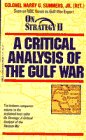
Summers' book is primarily concerned with celebrating Operations Desert Shield and Storm. This is hardly, as the title might lead one to believe, a "critical" analysis of the Gulf War. Instead it is the saga of how the Americans licked the "Vietnam Syndrome." As a conservative revisionist on Vietnam, the lessons Summers draws from that experience were also shared by the U.S. military establishment. That is, the failure to mobilize the American population for an all-out war with clearly show more defined objectives "caused" American defeat in Vietnam. Summers sees the victory in the Gulf as the consequence of having learned from our mistakes in Vietnam. For Desert Shield/Storm the reserves were called up, strategic objectives were clearly defined, and the military was given the support it needed from the civilians to win. This victory was also the first engagement in the new world order, where America's status as the one lone superpower will enable it to punish aggression and maintain international peace. Unless, of course, the Americans forget the "lessons of the Munich," which guided America's successful Cold War strategy, and retreat instead to "isolation." show less
Awards

You May Also Like


Associated Authors
Statistics
- Works
- 10
- Members
- 693
- Popularity
- #36,520
- Rating
- 3.9
- Reviews
- 5
- ISBNs
- 26
- Favorited
- 1