
Alain Robbe-Grillet (1922–2008)
Author of Jealousy
About the Author
Writer and filmmaker Alain Robbe-Grillet was born in Brest, France in 1922. Robbe-Grillet's first novel, The Erasers (1953) is considered to be one of the first books of the nouveau roman, or new novel, in which external reality is more important than character or plot. His other works included The show more Voyeur (1955), Jealousy (1957) and Djinn (1981). He worked in the film industry as a writer, actor and director. He died at the age of 85 on February 18, 2008. (Bowker Author Biography) show less
Image credit: Alain Robbe-Grillet in Saumur, France on June 10, 1997
Works by Alain Robbe-Grillet
L' Immortale 2 copies
Salsomaggiore: Art deco termale 2 copies
O ciúme 1 copy
LES DEMOISELLES D'HAMILTON 1 copy
Flaubert et ses héritiers 1 copy
"The Secret Room" 1 copy
Het strand (1956) 1 copy
For a New Novel 1 copy
Associated Works
The Art of the Tale: An International Anthology of Short Stories (1986) — Contributor — 383 copies, 3 reviews
The Belle, a journal of belles-lettres : Issue Two. — Contributor — 1 copy
Tagged
Common Knowledge
- Canonical name
- Robbe-Grillet, Alain
- Legal name
- Robbe-Grillet, Alain Paul
- Birthdate
- 1922-08-18
- Date of death
- 2008-02-18
- Gender
- male
- Education
- Lycée Saint-Louis
National Agronomy Institute (agricultural engineering) - Occupations
- agronomist
novelist
screenwriter
film director
critic - Organizations
- Académie française (2004)
- Awards and honors
- Prix des Critiques (1953)
Ovid Prize (2002) - Relationships
- Catherine Robbe-Grillet (wife)
Resnais, Alain (collaborator) - Nationality
- France
- Birthplace
- Saint-Pierre-Quilbignon, Finistère, Bretagne, France
- Places of residence
- Brest, Finistère, Bretagne, France
Caen, Calvados, Normandie, France - Place of death
- Caen, Calvados, Normandie, France
- Burial location
- cremated
- Associated Place (for map)
- France
Members
Discussions
Jealousy - Allen Press - A Rhythmic Review in Fine Press Forum (July 3)
Reviews

This avant-gardist "new novel" from 1965 hovers somewhere between a prose poem and an extended film treatment for an impressionistic thriller. The narrative continuity is distorted in every possible way, with flashbacks, flashforwards, conjectures coalescing as accounts, descriptions dissolving into perspectives, and frames imposed and broken in many other ways. There are plays performed at parties, and a passage that begins by describing action on stage may move seamlessly into an apparent show more real-world setting, or vice versa. Similar liberties are taken with a group of sculptures on the grounds of the Blue Villa (the Maison of the title), and with conversations of various sorts.
The first-person narrator is far from omniscient, offering numerous contradictions, and sometimes pausing to question details in the story being told. It is not even clear whether the Blue Villa is truly in Hong Kong, or whether it is merely a place where reminiscences and/or fantasies about Hong Kong find a home. There is a short list of characters who are multiplied by the effects of perspective, as demonstrated in their repeatedly-transformed names: Ava, Eva, Eve; Johnson, Johnston, Jonestone; Loraine, Lauren, and so on.
To the extent that a plot makes itself detectable, it involves human trafficking, the narcotics trade, Cold War espionage, elite society intrigue, murder, and even cannibalism. But the focus is on recurring motifs told with conspicuously similar details, such as travels by taxi, a girl walking a dog, a transaction over a desk, menace from the authorities, a magazine advertisement, a woman lying on her side and propped on one elbow. At points, the story re-enters a familiar groove and contents itself with an "etc." or even "etc. etc."
There are no chapter divisions, and the story "resolves" only in the manner of a musical composition, by returning to the chord which is thus revealed to be its tonic. Avowedly a fiction, it avoids showing the reader enough consistency or narrative authority to determine an "objective" course of events in the surfeit of description. Instead, the dreamlike associations of the text invite the reader to share in the manicured fantasy where the author wanders. show less
The first-person narrator is far from omniscient, offering numerous contradictions, and sometimes pausing to question details in the story being told. It is not even clear whether the Blue Villa is truly in Hong Kong, or whether it is merely a place where reminiscences and/or fantasies about Hong Kong find a home. There is a short list of characters who are multiplied by the effects of perspective, as demonstrated in their repeatedly-transformed names: Ava, Eva, Eve; Johnson, Johnston, Jonestone; Loraine, Lauren, and so on.
To the extent that a plot makes itself detectable, it involves human trafficking, the narcotics trade, Cold War espionage, elite society intrigue, murder, and even cannibalism. But the focus is on recurring motifs told with conspicuously similar details, such as travels by taxi, a girl walking a dog, a transaction over a desk, menace from the authorities, a magazine advertisement, a woman lying on her side and propped on one elbow. At points, the story re-enters a familiar groove and contents itself with an "etc." or even "etc. etc."
There are no chapter divisions, and the story "resolves" only in the manner of a musical composition, by returning to the chord which is thus revealed to be its tonic. Avowedly a fiction, it avoids showing the reader enough consistency or narrative authority to determine an "objective" course of events in the surfeit of description. Instead, the dreamlike associations of the text invite the reader to share in the manicured fantasy where the author wanders. show less
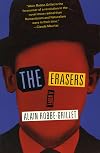
In an odd twist of fate, Alain Robbe-Grillet died the same week that I finally finished reading his debut novel, The Erasers. I don’t ascribe any importance to that, it was just odd.
The Erasers reminds me of Black Sabbath’s Black Sabbath or The Stooges The Stooges or Metallica’s Kill ‘Em All or Public Enemy’s Yo! Bum Rush the Show. There is something great here, it isn’t perfected yet, but there is hint of something amazing to come. This grand experiment will yield a Paranoid or show more a Fun House or a Master of Puppets or a It Takes A Nation of Millions….
In many ways, The Erasers is the most ‘conventional’ of Robbe-Grillet’s novels if for no other reason than it was his first stab at the New Novel. On the surface, the story can even be perceived as a more intricate form of crime fiction. In a small seaside town, Daniel Dupont, a professor, becomes the ninth victim in nine days of an unknown assassin. Theories abound as to the murder’s true identity: a terrorist group unhappy with the professor’s political leanings or a long lost bastard child. Arriving in town the day after the murder is one Detective Wallas who has been sent to investigate the murder. And so it begins…
Over a 24-hour period, Robbe-Grillet has us following Wallas, wandering down blind alleys, retracing steps, replaying scenes over and over again, as he would in Jealousy and In the Labyrinth. We are introduced to the assassin, or are we? We meet many witnesses, but have they actually seen anything? Soon we are forced to ask a disturbing question: Is Wallas in fact the assassin? Is he investigating himself much like Gian Maria Volontè’s police inspector in the classic Elio Petri film, Investigation of a Citizen Above Suspicion.
The twisting labyrinthine plot – what would become Robbe-Grillet’s hallmark – draws you into the story, taking it to a psychological level that most crime novels (and lesser authors) are unable to achieve. You are forced to consider the possibility that Wallace has a dark side to his character that even his own brain will not reveal to the reader (something RG used even more effectively in The Voyeur). Only by ‘tailing’ Wallas do we start to see the pieces of the disjointed puzzle pulled together and ultimately the grim, inevitable outcome.
In The Erasers, Robbe-Grillet has not completely abandoned traditional use of character and plot. There is a storyline here, but it is condensed into a frenetic series of meetings, arguments, subterfuge, and yes, murders. We are left with dead ends, miscues, faulty memories, and cryptic messages that the confound the reader as much as Wallas. It is this aspect that can turn someone away; the plot is not laid out as a simple series of events and an impatient readers quickly shut down. But compared to Robbe-Grillet’s later novels, The Erasers is a great entry point to his writing, the rabbit-hole if you will.
As I said, I don’t consider The Erasers to be Robbe-Grillet’s finest work. He is a young sprite, playing with new ideas. He wouldn’t hit his stride until Jealousy and In the Labyrinth. But my god, what a hell of a debut. And still more infinitely fascinating and perfectly executed than the endless train of ‘meta-novels’ unleashed in years after by lesser writers. It stands in the shadows of Robbe-Grillet’s later work, but still exists as one of the great experiments in novel writing. And more importantly, the story is still intriguing, fascinating, and addictive. show less
The Erasers reminds me of Black Sabbath’s Black Sabbath or The Stooges The Stooges or Metallica’s Kill ‘Em All or Public Enemy’s Yo! Bum Rush the Show. There is something great here, it isn’t perfected yet, but there is hint of something amazing to come. This grand experiment will yield a Paranoid or show more a Fun House or a Master of Puppets or a It Takes A Nation of Millions….
In many ways, The Erasers is the most ‘conventional’ of Robbe-Grillet’s novels if for no other reason than it was his first stab at the New Novel. On the surface, the story can even be perceived as a more intricate form of crime fiction. In a small seaside town, Daniel Dupont, a professor, becomes the ninth victim in nine days of an unknown assassin. Theories abound as to the murder’s true identity: a terrorist group unhappy with the professor’s political leanings or a long lost bastard child. Arriving in town the day after the murder is one Detective Wallas who has been sent to investigate the murder. And so it begins…
Over a 24-hour period, Robbe-Grillet has us following Wallas, wandering down blind alleys, retracing steps, replaying scenes over and over again, as he would in Jealousy and In the Labyrinth. We are introduced to the assassin, or are we? We meet many witnesses, but have they actually seen anything? Soon we are forced to ask a disturbing question: Is Wallas in fact the assassin? Is he investigating himself much like Gian Maria Volontè’s police inspector in the classic Elio Petri film, Investigation of a Citizen Above Suspicion.
The twisting labyrinthine plot – what would become Robbe-Grillet’s hallmark – draws you into the story, taking it to a psychological level that most crime novels (and lesser authors) are unable to achieve. You are forced to consider the possibility that Wallace has a dark side to his character that even his own brain will not reveal to the reader (something RG used even more effectively in The Voyeur). Only by ‘tailing’ Wallas do we start to see the pieces of the disjointed puzzle pulled together and ultimately the grim, inevitable outcome.
In The Erasers, Robbe-Grillet has not completely abandoned traditional use of character and plot. There is a storyline here, but it is condensed into a frenetic series of meetings, arguments, subterfuge, and yes, murders. We are left with dead ends, miscues, faulty memories, and cryptic messages that the confound the reader as much as Wallas. It is this aspect that can turn someone away; the plot is not laid out as a simple series of events and an impatient readers quickly shut down. But compared to Robbe-Grillet’s later novels, The Erasers is a great entry point to his writing, the rabbit-hole if you will.
As I said, I don’t consider The Erasers to be Robbe-Grillet’s finest work. He is a young sprite, playing with new ideas. He wouldn’t hit his stride until Jealousy and In the Labyrinth. But my god, what a hell of a debut. And still more infinitely fascinating and perfectly executed than the endless train of ‘meta-novels’ unleashed in years after by lesser writers. It stands in the shadows of Robbe-Grillet’s later work, but still exists as one of the great experiments in novel writing. And more importantly, the story is still intriguing, fascinating, and addictive. show less
Obra prima sem tamanho, compulsivamente o li em poucas horas, pois a capacidade do Robbe-Grillet repetir as mesmas cenas destrinchando a linguagem de formas diferentes é particularmente brilhante, especialmente porque reflete no tipo de pensamento obsessivo causado pelo ciúme, mesmo que se isente de qualquer tipo de análise psicológica no sentido clássico da acepção e sim aniquilando o tempo. Não é uma leitura difícil ou chata como vemos muitos dizendo por aí, mas sim melhor show more degustada por aqueles aptos a assumirem seu amor pela grandiosidade e diversidade da linguagem. show less

A deceptive book. First the title, then the cover and blurbs on the back lead you to think it's a mystery, that it contains a plot, or even meaningful characters. The back cover claims it is an expression of literature as art. But nouveau roman is a vague category. It can take many forms. I was reminded of Beckett, who's work, in my mind, ranged from atrocious to miraculously good. Robbe-Grillet's purpose in this novel seemed to be to experiment with detail, not to entertain, enlighten, or show more innovate. Hyper-attention to detail is fine in small doses. Yet, this becomes a catalogue of things normally subtracted from a good book.
If you're interested in this book (I can't think of any reason to read it unless you plan to live more than one lifetime) skip the first 110 pages. Or, better yet, skip to the last 20 pages. Nothing of consequence could be said to happen for 99% of the book, which is the reason for my rating. The main character wanders around a small island town not selling watches. The dialogue is mostly of the sales pitch variety. Having done sales myself, I didn't need to read about someone doing it. Especially with such lack of skill, clearly pre-judging his customers, and failing so miserably. But add to this a stifling, rococo hoard of environmental details - he spends pages describing chair legs, frilly curtains, rug patterns, carpet stains, gleaming windowpanes, puddles of mud on the side of the road, clouds in the shape of turds, and hundreds of other silly observations. With existential horror, I found myself reading it, being bored, and questioning my own sanity. show less
If you're interested in this book (I can't think of any reason to read it unless you plan to live more than one lifetime) skip the first 110 pages. Or, better yet, skip to the last 20 pages. Nothing of consequence could be said to happen for 99% of the book, which is the reason for my rating. The main character wanders around a small island town not selling watches. The dialogue is mostly of the sales pitch variety. Having done sales myself, I didn't need to read about someone doing it. Especially with such lack of skill, clearly pre-judging his customers, and failing so miserably. But add to this a stifling, rococo hoard of environmental details - he spends pages describing chair legs, frilly curtains, rug patterns, carpet stains, gleaming windowpanes, puddles of mud on the side of the road, clouds in the shape of turds, and hundreds of other silly observations. With existential horror, I found myself reading it, being bored, and questioning my own sanity. show less
Lists
Awards


You May Also Like


Associated Authors
Statistics
- Works
- 59
- Also by
- 9
- Members
- 5,379
- Popularity
- #4,633
- Rating
- 3.7
- Reviews
- 63
- ISBNs
- 265
- Languages
- 20
- Favorited
- 21

