
Karen Tei Yamashita
Author of Tropic of Orange
About the Author
Karen Tei Yamashita is the author of Through the Arc of the Rain Forest, Brazil-Maru, Tropic of Orange, Circle K Cycles, and I Hotel, all published by Coffee House Press. I Hotel was selected as a finalist for the National Book Award and awarded the California Book Award, the American Book Award, show more the Asian/Pacific American Librarians Association Award, and the Association for Asian American Studies Book Award. She has been a u.s. Artists Ford Foundation Fellow and is currently professor of literature and creative writing and the coholder of the University of California Presidential Chair in Feminist Critical Race and Ethnic Studies at the University of California, Santa Cruz. show less
Works by Karen Tei Yamashita
Associated Works
Charlie Chan Is Dead 2: At Home in the World: An Anthology of Contemporary Asian-American Fiction (2004) — Contributor — 98 copies, 1 review
Premonitions: The Kaya Anthology of New Asian North American Poetry (1995) — Contributor — 27 copies
Tagged
Common Knowledge
- Birthdate
- 1951-01-08
- Gender
- female
- Awards and honors
- John Dos Passos Prize (2018)
- Nationality
- USA
- Associated Place (for map)
- USA
Members
Reviews
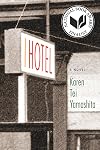
Just wow. A huge, sprawling, aimless and yet deadeye story of identity, resistance, success and failure, all that jazz (as in free, as in Rahsaan Roland Kirk's twin saxes blowing different melodies at the same time, as in Miles' electric phase fusing white-boy funk with black panther politics, as in Thomas P), ancient folk tales and pragmatic political actions, Mao vs Reagan, all scattered out over 600 pages, 10 years, the echo of billions and centuries in a few dozen people over 10 years, show more spoken in scores of voices and a new genre for every chapter. Written in every perspective and yet somehow ending in a clenched-fist first-person-plural. I'll try to write something more coherent about it, but I'm not sure I can. show less
The International Hotel (I-Hotel) was built a year after the devastating 1906 San Francisco earthquake in Manilatown, a community of some 20,000 Filipino immigrants on the edge of Chinatown. It was a residential hotel, which mainly housed Filipino and Chinese immigrant bachelors who worked in nearby businesses but couldn't afford homes, along with a smattering of artists and community and political activists that moved there in the 1960s. The I-Hotel sat in the shadow of the Financial show more District's famed Transamerica Pyramid, and as the area became more populated with gleaming office buildings the land adjacent to the hotel became more desirable while the building seemed more and more out of place. The hotel was purchased by a wealthy Chinese investor in 1968, who planned to tear down the building, evict its residents, and build a more profitable high-rise tower.
The residents of the hotel and community activists fought the developer and the city for years to prevent its demise. However, in 1977 the city's police department physically overpowered dozens of protesters and forcibly evicted its remaining residents, who were mostly elderly men who had lived there for decades, and the building was torn down immediately afterward. Ironically, the planned commercial development never took place, and a reincarnation of the I-Hotel for low- and middle-income residents was built on this site in 2005.
Karen Tei Yamashita, a professor of Literature and Creative Writing at UC Santa Cruz, uses the I-Hotel as the basis for this ambitious, sprawling, unique and successful novel about the Asian American civil rights movement, or Yellow Power movement, in San Francisco, Berkeley and other Bay Area cities in the 1960s and 1970s. The book is divided into 10 novellas, and each revolves around mostly fictional characters who are deeply involved in the burgeoning movement, including student protests at San Francisco State and UC Berkeley, the Native American takeover of Alcatraz Island, the efforts of farm workers to earn a decent wage and working conditions, and, of course, the unsuccessful efforts to save the I-Hotel. Yamashita uses a variety of tools to tell these stories, including poetry, portraits, graphic art, and government manuscripts.
Most of these novellas were very well done, and the book's ending was superb. Throughout the book I felt as if I was an observer being pulled along, sometimes breathlessly, from one story and one locale to another, in a whirlwind series of historical and personal narratives by a persistent and passionate guide. At the book's end I was somewhat fatigued, a bit overwhelmed, but ultimately grateful for the journey and what I learned along the way. show less
The residents of the hotel and community activists fought the developer and the city for years to prevent its demise. However, in 1977 the city's police department physically overpowered dozens of protesters and forcibly evicted its remaining residents, who were mostly elderly men who had lived there for decades, and the building was torn down immediately afterward. Ironically, the planned commercial development never took place, and a reincarnation of the I-Hotel for low- and middle-income residents was built on this site in 2005.
Karen Tei Yamashita, a professor of Literature and Creative Writing at UC Santa Cruz, uses the I-Hotel as the basis for this ambitious, sprawling, unique and successful novel about the Asian American civil rights movement, or Yellow Power movement, in San Francisco, Berkeley and other Bay Area cities in the 1960s and 1970s. The book is divided into 10 novellas, and each revolves around mostly fictional characters who are deeply involved in the burgeoning movement, including student protests at San Francisco State and UC Berkeley, the Native American takeover of Alcatraz Island, the efforts of farm workers to earn a decent wage and working conditions, and, of course, the unsuccessful efforts to save the I-Hotel. Yamashita uses a variety of tools to tell these stories, including poetry, portraits, graphic art, and government manuscripts.
Most of these novellas were very well done, and the book's ending was superb. Throughout the book I felt as if I was an observer being pulled along, sometimes breathlessly, from one story and one locale to another, in a whirlwind series of historical and personal narratives by a persistent and passionate guide. At the book's end I was somewhat fatigued, a bit overwhelmed, but ultimately grateful for the journey and what I learned along the way. show less

A very enjoyable read. This book reminds me of those strange and meandering novels (like Tom Robbins) except with an environmental bent, but not with the heavy-laden activist tone of early Carl Hiaasen. It is a great book with several interweaving plots and quite a bit of magical realism. Some parts of it are laugh out loud funny.
Yamashita is an interesting writer; while one of the protagonists is Japanese (and this takes place in the Japanese expatriate community in Brazil), this is not show more necessarily an Asian-American book. I have heard however her say in interviews that she completely identifies herself as an Asian-American author – I wonder if that is pointing to the new globalism/cosmopolitan trend we’re seeing nowadays.
It’s a fun read regardless of your political or racial proclivities so I would pick it up if you’re a fan of Robbins, Pynchon, maybe even David Foster Wallace (lite) and others. It explores interesting ideas in science, religion, and throws in some corporate irresponsibility for good measure. Overall a very memorable book and one of my new favorites. show less
Yamashita is an interesting writer; while one of the protagonists is Japanese (and this takes place in the Japanese expatriate community in Brazil), this is not show more necessarily an Asian-American book. I have heard however her say in interviews that she completely identifies herself as an Asian-American author – I wonder if that is pointing to the new globalism/cosmopolitan trend we’re seeing nowadays.
It’s a fun read regardless of your political or racial proclivities so I would pick it up if you’re a fan of Robbins, Pynchon, maybe even David Foster Wallace (lite) and others. It explores interesting ideas in science, religion, and throws in some corporate irresponsibility for good measure. Overall a very memorable book and one of my new favorites. show less
This book is a masterpiece.
It's somewhat experimental fiction, and clearly not everyone likes that (see other reviews), but as a whole I have seen nothing that tackles the subject matter and time period with such attention to detail, spirit, and, well, affection. Not nostalgic -- if anything certain segments remind me too much of situations I'm glad I'm not in anymore -- but I Hotel distills the political time and place of SF in the '70s better than anything I have ever read.
This book makes show more the untold history of this time come alive. Best book I read in 2010. show less
It's somewhat experimental fiction, and clearly not everyone likes that (see other reviews), but as a whole I have seen nothing that tackles the subject matter and time period with such attention to detail, spirit, and, well, affection. Not nostalgic -- if anything certain segments remind me too much of situations I'm glad I'm not in anymore -- but I Hotel distills the political time and place of SF in the '70s better than anything I have ever read.
This book makes show more the untold history of this time come alive. Best book I read in 2010. show less
Lists
Awards


You May Also Like


Associated Authors
Statistics
- Works
- 11
- Also by
- 6
- Members
- 1,265
- Popularity
- #20,290
- Rating
- 3.8
- Reviews
- 27
- ISBNs
- 33
- Languages
- 1
- Favorited
- 1