
Bettina Stangneth
Author of Eichmann Before Jerusalem: The Unexamined Life of a Mass Murderer
About the Author
Image credit: Via Wikipedia
Works by Bettina Stangneth
Associated Works
Tagged
Common Knowledge
Members
Reviews
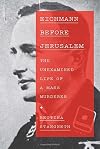
If the title of Bettina Stangneth's book brings to your mind Hannah Arendt's Eichmann in Jerusalem, you have come to the place Stangneth intended. This book is of course about Eichmann's career from SS man to one of the most-wanted Nazi exiles. But as Stangneth also notes, "Ever since Eichmann in Jerusalem: A Report on the Banality of Evil was published in 1963, every essay on Adolf Eichmann has also been a dialogue with Hannah Arendt."
In this case, Stangneth attempts a devastating dialogue show more indeed. Her supremely well-researched work refutes Arendt in a most calamitous manner. No mere "ordinary man who was turned into a thoughtless murderer by a totalitarian regime," Stangneth painstakingly documents the life and mind of a systematic thinker who relished his history of active and intentional annihilation. The "banality of evil" turns out to be an absolute bust delivered by one of the most perceptive of philosophical minds. Arendt made two major mistakes as pointed out by Norman Podhoretz and illustrated in Stangneth's book: 1) that Arendt naively took Eichmann at his word when he claimed to be a hapless and helpless cog in the Nazi regime, and 2) that Arendt was convinced that Eichmann must illustrate something about the nature of totalitarianism. However, as Podhoretz writes in Commentary in 1963:
It isn't shocking to be given such ample proof that Eichmann was an extraordinary monster. Indeed, as Podhoretz notes, that's what we all knew before Arendt arrived on the scene with her dazzling paradoxes. As an admirer of Arendt, what is truly shocking about Stangneth's book is how wrong Ardent could be and how bankrupt her eloquence now seems.
Not to misrepresent Eichmann Before Jerusalem: Stangneth's work is not concerned with refuting Arendt point by point. In fact, Arendt's name and references to her book appear only half a dozen times. Stangneth's research into Eichmann's career is itself the refutation of Eichmann's supposed "banality." The result, however, is to put the idea of the banality of evil on shaky intellectual ground. I can only repeat a term I used earlier: this is a devastating loss of an idea that once, at least for me, seemed so vital and illuminating. Stangneth's work forces the reader to see it from Podhoretz's confident high ground: the banality of evil simply doesn't wash. show less
In this case, Stangneth attempts a devastating dialogue show more indeed. Her supremely well-researched work refutes Arendt in a most calamitous manner. No mere "ordinary man who was turned into a thoughtless murderer by a totalitarian regime," Stangneth painstakingly documents the life and mind of a systematic thinker who relished his history of active and intentional annihilation. The "banality of evil" turns out to be an absolute bust delivered by one of the most perceptive of philosophical minds. Arendt made two major mistakes as pointed out by Norman Podhoretz and illustrated in Stangneth's book: 1) that Arendt naively took Eichmann at his word when he claimed to be a hapless and helpless cog in the Nazi regime, and 2) that Arendt was convinced that Eichmann must illustrate something about the nature of totalitarianism. However, as Podhoretz writes in Commentary in 1963:
No. It finally refuses to wash; it finally violates everything we know about the Nature of Man, and therefore the Nature of Totalitarianism must go hang. For uninteresting though it may be to say so, no person could have joined the Nazi party, let alone the S.S., who was not at the very least a vicious anti-Semite; to believe otherwise is to learn nothing about the nature of anti-Semitism. Uninteresting though it may be to say so, no person of conscience could have participated knowingly in mass murder: to believe otherwise is to learn nothing about the nature of conscience. And uninteresting though it may be to say so, no banality of a man could have done so hugely evil a job so well; to believe otherwise is to learn nothing about the nature of evil.
It isn't shocking to be given such ample proof that Eichmann was an extraordinary monster. Indeed, as Podhoretz notes, that's what we all knew before Arendt arrived on the scene with her dazzling paradoxes. As an admirer of Arendt, what is truly shocking about Stangneth's book is how wrong Ardent could be and how bankrupt her eloquence now seems.
Not to misrepresent Eichmann Before Jerusalem: Stangneth's work is not concerned with refuting Arendt point by point. In fact, Arendt's name and references to her book appear only half a dozen times. Stangneth's research into Eichmann's career is itself the refutation of Eichmann's supposed "banality." The result, however, is to put the idea of the banality of evil on shaky intellectual ground. I can only repeat a term I used earlier: this is a devastating loss of an idea that once, at least for me, seemed so vital and illuminating. Stangneth's work forces the reader to see it from Podhoretz's confident high ground: the banality of evil simply doesn't wash. show less
Club der Dilettanten: Warum niemand Bücher wirklich versteht, aber trotzdem jeder beim Lesen lernt | Eine Einladung zur Ehrlichkeit (German Edition) by Bettina Stangneth

Jedes Wort über dieses kluge, lesenswerte und elegant geschriebene Buch würde mich sofort als Dilettant entlarven. Daher nur soviel: Ein Besuchsprogramm, bei dem mehr Fragen als Antworten auftauchen. Und das ist auch gut so - ohne Fragen kein Denken. Machen Sie bitte Ihre eigenen Leseerfahrungen im Club der Dilettanten. Es lohnt sich.
Auf den letzten Seiten diese grandiose Aussage:
»Dass eine Minderheit der Gesellschaft (und eine noch kleinere der Welt) Vorteile davon hat, wenn Menschen mit show more niedrigem Bildungsniveau zu niedrigem Lohn beschäftigt werden können, ist nun einmal so. Man nennt das dann: Tatsache. Diesen Zustand nicht zu ändern, ist bestenfalls gedankenlos, auf jeden Fall sozial kalt. Unbildung aber nicht nur bewusst zu erhalten, weil sie für einige nützlich ist, sondern auch noch an der Entwicklung und dem Verkauf genau der Mittel zu verdienen, mit denen bereits Kinder von allem abgehalten werden, was sie unterstützen könnte, und stattdessen Zerstreuung zu kultivieren und die hungrigen kognitiven Kräfte an sinnlose Zeitverschwendung bis zur Abhängigkeit zu gewöhnen, ist ein Verbrechen. Gleichzeitig von Chancengleichheit zu reden, weil jeder ja die Geräte jederzeit ausschalten kann und sich einfach nur hinsetzen und diszipliniert lernen könnte, wenn er denn nur etwas werden wollte, das nennt man: moralische Verkommenheit.«
- Bettina Stangneth: Club der Dilettanten. Warum niemand Bücher wirklich versteht, aber trotzdem jeder beim Lesen lernt. - S. 243f show less
Auf den letzten Seiten diese grandiose Aussage:
»Dass eine Minderheit der Gesellschaft (und eine noch kleinere der Welt) Vorteile davon hat, wenn Menschen mit show more niedrigem Bildungsniveau zu niedrigem Lohn beschäftigt werden können, ist nun einmal so. Man nennt das dann: Tatsache. Diesen Zustand nicht zu ändern, ist bestenfalls gedankenlos, auf jeden Fall sozial kalt. Unbildung aber nicht nur bewusst zu erhalten, weil sie für einige nützlich ist, sondern auch noch an der Entwicklung und dem Verkauf genau der Mittel zu verdienen, mit denen bereits Kinder von allem abgehalten werden, was sie unterstützen könnte, und stattdessen Zerstreuung zu kultivieren und die hungrigen kognitiven Kräfte an sinnlose Zeitverschwendung bis zur Abhängigkeit zu gewöhnen, ist ein Verbrechen. Gleichzeitig von Chancengleichheit zu reden, weil jeder ja die Geräte jederzeit ausschalten kann und sich einfach nur hinsetzen und diszipliniert lernen könnte, wenn er denn nur etwas werden wollte, das nennt man: moralische Verkommenheit.«
- Bettina Stangneth: Club der Dilettanten. Warum niemand Bücher wirklich versteht, aber trotzdem jeder beim Lesen lernt. - S. 243f show less
No mere pencil pusher, Eichmann was, as he put it: “a fanatical warrior, fighting for the freedom of my blood.” He remained a committed Nazi even after the Reich collapsed and stayed true while on the run and right up to the end. Only his tactics changed as he posed in a humble demeanor after his capture in 1960. In Argentina, he attempted to publish his unapologetic memoir, which in 1957 even shocked some of his fellow Fourth Reich advocates.
They wanted to claim the holocaust was a show more Jewish lie. Some actually believed that and then tried to imagine the perpetrators, including Eichmann who refused to deny it occurred, as agents under the control of an outlandish Jewish conspiracy that perpetrated the holocaust on themselves through a secret control of SD & SS lackeys. Poor Hitler was hoodwinked!
If you’re crazy enough to be a racist, believing in genetic inbreeding as superior to swimming in a diverse gene pool, then you’re crazy enough to swallow these wild conspiracy theories! We can see parallels to current hard-line fanatics who will twist facts or refuse to believe them and cling to the wildest theories that defy the laws of logic and even gravity.
Nazi racial Anti-Semitism claimed the superiority of an imagined, somehow pure, “Aryan” race, but in Eichmann‘s rationale for genocide, he painted the Jews as “intellectually superior to” themselves and therefore a most dangerous and cunning enemy. See page 304 for a speech that he hoped would be his book‘s conclusion. show less
They wanted to claim the holocaust was a show more Jewish lie. Some actually believed that and then tried to imagine the perpetrators, including Eichmann who refused to deny it occurred, as agents under the control of an outlandish Jewish conspiracy that perpetrated the holocaust on themselves through a secret control of SD & SS lackeys. Poor Hitler was hoodwinked!
If you’re crazy enough to be a racist, believing in genetic inbreeding as superior to swimming in a diverse gene pool, then you’re crazy enough to swallow these wild conspiracy theories! We can see parallels to current hard-line fanatics who will twist facts or refuse to believe them and cling to the wildest theories that defy the laws of logic and even gravity.
Nazi racial Anti-Semitism claimed the superiority of an imagined, somehow pure, “Aryan” race, but in Eichmann‘s rationale for genocide, he painted the Jews as “intellectually superior to” themselves and therefore a most dangerous and cunning enemy. See page 304 for a speech that he hoped would be his book‘s conclusion. show less
Paraphrasing Eichmann:
"Oh, wait, did I forget to mention that I was an active piece of shit before the war years?"
"Eichmann Before Jerusalem" by Bettina Stangneth, the important work illuminating the real Eichmann, and respectfully disagreeing with Hannah Arendt and the naive/ignorant misapplication of her banality theory.
A little chatty and opinonated, but very readable and wholly interesting account of Eichmann immediately following the war and then his 15! years of hiding (without much show more effort).
Even though this is a modest "attack" on Arendt and her use of "the banality of evil" specifically for Eichmann (at the very beginning of the book), Stangeneth is mostly very respectful. In my 15 yrs of reading in depth about the Nazis, I was always at a huge advantage to Arendt (and 1960!) in knowing how very wrong she was. show less
"Oh, wait, did I forget to mention that I was an active piece of shit before the war years?"
"Eichmann Before Jerusalem" by Bettina Stangneth, the important work illuminating the real Eichmann, and respectfully disagreeing with Hannah Arendt and the naive/ignorant misapplication of her banality theory.
A little chatty and opinonated, but very readable and wholly interesting account of Eichmann immediately following the war and then his 15! years of hiding (without much show more effort).
Even though this is a modest "attack" on Arendt and her use of "the banality of evil" specifically for Eichmann (at the very beginning of the book), Stangeneth is mostly very respectful. In my 15 yrs of reading in depth about the Nazis, I was always at a huge advantage to Arendt (and 1960!) in knowing how very wrong she was. show less
Awards


You May Also Like


Associated Authors
Statistics
- Works
- 13
- Also by
- 1
- Members
- 292
- Popularity
- #80,151
- Rating
- 3.8
- Reviews
- 7
- ISBNs
- 28
- Languages
- 6