

Alan Moorehead (1910–1983)
Author of The White Nile
About the Author
Alan Moorehead was born in 1910 in Melbourne, Australia, and served as a foreign correspondent, winning international recognition for his reporting during WWII. Moorehead was the author of The White Nile, The Blue Nile, and over twenty other books. He passed away in 1983.
Series
Works by Alan Moorehead
The Fatal Impact: The Invasion of the South Pacific, 1767-1840 (1966) — Author — 493 copies, 6 reviews
The Blue & White Nile 1 copy
La guerra del deserto 1 copy
Associated Works
Tagged
Common Knowledge
- Canonical name
- Moorehead, Alan
- Legal name
- Moorehead, Alan McCrae
- Birthdate
- 1910-07-22
- Date of death
- 1983-09-29
- Gender
- male
- Education
- University of Melbourne (BA|1933)
Scotch College, Melbourne - Occupations
- foreign correspondent, London Daily Express (1936-39)
war correspondent (WWII)
writer - Organizations
- London Daily Express
World League for Conservation (patron) - Awards and honors
- Order of the British Empire (Commander, 1968)
Royal Society of Literature Prize (1956, 1963)
Order of Australia (Officer, 1978)
Duff Cooper Memorial Award (1956)
Order of the British Empire (Officer, 1946) - Relationships
- Moorehead, Lucy (wife - nee Milner)
- Cause of death
- stroke
- Nationality
- Australia
- Birthplace
- Melbourne, Victoria, Australia
- Places of residence
- Melbourne, Victoria, Australia
England, UK
Italy - Place of death
- London, England, UK
- Burial location
- Hampstead Cemetery, Fortune Green, London, England, UK
- Associated Place (for map)
- Fortune Green, London, England, UK
Members
Reviews
I would assume every Australian knows the story of Burke & Wills to cross the Australian continent in 1861 like every Brit knows the later Scott of the Antarctic. Like the Antarctic expedition the planning and strategy was haphazard and the choice of a leader was perhaps not ideal. Like Scott they were also plagued by extraordinarily bad luck. And like Scott, almost nothing of value was learned from the expensive fiasco. Wright becomes the villain as he selfishly delays to follow up the lead show more expedition and replenish depot LXV at Cooper's Creek. Brahe becomes the [a:Apsley Cherry-Garrard|27180|Apsley Cherry-Garrard|https://s.gr-assets.com/assets/nophoto/user/u_50x66-632230dc9882b4352d753eedf9396530.png] of this story as he abandons the depot a mere 9 hours before the lead expedition returns due to his own team's lack of resources and oncoming illness and Wright's failure to ever return to resupply.
Moorehead keeps the narrative interesting even though we know the basic outcome; just the right mix of lively and literate and accurate, clearly pointing out where he is interpolating. He has to piece together much of the information to create a complete story due to a paucity of source material; the expedition while in the bush was particularly lazy at keeping any sorts of journals or diaries.
I had read Moorehead's [b:The White Nile|4621482|The White Nile|Alan Moorehead|https://d.gr-assets.com/books/1343011040s/4621482.jpg|336217] before so I knew he could spin a suspenseful narrative out of historical ingredients.
Before this I had thought the British had cornered the market on the glorious disaster but after reading this I see the Australians have their own version. show less
Moorehead keeps the narrative interesting even though we know the basic outcome; just the right mix of lively and literate and accurate, clearly pointing out where he is interpolating. He has to piece together much of the information to create a complete story due to a paucity of source material; the expedition while in the bush was particularly lazy at keeping any sorts of journals or diaries.
I had read Moorehead's [b:The White Nile|4621482|The White Nile|Alan Moorehead|https://d.gr-assets.com/books/1343011040s/4621482.jpg|336217] before so I knew he could spin a suspenseful narrative out of historical ingredients.
Before this I had thought the British had cornered the market on the glorious disaster but after reading this I see the Australians have their own version. show less

I read a 1987 expanded edition of the original book published in 1966. This later edition is lavishly illustrated to coincide with the text Moorehead wrote. I think I read every single word of the captions to the illustrations, paintings and add-ins as well as every word of the book itself. Don't laugh. Non-fiction books can get tedious. Not this one.
The author is a skilled writer in bringing together various memoirs and events to show the effects of European exploration and contact in the show more Pacific Ocean, focusing in three parts on Tahiti, Australia and Antarctica. Primarily built around Captain Cook's three voyages. So much was recorded and collected and this book brought it forward in time. I knew bits of this but I found the narrative completely engrossing. Journeys of discovery and the end of the world that was.
As sad as it is for the indigenous peoples of Tahiti and Australia the worst world devastation to come was because of Cook's exploration of the Antarctic region. He found countless millions of seals, sea lions, penguins, sea birds, whales and other creatures living in a balance with their world. When he returned from his trip the whalers and others of the world set out from England and La Havre and Nantucket and elsewhere to kill and destroy relentlessly. It is sickening. show less
The author is a skilled writer in bringing together various memoirs and events to show the effects of European exploration and contact in the show more Pacific Ocean, focusing in three parts on Tahiti, Australia and Antarctica. Primarily built around Captain Cook's three voyages. So much was recorded and collected and this book brought it forward in time. I knew bits of this but I found the narrative completely engrossing. Journeys of discovery and the end of the world that was.
As sad as it is for the indigenous peoples of Tahiti and Australia the worst world devastation to come was because of Cook's exploration of the Antarctic region. He found countless millions of seals, sea lions, penguins, sea birds, whales and other creatures living in a balance with their world. When he returned from his trip the whalers and others of the world set out from England and La Havre and Nantucket and elsewhere to kill and destroy relentlessly. It is sickening. show less

Well written account of the author’s time covering WW2. Primarily across N Africa but also other travels including the US in the first 6 months of our entry into the war. The writing is excellent, and done in the moment not with benefit of the big picture. Very good insights into the personalities who were responsible for decision making as well as understanding the soldier at the point of the spear. Recommended.
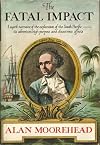
Moorehead has followed up his fascinating trek into Africa (The Blue Nile & The White Nile), with a short, but equally elegant "account of the invasion of the South Pacific, 1761-1840." The hero here, of course, is Captain James Cook, with Moorehead concentrating on the voyage to Tahiti, New Zealand & Australia, & the later exploration of the Antarctic Circle & the South Pole. As acknowledged, he's drawn heavily on the historian J.C. Beaglehole's definitive volumes, as well as from other show more weighty sources. But this should not dismay the layman. He has the novelist's eye, not only in his firm but sensuous descriptions, but also in his stunning ability to evoke character, interweave various tales, & see a Jumble of facts & conjectures as a means of releasing whatever dramatic moments are around. The confrontation between aggressive Europeans & innocent primitive tribes affords ample opportunity. The book is a requiem for an idyllic past, moving in its picture of a wild civilization slowly eroding under the impact of commercial progress or geographical expansion, exciting in its interplay of differing psychological attitudes or customs, & developed with many crisscrossing references: Bougainville & Banks, Melville & Gauguin, the Bounty mutiny & the little known efforts of the Englishwoman Daisy Bates to save the Aborigines. A lovely, sophisticated work. show less
Lists
THE WAR ROOM (1)
Awards


You May Also Like


Associated Authors
Statistics
- Works
- 29
- Also by
- 11
- Members
- 6,108
- Popularity
- #4,030
- Rating
- 3.9
- Reviews
- 85
- ISBNs
- 193
- Languages
- 12
- Favorited
- 10
