

Yevgeny Zamyatin (1884–1937)
Author of We
About the Author
Zamyatin studied at the Polytechnic Institute in St. Petersburg and became a professional naval engineer. His first story appeared in 1908, and he became serious about writing in 1913, when his short novel A Provincial Tale (1913) was favorably received. He became part of the neorealist group, show more which included Remizov and Prishvin. During World War I, he supervised the construction of icebreakers in England for the Russian government. After his return home, he published two satiric works about English life, "The Islanders" (1918) and "The Fisher of Men" (1922). During the civil war and the early 1920s, Zamyatin published theoretical essays as well as fiction. He played a central role in many cultural activities---as an editor, organizer, and teacher of literary technique---and had an important influence on younger writers, such as Olesha and Ivanov. Zamyatin's prose after the Revolution involved extensive use of ellipses, color symbolism, and elaborate chains of imagery. It is exemplified in such well-known stories as "Mamai" (1921) and "The Cage" (1922). His best-known work is the novel We (1924), a satiric, futuristic tale of a dystopia that was a plausible extrapolation from early twentieth-century social and political trends. The book, which directly influenced George Orwell's (see Vol. 1) 1984, 1984, was published abroad in several translations during the 1920s. In 1927 a shortened Russian version appeared in Prague, and the violent press campaign that followed led to Zamyatin's resignation from a writers' organization and, eventually, to his direct appeal to Stalin for permission to leave the Soviet Union. This being granted in 1931, Zamyatin settled in Paris, where he continued to work until his death. Until glasnost he was unpublished and virtually unknown in Russia. (Bowker Author Biography) show less
Series
Works by Yevgeny Zamyatin
ICS 4 copies
WE; THE IRON HEEL; THE AIR TRUST: A Dystopian Trilogy (Timeless Wisdom Collection Book 2500) (2014) 3 copies
Ilhéus 2 copies
Черно слънце 2 copies
Лица 2 copies
A Provincial Tale, A Godforsaken Hole and The Islanders: Uezdnoe, Na kulichkakh i Ostrovitiane (Russian Edition) (2016) 2 copies, 1 review
Мы : роман 1 copy
Избранное 1 copy
Kristali i snoviđenja 1 copy
Сказки 1 copy
ПОВЕСТИ И РАССКАЗЫ 1 copy
Relatos satìricos 1 copy
Избранное / Selected 1 copy
The Miracle Of Ash Wednesday 1 copy
Spotkanie 1 copy
La caverne ; suivi de Les feux de saint Dominique : et autres écrits sur la guerre civile, 1918-1921 (2024) 1 copy
Bajke za veliku decu 1 copy
Ostrvljani 1 copy
Erzählungen 1917-1928 1 copy
God 1 copy
Selected Short Stories: Mamai, The Cave, Tales for Big Kids, A Story about the Most Important Thing (Russian Edition) (2017) 1 copy
Нечестивые рассказы 1 copy
Избранное 1 copy
Associated Works
75 Short Masterpieces: Stories from the World's Literature (1961) — Contributor — 317 copies, 2 reviews
Anthology of Russian Literature in the Soviet Period from Gorki to Pasternak (1960) — Contributor — 69 copies
Dystopia Boxed Set: 18 Dystopian Classics in One Edition — Contributor — 1 copy
7 Novel Dystopian Collection — Contributor — 1 copy
Tagged
Common Knowledge
- Canonical name
- Zamyatin, Yevgeny
- Legal name
- Замя́тин, Евге́ний Ива́нович
- Other names
- Zamyatin, Evgenii
Zamyatin, Evgenii Ivanovich
Zamiatin, Eugene Ivanovich - Birthdate
- 1884-02-01
- Date of death
- 1937-03-10
- Gender
- male
- Education
- St. Petersburg Polytechnical Institute
- Occupations
- novelist
journalist
teacher
engineer - Organizations
- Serapion Brothers
Social-Democratic Party - Nationality
- Russia
- Birthplace
- Lebedyen, Tambov, Russia
- Places of residence
- St. Petersburg, Russia
Finland
Newcastle-upon-Tyne, Northumberland, England, UK - Place of death
- Paris, Île-de-France, France
- Burial location
- Cimetière Parisien de Thiais, Paris, Île-de-France, France
- Map Location
- Russia
Members
Discussions
We by Zamiatin in Fans of Russian authors (August 2011)
Reviews

A predecessor to dystopian classics 1984 and Brave New World, We is written in the style of a journal, that of of D-503, a spacecraft engineer who lives in the 'United State'. The organization and rules of the 'United State' strictly uphold the superiority of logic, mathematics, and reason, positing that individuality and freedom are roadblocks that prevent humans from reaching unbridled happiness. D-503 lives in a glass house like everyone so that all of his actions can be seen by his show more neighbors and the state, he follows the mandated 50 repetitions of 'mastication' before swallowing a bite of food, and he fills out 'pink sheets' on other community members for scheduled and detached sex. Yet through all of this D-503 has an awakening of his individuality, or his soul. He begins to see the world as it truly is, and discovers that there are others like him, that another revolution is not only possible but also imminent.
I'm split with my opinion on We. I struggled immensely through the actual prose of it. It's written in a way that heavily resembles the thought process of a confused and damaged mind. Sentences or even entire lines of the thought will end instantaneously, details are obfuscated and nebulous, and the location and timing of events is often unclear. There are certainly moments of clarity that provide perspective. Especially interesting is the final chapter of the book, after D-503 has had the surgery to remove his 'illness'. Everything is in focus and logical, detached from the events that are described. The ending made me rethink my opinion on the writing style, but I still can't quite get past it. It was not the most enjoyable of a reading experience, but looking back on it I'm glad that I pushed through finished the book.
That all being said, I think it's crazy that We isn't more commonly held in the same group of classic dystopian as those previously mentioned, especially since it predates and even heavily influenced them. There is some especially important and unique conversations about the role of revolution in society. Zamyatin, perhaps criticizing the position of the soviet state that was forming around him, argues that, just as there is no highest number, there can be no final revolution. There will always be resistance in any group, and this resistance is vital to the health of society. I also especially enjoyed discussion of self reflection as it relates to the line: "A healthy eye, a finger, a tooth is not felt. Is it not clear then that consciousness of oneself is a sickness?". We spends a lot of time dealing with self discovery and agency as it relates to a government that preaches conformity. D-503's journey is both interesting because of the revolution that buds around him, and his own growth as a person that eventually gets snuffed out by the state. I think that We grows stronger as the story progresses. It also has some dated by brilliant world building that is buttressed by knowing how creative it must've been at it's publication.
We is a flawed work to be sure, but it's also deeply thematic and rich. It deserves it's place as one of the grandfathers of the genre, but stands on it's own merits as well. show less
I'm split with my opinion on We. I struggled immensely through the actual prose of it. It's written in a way that heavily resembles the thought process of a confused and damaged mind. Sentences or even entire lines of the thought will end instantaneously, details are obfuscated and nebulous, and the location and timing of events is often unclear. There are certainly moments of clarity that provide perspective. Especially interesting is the final chapter of the book, after D-503 has had the surgery to remove his 'illness'. Everything is in focus and logical, detached from the events that are described. The ending made me rethink my opinion on the writing style, but I still can't quite get past it. It was not the most enjoyable of a reading experience, but looking back on it I'm glad that I pushed through finished the book.
That all being said, I think it's crazy that We isn't more commonly held in the same group of classic dystopian as those previously mentioned, especially since it predates and even heavily influenced them. There is some especially important and unique conversations about the role of revolution in society. Zamyatin, perhaps criticizing the position of the soviet state that was forming around him, argues that, just as there is no highest number, there can be no final revolution. There will always be resistance in any group, and this resistance is vital to the health of society. I also especially enjoyed discussion of self reflection as it relates to the line: "A healthy eye, a finger, a tooth is not felt. Is it not clear then that consciousness of oneself is a sickness?". We spends a lot of time dealing with self discovery and agency as it relates to a government that preaches conformity. D-503's journey is both interesting because of the revolution that buds around him, and his own growth as a person that eventually gets snuffed out by the state. I think that We grows stronger as the story progresses. It also has some dated by brilliant world building that is buttressed by knowing how creative it must've been at it's publication.
We is a flawed work to be sure, but it's also deeply thematic and rich. It deserves it's place as one of the grandfathers of the genre, but stands on it's own merits as well. show less
A Provincial Tale, a Godforsaken Hole and the Islanders: Uezdnoe, Na Kulichkakh I Ostrovitiane (Russian Edition) by Yevgeny Zamyatin
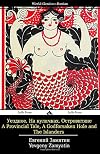
What a treat!.... I've recently discovered Yevgeny Zamyatin (1884-1937) as the author of "We" - a dystopian gem - and have been curious about him ever since. When I searched and found this little book of three novellas, I didn't know what to expect. And he blew me away again - but on another level. Not only it's completely different from "We" in style, it's seems utterly untranslatable into English, on maybe only remotely translatable - so much so that I was happy I ended up with the show more original Russian version.
He makes up his own words and phrases at times - words that describe a situation or a person so much more precisely than existing words, and that was an eye-opener too. He seems to thrive on satire and irony and is so clever and fresh and good at it as hardly any author I have encountered. His power of observation of a Russian soul, Russian identity is unparalleled, his adherence to detail in his descriptions is superb.
The first two novellas take place in Russia, the third - in England. And he shifts from East to West with incredible ease - pinpointing, in the outrageously descriptive, hilarious (and at times morbidly sarcastic and/or melodramatic) way everything that stands out in each nationality. But at the same time, he doesn't stereotype (well, he does - with a masterful touch - and he doesn't!) - his characters are made of their own individual traits, often very unusual in a compellingly good way, and often - so exaggeratedly off-putting that it takes you by surprise; but it makes them no less real. show less
He makes up his own words and phrases at times - words that describe a situation or a person so much more precisely than existing words, and that was an eye-opener too. He seems to thrive on satire and irony and is so clever and fresh and good at it as hardly any author I have encountered. His power of observation of a Russian soul, Russian identity is unparalleled, his adherence to detail in his descriptions is superb.
The first two novellas take place in Russia, the third - in England. And he shifts from East to West with incredible ease - pinpointing, in the outrageously descriptive, hilarious (and at times morbidly sarcastic and/or melodramatic) way everything that stands out in each nationality. But at the same time, he doesn't stereotype (well, he does - with a masterful touch - and he doesn't!) - his characters are made of their own individual traits, often very unusual in a compellingly good way, and often - so exaggeratedly off-putting that it takes you by surprise; but it makes them no less real. show less
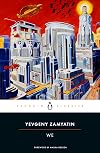
This classic novel is elegantly written (even in translation!), timeless in its message and so perfect in its assessment of what is often called "the human condition". I am so glad I read it. "We" is not "just another dystopian novel". Zamyatin captures the inability of humans to eliminate their soul, no matter how many generations of indoctrination have taken place. The story is told as a diary written by the main character, who begins as a supporter of the United State. In his writing, show more D-503 (yes everyone is a number) explores the concept that individuality breeds discontent and therefore never results in happiness. To avoid this unhappy state, one's life must be circumscribed by specific rules, including how many times to chew your food, in order to attain a feeling of contentment. He meets someone who totally contradicts that message and, perhaps for the first time in his life, has to confront what it means to think and act for oneself. This is devastating and leads him to seek medical help. He discovers that the happiness he thought he shared with others is not real. Other members of society have similar difficulties and fears about suppressing their individualism. Everything blows up at the end. I won't reveal what happens, but it is an amazing novel. Unforgettable and absolutely at the top of my list of all-time favorites. show less

In The Miracle of Ash Wednesday, in this collection, Zamyatin satirises religion, miracles, and selective vision. It posits that long-ago miracles are easier to believe than contemporary ones involving people one knows.
Doctor Voychek and Canon Simplicius regularly meet to play dominoes. The doctor has “green goat's eyes” and horns beneath red hair. The canon has delightful dimples in his cheeks and his eyes look like “two astonished babes with their thumbs in their mouths”.
The show more doctor suggests that the canon could extend his life and delay Judgement by travelling against the rotation of the earth.
This is going to be a strange story. And it is.
Image: Illustration for The Kenyon Review, by Edward Gorey, showing the three main protagonists
It’s hard to know what is ‘true’ in the context of the story, let alone what it means: there are many possibilities, all of them profound, and not all of them mutually exclusive.
Big spoiler: The canon starts to feel unwell and put on weight. He consults the doctor. In the waiting room, he talks to a spider-like woman, worried about the imminent birth of her third child. The doctor tells the canon that he is pregnant (it’s nine months since a special, private dinner with Archbishop Benedict) and ‘delivers’ a baby boy who the canon ‘adopts’ because the mother died in childbirth. On his deathbed, the canon says, “You must have thought, Felix, that I am your father. Well, I am not - I am your mother. Your father was the late Archbishop Benedict”.
A miracle, clerical abuse (but of a junior, male cleric, or is the canon a woman or intersex?), a prank by the doctor, a practical solution for a motherless babe, or what?
See also
This is very different from Zamyatin’s brilliant novel, We, which directly inspired Orwell’s 1984. See my review of We HERE, which includes a link to my review of 1984. However, the odd beautiful phrase here echoes those of the novel:
“The days were like amber rosary beads, one like the other, transparent, yellow. Then came a rosary of cool autumn crystal, and a rosary of snow-white ivory.”
Short story club
I read this in Black Water 2: More Tales of the Fantastic, by Alberto Manguel, from which I’m reading one story a week with The Short Story Club, starting 24 March 2025.
You can read this story in the group.
You can join the group here. show less
Doctor Voychek and Canon Simplicius regularly meet to play dominoes. The doctor has “green goat's eyes” and horns beneath red hair. The canon has delightful dimples in his cheeks and his eyes look like “two astonished babes with their thumbs in their mouths”.
The show more doctor suggests that the canon could extend his life and delay Judgement by travelling against the rotation of the earth.
This is going to be a strange story. And it is.
Image: Illustration for The Kenyon Review, by Edward Gorey, showing the three main protagonists
It’s hard to know what is ‘true’ in the context of the story, let alone what it means: there are many possibilities, all of them profound, and not all of them mutually exclusive.
Big spoiler:
A miracle, clerical abuse (but of a junior, male cleric, or is the canon a woman or intersex?), a prank by the doctor, a practical solution for a motherless babe, or what?
See also
This is very different from Zamyatin’s brilliant novel, We, which directly inspired Orwell’s 1984. See my review of We HERE, which includes a link to my review of 1984. However, the odd beautiful phrase here echoes those of the novel:
“The days were like amber rosary beads, one like the other, transparent, yellow. Then came a rosary of cool autumn crystal, and a rosary of snow-white ivory.”
Short story club
I read this in Black Water 2: More Tales of the Fantastic, by Alberto Manguel, from which I’m reading one story a week with The Short Story Club, starting 24 March 2025.
You can read this story in the group.
You can join the group here. show less
Lists
Best Dystopias (1)
Out of Copyright (1)
Reading LIst (1)
. (1)
100 knjiga (1)
Modernism (1)
A Novel Cure (1)
Unread books (1)
Reading Globally (1)
Folio Society (1)
Futurism Works (1)
1920s (1)
"We" narration (1)
Favourite Books (1)
Walls (1)
Best Satire (1)
Strange Cities (1)
Awards


You May Also Like


Associated Authors
Statistics
- Works
- 93
- Also by
- 21
- Members
- 10,610
- Popularity
- #2,242
- Rating
- 3.8
- Reviews
- 258
- ISBNs
- 355
- Languages
- 24
- Favorited
- 33

