
Clyde Prestowitz
Author of Rogue Nation: American Unilateralism And The Failure Of Good Intentions
About the Author
Clyde Prestowitz is the President of the Economic Strategy Institute in Washington, D.C. His previous book is Trading Places. He lives in Potomac, Maryland
Works by Clyde Prestowitz
Rogue Nation: American Unilateralism And The Failure Of Good Intentions (2003) 179 copies, 3 reviews
Three Billion New Capitalists: The Great Shift of Wealth and Power to the East (2005) 132 copies, 1 review
The Betrayal of American Prosperity: Free Market Delusions, America's Decline, and How We Must Compete in the Post-Dollar Era (2010) 55 copies
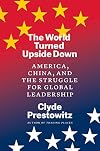
The World Turned Upside Down: America, China, and the Struggle for Global Leadership (2021) 17 copies, 3 reviews
Associated Works
Tagged
Common Knowledge
Members
Reviews

A real page-turner, laying bare the machinations of America's warped foreign policy and the hold of the industrial-political superstate, albeit somewhat dated (2003). If you join the dots, you could extend the line to the future, and in many ways explain the inevitability with which violence on an unprecedented scale is being perpetrated in this age of supposed enlightenment.
The World Turned Upside Down: America, China, and the Struggle for Global Leadership by Clyde Prestowitz
A good summary of the case against free trade, with some thoughtful observations about Chinese history and current politics.
I disagreed, back in the day, with the author's hardline position against Japan. Although history I think proved him wrong when Japanese industrial policy failed to achieve the dominance he predicted at the time, he makes a good defense for how it sowed the seeds of US eventual decline relative to China.
I disagreed, back in the day, with the author's hardline position against Japan. Although history I think proved him wrong when Japanese industrial policy failed to achieve the dominance he predicted at the time, he makes a good defense for how it sowed the seeds of US eventual decline relative to China.
The World Turned Upside Down: America, China, and the Struggle for Global Leadership by Clyde Prestowitz

In the latest issue of the American Prospect, Kuttner wrote a lengthy piece about US-China relations. In it, he cites a recent book—The World Turned Upside Down, by Clyde Prestowitz. I’ve been intrigued by the subject, so I just listened to the book over the past week.
Prestowitz and Kuttner argue that the US (and other global powers such as the UK) rose to global dominance through a mercantilist strategy, and that empires that move from mercantilism to a “free market” ideology fail. show more Their argument is support by the fact that, in the past 30 years, China has gone from being a rounding error in global economic terms, to likely surpass the US economically to become the largest economy in the world within the next decade. The UK and the US have strongly embraced “free markets” during this period, and China has pursued an extremely agressive mercantilist strategy.
China is run by the Chinese Communist Party. For every yuan the Party spends on its defense budget, it spends two yuan on domestic policing; in other words, the Party is very much not the “people’s” party. The Party is an alegal entity, meaning that there is no process whereby the party can be held to account. The military is run by the party, not the state.
US savings rates are 2%. Chinese savings rate are 45%. These funds are deposited in banks, and then directed by the CCP. 45% is a war-time savings rate; China has effectively been at war with the United States for the past 30 years…
It is worth calling out that this is in no way a racial issue. Taking issue with the CCP can be done in a way that stands in solidarity with the Chinese people, such as through supporting censorship resistance, human rights, etc.
I have a few questions related to some of my fields of work. With the CCP enforcing its crypto ban, which was issued in 2018, what is the outlook for the cryptocurrency community (whose values are likely the most archetypally diametric to the CCP)? And how will the CCP affect and engage with the global carbon markets? show less
Prestowitz and Kuttner argue that the US (and other global powers such as the UK) rose to global dominance through a mercantilist strategy, and that empires that move from mercantilism to a “free market” ideology fail. show more Their argument is support by the fact that, in the past 30 years, China has gone from being a rounding error in global economic terms, to likely surpass the US economically to become the largest economy in the world within the next decade. The UK and the US have strongly embraced “free markets” during this period, and China has pursued an extremely agressive mercantilist strategy.
China is run by the Chinese Communist Party. For every yuan the Party spends on its defense budget, it spends two yuan on domestic policing; in other words, the Party is very much not the “people’s” party. The Party is an alegal entity, meaning that there is no process whereby the party can be held to account. The military is run by the party, not the state.
US savings rates are 2%. Chinese savings rate are 45%. These funds are deposited in banks, and then directed by the CCP. 45% is a war-time savings rate; China has effectively been at war with the United States for the past 30 years…
It is worth calling out that this is in no way a racial issue. Taking issue with the CCP can be done in a way that stands in solidarity with the Chinese people, such as through supporting censorship resistance, human rights, etc.
I have a few questions related to some of my fields of work. With the CCP enforcing its crypto ban, which was issued in 2018, what is the outlook for the cryptocurrency community (whose values are likely the most archetypally diametric to the CCP)? And how will the CCP affect and engage with the global carbon markets? show less

slightly alarmist, but a good overview. some hilarious policy hopes though--I'm sure any day now the Japanese will give up the yen and join the dollar bloc. Yeah, right.
You May Also Like


Associated Authors
Statistics
- Works
- 10
- Also by
- 2
- Members
- 459
- Popularity
- #53,509
- Rating
- 3.8
- Reviews
- 7
- ISBNs
- 28
- Languages
- 3