
Svetlana Alexievich
Author of Voices from Chernobyl: The Oral History of a Nuclear Disaster
About the Author
Svetlana Alexievich was born in Stanislav, Ukraine, Soviet Union on May 31, 1948. She became a journalist and wrote narratives from interviews with witnesses to events such as World War II, the Soviet-Afghan war, the fall of the Soviet Union, and the Chernobyl disaster. Her books include Zinky show more Boys: Soviet Voices from the Afghanistan War and War's Unwomanly Face. She won the National Book Critics Circle Award in 2005 for Voices from Chernobyl: The Oral History of a Nuclear Disaster and the 2015 Nobel Prize in Literature. (Bowker Author Biography) show less
Image credit: Svetlana Alexievich, 2021
Works by Svetlana Alexievich
Associated Works
The Art of Fact: A Historical Anthology of Literary Journalism (1997) — Contributor — 225 copies, 1 review
Writing War: The Best Contemporary Journalism About Warfare and Conflict from Around the World (2003) — Contributor — 15 copies
Tagged
Common Knowledge
- Canonical name
- Alexievich, Svetlana
- Legal name
- Алексиевич, Светлана Александровна
Алексіевіч, Святлана Аляксандраўна
Alexievich, Svetlana Alexandrovna - Birthdate
- 1948-05-31
- Gender
- female
- Education
- Belarusian State University (journalism)
- Occupations
- investigative reporter
- Organizations
- Revue "Neuman" (Directeur du département d'essais et de journalisme (1976|1984)
Journal républicain " Selska Gazeta " (1973-1976)
Journal régional « Phare du communisme », Beroza (1972)
Journal régional « Pripyatskaya pravda », Narovlia (1966)
Ecole de sept ans Belazhevity du district de Mazyrskyi (Professeur, Histoire et allemand, 19 66)
Centre PEN biélorusse (Membre, 19 89 | ) (show all 7)
Union des écrivains soviétiques (Membe, 19 83 | ) - Awards and honors
- Ryszard Kapuściński Award (2011 ∙ 2015)
Friedenspreis des deutschen Buchhandels (2013)
Officier dans l'Ordre des Arts et des Lettres de la République française (2014)
Nobel Prize (Literature, 2015) - Agent
- Galina Dursthoff
- Short biography
- Elle a reçu de nombreux prix prestigieux pour son ouvrage La Supplication - Tchernobyl, chronique du monde après l'apocalypse (1997) (dont le Prix de la paix Erich-Maria-Remarque en 2001). Ce livre reste cependant toujours interdit en Biélorussie.
Elle est aussi l'auteure de La guerre n'aura pas un visage de femme (1985), ouvrage retraçant par des interviews le récit de femmes soldats de l'Armée rouge durant la Seconde Guerre mondiale, de Cercueils de zinc (1990, 1991 pour la version française), qui recueille des témoignages de soviétiques ayant participé à la guerre russo-afghane, de Ensorcelés par la mort, récits (1995), sur les suicides de citoyens russes après la chute du communisme et de Derniers témoins (2005), témoignages de femmes et d'hommes qui étaient enfants pendant la Seconde Guerre mondiale. En 2013, son livre La Fin de l’homme rouge ou Le Temps du désenchantement remporte le Prix Médicis essai.
Wikipedia - Nationality
- Belarus
- Birthplace
- Stanislaw, Ukraine, USSR (today: Ivano-Frankovsk, Ukraine)
- Places of residence
- Narovl, Gomel oblast, Byelorussian SSR, Soviet Union
Beresa, Brest oblast, Byelorussian SSR, Soviet Union
Minsk, Byelorussian SSR, Soviet Union
Paris, France
Gothenburg, Sweden
Berlin, Germany (show all 7)
Minsk, Belarus - Map Location
- Belarus
Members
Reviews
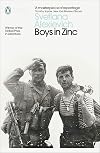
I strive desperately (from book to book) to do one and the same thing - reduce history to the human being... What must be reclaimed is the small, the personal and the specific. The single human being. The only human being for someone. Not as the state regards him, but who he is for his mother, for his wife, for his child. True to her aim, Alexievich details the Soviet government's systematic deception and neglect of its citizens and soldiers during the Soviet-Afghan war, as told to her by show more surviving soldiers and families. A collage of sacrifice, disillusion and heartbreak.
Interestingly, the last fifth of my edition of Boys in Zinc came with documents which detailed the trial where Alexievich was sued by some of the witnesses in her book for misconstruing their words.
Perhaps she did cherry-pick stories and change some details (and perhaps even composite stories into one) to support her own belief in the senselessness of the war or perhaps the trial was indeed a propaganda orchestrated by some powers-that-be coercing the witnesses to change their statements in order to discredit Alexievich.
I don't know.
Of course the statements must have been edited, for length, for clarity, for literary merit. Perhaps some details are not entirely accurate or perhaps downright false. But I believe in the general sentiment of the statements. That even if the details of one statement didn't actually all happen to that one witness, it happened to someone, interviewed or not. Oral history is so diaphanous, so emotionally charged, can it itself ever be truly factual, can it ever be captured factually?
That Alexievich manages to articulate such a public and private pain in a way that reduces meaningless historical statistics into stories about the individuals that we can relate to and empathise with, I find that to be more powerful than completely accurate "facts". But that might just be because this book and its version of events already conform with my preconceived ideas and this way my beliefs can go on unchallenged. show less
Interestingly, the last fifth of my edition of Boys in Zinc came with documents which detailed the trial where Alexievich was sued by some of the witnesses in her book for misconstruing their words.
Perhaps she did cherry-pick stories and change some details (and perhaps even composite stories into one) to support her own belief in the senselessness of the war or perhaps the trial was indeed a propaganda orchestrated by some powers-that-be coercing the witnesses to change their statements in order to discredit Alexievich.
I don't know.
Of course the statements must have been edited, for length, for clarity, for literary merit. Perhaps some details are not entirely accurate or perhaps downright false. But I believe in the general sentiment of the statements. That even if the details of one statement didn't actually all happen to that one witness, it happened to someone, interviewed or not. Oral history is so diaphanous, so emotionally charged, can it itself ever be truly factual, can it ever be captured factually?
That Alexievich manages to articulate such a public and private pain in a way that reduces meaningless historical statistics into stories about the individuals that we can relate to and empathise with, I find that to be more powerful than completely accurate "facts". But that might just be because this book and its version of events already conform with my preconceived ideas and this way my beliefs can go on unchallenged. show less
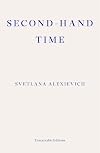
Because I generally hate fun, I spent April Fool’s Day avoiding the internet and reading about the downfall of the Soviet Union instead. Svetlana Alexievich’s books are always intense and devastating, it seems, although this one is longer and more thematically diffuse than [b:War's Unwomanly Face|4025275|War's Unwomanly Face|Svetlana Alexievich|https://i.gr-assets.com/images/S/compressed.photo.goodreads.com/books/1338204032l/4025275._SX50_.jpg|15615499] and [b:Chernobyl Prayer: A show more Chronicle of the Future|29675406|Chernobyl Prayer A Chronicle of the Future|Svetlana Alexievich|https://i.gr-assets.com/images/S/compressed.photo.goodreads.com/books/1459250416l/29675406._SY75_.jpg|1103107]. It seems appropriate to be reading about Russia’s recent history at the moment, to try and understand what the heck is going on. ‘Second-Hand Time’ reads well with [b:The Future Is History: How Totalitarianism Reclaimed Russia|34713325|The Future Is History How Totalitarianism Reclaimed Russia|Masha Gessen|https://i.gr-assets.com/images/S/compressed.photo.goodreads.com/books/1498868759l/34713325._SY75_.jpg|55893997] and [b:Nothing Is True and Everything Is Possible: The Surreal Heart of the New Russia|21413849|Nothing Is True and Everything Is Possible The Surreal Heart of the New Russia|Peter Pomerantsev|https://i.gr-assets.com/images/S/compressed.photo.goodreads.com/books/1407196452l/21413849._SY75_.jpg|40714614], both of which employ similar approaches. Nonetheless, it seems to me that ‘Second-Hand Time’ achieves much deeper insight. Alexievich weaves together personal testimonies from before and after the emergence of Russia from the USSR, combining horrifying suffering that makes Greek tragedy look mild with details of daily life’s texture. Of the latter, one that stood out was this joke from the seventies:
That joke has been recycled as the current FBI agent meme. The self-consciousness of being continually monitored by the authorities is now part of Western culture too.
'Second-Hand Time' gave me a better understanding of [b:The End of History and the Last Man|57981|The End of History and the Last Man|Francis Fukuyama|https://i.gr-assets.com/images/S/compressed.photo.goodreads.com/books/1566832175l/57981._SX50_.jpg|56476] triumphalism than anything else I've read, including Fukuyama's actual book. What emerges from the voices here is a sense that the USSR slide abruptly from authoritarian communism to authoritarian capitalism thanks to a collapse from the top. The people who took to the streets in 1991 and 1993 wanted a democracy and better-run socialism; they got another dictatorship and chaotic capitalism. The disorientating suddenness of this must have made capitalism seems inevitable, while the initial hopes for democracy suggested that the two go together. The nineties seem to have been a time of great deprivation yet idealism, while the 21st century saw economic stabilisation and a growing sense of fatalism. One idea that I found useful was that the USSR was a war state that could not function without violent conflict. The economy was set up to produce weapons, the culture to produce soldiers. Russia seems to have been sliding back in that direction in recent years, as Putin reignites old conflicts made new.
Inter-generational differences are a major theme. The wartime generation, the post-Stalin generation, and the post-Perestroika generation cannot understand or even trust each other. While generation gaps exist everywhere, they seem exceptionally wide and painful in Russia. A woman who was born in a gulag just before WWII:
Compare this with her son’s perspective:
The sprawling legacy of the USSR includes genocidal ethnic conflicts in Tajikistan and other former Soviet states, an epidemic of suicides, and widespread trauma. In the 1990s, there was hope that past wrongs could be confronted and some justice found; that hope is long gone now. An overwhelming sense of disillusionment pervades the whole book:
And this from a documentary-maker, which has a pathos that reminds me of Victor Hugo:
I advise the reader to take a break in the middle of ‘Second-Hand Time’, as it is very long and the intensity is difficult to handle for extended periods. I alternated it with some lighter reading. Alexievich’s books are uniquely extraordinary, I haven’t come across such a powerful, personal history anywhere else. For many of her interviewees, Alexievich seems to be a confessor, possibly also a therapist. Russia seems especially in need of this collective confession to deal with the many buried traumas of the past. show less
We talked non-stop, afraid that they were listening in, thinking they must be listening. There'd always be someone who'd halt mid-conversation and point to the ceiling light or the power outlet with a little grin, "Did you hear that, Comrade Lieutenant?" It felt a bit dangerous, a bit like a game.
That joke has been recycled as the current FBI agent meme. The self-consciousness of being continually monitored by the authorities is now part of Western culture too.
'Second-Hand Time' gave me a better understanding of [b:The End of History and the Last Man|57981|The End of History and the Last Man|Francis Fukuyama|https://i.gr-assets.com/images/S/compressed.photo.goodreads.com/books/1566832175l/57981._SX50_.jpg|56476] triumphalism than anything else I've read, including Fukuyama's actual book. What emerges from the voices here is a sense that the USSR slide abruptly from authoritarian communism to authoritarian capitalism thanks to a collapse from the top. The people who took to the streets in 1991 and 1993 wanted a democracy and better-run socialism; they got another dictatorship and chaotic capitalism. The disorientating suddenness of this must have made capitalism seems inevitable, while the initial hopes for democracy suggested that the two go together. The nineties seem to have been a time of great deprivation yet idealism, while the 21st century saw economic stabilisation and a growing sense of fatalism. One idea that I found useful was that the USSR was a war state that could not function without violent conflict. The economy was set up to produce weapons, the culture to produce soldiers. Russia seems to have been sliding back in that direction in recent years, as Putin reignites old conflicts made new.
Inter-generational differences are a major theme. The wartime generation, the post-Stalin generation, and the post-Perestroika generation cannot understand or even trust each other. While generation gaps exist everywhere, they seem exceptionally wide and painful in Russia. A woman who was born in a gulag just before WWII:
Does anyone care about any of this anymore? Show me - who? It hasn’t been useful or interesting to anyone for a long time. Our country doesn’t exist any more and it never will, but here we are… old and disgusting… with our terrifying memories and poisoned eyes. We’re right here! But what’s left of our past? Only the story that Stalin drenched the soil in blood, Khrushchev planted corn in it, and everybody laughed at Brezhnev. But what about our heroes?
Compare this with her son’s perspective:
That’s what we’re like… Imagine a victim and an executioner from Auschwitz sitting side by side in the same office, getting their wages out of the same window down in accounting. With identical war decorations. And now, the same pensions… [...] ...I’m very sad about our elderly, of course… They collect bottles in the stadiums, sell cigarettes in the metro at night. Pick through rubbish dumps. But our elderly are no innocents… That’s a terrifying thought! Seditious. I’m scared just thinking about it.
The sprawling legacy of the USSR includes genocidal ethnic conflicts in Tajikistan and other former Soviet states, an epidemic of suicides, and widespread trauma. In the 1990s, there was hope that past wrongs could be confronted and some justice found; that hope is long gone now. An overwhelming sense of disillusionment pervades the whole book:
I even put up flyers. We talked and read and read and talked. What did we want? Our parents wanted to say and read whatever they wanted. They dreamt of humane socialism… with a human face. And young people? We… we also dreamt of freedom. But what is it? Our idea of freedom was purely theoretical… We wanted to live like they do in the West. Listen to their music, dress like them, travel the world. “We want change… change…” sung Viktor Tsoi. We had no clue what we were hurtling towards. We just kept on dreaming...
And this from a documentary-maker, which has a pathos that reminds me of Victor Hugo:
When Gorbachev came to power, we ran around mad with glee. We lived in our dreams, our illusions. We wanted a new Russia… Twenty years down the line, it finally dawned on us: where was this new Russia supposed to come from? It never existed, and it still doesn’t today. Someone put it very accurately: in five years, everything can change in Russia, but in two hundred - nothing.
I advise the reader to take a break in the middle of ‘Second-Hand Time’, as it is very long and the intensity is difficult to handle for extended periods. I alternated it with some lighter reading. Alexievich’s books are uniquely extraordinary, I haven’t come across such a powerful, personal history anywhere else. For many of her interviewees, Alexievich seems to be a confessor, possibly also a therapist. Russia seems especially in need of this collective confession to deal with the many buried traumas of the past. show less
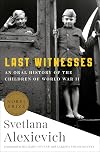
If you ever get in the doldrums and sit around feeling sorry for yourself about one First World problem or another, read this book to give you a better perspective of what it means to lose so so much. Heartbreaking doesn't begin to cover it. I listened to the audio and it was just excellent as the narrators took the parts of different Russians who survived the war when they were children. Barely.
It's not the first time I've read about people consuming their pets because they were in a state show more of starvation (see City of Thieves) but it is the first time I've heard actual first person descriptions of it. The children in the narration were aged from about four to early teens during the war. But believe me, they had no childhood; they were all adults regardless of their age because the horrific events they lived through took away any semblance of childhood.
This is a good book to keep in mind as we watch video footage of the innumerable war situations all over the world and consider the suffering of the children, especially the children. show less
It's not the first time I've read about people consuming their pets because they were in a state show more of starvation (see City of Thieves) but it is the first time I've heard actual first person descriptions of it. The children in the narration were aged from about four to early teens during the war. But believe me, they had no childhood; they were all adults regardless of their age because the horrific events they lived through took away any semblance of childhood.
This is a good book to keep in mind as we watch video footage of the innumerable war situations all over the world and consider the suffering of the children, especially the children. show less

„Megpróbálom a nagy történelmet emberléptékűvé kicsinyíteni, hogy valamit is megértsek. Megleljem a szavakat. De ezen a látszólag kicsiny és könnyen áttekinthető terepen – az emberi lélekben – még érthetetlenebb, még kevésbé megjósolható minden, mint a történelemben. Azért, mert valós könnyekkel, érzésekkel kerülök szembe. Valós emberi arccal, amelyen beszélgetés közben végigsuhannak a fájdalom és rettenet árnyai. Néha még meg is kísért az show more eretnek sejtés az emberi szenvedés alig felfogható szépségéről. Ilyenkor megrémülök magamtól.” (228. oldal)
Az első ötven oldal páros lábbal ugrik bele az emberbe. A többi pedig nyitva tartja a sebet. Alekszijevics nagy író, aki a más mondataival ír, de úgy, hogy végig érezni a jelenlétét a szavak mögött. Pedig riportalanyai gyakran érezhetően mítoszt teremtenek, foszlányokból összeeszkábált emlékképeket adnak el koherens valóság gyanánt, elhallgatnak, sőt: egyesek bizonyosan fabulálnak is. De ezzel is érzéseikről tanúskodnak, arról a vágyukról, hogy valami értelmet leljenek abban, amiben (ezt Alekszijeviccsel együtt hiszem) nincsen értelem – így egy monumentális kollázs részeként ők is segítenek, hogy közelebb jussunk az igazsághoz: hogy felismerjük bennük az embert. Ezeket a nőket arra nevelték, hogy nőként viselkedjenek, női szerepeket töltsenek be, női vágyaik legyenek, de egyszeriben egy olyan világban találják magukat, amire nem lehet felkészülni. Ez a világ (a háború) mindenkinek idegen, de a nők szemével nézve még erősebb a kontraszt. Nem az ő háborújuk – ha már valakié, akkor a politikusoké, akik ekkoriban szinte kivétel nélkül férfiak („karaktergyilkos szakma”, ahogy valaki mondta volt). Ha van értelme az egésznek, az az, hogy megmutatják, kilépve a nekik rendelt szerepekből is helyt tudnak állni. És ezt nem lehet visszacsinálni.
Ez a könyv irgalmatlanul közel hozza a háborút. Olyan közel, hogy émelyegni kell tőle – a vértől éppúgy, mint a hazugságoktól. Aki pedig ezektől nincs hányingere, az alighanem bolond vagy senkiházi. show less
Az első ötven oldal páros lábbal ugrik bele az emberbe. A többi pedig nyitva tartja a sebet. Alekszijevics nagy író, aki a más mondataival ír, de úgy, hogy végig érezni a jelenlétét a szavak mögött. Pedig riportalanyai gyakran érezhetően mítoszt teremtenek, foszlányokból összeeszkábált emlékképeket adnak el koherens valóság gyanánt, elhallgatnak, sőt: egyesek bizonyosan fabulálnak is. De ezzel is érzéseikről tanúskodnak, arról a vágyukról, hogy valami értelmet leljenek abban, amiben (ezt Alekszijeviccsel együtt hiszem) nincsen értelem – így egy monumentális kollázs részeként ők is segítenek, hogy közelebb jussunk az igazsághoz: hogy felismerjük bennük az embert. Ezeket a nőket arra nevelték, hogy nőként viselkedjenek, női szerepeket töltsenek be, női vágyaik legyenek, de egyszeriben egy olyan világban találják magukat, amire nem lehet felkészülni. Ez a világ (a háború) mindenkinek idegen, de a nők szemével nézve még erősebb a kontraszt. Nem az ő háborújuk – ha már valakié, akkor a politikusoké, akik ekkoriban szinte kivétel nélkül férfiak („karaktergyilkos szakma”, ahogy valaki mondta volt). Ha van értelme az egésznek, az az, hogy megmutatják, kilépve a nekik rendelt szerepekből is helyt tudnak állni. És ezt nem lehet visszacsinálni.
Ez a könyv irgalmatlanul közel hozza a háborút. Olyan közel, hogy émelyegni kell tőle – a vértől éppúgy, mint a hazugságoktól. Aki pedig ezektől nincs hányingere, az alighanem bolond vagy senkiházi. show less
Lists
1990s (1)
Women in War (1)
Oral Histories (1)
Vine Reads (1)
Disaster Books (1)
Read These Too (1)
Take Four Books (1)
Best of 2014 (1)
. (1)
Tagged Cold War (1)
Five star books (3)
Reading LIst (2)
THE WAR ROOM (1)
1980s (1)
Best First Lines (1)
Awards


You May Also Like


Associated Authors
Statistics
- Works
- 30
- Also by
- 6
- Members
- 8,331
- Popularity
- #2,897
- Rating
- 4.3
- Reviews
- 287
- ISBNs
- 364
- Languages
- 28
- Favorited
- 22
