
Christine de Pizan
Author of The Book of the City of Ladies
About the Author
Image credit: Christine de Pizan lecturing men. http://bcm.bc.edu/issues/winter_2010/endnotes/an-educated-lady.html
Works by Christine de Pizan
Christine De Pizan's Letter of Othea to Hector: Translated With Introduction, Notes, and Interpretative Essay (The Focus Library of Medieval Women) (1970) 24 copies
La rosa y el principe / The Rose and the Prince (Clasicos Medievales / Medieval Classics) (Spanish Edition) (2005) 3 copies
Christine de Pisan 2 copies
Le Livre Des Epitres Du Debat Sur Le Roman De La Rose (Moyen Age En Traduction, 12) (French Edition) (1401) 2 copies
L'oroyson nostre dame 1 copy
Žene i filozofija 1 copy
de Pisan, Christine Archive 1 copy
Associated Works
Wise Women: Over Two Thousand Years of Spiritual Writing by Women (1996) — Contributor — 230 copies, 1 review
The Defiant Muse: French Feminist Poems from the Middle Ages to the Present: A Bilingual Anthology (French and English Edition) (1986) — Contributor — 28 copies
Tagged
Common Knowledge
- Other names
- Pisan, Christine de
Pizan, Christine de - Birthdate
- 1364-09-11
- Date of death
- c. 1430
- Gender
- female
- Occupations
- poet
composer
biographer - Relationships
- Castel, Jean (son)
- Short biography
- Christine de Pizan was born in the Republic of Venice, in present-day Italy. Her father Tommaso di Benvenuto da Pizzano was a scholar, physician, and astrologer who encouraged her education. Her mother's name is unknown, but it is believed that she came from an aristocratic family. When Christine was four years old, the family moved to Paris, France, where her father was appointed court astrologer to King Charles V.
She was drawn to literature at an early age, but this was discouraged by her mother, who wanted her to concentrate on so-called women's work, such as spinning cloth and other domestic chores. In 1378, at about age 15, she was married to the French court secretary, Etienne du Castel, with whom she had three children. Ten years later, her father and then her husband died suddenly, leaving debts, and Christine had sole responsibility for the care of three children, her niece, and her mother.
She began writing poetry to make herself feel better, but eventually became the first female professional writer of the Middle Ages. She was able to win the support of wealthy and noble patrons who enjoyed her poems, ballads, and prose, and also gave her commissions.
In her work, she was unusually outspoken in her belief that women were the equals of men in every regard and should be given the same rights, opportunities, and respect. Her most important work, La cité des dames (The Book of the City of Ladies, 1405) was written to combat the sexist attitudes and negative stereotypes about women in her era. Although medieval women were not supposed to express their ideas or be independent, Christine de Pizan managed to do both successfully. - Nationality
- Republic of Venice (birth)
France - Birthplace
- Venice, Italy
- Places of residence
- Venice, Italy (birth)
Paris, France - Place of death
- Poissy, France
- Map Location
- France
Members
Reviews
The City of Ladies fits with Divine Comedy in the medieval burn book category. The structure is that of three allegorical women building a city for all good women to live within, but it’s a literary device to display the moral and intellectual goodness of women by bringing up a bunch of examples. The rhetorical device is actually incredibly similar to Dante's, where the narrator is a character with the name of the author who debases themselves to the guides, in this case female embodiments show more of Reason, Rectitude and Justice. This edition abbreviated some of the sections, but from what’s still there, my guess is that some of the additional examples were removed after one establishing one.
I found this one oddly inspirational. It’s described as an early feminist work, which is funny because it’s so basic, in terms of feminism, but I suppose that’s what you’re up to as a feminist in the fourteenth century. Arguments to support the ideas that, for example, women are not stupid, women can learn, women are not fickle or nagging or loose or morally inferior. show less
I found this one oddly inspirational. It’s described as an early feminist work, which is funny because it’s so basic, in terms of feminism, but I suppose that’s what you’re up to as a feminist in the fourteenth century. Arguments to support the ideas that, for example, women are not stupid, women can learn, women are not fickle or nagging or loose or morally inferior. show less
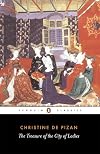
Considering this is written in 1405, Miss Christine can be quite savvy and forward-thinking. She often advocates tactics that today can be attributed to modern spin and public relations. This is an advice book for women from the first European professional female writer. It's an revealing window into the world of mostly upper class women in this time period, and things are not cut and dry. One of the strategies most advocated involves striking a happy medium.
Some of the advice, though not show more intended in this way, is simply precious. One of my favorites: A lady should not "use pilgrimages as an excuse to get away from the town in order to go somewhere to play about or kick up her heels in some merry company.... Nor should she go gadding around the town with young women..." This and other admonitions like it are balanced again strategies that suggest more power and wiggle room than one would think.
It's an informative look at Medieval upper and lower class as well as gender relations, and not always what I expected. She includes advice on how to handle military tactics, when it is okay to lie to your husband, how to keep from being swindled, and how to deal with a morally loose woman (especially when that woman is your lady employer). At times it is surprisingly contemporary. That the author had the conviction and authority to write it is a form of agency in itself. show less
Some of the advice, though not show more intended in this way, is simply precious. One of my favorites: A lady should not "use pilgrimages as an excuse to get away from the town in order to go somewhere to play about or kick up her heels in some merry company.... Nor should she go gadding around the town with young women..." This and other admonitions like it are balanced again strategies that suggest more power and wiggle room than one would think.
It's an informative look at Medieval upper and lower class as well as gender relations, and not always what I expected. She includes advice on how to handle military tactics, when it is okay to lie to your husband, how to keep from being swindled, and how to deal with a morally loose woman (especially when that woman is your lady employer). At times it is surprisingly contemporary. That the author had the conviction and authority to write it is a form of agency in itself. show less
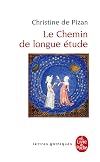
At the time of the writing of this book (1402) Christine de Pizan had much to be concerned about. Her country (France) was then plagued by a war against England, and it was just a matter of a few years before it would also descend into the Armagnac-Burgundian civil war. The situation might have been dire and dreadful, yet it had inspired her this long poem; an allegory on who's to blame for the state of her world and what could be done about it.
Being a retelling of the author's journey show more across various celestial spheres, much has been said about how it was based on Dante's 'Divine Comedy'. The comparison, though, stops there. If the structure may be loosely similar, Christine de Pizan does something very different when it comes to the content, as hers is about exposing a debate between Chivalry, Nobility, Wealth, and Wisdom to try and reach a consensus to solve the world's problems. Each starts by accusing each other for all the predicaments of the world before, at the suggestion of Reason, debating of what qualities should be embodied by a rightful leader who, it's expected, would be nominated to sort things out.
Now, as usual with Christine de Pizan what is striking here are two things. First, her putting forward of female characters to show female agency. She is, indeed, a woman taken by another woman to travel 'the path of long study', where she will ultimately meet the allegories named above (all females) before being chosen as their messenger to mankind. In a male world which was mostly dominated by male voices, the perspective was/ is refreshing. Then, her outlining of the medieval mentality even if, to her, there was nothing unusual here since she was just the product of a zeitgest to which, in many respect, she fully subscribed. The arguments put forth by Nobility, Chivalry and Wealth especially will strike as being seriously outdated to a modern audience; yet these arguments were nothing but common sense to medieval minds. She, then, can be accused of just parroting them without critical thinking, but to those interested in how people from another era thought and behaved such parroting ends up by being very enlightening in itself. One has indeed to be careful when assessing such historical figures; as for all her views deemed proto-feminism in many respect she, nevertheless, fully abided to many traditional standards of her time and it shows here (no matter how astute she had been on certain issues, she was certainly no revolutionary...).
In the end, this text surely has lost its poetry per se. This is not because it's badly written (it isn't!) but because it's written in Middle French, and so is impossible to assess in the original unless one reads Middle French (I don't). Having said that, as an allegory it remains a striking, enlightening journey. It's quite long to start, as it takes time before we enter into the debate itself. It, also, ends regretfully quite abruptly, as she is awaken from her dream a mere few verses after the debate actually ended! The arguments made, though, no matter how outdated to a modern audience are cleverly made, and demonstrate the author to have been a sharp mind as much as a creative one.
Is it a must-read? To those seeing Christine de Pizan only as a proto-feminist, and so concerned only about her work when explicitly addressing women's place and value in society, this poem won't be of interest by any shot. To others, though, curious about an era and how its many contemporaries thought, it will be a delightful allegory for what were troubled time and the ethos of those who lived through them. I, for one, took great pleasure reading this. show less
Being a retelling of the author's journey show more across various celestial spheres, much has been said about how it was based on Dante's 'Divine Comedy'. The comparison, though, stops there. If the structure may be loosely similar, Christine de Pizan does something very different when it comes to the content, as hers is about exposing a debate between Chivalry, Nobility, Wealth, and Wisdom to try and reach a consensus to solve the world's problems. Each starts by accusing each other for all the predicaments of the world before, at the suggestion of Reason, debating of what qualities should be embodied by a rightful leader who, it's expected, would be nominated to sort things out.
Now, as usual with Christine de Pizan what is striking here are two things. First, her putting forward of female characters to show female agency. She is, indeed, a woman taken by another woman to travel 'the path of long study', where she will ultimately meet the allegories named above (all females) before being chosen as their messenger to mankind. In a male world which was mostly dominated by male voices, the perspective was/ is refreshing. Then, her outlining of the medieval mentality even if, to her, there was nothing unusual here since she was just the product of a zeitgest to which, in many respect, she fully subscribed. The arguments put forth by Nobility, Chivalry and Wealth especially will strike as being seriously outdated to a modern audience; yet these arguments were nothing but common sense to medieval minds. She, then, can be accused of just parroting them without critical thinking, but to those interested in how people from another era thought and behaved such parroting ends up by being very enlightening in itself. One has indeed to be careful when assessing such historical figures; as for all her views deemed proto-feminism in many respect she, nevertheless, fully abided to many traditional standards of her time and it shows here (no matter how astute she had been on certain issues, she was certainly no revolutionary...).
In the end, this text surely has lost its poetry per se. This is not because it's badly written (it isn't!) but because it's written in Middle French, and so is impossible to assess in the original unless one reads Middle French (I don't). Having said that, as an allegory it remains a striking, enlightening journey. It's quite long to start, as it takes time before we enter into the debate itself. It, also, ends regretfully quite abruptly, as she is awaken from her dream a mere few verses after the debate actually ended! The arguments made, though, no matter how outdated to a modern audience are cleverly made, and demonstrate the author to have been a sharp mind as much as a creative one.
Is it a must-read? To those seeing Christine de Pizan only as a proto-feminist, and so concerned only about her work when explicitly addressing women's place and value in society, this poem won't be of interest by any shot. To others, though, curious about an era and how its many contemporaries thought, it will be a delightful allegory for what were troubled time and the ethos of those who lived through them. I, for one, took great pleasure reading this. show less
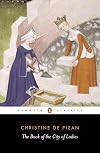
A cidade das damas foi fundamental para uma retratação de milênios de misoginia nas artes e na filosofia, de escritores vilipendiando a figura das mulheres. Também não podemos esquecer que Pizan constrói em tal livro um tratado moral baseado nos critérios de Razão, Retidão e Justiça que dão nome às damas de sua cidade utópica.
Tendo em vista que Pizan está sob o jugo do medievalismo cristão, fica patente que seu texto é seminal em progressismo feminista do que era vigente ao show more status quo da época. Um exemplo é como ela trabalha a questão de que a mulher saiu de fato da costela de Adão, Pizan podia enxergar nisso uma metáfora poética como pôde enxergar em outros momentos alegorias oriundas das penas masculinas, em sumo ela era mais afeita a enxergar uma figura de linguagem do que uma misoginia literal.
No livro primeiro há diálogos salutares entre Pizan e as Damas Razão, Retidão e Justiça em que a tríade exemplifica mulheres históricas e fictícias, sempre lembrando que Pizan não distinguia as qualidades palpáveis das metafóricas em torno da persona dessas mulheres. Com isso o livro primeiro deixa claro o verniz proto feminista ao dotar tais mulheres com a razão, retidão e senso de justiça no mesmo patamar que os homens. show less
Tendo em vista que Pizan está sob o jugo do medievalismo cristão, fica patente que seu texto é seminal em progressismo feminista do que era vigente ao show more status quo da época. Um exemplo é como ela trabalha a questão de que a mulher saiu de fato da costela de Adão, Pizan podia enxergar nisso uma metáfora poética como pôde enxergar em outros momentos alegorias oriundas das penas masculinas, em sumo ela era mais afeita a enxergar uma figura de linguagem do que uma misoginia literal.
No livro primeiro há diálogos salutares entre Pizan e as Damas Razão, Retidão e Justiça em que a tríade exemplifica mulheres históricas e fictícias, sempre lembrando que Pizan não distinguia as qualidades palpáveis das metafóricas em torno da persona dessas mulheres. Com isso o livro primeiro deixa claro o verniz proto feminista ao dotar tais mulheres com a razão, retidão e senso de justiça no mesmo patamar que os homens. show less
Lists
Lectuurlijst (1)
Western Canon (1)
Awards


You May Also Like


Associated Authors
Statistics
- Works
- 54
- Also by
- 7
- Members
- 3,428
- Popularity
- #7,421
- Rating
- 3.8
- Reviews
- 33
- ISBNs
- 134
- Languages
- 13
- Favorited
- 10

