
Peter Bichsel (1935–2025)
Author of There Is No such Place As America: Stories
About the Author
Image credit: Klaus Baum - 2008
Works by Peter Bichsel
Was wäre, wenn?: Ein Gespräch mit Sieglinde Geisel (Kampa Salon) (German Edition) (2018) — Author — 5 copies
Children's Stories 1 copy
Paris'e Giderken 1 copy
CUNY-Geschichten 1 copy
Leggere e scrivere 1 copy
E mille grazie del bel libro per bambini [sta in: A.Monterroso, come mi sono liberato di ...] 1 copy
Mit freundlichen Grüßen 1 copy
Associated Works
Die Geschichtenerzähler: Neues und Unbekanntes von Allende bis Zafón (suhrkamp taschenbuch) (2008) — Contributor — 5 copies
Willi Ritschard. Arbeiter - Gewerkschafter - Sozialdemokrat - Bundesrat (1983) (1983) — Contributor — 3 copies
Fiction, Volume 6, Number 1 — Contributor — 1 copy
Tagged
Common Knowledge
- Birthdate
- 1935-03-24
- Date of death
- 2025-03-15
- Gender
- male
- Occupations
- teacher
writer - Organizations
- Deutsche Akademie für Sprache und Dichtung
- Awards and honors
- Einzelwerkpreise der Schweizerischen Schillerstiftung (1964)
Preis der Gruppe 47 (1965)
Förderungspreis des Lessing-Preises der Freien und Hansestadt Hamburg (1965)
Förderungspreis der Stadt Olten (1966)
Deutscher Jugendbuchpreis für die Kindergeschichten (1970)
Kunstpreis des Kantons Solothurn (1978) (show all 17)
Literaturpreis des Kantons Bern (1978)
Stadtschreiber von Bergen (1981/82)
Johann-Peter-Hebel-Preis des Landes Baden-Württemberg (1986)
Gesamtwerkspreis der Schweizerischen Schillerstiftung (1987)
Mainzer Stadtschreiber (1996)
Gottfried-Keller-Preis (1999)
Einzelwerkpreise der Schweizerischen Schillerstiftung (1999)
Kasseler Literaturpreis für grotesken Humor (2000)
Ehrendoktortitel der Universität Basel (2004)
Werkbeitrag der Stiftung Pro Helvetia (2005)
Solothurner Literaturpreis (2011) - Cause of death
- old age
- Nationality
- Switzerland
- Birthplace
- Lucern, Lucern, Switzerland
- Places of residence
- Luzern, Switzerland
Olten, Switzerland
Solothurn, Switzerland
Bellach, Switzerland - Place of death
- Zuchwil, Solothurn, Switzerland
- Map Location
- Switzerland
Members
Reviews
มิสซิสบลูมอยากรู้จักคนส่งนม (And Really Frau Blum Would Very Much Like to Meet the Milkman) by Peter Bichsel

เรื่องสั้น 21 เรื่องของบิคเซล ที่ทำให้เขาโด่งดังทั้งที่เป็นผลงานเล่มแรก หนังสือเล่มบาง ๆ ที่อัดแน่นไปด้วยสิ่งที่บิคเซลเรียกว่า "เรื่องเล่า" เขาไม่เรียกงานของตนว่าเรื่องสั้น show more แต่มันคือเรื่องเล่า และงานของเขาก็ไม่มีความเป็นเรื่องสั้นแม้แต่กระผีกเดียว เรื่องราวทั้งหมดในหนังสือเล่มนี้ล้วนแต่เลื่อนลอย ชวนสับสน คลุมเครือ และไร้ปมเหตุใด ๆ ขณะอ่านก็รู้สึกเบื่ออย่างยิ่ง แต่ความพยายามย่อมส่งผลดี จึงพยายามอ่านซ้ำหลาย ๆ รอบจนพบว่า สไตล์การเขียนของบิคเซลนั้นเปรียบราวกับการจ้องมองภาพวาดสักภาพ เขาเป็นผู้ถ่ายทอดรูปภาพเหล่านั้นออกมาเป็นตัวหนังสือได้อย่างน่าสนใจ ถ่ายทอดอารมณ์ของเรื่องราว ความเศร้าสร้อย ความแปลกแยกจากความสัมพันธ์ และความขัดแย้งที่มนุษย์เดินดินล้วนต้องพบเจอสักครั้งในช่วงชีวิตของตน show less

The short stories in Kindergeschichten are like children's stories, and if they are read by children, they would be children's stories. Why shouldn't adults read children's stories? Or are they stories, cleverly disguised as children's stories.
Reading Kindergeschichten is refreshing. The short, simple sentences, onomatopoeia, repetition, etc are like poetry.
The main character in the stories is somewhat ridiculous in his disbelief of well-known facts. His impossible plans, and his stubborn show more resolve. Just like children.
Children are never described as stupid. Readers can be like children within these stories and recapture some of that freedom, reading along.
Kindergeschichten by the Swiss author Peter Bichsel is a very small booklet, of just about 84 pages of large print. It was published in an English translation as There is no such place as America. show less
Reading Kindergeschichten is refreshing. The short, simple sentences, onomatopoeia, repetition, etc are like poetry.
The main character in the stories is somewhat ridiculous in his disbelief of well-known facts. His impossible plans, and his stubborn show more resolve. Just like children.
Children are never described as stupid. Readers can be like children within these stories and recapture some of that freedom, reading along.
Kindergeschichten by the Swiss author Peter Bichsel is a very small booklet, of just about 84 pages of large print. It was published in an English translation as There is no such place as America. show less
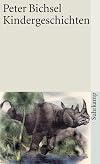
Sitzt du bequem? Then I'll begin…. The stories in this charming collection are written in the style of children's fables – which is fortunate for me, since my reading level in German is approximately that of a slow ten-year-old. (I was alarmed here to encounter the word Kranschiffwagenzieherkleiderwagenzieher, meaning ‘the person who pulls the wagon which is carrying the clothes of the person pulling the wagon that holds the boat that carries the crane’.) At any rate, the content is show more for all ages, and Swiss author Peter Bichsel uses the register very cleverly as a way of asking deceptively complex questions.
The characters in these tales are all fretting about knowledge – what they know, and how they know what they know. In one, a man sets off to walk around the world, just to prove that he will in fact end up back where he started; in another, a boy named Columbus invents a country called ‘America’, and is baffled when explorers promptly go out and find it – he can never be sure, afterwards, if the people who say they've been there are making it up or not.
Throughout, there is a Wittgensteinian sense of how shaky language is as a basis for knowing things. A character in one story gradually replaces every word in his vocabulary with his mysterious uncle's name, ‘Jodok’. Elsewhere, a man starts to swap words around: he calls a bed a picture, a man a foot, freezing he calls looking, standing he calls browsing, and so on, so that a description of his morning routine begins:
Am Mann blieb der alte Fuß lange im Bild läuten, um neun stellte das Fotoalbum, der Fuß fror auf und blätterte sich auf den Schrank, damit er nicht an die Morgen schaute.
[In the man, the old foot rang in picture for a long time; at nine o'clock the photograph album put, and the foot froze up and browsed on the fridge so his mornings wouldn't look.]
This is somewhat reminiscent of the obscure Tom Stoppard play Dogg's Hamlet, which was also based on a thought experiment in Wittgenstein. But you don't need any philosophical background to enjoy these bite-sized little brain-scramblers – they're good clean epistomological fun for kids of all ages. show less
The characters in these tales are all fretting about knowledge – what they know, and how they know what they know. In one, a man sets off to walk around the world, just to prove that he will in fact end up back where he started; in another, a boy named Columbus invents a country called ‘America’, and is baffled when explorers promptly go out and find it – he can never be sure, afterwards, if the people who say they've been there are making it up or not.
Throughout, there is a Wittgensteinian sense of how shaky language is as a basis for knowing things. A character in one story gradually replaces every word in his vocabulary with his mysterious uncle's name, ‘Jodok’. Elsewhere, a man starts to swap words around: he calls a bed a picture, a man a foot, freezing he calls looking, standing he calls browsing, and so on, so that a description of his morning routine begins:
Am Mann blieb der alte Fuß lange im Bild läuten, um neun stellte das Fotoalbum, der Fuß fror auf und blätterte sich auf den Schrank, damit er nicht an die Morgen schaute.
[In the man, the old foot rang in picture for a long time; at nine o'clock the photograph album put, and the foot froze up and browsed on the fridge so his mornings wouldn't look.]
This is somewhat reminiscent of the obscure Tom Stoppard play Dogg's Hamlet, which was also based on a thought experiment in Wittgenstein. But you don't need any philosophical background to enjoy these bite-sized little brain-scramblers – they're good clean epistomological fun for kids of all ages. show less

These stories are written in a very laconic language, quite often starting with a very simple and matter-of-factly statement like "Earth is round" or "Table is a table"--both titles of stories--, advancing with a child-like (and yet not) logic based their (kids) habit of taking words literally, which more often than not leads to total misunderstanding. They also often reveal the absurdity of the adult life, or at least what it may look like to child's eyes.
Awards


You May Also Like


Associated Authors
Statistics
- Works
- 58
- Also by
- 7
- Members
- 627
- Popularity
- #40,190
- Rating
- 4.0
- Reviews
- 10
- ISBNs
- 147
- Languages
- 17
- Favorited
- 2