
Félix Fénéon (1861–1944)
Author of Novels in Three Lines
About the Author
Image credit: By Photographer non-identified, anonymous - Reproduced in Le procès des Trente, Histoires littéraires n°20, Du Lérot, Public Domain, https://commons.wikimedia.org/w/index.php?curid=37380787
Works by Félix Fénéon
Scritti scelti 1 copy
Novels in Three Lines 1 copy
Associated Works
Tagged
Common Knowledge
- Canonical name
- Fénéon, Félix
- Birthdate
- 1861-06-22
- Date of death
- 1944-02-29
- Gender
- male
- Occupations
- art critic
gallery director
writer
editor
journalist
anarchist - Organizations
- French War Office
Galerie Bernheim-Jeune
La Revue Blanche
Editions de la Sirène - Short biography
- The anarchist, critic, curator, and collector Félix Fénéon was a pioneering advocate of art and literature in France in the late nineteenth and early twentieth centuries.
- Nationality
- France
- Birthplace
- Turin, Italy
- Places of residence
- Paris, France
- Place of death
- Châtenay-Malabry, France
- Associated Place (for map)
- France
Members
Reviews

Wonderful fun. Gallows humor, extremely dry. Arid. Feneon published these faits-divers in the newspaper Le Matin in 1906. 1,066 of the original 1,220 (Sante omits 154 of them for being too obscure ... though reading the ones that remain, I'd love to see the ones that were rejected ... what counts as "obscurity" with these?) mordant, often violent bits of French life are reprinted in this slim NYRB volume. Two nits: there's nothing regarding the images reproduced throughout (some are pages of show more newsprint but most seem to be woodcuts by -- I guess, given the initials 'FV' on them -- Felix Vallotton) and the repeating header on the right-hand pages reads "Novels in The Three Lines" ... where was your copy-editor, NYRB Classics? show less
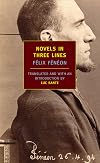
Marvelous, weird, grim, blackly funny. Originally published in the French newspaper Le Matin in 1906 as "Faits-divers," (literally, "diverse facts"), Feneon constructed these precursors to flash [non]fiction based on newswire and other provincial newspaper reports. Murder. Suicide. Rape. Domestic abuse - marital, adulterous, child sexual. Road accidents. Festival queens. Rabid dogs. Local politics. Disputes over crucifixes in classrooms. And who knew the French carried so many guns?! Each show more drama compressed into three lines of type, which managed to include the requisites of who, where, how, and why, and frequently a single word of dry comment. Read them as though they were haiku, in no particular order (only very rarely does a single event get more than one, though there are multiple thefts of telegraph cables mentioned).
Among my favorites: "In the vicinity of Noisy-sur-Ecole, M. Louis Delillieau, seventy, dropped dead of sunstroke. Quickly his dog Fido ate his head." and "Two mayors in the Somme were determined to restore to classroom walls the image of divine torture. The prefect suspended those mayors."
Feneon was an eccentric, writing and editing prolifically, the founder of important arts journals. But when offered the opportunity to publish a book, he announced "I aspire only to silence." The over a thousand "faits-divers" were printed anonymously, but his wife and his mistress carefully clipped and saved them. Luc Sante has captured their dry brevity with wit in translation, but I often found myself wanting to see them in the original French (what would the French idiom be for "fished out of the [name your choice of river here]," anyway? Sante's introduction is useful for understanding some of the allusions and social background of these tiny, lurid glimpses into French society of 1906. Fun for francophiles - and illustrated by several of Felix Vallotton's appropriately black and menacing woodcuts. show less
Among my favorites: "In the vicinity of Noisy-sur-Ecole, M. Louis Delillieau, seventy, dropped dead of sunstroke. Quickly his dog Fido ate his head." and "Two mayors in the Somme were determined to restore to classroom walls the image of divine torture. The prefect suspended those mayors."
Feneon was an eccentric, writing and editing prolifically, the founder of important arts journals. But when offered the opportunity to publish a book, he announced "I aspire only to silence." The over a thousand "faits-divers" were printed anonymously, but his wife and his mistress carefully clipped and saved them. Luc Sante has captured their dry brevity with wit in translation, but I often found myself wanting to see them in the original French (what would the French idiom be for "fished out of the [name your choice of river here]," anyway? Sante's introduction is useful for understanding some of the allusions and social background of these tiny, lurid glimpses into French society of 1906. Fun for francophiles - and illustrated by several of Felix Vallotton's appropriately black and menacing woodcuts. show less
A collection of roughly 1000 little faits-divers (brief column-filling news stories) which Félix Fénéon contributed to a Parisian newspaper in 1906. Each of them took up a maximum of three lines of news print, hence the book's title. When Fénéon was on top form, these glimpses of life's tragedies and unusual occurrences can be mordantly funny and occasionally even beautiful. For the most part, though, this litany of strikes, suicides, child abuse, domestic violence, road accidents, show more train crashes, and religious disputes, takes on a kind of banal same-ishness. A more judicious selection would probably have worked better. show less
Digesting an entire story and reproducing it in three lines is an art form. To have had it your daily paper was a privilege denied to all of us. Feneon could make the most mundane news item into a fascinating gem. He could communicate angles with extraordinarily efficient use of words. He was the Al Hirschfeld of news. Like Hirschfeld, Feneon's news items are tinged with humor:
Brandy he thought. Actually it was carbolic acid.
Thus Philibert Faroux, of Noroy, Oise, outlived
his spree by a mere show more two hours.
If you read this book while imagining the nationwide roundup page in USA Today, you will mourn the death of creativity. Journalism today is so dry and careful, so politically correct, as to be completely disposable and avoidable. Try this item, one of series describing the ongoing battle to get crucifixes out of classrooms in 1906:
Two mayors in the Somme were determined
to restore to classroom walls the image
of divine torture. The prefect suspended
those mayors.
And let me leave you with one last gem that could also never appear in an American paper today:
The name of a man arrested in Blainville
as a spy: Tourdias. His age: 24. His
profession: traveling salesman of bandages
and medicine.
Truly a novel, an elevator pitch for a Hollywood thriller. Leaves you asking questions, like nothing in the papers today. And that's the whole point, isn't it? Leave them asking for more! show less
Brandy he thought. Actually it was carbolic acid.
Thus Philibert Faroux, of Noroy, Oise, outlived
his spree by a mere show more two hours.
If you read this book while imagining the nationwide roundup page in USA Today, you will mourn the death of creativity. Journalism today is so dry and careful, so politically correct, as to be completely disposable and avoidable. Try this item, one of series describing the ongoing battle to get crucifixes out of classrooms in 1906:
Two mayors in the Somme were determined
to restore to classroom walls the image
of divine torture. The prefect suspended
those mayors.
And let me leave you with one last gem that could also never appear in an American paper today:
The name of a man arrested in Blainville
as a spy: Tourdias. His age: 24. His
profession: traveling salesman of bandages
and medicine.
Truly a novel, an elevator pitch for a Hollywood thriller. Leaves you asking questions, like nothing in the papers today. And that's the whole point, isn't it? Leave them asking for more! show less
Awards


You May Also Like


Associated Authors
Statistics
- Works
- 17
- Also by
- 2
- Members
- 705
- Popularity
- #35,923
- Rating
- 3.8
- Reviews
- 17
- ISBNs
- 30
- Languages
- 8
- Favorited
- 6

