
Vicente Huidobro (1893–1948)
Author of Altazor, or, A voyage in a parachute
About the Author
Virtually unknown in the United States, Huidobro was one of the most important innovators in Latin America poetry of the early twentieth century and an important theoretician of the new art. He lived in Europe for many years, specifically in Paris from 1916 to 1926, where he wrote poetry in French show more and participated in French poetic movements. He proclaimed himself the inventor of the school that he called Creationism, which he considered the foundation of a new way of conceiving art. For Huidobro the mission of the poet was the creation of new poetic realities. Art was totally free and the poem was free of both its poet-creator and the circumstances in which it was created. Huidobro tended to exaggerate and became a center of polemics, but he was one of the first to announce such important avant-garde concepts. His creative work is startling because of the novelty of the metaphors and the formal and verbal experimentation. (Bowker Author Biography) show less
Image credit: Vicente Huidobro
Works by Vicente Huidobro
Sus mejores poemas 4 copies
Obras completas 4 copies
Papá o el diario de Alicia Mir (Colección Los Grandes de la Literatura Chilena Zig-Zag) (1996) 3 copies
La próxima 2 copies
Tres Inmensas Novelas With Tres Novelas Ejemplares (Three Immense Novels With Three Exemplary Novels) (1990) 2 copies
Temblor de cielo : [1928] 2 copies
Poesias 1 copy
Horizon Carré 1 copy
Cagliostro y otros poemas 1 copy
Tres Inmensas Novelas 1 copy
Tour Eiffel 1 copy
Saisons choisies: poe mes 1 copy
Poesía y prosa 1 copy
Ecuatorial/Poemas árticos 1 copy
poetry 1 copy
Vientos contrarios 1 copy
Huidobro 1 copy
Ver y palpar (1923-1933) 1 copy
La vida es Sueño 1 copy
Tout à coup: poèmes 1 copy
Associated Works
The Serpent and the Fire: Poetries of the Americas from Origins to Present (2024) — Contributor — 18 copies
Montemora No. 1 — Composer — 2 copies
Tagged
Common Knowledge
- Canonical name
- Huidobro, Vicente
- Legal name
- Huidobro Fernandez, Vicente Garcia
- Birthdate
- 1893-01-10
- Date of death
- 1948-01-02
- Gender
- male
- Occupations
- poet
- Nationality
- Chile
- Birthplace
- Santiago de Chili, Chili
- Places of residence
- Santiago, Chile (birth|death)
Paris, France
Madrid, Spain - Place of death
- Santiago de Chili, Chili
- Map Location
- Chile
Members
Reviews
Altazor, or a Voyage in a Parachute/1919, a Poem in VII Cantos (English and Spanish Edition) by Vicente Huidobro

I have read very little poetry, so I’m quite a novice at even describing & understanding it. Altazor leaves me questioning, reinterpreting the images, the meanings. And I know I love it. Beautiful. Strange. Lyrical.
When I fell into Altazor, it’s as if I…
Transformed a Dali into words, a dictionary of letters
Etched a Philip Glass resonance into a crystalline cloud lining
Drew a teardrop of sadness through a breath
Waved a ribbon of mythology, terra, aqua, ignis, aer
Flew to the heights of show more the sea
Swam to the depths of the universe
Plucked the strands of string theory, sibilating
Simultaneously drank the suns, the moons, the stars, the astrals
While clutching the seed of a tree.
I’m awed and in debt to Eliot Weinberger for even attempting to translate this art, visionary art from the 1930s. Breathtaking translation. Even though my Spanish is thoroughly oxidized, I’m reading it aloud to myself in Spanish now to hear the beauty.
Wow. This blew me away. And, I think it may have spoiled me for any future poetry reading I had planned….
So glad that Mike Puma posted a quote from this poem on his page. I saw the quote, fell in love with it, & read the poem. Thank you, Mike, for reviewing & posting about this work.
“The four cardinal points are three: South and North.” – Vicente Huidobro, Altazor show less
When I fell into Altazor, it’s as if I…
Transformed a Dali into words, a dictionary of letters
Etched a Philip Glass resonance into a crystalline cloud lining
Drew a teardrop of sadness through a breath
Waved a ribbon of mythology, terra, aqua, ignis, aer
Flew to the heights of show more the sea
Swam to the depths of the universe
Plucked the strands of string theory, sibilating
Simultaneously drank the suns, the moons, the stars, the astrals
While clutching the seed of a tree.
I’m awed and in debt to Eliot Weinberger for even attempting to translate this art, visionary art from the 1930s. Breathtaking translation. Even though my Spanish is thoroughly oxidized, I’m reading it aloud to myself in Spanish now to hear the beauty.
Wow. This blew me away. And, I think it may have spoiled me for any future poetry reading I had planned….
So glad that Mike Puma posted a quote from this poem on his page. I saw the quote, fell in love with it, & read the poem. Thank you, Mike, for reviewing & posting about this work.
“The four cardinal points are three: South and North.” – Vicente Huidobro, Altazor show less
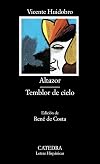
When I was a student I studied for a semester in Santiago, Chile, and I took a course on poetry, from which I took the idea that the four most significant Chilean poets were Vicente Huidobro, Gabriela Mistral, Pablo Neruda and Nicanor Parra. Of these, I was attracted the most to Parra, who reminded me very much of Kurt Vonnegut. Neruda's politics bothered me (he had all these fancy residences in Chile, but he was a communist, and a Stalinist at that), and his odes weren't really my thing show more either; nonetheless, I've returned to his poetry from time to time and I´ve enjoyed it. I always admired Mistral's life story and thought she was a very honorable and inspiring person. And, for some reason, I decided there was something about Huidobro that I didn't like and I kind discarded him, put him aside and never really even gave Altazor a chance. But, my love of searching the internet for cheap Cátedra editions led me to a critical edition of Altazor at a price I couldn´t resist, and I decided to give it a try. I don't really know why I was put off of Huidobro, because there was a lot about this, his most famous work, that I really liked.
Altazor is a poem constructed over a period of many years, from around 1919 to 1931. It has seven cantos, and is written from the perspective of Altazor, a person who is descending through the sky on a parachute. The language as the poem goes on changes, with later cantos containing combinations of real words, made up words, and finally just a bunch of vowels at the very end. In the introduction it talks about how the poem is a sort of synthesis of all of the artistic movements (-isms) that were being developed during Huidobro's time. In general, the poem represents a questioning or refutation of the possiblity of defining art and the role of the artist, or to find one, or even many different ways of looking at life, art, or anything really. I don't think I can wrap my head around all of this in one initial reading. I thought the language was very beautiful, and I enjoyed the way that it was manipulated in different and fascinating ways. For me, reading this poem was like walking through the modern wing of the Art Institute of Chicago (I miss that museum, I don't live in the Chi any more) and looking at art from the same interwar time period: there were a bunch of images that I really liked and thought were very beautiful, but I did not feel that I understood them very much at all, nor the context in which they were created. There were portions of the poem that I was especially intrigued by and that I wanted to know more about, just like there are artists from that time that I feel especially drawn to. It was just so sprawling, I feel a bit lost when I try to explain the poem as a whole.
One thing that was mentioned in the introduction that I found interesting was a line from the poem, "Se debe escribir en una lengua que no sea materna," which is exactly what Huidobro did in this poem, alternating between French and Spanish in the synthesis of Altazor. One of my favorite parts of this edition was that the editor compared some portions of the poem between the two languages, showing the interplay between the original French and the Spanish equivalents that Huidobro chose. As a language learner, I am intrigued by the possibilities of expression in languages that are not one's first language. In the case of French and Spanish, I think the closeness between the two languages makes for some fascinating possibiliities for a person who is bilingual and not only knows both languages, but seeks to understand the connection between the two. I liked learning about the bilingual creative process Huidobro followed in Altazor, and the introductory study helped me appreciate the poem more by shedding light on its French-language genesis.
Finally, Altazor made me think of an old favorite of mine, The Little Prince. I feel that Saint-Exupery must have been familiar with Altazor, and been inspired by it. The rose that Altazor speaks of regularly, his travels through the sky, and the way he yearns to understand the things that he sees, they all remind me of the Little Prince and his trip trough space, as well as his time on earth. It's more of a feeling I have than anything concrete, but from the beginning, I felt a connection between the two characters. show less
Altazor is a poem constructed over a period of many years, from around 1919 to 1931. It has seven cantos, and is written from the perspective of Altazor, a person who is descending through the sky on a parachute. The language as the poem goes on changes, with later cantos containing combinations of real words, made up words, and finally just a bunch of vowels at the very end. In the introduction it talks about how the poem is a sort of synthesis of all of the artistic movements (-isms) that were being developed during Huidobro's time. In general, the poem represents a questioning or refutation of the possiblity of defining art and the role of the artist, or to find one, or even many different ways of looking at life, art, or anything really. I don't think I can wrap my head around all of this in one initial reading. I thought the language was very beautiful, and I enjoyed the way that it was manipulated in different and fascinating ways. For me, reading this poem was like walking through the modern wing of the Art Institute of Chicago (I miss that museum, I don't live in the Chi any more) and looking at art from the same interwar time period: there were a bunch of images that I really liked and thought were very beautiful, but I did not feel that I understood them very much at all, nor the context in which they were created. There were portions of the poem that I was especially intrigued by and that I wanted to know more about, just like there are artists from that time that I feel especially drawn to. It was just so sprawling, I feel a bit lost when I try to explain the poem as a whole.
One thing that was mentioned in the introduction that I found interesting was a line from the poem, "Se debe escribir en una lengua que no sea materna," which is exactly what Huidobro did in this poem, alternating between French and Spanish in the synthesis of Altazor. One of my favorite parts of this edition was that the editor compared some portions of the poem between the two languages, showing the interplay between the original French and the Spanish equivalents that Huidobro chose. As a language learner, I am intrigued by the possibilities of expression in languages that are not one's first language. In the case of French and Spanish, I think the closeness between the two languages makes for some fascinating possibiliities for a person who is bilingual and not only knows both languages, but seeks to understand the connection between the two. I liked learning about the bilingual creative process Huidobro followed in Altazor, and the introductory study helped me appreciate the poem more by shedding light on its French-language genesis.
Finally, Altazor made me think of an old favorite of mine, The Little Prince. I feel that Saint-Exupery must have been familiar with Altazor, and been inspired by it. The rose that Altazor speaks of regularly, his travels through the sky, and the way he yearns to understand the things that he sees, they all remind me of the Little Prince and his trip trough space, as well as his time on earth. It's more of a feeling I have than anything concrete, but from the beginning, I felt a connection between the two characters. show less

Awards

You May Also Like


Associated Authors
Statistics
- Works
- 85
- Also by
- 6
- Members
- 596
- Popularity
- #42,150
- Rating
- 4.1
- Reviews
- 14
- ISBNs
- 106
- Languages
- 5
- Favorited
- 8