
Neil MacGregor
Author of A History of the World in 100 Objects
About the Author
Robert Neil MacGregor, OM, FSA (born on June 16, 1946, in Glasgow, Scotland) is an art historian and museum director. He was the Editor of the Burlington Magazine from 1981 to 1987, the Director of the National Gallery, London, from 1987 to 2002, and was appointed Director of the British Museum in show more 2002. He has presented three television series on art and the radio series A History of the World in 100 Objects, which aired in 2010. (Bowker Author Biography) show less
Works by Neil MacGregor
A Victim of Anonymity: The Master of the Saint Bartholomew Altarpiece (Walter Neurath Memorial Lectures) (1994) 12 copies
Restless World 1 copy
Statue of Ramesses II, Egypt 1 copy
Mold Gold Cape, North Wales 1 copy
Minoan Bull Leaper, Crete 1 copy
Flood Tablet, Iraq 1 copy
Swimming Reindeer (Carved Mammoth Tusk) (Rock shelter near Montastruc, France) (Late Magdalenian) 1 copy
Living and Dying 1 copy
À monde nouveau, nouveaux musées: Les musées, les monuments, et la communauté réinventée (2021) 1 copy
Jomon Pot Japan 1 copy
Standard of Ur 1 copy
Associated Works
French Paintings from the USSR : Watteau to Matisse [exhibition] The National Gallery, London 15 June-18 September 1988 (1988) — Foreword — 30 copies
Baroque painting in Genoa [cat. exp., Londres, National Gallery, 13 mars – 16 juin 2002] (2002) — Foreword — 17 copies
Treasures from the World's Cultures: The British Museum after 250 Years (1991) — Foreword, some editions — 4 copies
Netsuke : 100 Miniature Masterpieces from Japan — Director's foreword, some editions — 1 copy
Tagged
Common Knowledge
- Canonical name
- MacGregor, Neil
- Legal name
- MacGregor, Robert Neil
- Birthdate
- 1946-06-16
- Gender
- male
- Education
- Glasgow Academy
University of Oxford (New College)
École Normale Supérieure
Edinburgh University (LL.B|1972)
Courtauld Institute of Art, University of London (M.A.|1975) - Occupations
- director (National Gallery ∙ London)
director (British Museum)
art historian
broadcaster - Organizations
- The Burlington Magazine
National Gallery
British Museum
Humboldt Forum - Awards and honors
- Order of Merit (2010)
Society of Antiquaries of London (Fellow)
Order of Australia (Officer, 2013)
Friedrich-Gundolf Preis (2015)
German National Prize (2015)
Goethe Medal (2015) (show all 7)
Nayef Al-Rodhan Prize (2015) - Nationality
- Scotland
UK - Birthplace
- Glasgow, Scotland, UK
- Places of residence
- London, England, UK
- Map Location
- Scotland, UK
Members
Reviews
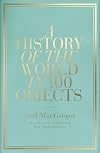
I am at a loss for what to rate this. On the one hand, it covers mostly the parts of history I’m interested in: ritual and domestic life, the things that tend not to be covered in Big History Books. And it’s interesting, and offers little bite-sized pieces of information about a lot of history and a lot of the world. But on the other hand, this book made me mad, so mad that I had to take several breaks while reading it to read other books and cool down.
This book has a narrative show more underlying the many separate chapters, and it is one about the British showing up in a place and taking whatever they wanted, again and again and again. And, I mean, fair! That happened! And, honestly, few countries have any kind of history in that area to be proud of. But what is frustrating is how completely MacGregor just — accepts it.
He talks about how people in various areas are building new identites around ancient objects that have deep meaning for them — ancient objects the British Museum has, and plans to keep, even though those people desparately want them back. He talks about how the museum didn’t know what a Japanese mirror was for, or what its history was, until a visiting Japanese scholar explained it, yet never wonders if perhaps the items in question might be better understood, might speak more effectively to the world, in a museum closer to their original home. He mentions how odd it is, in a secular museum, to find offerings in front of statues of gods, and never wonders if perhaps those statues belong in a place of worship instead.
I’m sure he does grapple with those issues in private life — I hope he does — and it’s also very clear that in presenting this all as “isn’t it great that the British Museum has all these things?” he’s toeing the official party line, but GOD was it frustrating to see essentially no acknowledgement of these things in the book.
But, you know, I did read it. (Though it took a month, what with all the breaks I took.) And I did enjoy it. (Albeit with some shrieking of, “It’s more complicated than that!” about the few areas of history I knew something about.) I just also grabbed a friend who is a Hittite scholar and made her justify museums (“I can’t, really”) and ranted at her for probably longer than she wanted. show less
This book has a narrative show more underlying the many separate chapters, and it is one about the British showing up in a place and taking whatever they wanted, again and again and again. And, I mean, fair! That happened! And, honestly, few countries have any kind of history in that area to be proud of. But what is frustrating is how completely MacGregor just — accepts it.
He talks about how people in various areas are building new identites around ancient objects that have deep meaning for them — ancient objects the British Museum has, and plans to keep, even though those people desparately want them back. He talks about how the museum didn’t know what a Japanese mirror was for, or what its history was, until a visiting Japanese scholar explained it, yet never wonders if perhaps the items in question might be better understood, might speak more effectively to the world, in a museum closer to their original home. He mentions how odd it is, in a secular museum, to find offerings in front of statues of gods, and never wonders if perhaps those statues belong in a place of worship instead.
I’m sure he does grapple with those issues in private life — I hope he does — and it’s also very clear that in presenting this all as “isn’t it great that the British Museum has all these things?” he’s toeing the official party line, but GOD was it frustrating to see essentially no acknowledgement of these things in the book.
But, you know, I did read it. (Though it took a month, what with all the breaks I took.) And I did enjoy it. (Albeit with some shrieking of, “It’s more complicated than that!” about the few areas of history I knew something about.) I just also grabbed a friend who is a Hittite scholar and made her justify museums (“I can’t, really”) and ranted at her for probably longer than she wanted. show less
I gave this one a rare five stars, because it's an awesome book. I actually listened to it on audio CD (and suspect reading it might be tough sledding for me), but got the book to enjoy the pictures fairly quickly.
Talk about scope! From protohuman hand tools to a solar powered lamp, MacGregor describes his objects and their histories to us with knowledge, passion, humor, and style. Most of the history here is outside the normal dates-when-generals-did-stuff run of the mill history, so unless show more you know a lot of art history, you'll probably find it fresh material. It's loosely grouped into larger categories, but each object stands well on its own.
And the details of these many objects flow together to create a very different holistic history: not Jared Diamond's tale of migration and ecology, or the more common geopolitics, but something different. It's a tale of the arc of the human experience that deals with technology, religion, and intellectual life as a single seamless story. I am richer for the experience. You will be too. Neil MacGregor rocks! show less
Talk about scope! From protohuman hand tools to a solar powered lamp, MacGregor describes his objects and their histories to us with knowledge, passion, humor, and style. Most of the history here is outside the normal dates-when-generals-did-stuff run of the mill history, so unless show more you know a lot of art history, you'll probably find it fresh material. It's loosely grouped into larger categories, but each object stands well on its own.
And the details of these many objects flow together to create a very different holistic history: not Jared Diamond's tale of migration and ecology, or the more common geopolitics, but something different. It's a tale of the arc of the human experience that deals with technology, religion, and intellectual life as a single seamless story. I am richer for the experience. You will be too. Neil MacGregor rocks! show less
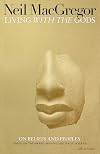
https://fromtheheartofeurope.eu/living-with-the-gods-by-neil-macgregor/
A lovely book, based on a BBC Radio series of the same name, lavishly illustrated (as the radio cannot be) with photographs of art and architecture, and enriched by quotes from commentators who know what they are talking about. Some people like to simply dismiss religion as at best a distraction and at worst a force for conflict and division; MacGregor doesn’t shy away from that side of things, but he goes deep into show more what religious people are actually doing – symbolism, practice, history, politics. He draws some very interesting parallels between religions separated by continents and centuries.
I found it a very healthy perspective on what is and isn’t unique to each of the main strands of world belief. It’s also a surprisingly light read, despite its length and weight, perhaps because of its origin as radio scripts. Recommended. show less
A lovely book, based on a BBC Radio series of the same name, lavishly illustrated (as the radio cannot be) with photographs of art and architecture, and enriched by quotes from commentators who know what they are talking about. Some people like to simply dismiss religion as at best a distraction and at worst a force for conflict and division; MacGregor doesn’t shy away from that side of things, but he goes deep into show more what religious people are actually doing – symbolism, practice, history, politics. He draws some very interesting parallels between religions separated by continents and centuries.
I found it a very healthy perspective on what is and isn’t unique to each of the main strands of world belief. It’s also a surprisingly light read, despite its length and weight, perhaps because of its origin as radio scripts. Recommended. show less
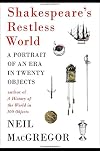
Amazing! This is definitely my type of non-fiction. It's about Shakespeare, it paints a picture of Elizabethan and Jacobean life, and it is a quick, fun read. Through these objects MacGregor gives Shakespeare's plays a humanity that they sometimes lose because they are so symbolic. We start to remember that these plays were written by a real man who expressed the public's fears about the succession of the throne, pride on the triumphs of their queen, curiosity about the new scientific show more discoveries and new inventions, suspicions about but also acceptance of foreigners. Shakespeare may have written plays so transcendent they have lasted for 400 years and will easily last more, but he also navigated a world affected by plague and violence, assassination plots and war. MacGregor takes Shakespeare, the idea, and transforms him into Shakespeare, the man. show less
Lists
Awards


You May Also Like


Associated Authors
Statistics
- Works
- 47
- Also by
- 19
- Members
- 4,689
- Popularity
- #5,380
- Rating
- 4.2
- Reviews
- 89
- ISBNs
- 112
- Languages
- 9
- Favorited
- 1