
Alexei Panshin (1940–2022)
Author of Rite of Passage
About the Author
Image credit: Alexei Panshin
Series
Works by Alexei Panshin
The World Beyond the Hill: Science Fiction and the Quest for Transcendence (1989) — Author — 98 copies, 2 reviews
Star Well - La rivoluzione Thurb 2 copies
Now I'm Watching Roger [short story] 2 copies
What's Your Excuse? [short story] 2 copies
One Sunday In Neptune 2 copies
The Sons of Prometheus (Novelette) 2 copies
Segredo Inter-Estrelar 1 copy
Segredo Interstelar 1 copy
The Thurb Revolution 1 copy
Associated Works
Science Fiction Today and Tomorrow: A Discursive Symposium (1974) — Contributor — 99 copies, 2 reviews
The Magazine of Fantasy and Science Fiction December 1974, Vol. 47, No. 6 (1974) — Contributor — 17 copies
The Magazine of Fantasy and Science Fiction November 1969, Vol. 37, No. 5 (1969) — Contributor — 15 copies
The Magazine of Fantasy and Science Fiction November 1964, Vol. 27, No. 5 (1964) — Author (under shared pseudonym Louis J. A. Adams) — 13 copies
Tagged
Common Knowledge
- Legal name
- Panshin, Alexis Adams
- Birthdate
- 1940-08-14
- Date of death
- 2022-08-21
- Gender
- male
- Occupations
- author
science fiction critic
science fiction writer - Awards and honors
- Hugo (fan writer, 1967)
- Relationships
- Panshin, A.J. (father)
Panshin, Cory (widow) - Cause of death
- cardiac arrest
- Nationality
- USA
- Birthplace
- Lansing, Michigan, USA
- Associated Place (for map)
- Michigan, USA
Members
Reviews

Some years ago, someone wrote a vignette about travelling by air in the present day in the style of a science fiction novel. Everything - airports, passports, aeroplanes, baggage claim - was explained in info-dumps. Rite of Passage, which was nominated for the Hugo Award and won the Nebula Award, is like that. In the first chapter, Mia plays football - and then explains the game to the reader. She goes on to explain pretty much everything she encounters, little of which would be unfamiliar show more to an American reader in 1968.
Mia is a twelve-year-old girl on the Ship, a FTL-capable asteroid spaceship, which had been used centuries earlier to transport colonists to habitable worlds. It is one of several, but the only one mentioned. The colonies have been kept at low tech levels - think Revolutionary USA - and resent the high-handedness of the Ships and their inhabitants. Who, in turn, regard the colonists as intellectually and morally inferior “Mudeaters”. At the age of fourteen, Mia, like all Ship teenagers, will be dropped in the wilderness on a planet to survive for a month on her own. It’s called the Trial. Survivors are welcomed back to the Ship as adults.
Rite of Passage is Mia’s life up until her Trial, the friends she makes, her explorations of areas of the Ship, her education in Ship politics, culture and ethics… She’s chatty, opinionated, and clearly intended to be sympathetic. It’s all very… Heinleinesque (his juveniles, at least). Mia’s Trial, unfortunately, does not go as planned - the world is inhabited by colonists, Mia infiltrates the local capital when she learns her boyfriend has been captured, but she manages to break him out. They’re only fourteen, remember. Because of their treatment by the colonists, the Ship decides to “destroy” the world. Mia thinks this is wrong, thanks to her study of ethics. But, seriously, if you need to study ethics to decide genocide is wrong, then there’s something clearly fucked up with you.
In fact, there’s a lot that feels wrong about Rite of Passage - the elitism, the eugenics, the sexualisation of underage teens (what is with white male US science fiction authors of 40+ years ago and underage sex?), the dodgy philosophy, the lack of any real invention... I’m not even convinced the book is actually science fiction. It’s not like there aren’t US cities with affluent gated communities (predominantly white) and poor decaying neighbourhoods (predominantly black). Rite of Passage could be cast as a coming-of-age novel in Detroit or Chicago, and very little needs to change in the story.
Rite of Passage lost the Hugo to Brunner’s Stand on Zanzibar, a novel which is still highly-regarded (although I thought it had aged very badly), but beat it to the Nebula. Delany’s Nova would have been a better Hugo winner, and Russ’s Picnic on Paradise a better Nebula winner. Frankly, I’m baffled Rite of Passage made either award shortlist. show less
Mia is a twelve-year-old girl on the Ship, a FTL-capable asteroid spaceship, which had been used centuries earlier to transport colonists to habitable worlds. It is one of several, but the only one mentioned. The colonies have been kept at low tech levels - think Revolutionary USA - and resent the high-handedness of the Ships and their inhabitants. Who, in turn, regard the colonists as intellectually and morally inferior “Mudeaters”. At the age of fourteen, Mia, like all Ship teenagers, will be dropped in the wilderness on a planet to survive for a month on her own. It’s called the Trial. Survivors are welcomed back to the Ship as adults.
Rite of Passage is Mia’s life up until her Trial, the friends she makes, her explorations of areas of the Ship, her education in Ship politics, culture and ethics… She’s chatty, opinionated, and clearly intended to be sympathetic. It’s all very… Heinleinesque (his juveniles, at least). Mia’s Trial, unfortunately, does not go as planned - the world is inhabited by colonists, Mia infiltrates the local capital when she learns her boyfriend has been captured, but she manages to break him out. They’re only fourteen, remember. Because of their treatment by the colonists, the Ship decides to “destroy” the world. Mia thinks this is wrong, thanks to her study of ethics. But, seriously, if you need to study ethics to decide genocide is wrong, then there’s something clearly fucked up with you.
In fact, there’s a lot that feels wrong about Rite of Passage - the elitism, the eugenics, the sexualisation of underage teens (what is with white male US science fiction authors of 40+ years ago and underage sex?), the dodgy philosophy, the lack of any real invention... I’m not even convinced the book is actually science fiction. It’s not like there aren’t US cities with affluent gated communities (predominantly white) and poor decaying neighbourhoods (predominantly black). Rite of Passage could be cast as a coming-of-age novel in Detroit or Chicago, and very little needs to change in the story.
Rite of Passage lost the Hugo to Brunner’s Stand on Zanzibar, a novel which is still highly-regarded (although I thought it had aged very badly), but beat it to the Nebula. Delany’s Nova would have been a better Hugo winner, and Russ’s Picnic on Paradise a better Nebula winner. Frankly, I’m baffled Rite of Passage made either award shortlist. show less
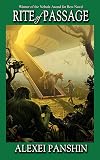
This book would have been great when I was 12 years old. It helps you wrestle with moral dilemmas. But reading it at the age I am, it seemed plodding. I did enjoy the moral lesson given on Free Birthers; the author's disgust was palpable. Our own planet would have been destroyed, if there existed Overlords for us, as it did in the story. As it is, we take the slow suicide, yea?
Rite of Passage by Alexei Panshin (My latest book review)
Mia Havero was born on one of the seven great starships constructed from hollowed-out asteroids, originally intended to transport colonists from Earth to more than one hundred colony worlds. But then the people of Earth destroyed their own planet, and the survivors among mankind are now scattered among these colonies, with the Ships continuously traveling between them, trading technical knowledge for raw materials. When teenage show more inhabitants of these vessels reach the age of fourteen, they undergo Trial, which involves being abandoned on one of the colony worlds to fend for themselves for a month without any contact with their respective Ships. They are given comprehensive training in the months before they leave and are provided with a small amount of survival gear. But since the colony worlds can be dangerous, a small percentage of these young people do not survive. This loss helps to keep the strictly-controlled population within safe limits while weeding out those who may be less fit for survival. Those who do return are granted full rights as adults, hence the title Rite of Passage.
The first half of the book does not contain much in the way of adventure. It is a description of the everyday life of Mia, a young girl living on one of the Ships, told from her perspective and replete with her opinions and musings. Mia tells us about the culture and prejudices of those who live alongside her, and she shares the views of her influential father on most issues. Many of Mia’s experiences are common to all young people everywhere. The only hints of adventure in this part of the book are a dangerous exploration of the ventilation system in an unfamiliar part of the Ship, and the ‘borrowing’ of spacesuits to conduct a potentially fatal spacewalk on the exterior of the asteroid which encases the Ship.
Although Mia seems to make up her mind very easily about the relative values of philosophical systems, she really only has a very superficial grasp of the complexities of these ideas, and many obvious questions do not even occur to her until during and after her period of Trial. In this way, the book realistically portrays the confidence and the folly of youth. The second half of the book is much more action-packed, and describes Mia’s period of Trial on a particularly unfriendly colony planet.
Moral and ethical questions which seemed clear-cut to Mia before Trial, now appear much more complicated, and when some of these issues are discussed openly by a Ship’s Assembly in the final part of the story, Mia is forced by her newly-acquired convictions to take a stand diametrically opposite to that of her father.
Some of most thought-provoking content consists of Mia’s musings on the nature of things. Here are some direct quotes from the book:
"I don't like the idea of people who don't sing to themselves when they're all alone. They're too sober for me. At least hum-- anybody can do that."
"The truth is, I guess, I just find it easier to cope with things than with people."
"It doesn’t hurt to like the inevitable."
"I had never realized before that adventures took so much doing, so much preparation and so much cleaning up afterward. That’s something you don’t see in stories. Who buys the food and cooks it, washes the dishes, minds the baby, to swing from, blows fanfares, polishes medals, and dies beautifully, all so that the hero can be a hero? Who finances him? I’m not saying I don’t believe in heroes — I’m just saying that they are either parasites or they spend the bulk of their time in making their little adventures possible, not in enjoying them."
"The trouble with stoicism, it seems to me, is that it is a soporific. It affirms the status quo and thereby puts an end to all ambition, all change. It says, as Christianity did a thousand years ago, that kings should be kings and slaves should be slaves, and it seems to me that that is a philosophy infinitely more attractive to the king than the slave."
"Whether or not your actions are determined, you have to act on the assumption that you have free will. If you are determined, your attempt at free will loses you nothing. However, if you are not determined and you act on the assumption that you are, you will never attempt anything. You will simply be a passive blob that things happen to."
"I believe in judging people by their faces, myself. A man can’t help the face he owns, but he can help the expression he wears on it. If a man looks mean, I generally believe he is unless I have reason to change my mind."
"Maturity is the ability to sort the portions of truth from the accepted lies and self-deceptions that you have grown up with. "
"I've always wondered what it would be like to be a spear carrier in somebody else's story. A spear carrier is somebody who stands in the hall when Caesar passes, comes to attention and thumps his spear. A spear carrier is the anonymous character cut down by the hero as he advances to save the menaced heroine. A spear carrier is a character put in a story to be used like a piece of disposable tissue. . . . The trouble is that each of us is his own hero, existing in a world of spear carriers. We take no joy in being used and discarded. "
"If I had the opportunity, I would make the proposal that no man should be killed except by somebody who knows him well enough for the act to have impact. No death should be like nose blowing. Death is important enough that it should affect the person who causes it."
"If you meet life squarely, you are likely to make mistakes, do things you wish you hadn't, say things you wish you could retract or phrase more felicitously, and, in short, fumble your way along. Those "mature" people whose lives are even without a single sour note or a single mistake, who never fumble, manage only at the cost of original thought and original action. They do without the successes as well as the failures."
I think this book would have been viewed as considerably unconventional when it was first published in 1968, and that is partly why it won a Nebula Award for Best Novel and was nominated for a Hugo. It is a very well-written and structured piece of work which still contains much of relevance for readers today, and it clearly has a unique place among science fiction coming-of-age stories. show less
Mia Havero was born on one of the seven great starships constructed from hollowed-out asteroids, originally intended to transport colonists from Earth to more than one hundred colony worlds. But then the people of Earth destroyed their own planet, and the survivors among mankind are now scattered among these colonies, with the Ships continuously traveling between them, trading technical knowledge for raw materials. When teenage show more inhabitants of these vessels reach the age of fourteen, they undergo Trial, which involves being abandoned on one of the colony worlds to fend for themselves for a month without any contact with their respective Ships. They are given comprehensive training in the months before they leave and are provided with a small amount of survival gear. But since the colony worlds can be dangerous, a small percentage of these young people do not survive. This loss helps to keep the strictly-controlled population within safe limits while weeding out those who may be less fit for survival. Those who do return are granted full rights as adults, hence the title Rite of Passage.
The first half of the book does not contain much in the way of adventure. It is a description of the everyday life of Mia, a young girl living on one of the Ships, told from her perspective and replete with her opinions and musings. Mia tells us about the culture and prejudices of those who live alongside her, and she shares the views of her influential father on most issues. Many of Mia’s experiences are common to all young people everywhere. The only hints of adventure in this part of the book are a dangerous exploration of the ventilation system in an unfamiliar part of the Ship, and the ‘borrowing’ of spacesuits to conduct a potentially fatal spacewalk on the exterior of the asteroid which encases the Ship.
Although Mia seems to make up her mind very easily about the relative values of philosophical systems, she really only has a very superficial grasp of the complexities of these ideas, and many obvious questions do not even occur to her until during and after her period of Trial. In this way, the book realistically portrays the confidence and the folly of youth. The second half of the book is much more action-packed, and describes Mia’s period of Trial on a particularly unfriendly colony planet.
Moral and ethical questions which seemed clear-cut to Mia before Trial, now appear much more complicated, and when some of these issues are discussed openly by a Ship’s Assembly in the final part of the story, Mia is forced by her newly-acquired convictions to take a stand diametrically opposite to that of her father.
Some of most thought-provoking content consists of Mia’s musings on the nature of things. Here are some direct quotes from the book:
"I don't like the idea of people who don't sing to themselves when they're all alone. They're too sober for me. At least hum-- anybody can do that."
"The truth is, I guess, I just find it easier to cope with things than with people."
"It doesn’t hurt to like the inevitable."
"I had never realized before that adventures took so much doing, so much preparation and so much cleaning up afterward. That’s something you don’t see in stories. Who buys the food and cooks it, washes the dishes, minds the baby, to swing from, blows fanfares, polishes medals, and dies beautifully, all so that the hero can be a hero? Who finances him? I’m not saying I don’t believe in heroes — I’m just saying that they are either parasites or they spend the bulk of their time in making their little adventures possible, not in enjoying them."
"The trouble with stoicism, it seems to me, is that it is a soporific. It affirms the status quo and thereby puts an end to all ambition, all change. It says, as Christianity did a thousand years ago, that kings should be kings and slaves should be slaves, and it seems to me that that is a philosophy infinitely more attractive to the king than the slave."
"Whether or not your actions are determined, you have to act on the assumption that you have free will. If you are determined, your attempt at free will loses you nothing. However, if you are not determined and you act on the assumption that you are, you will never attempt anything. You will simply be a passive blob that things happen to."
"I believe in judging people by their faces, myself. A man can’t help the face he owns, but he can help the expression he wears on it. If a man looks mean, I generally believe he is unless I have reason to change my mind."
"Maturity is the ability to sort the portions of truth from the accepted lies and self-deceptions that you have grown up with. "
"I've always wondered what it would be like to be a spear carrier in somebody else's story. A spear carrier is somebody who stands in the hall when Caesar passes, comes to attention and thumps his spear. A spear carrier is the anonymous character cut down by the hero as he advances to save the menaced heroine. A spear carrier is a character put in a story to be used like a piece of disposable tissue. . . . The trouble is that each of us is his own hero, existing in a world of spear carriers. We take no joy in being used and discarded. "
"If I had the opportunity, I would make the proposal that no man should be killed except by somebody who knows him well enough for the act to have impact. No death should be like nose blowing. Death is important enough that it should affect the person who causes it."
"If you meet life squarely, you are likely to make mistakes, do things you wish you hadn't, say things you wish you could retract or phrase more felicitously, and, in short, fumble your way along. Those "mature" people whose lives are even without a single sour note or a single mistake, who never fumble, manage only at the cost of original thought and original action. They do without the successes as well as the failures."
I think this book would have been viewed as considerably unconventional when it was first published in 1968, and that is partly why it won a Nebula Award for Best Novel and was nominated for a Hugo. It is a very well-written and structured piece of work which still contains much of relevance for readers today, and it clearly has a unique place among science fiction coming-of-age stories. show less

Star Well by Alexei Panshin
First of all, if the reader expects another novel like Panshin’s Rite of Passage, Star Well may cause some disappointment, since this book is very different in content and style.
Some reviewers have described Star Well as a “comedy of manners”, something like a Jane Austen novel set in a future space-faring civilization or like a less overtly ludicrous The Hitchhiker’s Guide to the Galaxy. I wonder if Douglas Adams ever read it, as there are certain show more similarities in the style of the narration. The narrator has definite opinions, and often expresses them with mild sarcasm. A similar feature to Rite of Passage may be found in the pithy and often humorous observations about the nature of life, the universe and society.
The protagonist, Anthony Villiers, is a very likable, mild-mannered gentleman with hidden depths. I identified with him because he loves books and has a tendency to walk about in public absorbed in reading (which can at times also provide Villiers with an excuse for ending up where he is not supposed to be), something I used to do frequently in my younger days. He is evidently practiced at searching antiquarian book sellers, which makes him a man after my own heart. The observation of the narrator that physical books never lost their popularity because nothing else of similar usefulness and portability could be invented to replace them has of course in our day to an extent been invalidated by the capacity of devices like mobile phones to store and display thousands of different texts, which you could conceivably become immersed in while navigating thoroughfares on foot.
Villiers’ invariably polite but highly intelligent and strategically witty conversational responses are one of the most amusing aspects of the story. The reader gradually realizes that there is more to this man than at first meets the eye, but you never really get a handle on exactly how ingenuous or calculating he really is.
And this brings us to Torve the Trog. I must admit that I chose to read this book on the basis of a fascination with this name and its promise of an unforgettable character. Torve is a book-loving alien who looks something like a man-sized furry toad, and he has a view of reality which is at variance with that of the humans around him, including Villiers, who apparently finds the Trog’s ideas impossible to comprehend. Torve’s central belief (which he maintains is a wholly scientific and self-evident fact, although others misunderstand it as being philosophical or religious in nature) is that causality does not exist, and that apparent links between events are simply coincidental interconnected “lines of occurrence” which may be either pleasingly serendipitous or discouragingly infelicitous. Denying causality might seem rather dangerous, but it works for Torve, who even seems able to use his method to predict how matters will turn out. Villiers claims to be non-plussed by all this, but I get the feeling that he understands more than he admits, and this way of thinking actually benefits him and gives him uncommon insight into events. However, I stress to add that this could just be my interpretation and may not have been the intention of the author.
In summary, Star Well is a light science fiction novel which is both quick and fun to read. The plot is adequate but rather basic and predictable. The most memorable aspects are arguably the quotable passages of narration and the witticisms. Here are some of them:
“Power does corrupt. Total personal honesty is a myth. Secret wrong righting is a make-believe game for children to toy with.”
“When you wish to insult a man — the Cut Direct. When you wish to snub a man — the Cut Indirect. The Studied Insult, the Pertinent Reflection — to be overheard, of course — even the smiles available for twelve separate effects.”
“You can take it as an axiom: celebrities who travel meet only fools, creeps, panhandlers, and climbers. People they would truly like to meet never have the bad taste to present themselves. The quality that makes them worth meeting automatically determines they will never be met.”
“While he lied little, he was excellent at being oblique.”
“It is a pity that the game of hare and hounds should suffer from savage rabbits and hen-hearted hounds, but if the world was as it ought to be we would all be playing wooden whistles and eating bananas in Eden, as my mother used to say.”
“Perhaps, if our minds were trained to accept the idea and our language permitted, it would be altogether better not to believe in causality.”
“Duels aren’t fair if the wrong people win them.”
“Look at him: Hisan Bashir Shirabi, a man near the end of the line. Purple robes, dark face, sharp nose, black mustache. Everything for total menace except the element of presence.” show less
First of all, if the reader expects another novel like Panshin’s Rite of Passage, Star Well may cause some disappointment, since this book is very different in content and style.
Some reviewers have described Star Well as a “comedy of manners”, something like a Jane Austen novel set in a future space-faring civilization or like a less overtly ludicrous The Hitchhiker’s Guide to the Galaxy. I wonder if Douglas Adams ever read it, as there are certain show more similarities in the style of the narration. The narrator has definite opinions, and often expresses them with mild sarcasm. A similar feature to Rite of Passage may be found in the pithy and often humorous observations about the nature of life, the universe and society.
The protagonist, Anthony Villiers, is a very likable, mild-mannered gentleman with hidden depths. I identified with him because he loves books and has a tendency to walk about in public absorbed in reading (which can at times also provide Villiers with an excuse for ending up where he is not supposed to be), something I used to do frequently in my younger days. He is evidently practiced at searching antiquarian book sellers, which makes him a man after my own heart. The observation of the narrator that physical books never lost their popularity because nothing else of similar usefulness and portability could be invented to replace them has of course in our day to an extent been invalidated by the capacity of devices like mobile phones to store and display thousands of different texts, which you could conceivably become immersed in while navigating thoroughfares on foot.
Villiers’ invariably polite but highly intelligent and strategically witty conversational responses are one of the most amusing aspects of the story. The reader gradually realizes that there is more to this man than at first meets the eye, but you never really get a handle on exactly how ingenuous or calculating he really is.
And this brings us to Torve the Trog. I must admit that I chose to read this book on the basis of a fascination with this name and its promise of an unforgettable character. Torve is a book-loving alien who looks something like a man-sized furry toad, and he has a view of reality which is at variance with that of the humans around him, including Villiers, who apparently finds the Trog’s ideas impossible to comprehend. Torve’s central belief (which he maintains is a wholly scientific and self-evident fact, although others misunderstand it as being philosophical or religious in nature) is that causality does not exist, and that apparent links between events are simply coincidental interconnected “lines of occurrence” which may be either pleasingly serendipitous or discouragingly infelicitous. Denying causality might seem rather dangerous, but it works for Torve, who even seems able to use his method to predict how matters will turn out. Villiers claims to be non-plussed by all this, but I get the feeling that he understands more than he admits, and this way of thinking actually benefits him and gives him uncommon insight into events. However, I stress to add that this could just be my interpretation and may not have been the intention of the author.
In summary, Star Well is a light science fiction novel which is both quick and fun to read. The plot is adequate but rather basic and predictable. The most memorable aspects are arguably the quotable passages of narration and the witticisms. Here are some of them:
“Power does corrupt. Total personal honesty is a myth. Secret wrong righting is a make-believe game for children to toy with.”
“When you wish to insult a man — the Cut Direct. When you wish to snub a man — the Cut Indirect. The Studied Insult, the Pertinent Reflection — to be overheard, of course — even the smiles available for twelve separate effects.”
“You can take it as an axiom: celebrities who travel meet only fools, creeps, panhandlers, and climbers. People they would truly like to meet never have the bad taste to present themselves. The quality that makes them worth meeting automatically determines they will never be met.”
“While he lied little, he was excellent at being oblique.”
“It is a pity that the game of hare and hounds should suffer from savage rabbits and hen-hearted hounds, but if the world was as it ought to be we would all be playing wooden whistles and eating bananas in Eden, as my mother used to say.”
“Perhaps, if our minds were trained to accept the idea and our language permitted, it would be altogether better not to believe in causality.”
“Duels aren’t fair if the wrong people win them.”
“Look at him: Hisan Bashir Shirabi, a man near the end of the line. Purple robes, dark face, sharp nose, black mustache. Everything for total menace except the element of presence.” show less
Lists
Awards


You May Also Like


Associated Authors
Statistics
- Works
- 28
- Also by
- 28
- Members
- 2,417
- Popularity
- #10,602
- Rating
- 3.7
- Reviews
- 63
- ISBNs
- 59
- Languages
- 7
- Favorited
- 6