
Colin Woodard
Author of American Nations: A History of the Eleven Rival Regional Cultures of North America
About the Author
Colin Woodard is a journalist and writer who was born on 12/3/1968. He is a reporter for the Portland Press Herald and Maine Sunday Telegram for State and National Affairs. He won a 2012 George Polk Award for investigative reporting and a finalist for the 2016 Pulitzer Prize for Explanatory show more Reporting for a series on climate change. He has been a long-time foreign correspondent of The Christian Science Monitor, San Francisco Chronicle, and The Chronicle of Higher Education, and has reported from fifty foreign countries and seven continents. His work has appeared in many publications including The Economist, Smithsonian, The Washington Post, Newsweek/The Daily Beast and Bloomberg View. His first book Ocean's End: Travels Through Endangered Seas, was released in 2000. Since then he has published several others including: The Lobster Coast: Rebels, Rusticators, and the Struggle for a Forgotten Frontier, The Republic of Pirates: Being The True and Surprising Story of the Caribbean Pirates and the Man Who Brought Them Down, American Nations: A History of the Eleven Rival Regional Cultures of North America, and American Character: A History of the Epic Struggle Between Individual Liberty and the Common Good. (Bowker Author Biography) show less
Works by Colin Woodard
American Nations: A History of the Eleven Rival Regional Cultures of North America (2011) 1,843 copies, 47 reviews
The Republic of Pirates: Being the True and Surprising Story of the Caribbean Pirates and the Man Who Brought Them Down (2007) — Author — 1,355 copies, 24 reviews
The Lobster Coast: Rebels, Rusticators, and the Struggle for a Forgotten Frontier (2004) 321 copies, 5 reviews
American Character: A History of the Epic Struggle Between Individual Liberty and the Common Good (2016) 180 copies, 4 reviews
The Stolen Art of War 1 copy
Associated Works
MHQ: The Quarterly Journal of Military History — Spring 2009 (2009) — Author "Quelling a Pirate Revolt," "In the Pirate's Lair" and "History Lesson" — 6 copies
MHQ: The Quarterly Journal of Military History — Summer 2010 (2010) — Author "The War Over Plunder" and "The Revolution's Band of Brothers" — 4 copies
MHQ: The Quarterly Journal of Military History — Autumn 2011 (2011) — Author "Why We Won't Give Up Torture" — 3 copies
Tagged
Common Knowledge
- Birthdate
- 1968
- Gender
- male
- Agent
- Jill Grinberg
- Nationality
- USA
- Places of residence
- Portland, Maine, USA
Budapest, Hungary
Zagreb, Croatia
Washington, D.C., USA - Associated Place (for map)
- USA
Members
Discussions
The Eleven Rival Regional Cultures of North America in GEOGRAPHY; Everybody Gotta be Someplace (December 2011)
Reviews
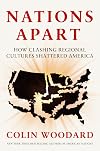
The first shocking thing about Nations Apart, by Colin Woodard is that all the stereotypes Americans use for themselves are accurate. And unchanging. The characterizations (or assassinations) of the Deep South are accurate, and so are the New England Yankee ones, the Far West, the New France of Louisiana and El Norte of Mexican border areas. All true. That’s the premise, and it was unsettling to have to accept that as the basis for any kind of scientific analysis, because they are just show more mean clichés. Or are they?
At first, thoughtful readers will rightly reject the stereotypes as a terrible basis for analysis of the Trump era, because it is basically just name-calling. But Woodard doubles down. Not only are those stereotypes accurate, but they have not changed in 300 years. He shows that groups of founding immigrants, from Deep Southern to Appalachian to intolerant Puritans dominating the northeast not only brought their prejudices with them from England or Scotland or Germany, but they have hung onto them, throughout their expansion into more distant areas of the country. That movement can be followed by their continued prejudices, habits, philosophies, laws and attitudes, right down to today. They continue to show up in studies, polls, and the news.
Accordingly, Woodard has broken up the USA into seven separate nations, where those 300 year-old traits continue to shape party affiliations, poll findings, election results and community positions on essentially everything. They even follow dialects and accents, confirming their existence as nations.
Woodard has been working at this for a long time. He founded Nationhood Lab, which studies the different traits Americans carry. The lab dissects polls and studies, accounting for the slightest weaknesses in their structure, presentation and conclusion. For accuracy’s sake, they only include studies down to the county level, where the influences of various churches can be accounted for. So for example, in a meetingplace state like Ohio, the voting for or against abortion rights can be seen to border on the influence areas of several of these Nations Woodard proposes. That’s how real they are. (See map below)
At numerous points, he exempts nations like Hawaiian and indigenous because their numbers are insufficient to make accurate statements. He is careful about what he says and how he says it – up to a point. But the truth is that nations like Deep South, Greater Appalachia and New France are largely ignorant, self-centered, isolated and failing.
He looks at current issues, all very front and center, like abortion, immigration, guns, climate – the usual suspects. He shows how the locals view them, and how their responses perfectly fit the stereotypes of their nations. It is sadly predictable, with never a hint that that any kind of fact-finding or reporting makes the slightest difference to anyone’s automatic response. Americans’ ideas and ideals are set in cement and nothing will budge them, and have not for 300 years. Only the topics change; the stereotypes predict the results.
A lot of the blame falls on religion, from Catholic to various flavors of Protestant and the evangelicals. It is those churches that determine Americans’ decisions on abortion, for example. And despite 300 years of evolving science and medicine, as well as the waning influence of the Church in general, those ideas remain. “When it comes to abortion,” Woodard says, “religion is destiny.”
Yet farther on, he shows definitively, much as Noam Chomsky always claimed, Americans are far more progressive than their elected representatives. Americans apparently favor abortion in an absolute majority. They don’t want to punish LGBTQ people, have no burning need to destroy transgender people, and so on down a long list of issues. But their elected lawmakers do. And the extreme right and evangelicals in particular, make sure they get the message right: take away all rights from those who don’t fit the WASP patriarchal mold.
The business of ignoring the will of the people has come to the point where the governor of Missouri has singlehandedly repealed a number of laws that the electorate proposed and passed as voting issues in general elections. This is just one symptom of a fascist state Woodard sees forming, and very quickly. The disunity among the seven nations of the USA actually promotes the rise of fascism, he thinks.
Empathy and the common good feature prominently in the differences between these American nations. He describes Greater Appalachia and the Deep South as places where “the common good has few friends.” Guns are more widely owned there, and white suicide rates by firearms lead the country.
The Deep South remains stubbornly and proudly poor and backward. Woodard says: “(T)he reason they’re poor is precisely because they’re aggressively individualistic, with centuries of underinvestment in their people, their institutions and infrastructure, a choice made by generations of elites so that they would have low taxes, cheap labor and uncontested political control […] If laissez-faire economics was a panacea, the Deep South would be the wealthiest region in the country and Honduras would be among the world’s wealthiest nations. If high taxes and expansive services were destructive to economic performance, New Netherland, Yankeedom and the Left Coast would be the country’s poorest regions and Scandinavia the world’s worst. It’s just not the case.”
This book was completed at the top of the year, just before Trump resumed office, and Woodard makes all kinds of predictions about this regime, all of which have come true. He cites Robert Paxton’s famous list of nine points for the traits of fascism, and they fit the MAGA ethos to a tee. Woodard says Trump and Trumpism tick every one of scholars’ boxes defining fascism.
The best performances economically and socially in the USA can be seen in Yankeedom and Left Coast, where people reject individual solo efforts in favor of community and team-oriented solutions. These areas are richer, more highly educated, healthier, and longer-lived. This matches the Red-Bad, Blue-Good analysis I reviewed in 2023’s State of Neglect, by far my most widely viewed review on Medium. ( https://medium.com/the-straight-dope/red-states-much-worse-than-you-think-and-th... ) . That book showed how far down the scale Red states are, in virtually every category from longevity to education, wealth, income and community-building. Woodard’s book is a historically consistent yet significantly different way of looking at Americans across state lines, calling their geographic areas whole nations of likeminded people instead.
One unsatisfying thing about Nations Apart is that Woodard never tries to explain how it is even possible that 300 year-old prejudices remain unchanged, despite history, community, intermarriage, changes in society, laws, education and changed circumstances. How will anything ever evolve if apparently nothing can shake the 300 year old prejudices of 2025 Americans, no matter where or how they live now?
There are plenty of other questions unanswered too. Why is it that the French in Canada are so open minded and communitarian, but the French in New France (former Acadians from the Maritimes) of the southern USA are such loners? How does that work with unchanging values over 300 years? How does that jibe with where they are today? That it does not matter what you propose; Americans are locked into preset attitudes, and no amount of campaigning will see them vote against those principles.
It is precisely because he does not examine those fundamental issues that his Conclusion isn’t worth anything. Woodard’s Nationhood Lab posed pairs of statements to thousands of Americans, looking for ones that resonated. The idea was to find what Americans really want, and give it to them in political talking points, slogans, platform planks and so on. But if Americans are this rigid, how will any of it break through the closed minds?
His own lab studies show that essentially every new statement was rejected by Republicans and their subset of Evangelical Protestants. And even if “only” 28% of the electorate is registered as Republican, Woodard has still not found the words to appeal to them. They want their cult, their cult leader, a thrashing of the constitution, the supremacy of WASPs, the subjugation of women and will believe all the lies their cult spouts daily. What they will not stand for is that there are better ways to live and to relate to their fellow Americans.
But worst of all, this analysis means no one in the country is going to adapt or change their mind. That is damning. It’s been 300 years now, so don’t expect any sudden change of heart or mind. Americans will not clamor for better management by Democrats in 2028 (if there is an election at all). Talking sense to the other side is clearly pointless. Facts carry no weight. As Woodard accidently proved in his attempts to find inspiring messaging, everyone cannot relate to them; there is no common ground in the USA. None.
From the looks of it, the USA has little choice but to split into these seven separate nations, where citizen rights differ in each one. To be an American will have no meaning any more. Despite Woodard’s hopeful efforts to find unifying messages, several of these nations will only be satisfied with fascism and no civil rights. Even Woodard has to admit “the single-minded pursuit of individual freedom is driving us to the brink of despotism.”
Civil war will result if they all don’t get everything they want right away. New England states will want to join a saner Canada, and so might Left Coast portions. No one will want The Deep South as a partner, but that’s okay; The Deep South wants to go it alone anyway.
This is not the future Trump envisioned, but it is the one he is fomenting.
David Wineberg show less
At first, thoughtful readers will rightly reject the stereotypes as a terrible basis for analysis of the Trump era, because it is basically just name-calling. But Woodard doubles down. Not only are those stereotypes accurate, but they have not changed in 300 years. He shows that groups of founding immigrants, from Deep Southern to Appalachian to intolerant Puritans dominating the northeast not only brought their prejudices with them from England or Scotland or Germany, but they have hung onto them, throughout their expansion into more distant areas of the country. That movement can be followed by their continued prejudices, habits, philosophies, laws and attitudes, right down to today. They continue to show up in studies, polls, and the news.
Accordingly, Woodard has broken up the USA into seven separate nations, where those 300 year-old traits continue to shape party affiliations, poll findings, election results and community positions on essentially everything. They even follow dialects and accents, confirming their existence as nations.
Woodard has been working at this for a long time. He founded Nationhood Lab, which studies the different traits Americans carry. The lab dissects polls and studies, accounting for the slightest weaknesses in their structure, presentation and conclusion. For accuracy’s sake, they only include studies down to the county level, where the influences of various churches can be accounted for. So for example, in a meetingplace state like Ohio, the voting for or against abortion rights can be seen to border on the influence areas of several of these Nations Woodard proposes. That’s how real they are. (See map below)
At numerous points, he exempts nations like Hawaiian and indigenous because their numbers are insufficient to make accurate statements. He is careful about what he says and how he says it – up to a point. But the truth is that nations like Deep South, Greater Appalachia and New France are largely ignorant, self-centered, isolated and failing.
He looks at current issues, all very front and center, like abortion, immigration, guns, climate – the usual suspects. He shows how the locals view them, and how their responses perfectly fit the stereotypes of their nations. It is sadly predictable, with never a hint that that any kind of fact-finding or reporting makes the slightest difference to anyone’s automatic response. Americans’ ideas and ideals are set in cement and nothing will budge them, and have not for 300 years. Only the topics change; the stereotypes predict the results.
A lot of the blame falls on religion, from Catholic to various flavors of Protestant and the evangelicals. It is those churches that determine Americans’ decisions on abortion, for example. And despite 300 years of evolving science and medicine, as well as the waning influence of the Church in general, those ideas remain. “When it comes to abortion,” Woodard says, “religion is destiny.”
Yet farther on, he shows definitively, much as Noam Chomsky always claimed, Americans are far more progressive than their elected representatives. Americans apparently favor abortion in an absolute majority. They don’t want to punish LGBTQ people, have no burning need to destroy transgender people, and so on down a long list of issues. But their elected lawmakers do. And the extreme right and evangelicals in particular, make sure they get the message right: take away all rights from those who don’t fit the WASP patriarchal mold.
The business of ignoring the will of the people has come to the point where the governor of Missouri has singlehandedly repealed a number of laws that the electorate proposed and passed as voting issues in general elections. This is just one symptom of a fascist state Woodard sees forming, and very quickly. The disunity among the seven nations of the USA actually promotes the rise of fascism, he thinks.
Empathy and the common good feature prominently in the differences between these American nations. He describes Greater Appalachia and the Deep South as places where “the common good has few friends.” Guns are more widely owned there, and white suicide rates by firearms lead the country.
The Deep South remains stubbornly and proudly poor and backward. Woodard says: “(T)he reason they’re poor is precisely because they’re aggressively individualistic, with centuries of underinvestment in their people, their institutions and infrastructure, a choice made by generations of elites so that they would have low taxes, cheap labor and uncontested political control […] If laissez-faire economics was a panacea, the Deep South would be the wealthiest region in the country and Honduras would be among the world’s wealthiest nations. If high taxes and expansive services were destructive to economic performance, New Netherland, Yankeedom and the Left Coast would be the country’s poorest regions and Scandinavia the world’s worst. It’s just not the case.”
This book was completed at the top of the year, just before Trump resumed office, and Woodard makes all kinds of predictions about this regime, all of which have come true. He cites Robert Paxton’s famous list of nine points for the traits of fascism, and they fit the MAGA ethos to a tee. Woodard says Trump and Trumpism tick every one of scholars’ boxes defining fascism.
The best performances economically and socially in the USA can be seen in Yankeedom and Left Coast, where people reject individual solo efforts in favor of community and team-oriented solutions. These areas are richer, more highly educated, healthier, and longer-lived. This matches the Red-Bad, Blue-Good analysis I reviewed in 2023’s State of Neglect, by far my most widely viewed review on Medium. ( https://medium.com/the-straight-dope/red-states-much-worse-than-you-think-and-th... ) . That book showed how far down the scale Red states are, in virtually every category from longevity to education, wealth, income and community-building. Woodard’s book is a historically consistent yet significantly different way of looking at Americans across state lines, calling their geographic areas whole nations of likeminded people instead.
One unsatisfying thing about Nations Apart is that Woodard never tries to explain how it is even possible that 300 year-old prejudices remain unchanged, despite history, community, intermarriage, changes in society, laws, education and changed circumstances. How will anything ever evolve if apparently nothing can shake the 300 year old prejudices of 2025 Americans, no matter where or how they live now?
There are plenty of other questions unanswered too. Why is it that the French in Canada are so open minded and communitarian, but the French in New France (former Acadians from the Maritimes) of the southern USA are such loners? How does that work with unchanging values over 300 years? How does that jibe with where they are today? That it does not matter what you propose; Americans are locked into preset attitudes, and no amount of campaigning will see them vote against those principles.
It is precisely because he does not examine those fundamental issues that his Conclusion isn’t worth anything. Woodard’s Nationhood Lab posed pairs of statements to thousands of Americans, looking for ones that resonated. The idea was to find what Americans really want, and give it to them in political talking points, slogans, platform planks and so on. But if Americans are this rigid, how will any of it break through the closed minds?
His own lab studies show that essentially every new statement was rejected by Republicans and their subset of Evangelical Protestants. And even if “only” 28% of the electorate is registered as Republican, Woodard has still not found the words to appeal to them. They want their cult, their cult leader, a thrashing of the constitution, the supremacy of WASPs, the subjugation of women and will believe all the lies their cult spouts daily. What they will not stand for is that there are better ways to live and to relate to their fellow Americans.
But worst of all, this analysis means no one in the country is going to adapt or change their mind. That is damning. It’s been 300 years now, so don’t expect any sudden change of heart or mind. Americans will not clamor for better management by Democrats in 2028 (if there is an election at all). Talking sense to the other side is clearly pointless. Facts carry no weight. As Woodard accidently proved in his attempts to find inspiring messaging, everyone cannot relate to them; there is no common ground in the USA. None.
From the looks of it, the USA has little choice but to split into these seven separate nations, where citizen rights differ in each one. To be an American will have no meaning any more. Despite Woodard’s hopeful efforts to find unifying messages, several of these nations will only be satisfied with fascism and no civil rights. Even Woodard has to admit “the single-minded pursuit of individual freedom is driving us to the brink of despotism.”
Civil war will result if they all don’t get everything they want right away. New England states will want to join a saner Canada, and so might Left Coast portions. No one will want The Deep South as a partner, but that’s okay; The Deep South wants to go it alone anyway.
This is not the future Trump envisioned, but it is the one he is fomenting.
David Wineberg show less
American nations : a history of the eleven rival regional cultures of North America by Colin Woodard
(review revised 8/14/2017)
This is almost certainly the best book I've read in 2017. I took copious notes.
Author Colin Woodard's political bias and lack of professionalism badly detract from the book and my opinion of it. No professional historian is he. By the end, I was taking fewer notes and skipping passages in disgust. Long before that, I noted the author's description of a certain event as "obscene": it immediately recalled for me a time in a college history course when (in a display of show more immaturity) I blatantly insulted one of the intellectual drivers of the American Revolution In an essay exam, for his political views. Afterward, the professor rightly told me "you need to be more objective."
But the information; the many conclusions it led me to draw; and the enormous help it provided in making parts of American history clearer, far outweighed the author's bias. Very highly recommended.
My biggest takeaway is a clearer understanding of the Christian culture of New England ("Yankeedom"): how it secularized as it aged and America grew; and to what extent the Puritans were Christians on an individual level. I already knew the Puritans were known to put Quakers in stocks, but I didn't know they went as far as executing Quakers. It's right to feel skeptical of the Puritans' form of Christianity when many among it would murder members of other religious groups. (The later secularization of Yankee culture only strengths my skepticism of the Puritans.) Woodard displays both the light side and the dark sides of Yankee culture's influence on the other regions: the vast majority of crusades for moral and social reform in America have been led by Yankeedom; but Yankeedom was always seen as meddlesome and arrogant by other regions. Worse in my interpretation, Yankeedom did not spread Christianity among other regions of America the way it spread various secular reforms.
__________________________________________________________
Other interesting things I learned, or conclusions I drew:
This is almost certainly the best book I've read in 2017. I took copious notes.
Author Colin Woodard's political bias and lack of professionalism badly detract from the book and my opinion of it. No professional historian is he. By the end, I was taking fewer notes and skipping passages in disgust. Long before that, I noted the author's description of a certain event as "obscene": it immediately recalled for me a time in a college history course when (in a display of show more immaturity) I blatantly insulted one of the intellectual drivers of the American Revolution In an essay exam, for his political views. Afterward, the professor rightly told me "you need to be more objective."
But the information; the many conclusions it led me to draw; and the enormous help it provided in making parts of American history clearer, far outweighed the author's bias. Very highly recommended.
My biggest takeaway is a clearer understanding of the Christian culture of New England ("Yankeedom"): how it secularized as it aged and America grew; and to what extent the Puritans were Christians on an individual level. I already knew the Puritans were known to put Quakers in stocks, but I didn't know they went as far as executing Quakers. It's right to feel skeptical of the Puritans' form of Christianity when many among it would murder members of other religious groups. (The later secularization of Yankee culture only strengths my skepticism of the Puritans.) Woodard displays both the light side and the dark sides of Yankee culture's influence on the other regions: the vast majority of crusades for moral and social reform in America have been led by Yankeedom; but Yankeedom was always seen as meddlesome and arrogant by other regions. Worse in my interpretation, Yankeedom did not spread Christianity among other regions of America the way it spread various secular reforms.
__________________________________________________________
Other interesting things I learned, or conclusions I drew:
show less
State of Franklin. This was a new aspiring state formed by Appalachia in parts of Tennessee and Pennsylvania, which did not survive, due to being reabsorbed by the other states. Andrew Jackson came from the region of Franklin, though the State was gone before his presidency.
In the author's opinion, the Civil War was fought not between "north and south" but between a Yankeedom-led coalition and a Deep South-Tidewater coalition. "The South" did not exist as a unified political entity before the Civil War. Appalachia was divided.
Jefferson Davis was urged to keep secession peaceful, and ignored the advice.
The Appalachians despised both Yankeedom and the Deep South. Whether each subsection of Appalachia joined the "North" or "South" depended on which region they hated more; the most obvious example is that the Appalachian part of Virginia seceded to form West Virginia, and ally with the Union, because those particular Appalachians considered the Tidewater aristocrats more their enemy than the Yankees. Yankeedom had no use for Appalachia either (as shown in their later attempts to "civilize" the Appalachians); but, then, all regions despised Appalachia for one reason or another.
More than one region wanted to secede before or during the Civil War. The Midlands and Appalachia wanted to form a separate Central Confederacy.
The reason Midland culture won the American heartland is continued German immigration.
California: development, and sub-cultures.
Why the "Left Coast" [yes, the author names the Pacific Northwest that] is often politically aligned with New England.
Why there tends to be a culture clash between northern, central and southern California. (same reason)
American settlement of Tejas. At one time while Mexico controlled Texas, it did not admit Americans; they were illegal immigrants. Appalachians in particular blatantly ignored Mexican law to stream into Texas. Which gives the contemporary issue some historical perspective.
Winston. Part of Alabama tried to form another political entity, the Free State of Winston. Obviously, it didn't survive either. The author strongly implies it was an "outlaw" state in the sense of being based entirely on several kinds of illegal activity (mainly ignoring Mexican law to immigrate to Texas, as noted above).
Texas sub-cultures. The starkly different sub-cultures in different parts of Texas are due to being settled by at least four different regions: Deep South, Appalachia, El Norte, and Midlands (in the Panhandle). President Lyndon Johnson was culturally Appalachian. (Which gives context to stories I've read elsewhere about regional culture-based friction between Johnson and the Kennedys.)
The Great Wave of immigrants in the 19th century avoided Deep South, Tidewater, Appalachia, and El Norte. The reason is that those regions' governments and social systems had nothing to attract immigrants.
Recent non-ethnic and abstract concepts of Americanism (e.g., America being a place where one has the most freedom to fulfill one's potential) are strongest on/in the Left Coast and the Far West.
Where and from whom the melting pot concept originates.
Between the late 19th and early 20th centuries, Yankeedom recast Puritans as champions of religious freedom.
Yankeedom and the Deep South had/have vastly different conceptions of Protestantism. cWoodard repeatedly emphasizes that Yankeedom saw salvation and freedom on the level of the community rather than individuals, whereas the Deep South's form of Protestantism was much more individualistic. Yankee Protestantism's lesser interest in the individual's relationship with God is owing to the strength of Yankee Calvinism, though Woodard does not expound on that except to say the individual's fate was seen as already decided.
As the Yankee culture secularized, only the utopian crusading/reforming urges survived, because they were stronger than the culture's faith in God. It is therefore hard not to conclude that the Southern form of Protestantism was stronger, because it has outlasted the Yankee form. It's for a reason that most people now tend to associate Baptists with the South; and it's for a reason that the "Congregationalist" church in New England long ago ceased to exist in its original form and theology, although many Protestant churches in America have a congregationalist polity.
The author explains that many Yankees turned to other faiths, especially Unitarianism, as a rebellion against the more coercive nature of the Yankee Christian culture. My interpretation: the Yankee Christian culture essentially ate itself. (The Yankee emphasis on salvation and freedom at the community level makes it plausible and appropriate to speak of all this in collective terms.) These developments can be seen as a cautionary tale against culturally enforced Christianity; against emphasizing a society's relationship with God more than the individual relationship; and against a society seeing itself as God's chosen.
As the South became reactionary, Yankeedom, New Netherlands and the Left Coast became more liberal.
The origin and characteristics of Deep South plantation slavery can be traced to one specific place—Barbados. Deep South plantation slavery originated with wealthy Barbadian planters, who had created on that island a hellhole notorious for its cruelty. The Deep South was a conscious effort to replicate Barbadian planter society in America. At least one Founding Father, Alexander Hamilton, was Barbadian. I think the book also cited financier Robert Morris (who, interestingly, worked closely with Hamilton in blatantly unethical financial speculation schemes) as Barbadian, but I can't quite remember. The Barbadian aristocrats like Hamilton tended to display other sins—naked greed and (less emphasized by the author) sexual perversity.
Appalachian individualism and its political implications. Woodard repeatedly describes the Appalachians as individualistic but "hedonistic" (I believe he used a compound phrase that might have been "hedonistic individualism"). Essentially, an amoral individualism bereft of any religious dimension or idealistic quality. At some point, Woodard claims Appalachian culture is the emotional origin or center of American libertarianism--the ethos, not necessarily the political movement; essentially, that Appalachians were libertarian before libertarianism was cool. I'm skeptical of this, and fortunately, Woodard does not proceed very far into in a dubious attempt to tie Appalachian culture to today's Libertarians.
The Republic of Pirates: Being the True and Surprising Story of the Caribbean Pirates and the Man Who Brought Them Down by Colin Woodard

This one tells the story of the Golden Age of Piracy through the lives of Henry Avery, Samuel Bellamy, Edward Thatch (Teach), Charles Vane, Benjamin Hornigold, Henry Jennings and - infamous pirate hunter - Woodes Rogers. Rogers came from a prominent slave-trading family, but was intimately familiar with the dangers of seafaring. What makes this microcosm of history so interesting is that all their lives overlapped. Woodes and Thatch may have been acquainted as kids, Vane briefly joined show more Bellamy, Hornigold was Thatch's mentor, and Bellamy swindled Jennings to join Hornigold. Ultimately it was the unstoppable trio of Bellamy, Hornigold and Thatch who created the perfect base in the Bahamas, calling themselves The Flying Gang. It became a haven not just for pirates, but also for runaway slaves, free mulattos, poor farmers and sailors, and those just looking to escape. Even John and Anne Bonny made their way to this unlawful island paradise!
Action packed but the only reason it got 4/5⭐ is because the "Republic" itself arrived so late in the book - the end of Ch. 5. It opens with Henry Avery, who I understand was an important part of the history of Nassau, but he died long before these events. I wanted more of William Dampier, a cohort of Avery, who had a much bigger role in Roger's early privateering schemes and rise to prominence. Thatch, starting to go by Blackbeard, takes a backseat to Bellamy's stardom, despite being a co-founder. Be prepared for a lot of backstory before all the pirates begin to gather and set up for the great showdown. But Woodard successfully explains why the Golden Age emerged when it did, describes life aboard a naval vs pirate vessel, and the politics of pirate hunting through Rogers. Overall, this one succeeded where Under the Black Flag did not and was thoroughly enjoyable! show less
Action packed but the only reason it got 4/5⭐ is because the "Republic" itself arrived so late in the book - the end of Ch. 5. It opens with Henry Avery, who I understand was an important part of the history of Nassau, but he died long before these events. I wanted more of William Dampier, a cohort of Avery, who had a much bigger role in Roger's early privateering schemes and rise to prominence. Thatch, starting to go by Blackbeard, takes a backseat to Bellamy's stardom, despite being a co-founder. Be prepared for a lot of backstory before all the pirates begin to gather and set up for the great showdown. But Woodard successfully explains why the Golden Age emerged when it did, describes life aboard a naval vs pirate vessel, and the politics of pirate hunting through Rogers. Overall, this one succeeded where Under the Black Flag did not and was thoroughly enjoyable! show less

I'm a Massachusetts resident who has been going to Maine to visit relatives and friends since I was a kid, so in many ways, I'm the ideal audience for this book. Woodard pits Massachusetts and Maine against each other, as four-hundred-year-old warring (sometimes literally) nations.
This is the second Woodard book I've read (and likely far from the last, looking at the rest of his line up.) I can't recommend his 2011 "American Nations" highly enough. The subtitle aptly describes the subject show more area: "a history of the eleven rival regional cultures of North America." As a Mainer looking at history and regional cultural difference, "The Lobster Coast" was essentially the pilot version of the more fleshed-out thesis of 2011. As a New Englander myself, I've been very excited to finally get around to reading "The Lobster Coast."
The book is superbly readable. I finished it in about a week. It begins with a few hands-on cultural portraits of Maine at the turn of the millennium (when the book was written). It then goes through the history over the last 400 years (briefly touching on the geological and Native American histories from the past few thousand years). It then concludes with a summary of current-day suburban sprawl, and a restatement of the ongoing tensions within the state.
I would love to hear an update on the Native American aspects of this history—for example, it seems like Woodard hadn't yet fully integrated the research of Charles Mann's 2005 "1491," (which is understandable, as it hadn't yet been published).
Contrary to popular belief, Plymouth and Jamestown were not the only early Brittish North American settlements: Popham, Maine was another settlement, established in 1607. One of the reasons we don't hear about it much is because it only lasted fourteen months. This kind of volatility is a repeating theme in Maine's history; the past four-hundred years have been a time of strife, famine, and migration. I won't articulate all of the ups and downs here, but the book is worth reading just as a record of all that Maine has been through.
All of this leads us to the core tension that Maine has faced. Starting about 300 years ago, Scotch-Irish asylum seekers became the primary settlers of Maine, and many towns and villages along the Maine coast are still named after them today. These people were farmers and fisherman, and prioritized long-term community stability. One example of this were the laws in the middle of the eighteen hundreds in Maine regarding shipping vessels. Each ship was required by law to split revenues according to the contributions of its crew. This lead to both an extremely equitable pay scale across all fishermen in the state, and also lead to a high degree of equity regarding boat ownership. Unfortunately, these laws came to end after the Civil War, but they were reflective of the kind of values shared by a certain set of Mainers.
On the other hand, we have Massachusetts, which has been a key antagonist in the plot of Maine's history. Up until 1820, Maine was even a territory of Massachusetts. This didn't sit well with Mainers, but did mean that a lot of Massachusetts-aligned individuals played a key role in the economics of Maine—from being a key market for Maine's fishing industry, to now being a key population of property-owning summertime beachgoers.
There's a poignant moment when one of these Scotch-Irish descendants walks into the new McDonalds and is greeted by a photo of her recently deceased father on the wall. She is horrified by this cultural appropriation. Understanding these kinds of dynamics goes a long ways towards understanding the animosity between various American Nations in recent electoral cycles.
This book is dominantly about the Maine coast, and touches very little on Maine's interior (New England's largest state, by acreage). This is likely because there has just been a lot more to talk about on the coast. That said, I'd be fascinated to learn more about the history of Maine's interior (one intriguing fact I learned recently is that, during the Cold War, Aroostook County was home to the US' largest air force base, although it was closed when the war ended).
If you love Maine and love cultural histories, this is the book for you! show less
This is the second Woodard book I've read (and likely far from the last, looking at the rest of his line up.) I can't recommend his 2011 "American Nations" highly enough. The subtitle aptly describes the subject show more area: "a history of the eleven rival regional cultures of North America." As a Mainer looking at history and regional cultural difference, "The Lobster Coast" was essentially the pilot version of the more fleshed-out thesis of 2011. As a New Englander myself, I've been very excited to finally get around to reading "The Lobster Coast."
The book is superbly readable. I finished it in about a week. It begins with a few hands-on cultural portraits of Maine at the turn of the millennium (when the book was written). It then goes through the history over the last 400 years (briefly touching on the geological and Native American histories from the past few thousand years). It then concludes with a summary of current-day suburban sprawl, and a restatement of the ongoing tensions within the state.
I would love to hear an update on the Native American aspects of this history—for example, it seems like Woodard hadn't yet fully integrated the research of Charles Mann's 2005 "1491," (which is understandable, as it hadn't yet been published).
Contrary to popular belief, Plymouth and Jamestown were not the only early Brittish North American settlements: Popham, Maine was another settlement, established in 1607. One of the reasons we don't hear about it much is because it only lasted fourteen months. This kind of volatility is a repeating theme in Maine's history; the past four-hundred years have been a time of strife, famine, and migration. I won't articulate all of the ups and downs here, but the book is worth reading just as a record of all that Maine has been through.
All of this leads us to the core tension that Maine has faced. Starting about 300 years ago, Scotch-Irish asylum seekers became the primary settlers of Maine, and many towns and villages along the Maine coast are still named after them today. These people were farmers and fisherman, and prioritized long-term community stability. One example of this were the laws in the middle of the eighteen hundreds in Maine regarding shipping vessels. Each ship was required by law to split revenues according to the contributions of its crew. This lead to both an extremely equitable pay scale across all fishermen in the state, and also lead to a high degree of equity regarding boat ownership. Unfortunately, these laws came to end after the Civil War, but they were reflective of the kind of values shared by a certain set of Mainers.
On the other hand, we have Massachusetts, which has been a key antagonist in the plot of Maine's history. Up until 1820, Maine was even a territory of Massachusetts. This didn't sit well with Mainers, but did mean that a lot of Massachusetts-aligned individuals played a key role in the economics of Maine—from being a key market for Maine's fishing industry, to now being a key population of property-owning summertime beachgoers.
There's a poignant moment when one of these Scotch-Irish descendants walks into the new McDonalds and is greeted by a photo of her recently deceased father on the wall. She is horrified by this cultural appropriation. Understanding these kinds of dynamics goes a long ways towards understanding the animosity between various American Nations in recent electoral cycles.
This book is dominantly about the Maine coast, and touches very little on Maine's interior (New England's largest state, by acreage). This is likely because there has just been a lot more to talk about on the coast. That said, I'd be fascinated to learn more about the history of Maine's interior (one intriguing fact I learned recently is that, during the Cold War, Aroostook County was home to the US' largest air force base, although it was closed when the war ended).
If you love Maine and love cultural histories, this is the book for you! show less
Lists
Must-Read Maine (1)
Midwest (1)
Awards


You May Also Like


Associated Authors
Statistics
- Works
- 13
- Also by
- 3
- Members
- 3,949
- Popularity
- #6,400
- Rating
- 3.9
- Reviews
- 84
- ISBNs
- 47
- Languages
- 3
- Favorited
- 1