
Kurt Andersen (1) (1954–)
Author of Fantasyland: How America Went Haywire: A 500-Year History
For other authors named Kurt Andersen, see the disambiguation page.
About the Author
Kurt Anderson is an American author, born in Nebraska in 1954. He is a graduate of Harvard College and was an editor of The Harvard Lampoon. He is the host and co-creator of the radio show and podcast, Studio 360 for which he won a Peabody Award. He is a co-founder of Spy Magazine. He has also show more worked as editor-in-chief for New York, and a cultural columnist and critic for Time magazine and New Yorker. He writes for television, film and stage. His most recent book is entitled, Fantasyland: How America Went Haywire: A 500-Year History. (Bowker Author Biography) show less
Image credit: Brigitte Lacombe
Works by Kurt Andersen
Associated Works
Significant Objects: 100 Extraordinary Stories about Ordinary Things (2012) — Contributor — 65 copies, 1 review
Tagged
Common Knowledge
- Birthdate
- 1954-08-22
- Gender
- male
- Education
- Harvard College
- Occupations
- journalist
- Nationality
- USA
- Birthplace
- Omaha, Nebraska, USA
- Places of residence
- New York, New York, USA
- Associated Place (for map)
- USA
Members
Reviews
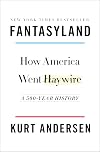
Fantasyland is a history of the United States through one particular lens – our infatuation with fantasy from hyper-religiosity to science denialism. One way of looking at American colonization, for example, is that was driven by dissenters, people seeking freedom to worship according to their own beliefs. Another way is to see them as fantasists seeking a place to indulge their penchant to invent new doctrine. Looking through Kurt Andersen’s lens, it is though our history is a show more progression of natural selection for credulity and fantasy – a kind of memetics of irrationality.
Fantasyland begins at the beginning, with colonization and westward expansion and manifest destiny. The various movements and historical events that shaped our drift toward irrationality and the countervailing checks of rationalism are reviewed with glorious snark and delicious detail. It is a book full of the kind of gossipy details that can make history not just interesting, but downright amusing.
Much of this history is focused on the increasing power and stranglehold the Evangelical movement has on America. Looking at why we are so different from Europe in our fervent pursuit of charismatic supernaturalism, it makes sense that a country founded by people who created a new religion that made them intolerant of and intolerable to their home country would keep inventing new religions over and over and over through the centuries – increasingly fantastical and untethered.
Andersen has a gift for finding the salacious bits of historical minutia that will perfectly enliven his stories of hucksters, grifters, and true believers who have been the drivers of our derailing train. He is not seeking to persuade those in thrall to irrationality, so he pulls no punches. He is assuming the people reading his book perceive the irrational as deluded fantasists and want to know how in the world we ended up with so many of them. Why do so many believe conspiracy theories? Why do people think vaccines are dangerous and that GMO foods are dangerous? Why do people fear fluoride but not climate change? Why are people afraid of Shariah law, but not Creation “Science?” It’s a good question and Andersen makes a good case for it being a product of longstanding cultural values that prioritize individualism and the freedom to believe whatever the hell you want – no matter how irrational it may be.
He finds the enablers among the intelligentsia who argue there is no such thing as reality, that the idea of truth and facts is just oppressive. Reading some of the quotes, I could only think, “Just kill me now.” And yet, we know that irrationality is triumphant and untruth reigns when we have a conspiracy theorist who has no capacity for telling fact from fiction in the White House. The political party in control of every branch of government is run by irrationalists who deny climate science, economic facts of history and cling to superstition and falsehood. We are, in a word, screwed.
Andersen, unfortunately, has not advice on how to get out of the mess other than to be a voice crying in the wilderness – refuting the lies, standing up for the truth. Of course, research shows that presenting someone who believes a conspiracy with facts to disprove their delusion only reinforces their belief. After all, if it were not true, why would the elite go to so much effort to show it was false?
Fantasyland is a depressing, funny, infuriating, and entertaining history. It sometimes feels repetitious, in part because so much of the road to irrationality is a complex interacting mutually-reinforcing feedback loop of bad actors and true believers and in part because Andersen sometimes beats a dying horse. He makes his case, I am persuaded, but he keeps on making the case and keeps on persuading past the point of usefulness.
I liked Fantasyland. The problem is, the folks who really need it, won’t read it. For the rest of us, it reinforces our fears and perhaps, makes us feel a bit smug. It’s tough to feel smug, though, in a country where climate change is literally battering our coastline and burning our interior while the Denier in Chief pretends that it’s all just coincidence.
Fantasyland was released on September 5th. I received an e-galley for review from the publisher through NetGalley.
Fantasyland at Penguin Random House
Kurt Andersen author site.
https://tonstantweaderreviews.wordpress.com/2017/09/09/9781400067213/ show less
Fantasyland begins at the beginning, with colonization and westward expansion and manifest destiny. The various movements and historical events that shaped our drift toward irrationality and the countervailing checks of rationalism are reviewed with glorious snark and delicious detail. It is a book full of the kind of gossipy details that can make history not just interesting, but downright amusing.
Much of this history is focused on the increasing power and stranglehold the Evangelical movement has on America. Looking at why we are so different from Europe in our fervent pursuit of charismatic supernaturalism, it makes sense that a country founded by people who created a new religion that made them intolerant of and intolerable to their home country would keep inventing new religions over and over and over through the centuries – increasingly fantastical and untethered.
Andersen has a gift for finding the salacious bits of historical minutia that will perfectly enliven his stories of hucksters, grifters, and true believers who have been the drivers of our derailing train. He is not seeking to persuade those in thrall to irrationality, so he pulls no punches. He is assuming the people reading his book perceive the irrational as deluded fantasists and want to know how in the world we ended up with so many of them. Why do so many believe conspiracy theories? Why do people think vaccines are dangerous and that GMO foods are dangerous? Why do people fear fluoride but not climate change? Why are people afraid of Shariah law, but not Creation “Science?” It’s a good question and Andersen makes a good case for it being a product of longstanding cultural values that prioritize individualism and the freedom to believe whatever the hell you want – no matter how irrational it may be.
He finds the enablers among the intelligentsia who argue there is no such thing as reality, that the idea of truth and facts is just oppressive. Reading some of the quotes, I could only think, “Just kill me now.” And yet, we know that irrationality is triumphant and untruth reigns when we have a conspiracy theorist who has no capacity for telling fact from fiction in the White House. The political party in control of every branch of government is run by irrationalists who deny climate science, economic facts of history and cling to superstition and falsehood. We are, in a word, screwed.
Andersen, unfortunately, has not advice on how to get out of the mess other than to be a voice crying in the wilderness – refuting the lies, standing up for the truth. Of course, research shows that presenting someone who believes a conspiracy with facts to disprove their delusion only reinforces their belief. After all, if it were not true, why would the elite go to so much effort to show it was false?
Fantasyland is a depressing, funny, infuriating, and entertaining history. It sometimes feels repetitious, in part because so much of the road to irrationality is a complex interacting mutually-reinforcing feedback loop of bad actors and true believers and in part because Andersen sometimes beats a dying horse. He makes his case, I am persuaded, but he keeps on making the case and keeps on persuading past the point of usefulness.
I liked Fantasyland. The problem is, the folks who really need it, won’t read it. For the rest of us, it reinforces our fears and perhaps, makes us feel a bit smug. It’s tough to feel smug, though, in a country where climate change is literally battering our coastline and burning our interior while the Denier in Chief pretends that it’s all just coincidence.
Fantasyland was released on September 5th. I received an e-galley for review from the publisher through NetGalley.
Fantasyland at Penguin Random House
Kurt Andersen author site.
https://tonstantweaderreviews.wordpress.com/2017/09/09/9781400067213/ show less

Kurt Andersen, co-founder of Spy magazine, was a pioneer of Trump-baiting in the late 1980s. This history of the American susceptibility to irrational beliefs doesn’t seem to have been planned that way, but appearing not long after the shocking arrival of Trump in the White House in 2017, it was widely seen as an analysis of how the enlightened American democracy devised by the Founding Fathers had allowed itself to be manoeuvred into such an absurd outcome.
Andersen looks at the long and show more varied history of fantastic thinking in the US, from the development of weird religious sects and the continuing near-universality of religious belief (something in which the US differs from almost every other country in the developed world) to non-evidence-based medical nonsense (medicine shows, faith-healing, homeopathy, Oprah, RFK jr., etc.), the entertainment industry (Barnum, Hollywood, Disney, the internet), conspiracy theories, UFOs, the popularity of role-playing and dressing-up, hobbits, super-heroes, gun-fantasies, Hugh Hefner, and all the rest, leading to a state of mind in which every American feels entitled to their own beliefs and sets of facts, irrespective of truth, and is highly suspicious of anyone who contradicts those beliefs.
Andersen’s very good at charting the ridiculousness of many of the manifestations of all this, and the dangerous effects that some of them have had, but it gets a bit muddy trying to find a pattern and work out why this devotion to fantasy should all have become such a peculiarly American problem. He suggests that there’s a dangerous synergy between the arrogance bred from the Puritan “priesthood of all believers” idea and the Enlightened skepticism about (other people’s) ideas inherited from the Founding Fathers, but that doesn’t really account for the vast proportion of Americans whose ancestors came to the US from peasant backgrounds in places with dull and respectable established churches, long after all the intellectual excitement of the 17th and 18th centuries.
Interesting, anyway, and perhaps there are some clues along the line for trying to put things right and bring the country back onto an even keel. But if there were, they clearly didn’t work in the short term… show less
Andersen looks at the long and show more varied history of fantastic thinking in the US, from the development of weird religious sects and the continuing near-universality of religious belief (something in which the US differs from almost every other country in the developed world) to non-evidence-based medical nonsense (medicine shows, faith-healing, homeopathy, Oprah, RFK jr., etc.), the entertainment industry (Barnum, Hollywood, Disney, the internet), conspiracy theories, UFOs, the popularity of role-playing and dressing-up, hobbits, super-heroes, gun-fantasies, Hugh Hefner, and all the rest, leading to a state of mind in which every American feels entitled to their own beliefs and sets of facts, irrespective of truth, and is highly suspicious of anyone who contradicts those beliefs.
Andersen’s very good at charting the ridiculousness of many of the manifestations of all this, and the dangerous effects that some of them have had, but it gets a bit muddy trying to find a pattern and work out why this devotion to fantasy should all have become such a peculiarly American problem. He suggests that there’s a dangerous synergy between the arrogance bred from the Puritan “priesthood of all believers” idea and the Enlightened skepticism about (other people’s) ideas inherited from the Founding Fathers, but that doesn’t really account for the vast proportion of Americans whose ancestors came to the US from peasant backgrounds in places with dull and respectable established churches, long after all the intellectual excitement of the 17th and 18th centuries.
Interesting, anyway, and perhaps there are some clues along the line for trying to put things right and bring the country back onto an even keel. But if there were, they clearly didn’t work in the short term… show less
This book has two major premises: (1) American irrationality is as old as the republic itself, older. It's as American as apple pie. (2) Right wing and Christian ascendency and imperviousness to facts share a common origin with left wing hippie culture of the 1960s, i.e. create your own reality. However you weigh the accuracy of the arguments, this book is a delight to read in both its accessibility and its inspiration.
If you want a screed about how much America sucks and how the roots of that stem from the religious convictions white Europeans brought over from the outset, this is your book. Andersen concludes that the collapse in shared reality comes from our childishness, which is tied to our religiosity. Fan fiction comes in for condemnation, as does cosplay, and conspiracy theories and belief in UFOs and pretty much everything else that isn’t at least cold-eyed agnosticism. I recognize that my ox is show more being gored so perhaps I’m not in the best position to judge, but it seemed to me that Andersen confused two very different things: relativism, which is to say that not everything that is true for me is true for you, and evangelicism, which is to say that everything I feel is true is true and if you disagree you are wrong and must be punished. By condemning both together, Andersen makes it hard for people who believe in pluralism to find a place to stand. show less
Lists
Awards


You May Also Like


Associated Authors
Statistics
- Works
- 14
- Also by
- 5
- Members
- 3,053
- Popularity
- #8,362
- Rating
- 3.7
- Reviews
- 113
- ISBNs
- 82
- Languages
- 5
- Favorited
- 2
