
Loren C. Eiseley (1907–1977)
Author of The Immense Journey: An Imaginative Naturalist Explores the Mysteries of Man and Nature
About the Author
Works by Loren C. Eiseley
The Immense Journey: An Imaginative Naturalist Explores the Mysteries of Man and Nature (1946) 1,055 copies, 18 reviews
Collected Essays on Evolution, Nature, and the Cosmos, Vol. I: The Immense Journey, The Firmament of Time, The Unexpected Universe, Uncollected Writings (2016) 103 copies, 2 reviews
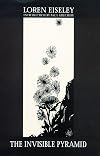
Collected Essays on Evolution, Nature, and the Cosmos, Vol. II: The Invisible Pyramid, The Night Country, Essays from The Star Thrower (2016) 94 copies, 1 review
Associated Works
The Glorious American Essay: One Hundred Essays from Colonial Times to the Present (2020) — Contributor — 119 copies
Writing New York: A Literary Anthology (Expanded 10th-Anniversary Edition) (2008) — Contributor — 101 copies, 1 review
Gentlemen, Scholars and Scoundrels: A Treasury of the Best of Harper's Magazine from 1850 to the Present (1972) — Contributor — 62 copies
Tagged
Common Knowledge
- Canonical name
- Eiseley, Loren C.
- Legal name
- Eiseley, Loren Corey
- Birthdate
- 1907-09-03
- Date of death
- 1977-07-09
- Gender
- male
- Education
- University of Nebraska (BA|BS | English and Geology/Anthropology)
University of Pennsylvania (Ph.D | 1937) - Occupations
- philosopher
professor
anthropologist
science writer
ecologist
poet - Organizations
- University of Pennsylvania (Provost, 1959-1961)
Oberlin College
University of Kansas
American Institute of Human Paleontology (President, 1949)
American Association for the Advancement of Science - Awards and honors
- American Academy of Arts and Letters (1971)
American Philosophical Society (1960)
American Academy of Arts & Sciences (1967)
Bradford Washburn Award (1976)
Joseph Wood Krutch Medal (1976)
Nebraska Hall of Fame (1986) (show all 7)
received 36 honorary degrees over 20 years - Cause of death
- cardiac arrest
- Nationality
- USA
- Birthplace
- Lincoln, Nebraska, USA
- Places of residence
- Philadelphia, Pennsylvania, USA
- Place of death
- Philadelphia, Pennsylvania, USA
- Burial location
- West Laurel Hill Cemetery, Bala Cynwyd, Pennsylvania, USA
- Associated Place (for map)
- Pennsylvania, USA
Members
Reviews
Thanks for the recommendation. I found myself really relating to his almost casual style of thought exploration, and despite some reservations I had with his admiration for Francis Bacon I found myself unable to essentially disagree with anything he said. He has a bravery to try to objectively consider ideas that conflict with his personal prejudices, like the possibility that there is an innate human drive to consume the planet until no option remains but escape to outer space. After a long show more discussion of this possibility and its implications, he concludes that our destructiveness is not innate as demonstrated by our four million years of hunting and gathering.
He distinguishes this long experience of our "first world" of nature from our more recent immersion in the "second world" of culture. Complex agricultural society plunged us exclusively into this second world, enabling us for the first time to observe nature with the detachment that would give rise to modern science, the "invisible pyramid." (p.87) Before that, earlier civilizations devoted similar attention and energy to the construction of the real pyramids which memorialized their belief that the second world is of primary importance.
We, the "world eaters," continue to manifest this now demonstrably mistaken belief in our current society as we gobble up every non-renewable resource as fast as we can. Eiseley says that, propelled by modern science, we are the most aggressive society in history, that "the future has become our primary obsession." (p.105) We took to heart all of Bacon's scientific genius, but we ignored his belief that the all learning should contribute to the enlightened life. (p.69)
Science, and the epistemology of any culture, pursues a comprehensive understanding of the natural world that is meaningful to us in cultural terms. While our modern science is of great value on its own terms, on a larger scale, its value is less certain. Through myth, past cultures "had achieved what modern man in his thickening shell of technology is only now seeking unsuccessfully to accomplish." (p.114)
The question that arises to me is, wrapped up in these unquestionables of science and technology, is there a kind of social power that desperately needs to be questioned with at least as much vigor as the power of the state and capital? Eiseley does not break it down this way, and I suspect he would resist my doing so. He saw the hippies (contemporary to Eiseley's writing) as another manifestation of the same rejection of tradition--"Faustian hunger" (p.109)--that remains our culture's greatest pride and most lethal attribute. He is conservative because change--restlessness--is what drives the world eaters. But his conservative impulse that would be desirable in a sustainable culture seems incompatible with the task of changing our unsustainable one.
This is probably the source of the resignation I detected, which bothered me a little bit throughout the work. In the end Eiseley expresses a sincere and heartfelt love for the world: we must make a "conscious reentry into the sunflower forest" (p.155) which our culture has turned into "an instrument," a "mere source of materials." (p.143) If we succeed in doing so, he imagines that we will have realized something of the "axial" values of Christ, Buddha, Confucius, and Lao-Tse. But when he associates the social tumult of the 1960s with the culture of the world eaters, he presents a real challenge to the possibility of the social revolution that is required to achieve the end he desires. show less
He distinguishes this long experience of our "first world" of nature from our more recent immersion in the "second world" of culture. Complex agricultural society plunged us exclusively into this second world, enabling us for the first time to observe nature with the detachment that would give rise to modern science, the "invisible pyramid." (p.87) Before that, earlier civilizations devoted similar attention and energy to the construction of the real pyramids which memorialized their belief that the second world is of primary importance.
We, the "world eaters," continue to manifest this now demonstrably mistaken belief in our current society as we gobble up every non-renewable resource as fast as we can. Eiseley says that, propelled by modern science, we are the most aggressive society in history, that "the future has become our primary obsession." (p.105) We took to heart all of Bacon's scientific genius, but we ignored his belief that the all learning should contribute to the enlightened life. (p.69)
Science, and the epistemology of any culture, pursues a comprehensive understanding of the natural world that is meaningful to us in cultural terms. While our modern science is of great value on its own terms, on a larger scale, its value is less certain. Through myth, past cultures "had achieved what modern man in his thickening shell of technology is only now seeking unsuccessfully to accomplish." (p.114)
The question that arises to me is, wrapped up in these unquestionables of science and technology, is there a kind of social power that desperately needs to be questioned with at least as much vigor as the power of the state and capital? Eiseley does not break it down this way, and I suspect he would resist my doing so. He saw the hippies (contemporary to Eiseley's writing) as another manifestation of the same rejection of tradition--"Faustian hunger" (p.109)--that remains our culture's greatest pride and most lethal attribute. He is conservative because change--restlessness--is what drives the world eaters. But his conservative impulse that would be desirable in a sustainable culture seems incompatible with the task of changing our unsustainable one.
This is probably the source of the resignation I detected, which bothered me a little bit throughout the work. In the end Eiseley expresses a sincere and heartfelt love for the world: we must make a "conscious reentry into the sunflower forest" (p.155) which our culture has turned into "an instrument," a "mere source of materials." (p.143) If we succeed in doing so, he imagines that we will have realized something of the "axial" values of Christ, Buddha, Confucius, and Lao-Tse. But when he associates the social tumult of the 1960s with the culture of the world eaters, he presents a real challenge to the possibility of the social revolution that is required to achieve the end he desires. show less

This book was sitting on an outside shelf at Wonderbooks in Frederick, obviously crying, "Take me away. I'm not wanted here. They either have too many of me or I'm hopelessly out of date!" I took pity on it based on the "High Praise for The Night Country" on the back cover. In this case, the blurbs did not overstate how good the book is. Eiseley portrays himself as a bone hunter and he taught at the University of Pennsylvania until his death at age 69. But his writing, while it deals with show more aspects of his trade, is something else entirely. It is timeless. He isn't trying to (at least directly) teach you anything about old fossils; rather he is describing moment in his life that have given him some sort of glimpses into what perhaps may be truths. These pieces, whether they take place at night or not, are all about shadows, whether literal or spiritual. Eiseley was not a religious person, but he was familiar with religious teachings and with Shakespeare, Bacon, Bunyan, and probably just about every other important writer, and he weaves all of this knowledge into pieces that read like fiction. At any moment, you expect a monster to jump out. I don't think it is surprising that Ray Bradbury was a huge fan; there is really much in common in their perspectives--I can easily see Eiseley as a character in The Martian Chronicles, for instance. Not long after starting reading this I went crazy, logged on to abehbooks.com, and bought all but one of Eiseley's other books. The one holdout seemed a bit expensive at the time. The others, like this one, apparently exist in great numbers and are not collectors items. Pick up one of these orphans at your next visit to a used book store and see if you aren't engaged and amazed also. Eiseley is simply one of the best pure writers I have ever read. Obviously, not every piece is as good as his best, but each has moments of pleasure and wonderment. show less

There were times when reading The Unexpected Universe that I thought I'd found, in Loren Eiseley, another William Bolitho. Now unconscionably obscure, Bolitho was an erudite and ornately lyrical essayist of the 1920s, whose out-of-print books like Twelve Against the Gods and Camera Obscura proved such an unexpected joy for me. Coming across The Unexpected Universe, Eiseley's collection of erudite, ornate essays, in similarly unpromising circumstances (a second-hand book store, miscatalogued show more in the sci-fi section next to a book proving that God was an alien), I saw plenty to excite me. But the precious metals were packed hard into the rock, and many of them proved too difficult to extract.
Discussing science, anthropology, naturalism and spirituality, Eiseley's wide-ranging essays had plenty of potential, and his learned digressions into history, mythology and personal anecdote boded well for a lush reading experience. However, I began to recognise just how slowly I was getting through the book, and how jaded I was becoming. I'm neither a quick nor a slow reader, merely a regular and persistent one, but I was surprised how long it took me to get through this slim volume.
As the initial promise wore off, I began to look more closely at why I felt jaded. At first, I began to notice that while Eiseley's topics of discussion were fascinating, his writing was often quite verbose and bloated. What I had thought to be ornate decoration was increasingly a sickly garnish, and in many paragraphs I found I would lose the thread of argument. In addition to his academic pursuits, Eiseley was also a published poet, and much of his prose – particularly in his occasional flights of fancy – read like prose-poems – but ones injudiciously wrought.
This verbosity was something I also felt with Bolitho – though to a much lesser extent there – but Bolitho was always redeemed by his fantastic, acute observations. With Eiseley, however, I increasingly found that not only was the heavy prose making me lose the thread of argument, but I was often unsure what the argument was. When the argument is clear, Eiseley's bejewelled pursuit can be enjoyable, as in the essay 'The Invisible Island', where the common understanding of Darwinian evolution is recast to pay homage to those all-important genetic and cultural misfits ("... so much has been written about the triumph of the fittest and so little about the survival of the failures who have changed... the world" (pg. 120); "Competition may simply suppress what exists only as potential" (pg. 128)). But too often I didn't know what Eiseley's dreamy, shifting sands were trying to say, and it would be a few paragraphs before I could find something to fix onto.
The Unexpected Universe is a worthwhile book, intermittently inspiring, entertaining and thought-provoking. The name Loren Eiseley is on my radar now, and I am certainly going to pursue more of his writing. But The Unexpected Universe was also intermittently indulgent, ponderous and roundabout, and for all its qualities I believe my lasting memory of the book will be this sluggishness. show less
Discussing science, anthropology, naturalism and spirituality, Eiseley's wide-ranging essays had plenty of potential, and his learned digressions into history, mythology and personal anecdote boded well for a lush reading experience. However, I began to recognise just how slowly I was getting through the book, and how jaded I was becoming. I'm neither a quick nor a slow reader, merely a regular and persistent one, but I was surprised how long it took me to get through this slim volume.
As the initial promise wore off, I began to look more closely at why I felt jaded. At first, I began to notice that while Eiseley's topics of discussion were fascinating, his writing was often quite verbose and bloated. What I had thought to be ornate decoration was increasingly a sickly garnish, and in many paragraphs I found I would lose the thread of argument. In addition to his academic pursuits, Eiseley was also a published poet, and much of his prose – particularly in his occasional flights of fancy – read like prose-poems – but ones injudiciously wrought.
This verbosity was something I also felt with Bolitho – though to a much lesser extent there – but Bolitho was always redeemed by his fantastic, acute observations. With Eiseley, however, I increasingly found that not only was the heavy prose making me lose the thread of argument, but I was often unsure what the argument was. When the argument is clear, Eiseley's bejewelled pursuit can be enjoyable, as in the essay 'The Invisible Island', where the common understanding of Darwinian evolution is recast to pay homage to those all-important genetic and cultural misfits ("... so much has been written about the triumph of the fittest and so little about the survival of the failures who have changed... the world" (pg. 120); "Competition may simply suppress what exists only as potential" (pg. 128)). But too often I didn't know what Eiseley's dreamy, shifting sands were trying to say, and it would be a few paragraphs before I could find something to fix onto.
The Unexpected Universe is a worthwhile book, intermittently inspiring, entertaining and thought-provoking. The name Loren Eiseley is on my radar now, and I am certainly going to pursue more of his writing. But The Unexpected Universe was also intermittently indulgent, ponderous and roundabout, and for all its qualities I believe my lasting memory of the book will be this sluggishness. show less

Of these four essays about Francis Bacon, I liked the last one the best. Because there is so much duplication between the essays, you might get by with reading just this one. According to Eiseley--and who would doubt him--Bacon's almost invention of the scientific method changed history, for the better and worse. Eiseley writes under the shadow of atomic annihilation, and as we are moving toward it again, his sentiments carry more weight. He paints a very good portrait of those for whom show more science has become as dogmatic and exclusionary as religion, while showing us his own humanity in every sentence. show less
Lists
Awards


You May Also Like


Associated Authors
Statistics
- Works
- 34
- Also by
- 16
- Members
- 4,775
- Popularity
- #5,260
- Rating
- 4.0
- Reviews
- 51
- ISBNs
- 73
- Languages
- 2
- Favorited
- 31