
Steven Johnson
Author of THe Ghost Map
About the Author
Image credit: Steven Berlin Johnson. Photo courtesy Meet the Media Guru.
Works by Steven Johnson
Emergence: The Connected Lives of Ants, Brains, Cities, and Software (2001) 1,899 copies, 25 reviews
The Invention of Air: A Story Of Science, Faith, Revolution, And The Birth Of America (2008) 1,023 copies, 37 reviews
Enemy of All Mankind: A True Story of Piracy, Power, and History's First Global Manhunt (2020) 400 copies, 11 reviews
Interface Culture : How New Technology Transforms the Way We Create and Communicate (1997) 371 copies, 4 reviews
The Infernal Machine: A True Story of Dynamite, Terror, and the Rise of the Modern Detective (2024) 182 copies, 3 reviews
How We Got To Now: Six Innovations That Made the Modern World [young reader's edition] (2018) 64 copies, 3 reviews
Associated Works
Supercade: A Visual History of the Videogame Age 1971-1984 (2001) — Contributor — 175 copies, 2 reviews
Tagged
Common Knowledge
- Canonical name
- Johnson, Steven
- Legal name
- Johnson, Steven Berlin
- Birthdate
- 1968-06-06
- Gender
- male
- Education
- St Alban's School, Washington, USA
Brown University (BA|1990)
Columbia University (MA) - Occupations
- non-fiction writer
media theorist - Relationships
- Robinson, Alexa (spouse)
- Nationality
- USA
- Birthplace
- Washington, D.C., USA
- Places of residence
- Park Slope, Brooklyn, New York, USA
Marin County, California, USA - Associated Place (for map)
- USA
Members
Discussions
The 2013 Science, Religion, and History group read discussion thread in 75 Books Challenge for 2013 (March 2017)
The Ghost Map - Group Read in 75 Books Challenge for 2013 (April 2013)
Reviews
Enemy of All Mankind: A True Story of Piracy, Power, and History's First Global Manhunt by Steven Johnson
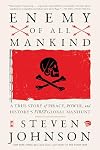
"...few human beings had ever captured the imagination of so many strangers around the world without commanding an army, presiding over a major religious sect or being born with royal blood."
Henry Every was one of the richest pirates in history and not how you'd expect. Instead of vying for Spanish Treasure Fleets, Every took his men to Madagascar. In the 17th century, India and the Mughal Empire, boasted the richest kingdom in the world. Despite the East India Co.'s attempts to dominate, show more the Grand Mughal Aurangzeb kept them on a tight leash. But whatever beneficial relationship the British had soon crumbled after Every took the Ganj-i-Sawai. The "Ganj-i-Sawai" or Gunsway, was massive, far larger than Every's "Fancy" and carried an astounding amount of treasure as well as pilgrims from Mecca. These were all noblewomen of Aurangzeb's own family. What happens next, as Every's men took the ship, I won't describe in detail. Suffice it to say Aurangzeb anger could not be contained. The East India factory in Surat was seized and an international bounty was put on Every's head.
While I can't seem to find the perfect biography of Every, this one is still better than "The Pirate King." Unlike "The Pirate King," Johnson does not try to romanticize Every in any way. The men "were r*pists of the worst order" and as captain, Every bears full responsibility. Referring to Indian narrative and survivor testimonies, Johnson effectively dispels the myth of Every as the "Robin Hood" of the seas. In fact, Every also promised to never attack English ships, but he did. Using an alias, he even money launders some of his loot in exchange for slaves, the "universal currency," to sell in the colonies. While Johnson included so much that is often ignored or glossed over, it did help that I had read Woodard and Cordingly first. It needed just a bit more leading into the Golden Age. show less
Henry Every was one of the richest pirates in history and not how you'd expect. Instead of vying for Spanish Treasure Fleets, Every took his men to Madagascar. In the 17th century, India and the Mughal Empire, boasted the richest kingdom in the world. Despite the East India Co.'s attempts to dominate, show more the Grand Mughal Aurangzeb kept them on a tight leash. But whatever beneficial relationship the British had soon crumbled after Every took the Ganj-i-Sawai. The "Ganj-i-Sawai" or Gunsway, was massive, far larger than Every's "Fancy" and carried an astounding amount of treasure as well as pilgrims from Mecca. These were all noblewomen of Aurangzeb's own family. What happens next, as Every's men took the ship, I won't describe in detail. Suffice it to say Aurangzeb anger could not be contained. The East India factory in Surat was seized and an international bounty was put on Every's head.
While I can't seem to find the perfect biography of Every, this one is still better than "The Pirate King." Unlike "The Pirate King," Johnson does not try to romanticize Every in any way. The men "were r*pists of the worst order" and as captain, Every bears full responsibility. Referring to Indian narrative and survivor testimonies, Johnson effectively dispels the myth of Every as the "Robin Hood" of the seas. In fact, Every also promised to never attack English ships, but he did. Using an alias, he even money launders some of his loot in exchange for slaves, the "universal currency," to sell in the colonies. While Johnson included so much that is often ignored or glossed over, it did help that I had read Woodard and Cordingly first. It needed just a bit more leading into the Golden Age. show less

I enjoyed Steven Johnson's treatment of a famous cholera epidemic in Victorian London. I was skeptical at first a book-long treatment would hold my interest, like so many non-fiction books these days which are bloated with encyclopedia tangents and hung along a thin cord of a story. But Johnson's narrative skills are top notch and the book works well on a number of levels. On the surface it's a Sherlockian detective story, the mystery of what is causing the cholera and how its discovered. show more There were times I could hear the horse hoves on cobblestone, smell rank sewers and see black pools of sewage. Johnson sets the stage throughout and is a master at providing context in an atmospheric way that turns a seemingly dry topic into a lively trip back in time. It's also literary with many references to Dickens and other period excerpts. I also liked how Johnson looked at so many aspects from the biological to the sociological to the political - he can zoom out from the very small to the very large, from the specific "micro history" to the grand "big history" and bring it all together. Overall a well crafted story that is educational and entertaining popular history. show less
The ghost map : the story of London's most terrifying epidemic--and how it changed science, cities, and the modern world by Steven Johnson

The “hero” of Steven Johnson's The Ghost Map, Dr. John Snow, I had already recently met in the pages of The Butchering Art: Joseph Lister's Quest To Transform the Grisly World of Victorian Medicine by Lindsey Fitzharris. The two books share accounts of the newly discovered use of chloroform and ether to anesthetize patients before surgeries and tooth extractions. Both describe Snow's concept of mapping the locations of cholera infections and deaths to discover the source and means of show more transmission of the disease. Both address the then-popular concept of miasma as an agent of infection (inasmuch as microbial life was unknown or disbelieved in the mid 1800s).
These points of commonality are merely part of Fitzharris's book but constitute the mainstream of Johnson's. In fact, Johnson hails Dr. Snow's mapping idea as the beginning of modern epidemiology. Then he goes further by crediting Snow's research, along with that of Henry Whitehead, a cleric who also sought to identify the source and means of transmission of the cholera bacterium, without knowing that it was a bacterium, of course, of enabling cities to exist.
True, one can trace developments from identifying polluted water as a source of disease to the construction of sewer systems to keep waste water separated from drinking water, and, yes, one can make the case that, without sources of clean water and hygienic disposal of waste water, humans could not live safely in concentrated masses, i.e., cities. However, I feel that Johnson attributes Snow and Whitehead with just a bit too much influence on the subsequent creation of city life.
Nonetheless, had The Ghost Map concluded with the story of the London cholera outbreak in 1854, it would have been an interestingly written retelling of the event, of the nascent debunking of “miasma” as a disease agent, and of the subsequent creation of an effective sewer system in 19th century London. However, the book includes a fairly lengthy epilogue which has little to do with the history of disease and of the discoveries that helped modernize both medicine and hygiene. Johnson appears to believe that the only hope for humankind is to live in the gray cement canyons and the sealed-window apartment warrens of congested cities. Optimistically, he concludes that, outside the sterile environments of man-made megalopolises, nature will be allowed to “do her thing” to keep Earth going despite the weight of human overpopulation, which he claims will actually be relieved by city dwelling. True, he does admit that nuclear war and terrorism may disrupt the security of cities and that mankind may have to learn with such things, but c'est la vie.
Had it not been for the 25 page soapbox epilogue and its sermon that humankind will survive only in the artificial environs of concrete, asphalt, steel, and glass, The Ghost Map may have eked out a four-star rating from me, not that this history has not been recounted elsewhere many times before but that this retelling is well done and is a fairly entertaining as well as informative history. However, to include what is in essence a final chapter that has little connection with what has come before and which presumes not only to predict humankind's future but also to presume to prescribe how that future should unfold appears to me to be unpardonably pretentious. With that, the fourth star disappeared. show less
These points of commonality are merely part of Fitzharris's book but constitute the mainstream of Johnson's. In fact, Johnson hails Dr. Snow's mapping idea as the beginning of modern epidemiology. Then he goes further by crediting Snow's research, along with that of Henry Whitehead, a cleric who also sought to identify the source and means of transmission of the cholera bacterium, without knowing that it was a bacterium, of course, of enabling cities to exist.
True, one can trace developments from identifying polluted water as a source of disease to the construction of sewer systems to keep waste water separated from drinking water, and, yes, one can make the case that, without sources of clean water and hygienic disposal of waste water, humans could not live safely in concentrated masses, i.e., cities. However, I feel that Johnson attributes Snow and Whitehead with just a bit too much influence on the subsequent creation of city life.
Nonetheless, had The Ghost Map concluded with the story of the London cholera outbreak in 1854, it would have been an interestingly written retelling of the event, of the nascent debunking of “miasma” as a disease agent, and of the subsequent creation of an effective sewer system in 19th century London. However, the book includes a fairly lengthy epilogue which has little to do with the history of disease and of the discoveries that helped modernize both medicine and hygiene. Johnson appears to believe that the only hope for humankind is to live in the gray cement canyons and the sealed-window apartment warrens of congested cities. Optimistically, he concludes that, outside the sterile environments of man-made megalopolises, nature will be allowed to “do her thing” to keep Earth going despite the weight of human overpopulation, which he claims will actually be relieved by city dwelling. True, he does admit that nuclear war and terrorism may disrupt the security of cities and that mankind may have to learn with such things, but c'est la vie.
Had it not been for the 25 page soapbox epilogue and its sermon that humankind will survive only in the artificial environs of concrete, asphalt, steel, and glass, The Ghost Map may have eked out a four-star rating from me, not that this history has not been recounted elsewhere many times before but that this retelling is well done and is a fairly entertaining as well as informative history. However, to include what is in essence a final chapter that has little connection with what has come before and which presumes not only to predict humankind's future but also to presume to prescribe how that future should unfold appears to me to be unpardonably pretentious. With that, the fourth star disappeared. show less

Future Perfect is an optimistic book about technology, society, and the future. That’s remarkable in itself, since pessimistic (or at least cautionary) books tend to outnumber optimistic ones, but what’s even more remarkable is the care and precision with which Johnson makes his case. The new communications technologies, he argues, are significant less for what they do than for what their capabilities enable us to do, if we choose to do it.
The first of the book’s two sections lays out show more its central premise: that distributed “peer networks” allowing the free flow of information between diverse individuals are a powerful force for social progress. decentralized networks are a powerful tool for facilitating interaction between individuals, and thus for social progress. It concludes: “We have a theory of peer networks. We have the practice of building them. And we have results. We know that peer networks can work in the real world. The task now is to discover how far they can take us.” The second, longer section – a series of thematic chapters on subjects like journalism, technology, and government – makes good on that promise. It presents case studies that show what peer networks have already accomplished, and contemplates what they might accomplish in the future.
Johnson’s goal, in Future Perfect is not to write a primer on the theory of networks, an analysis of how distributed networks function, or a history of distributed networks (though he touches, expertly but wearing his expertise lightly, on all those subjects). Nor is his goal to predict the future: The potential applications he describes for peer networks are presented as possibilities, not certainties. His evident goal is, rather, to encourage readers raised in a world (largely) defined by centralized networks to think seriously about one (more) defined by peer networks. It is a manifesto, but an intellectual rather than a political one. In the spirit of Apple Computer (the subject of one of Johnson’s case studies), it urges: “Think different.”
Future Perfect is, in this sense, a spiritual sequel to Johnson’s Everything Bad is Good for You. Like the earlier work, it takes a proposition that, at first glance, seems completely absurd -- the height of fuzzy headed wishful thinking -- and patiently shows that the “absurd” idea is a more useful tool than the received wisdom that “everybody knows.” Future Perfect improves on Everything Bad, however, by its carefully delineated internal structure and its layering of case study on case study, thematic chapter on thematic chapter. Johnson’s central idea is breathtakingly simple. His development of it, at length and in detail, is what gives the book its power.
Steven Johnson is both an insightful thinker and an exceptionally graceful writer. If you haven’t encountered his work before, this is an excellent place to begin. show less
The first of the book’s two sections lays out show more its central premise: that distributed “peer networks” allowing the free flow of information between diverse individuals are a powerful force for social progress. decentralized networks are a powerful tool for facilitating interaction between individuals, and thus for social progress. It concludes: “We have a theory of peer networks. We have the practice of building them. And we have results. We know that peer networks can work in the real world. The task now is to discover how far they can take us.” The second, longer section – a series of thematic chapters on subjects like journalism, technology, and government – makes good on that promise. It presents case studies that show what peer networks have already accomplished, and contemplates what they might accomplish in the future.
Johnson’s goal, in Future Perfect is not to write a primer on the theory of networks, an analysis of how distributed networks function, or a history of distributed networks (though he touches, expertly but wearing his expertise lightly, on all those subjects). Nor is his goal to predict the future: The potential applications he describes for peer networks are presented as possibilities, not certainties. His evident goal is, rather, to encourage readers raised in a world (largely) defined by centralized networks to think seriously about one (more) defined by peer networks. It is a manifesto, but an intellectual rather than a political one. In the spirit of Apple Computer (the subject of one of Johnson’s case studies), it urges: “Think different.”
Future Perfect is, in this sense, a spiritual sequel to Johnson’s Everything Bad is Good for You. Like the earlier work, it takes a proposition that, at first glance, seems completely absurd -- the height of fuzzy headed wishful thinking -- and patiently shows that the “absurd” idea is a more useful tool than the received wisdom that “everybody knows.” Future Perfect improves on Everything Bad, however, by its carefully delineated internal structure and its layering of case study on case study, thematic chapter on thematic chapter. Johnson’s central idea is breathtakingly simple. His development of it, at length and in detail, is what gives the book its power.
Steven Johnson is both an insightful thinker and an exceptionally graceful writer. If you haven’t encountered his work before, this is an excellent place to begin. show less
 This review was written for LibraryThing Early Reviewers.
Lists
Disaster Books (1)
True Crime (1)
Book Club List (1)
Awards


You May Also Like


Associated Authors
Statistics
- Works
- 19
- Also by
- 2
- Members
- 16,061
- Popularity
- #1,412
- Rating
- 3.8
- Reviews
- 501
- ISBNs
- 233
- Languages
- 14
- Favorited
- 1
