
Richard White (2) (1947–)
Author of The Native Americans: An Illustrated History
For other authors named Richard White, see the disambiguation page.
About the Author
Richard White is an historian of great originality, range, and authority. Winner of a MacArthur award and the Parkman Prize, he is the Margaret Byrne Professor of American History at Stanford University.
Image credit: Stanford University
Works by Richard White
The Republic for Which It Stands: The United States during Reconstruction and the Gilded Age, 1865-1896 (2017) 623 copies, 12 reviews
The Middle Ground: Indian, Empires, and Republics in the Great Lakes Region, 1650-1815 (1991) 480 copies, 6 reviews
It's Your Misfortune and None of My Own: A New History of the American West (1991) 272 copies, 3 reviews
Who Killed Jane Stanford? A Gilded Age Tale of Murder, Deceit, Spirits, and the Birth of a University (2022) 180 copies, 5 reviews
Associated Works
Novel History: Historians and Novelists Confront America's Past and Each Other (2001) — Contributor — 139 copies, 1 review
Major Problems in the Gilded Age and the Progressive Era: Documents and Essays (1993) — Contributor — 85 copies
Major Problems in the History of the American West: Documents and Essays (1989) — Contributor — 67 copies
Through a Glass Darkly: Reflections on Personal Identity in Early America (1997) — Contributor — 45 copies
The Indian Tribes of the Upper Mississippi Valley and Region of the Great Lakes: Two Volumes in One (1996) — Introduction, some editions — 30 copies
Tagged
Common Knowledge
- Canonical name
- White, Richard
- Birthdate
- 1947-05-28
- Gender
- male
- Education
- University of California, Santa Cruz (BA|1969)
University of Washington (MA|1972 | history)
University of Washington (Ph.D|1975 | history) - Occupations
- historian
professor - Organizations
- Organization of American Historians (past president)
Stanford University
University of Washington
University of Utah
Michigan State University - Awards and honors
- MacArthur Fellowship (1995)
Thomas J. Blegen Award (1981, 1986)
Forest History Society Book Award (1981)
Wheeler-Vogelin Book Prize (1984)
Western Heritage Award (1992)
American Society of the Colonial Wars Prize (1992) (show all 18)
Francis Parkman Prize (1992, 2012)
Rawley Prize (1992)
Albert B. Corey Prize (1992)
Albert J. Beveridge Award (1992)
Governor's Award (1999)
Autry Humanities Award (2003)
Gomroy Prize (2012)
Los Angeles Times Book Award for History (2012)
Ellis W. Hawley Prize (2018)
American Philosophical Society (2016)
American Antiquarian Society (1998)
American Academy of Arts & Sciences (1998) - Agent
- Georges Borchardt
- Relationships
- White, Stephen (brother)
- Nationality
- USA
- Map Location
- USA
Members
Reviews
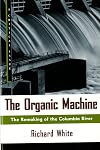
Richard White has an ability to describe in easy prose the interconnectivity of humans and nature that causes his readers to stop and think, "Of course, but why didn't I see that before." This tight book is a great read, with its focus on the Columbia River and the seemingly unending attempts to change, harness, capture, exploit, etc., its flow. White gives readers a reason to reassess their thoughts on the Columbia River Basin's social and environmental history. His apt desciptions, like show more dams as a kind of "ghost technology " (x), and, "In a democracy boredom works for bureaucracies and corporations as smell works for a skunk. It keeps danger away" (64), kept me reading. A worthy book in nearly every way. show less
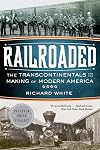
Long ago I read an essay by Ayn Rand in Capitalism: The Unknown Ideal (1966) that argued that among the transcontinental railroads, only the Great Northern was a success because it did not accept any subsidies from the Federal government. The other railroads were corrupt, poorly managed boondoggles that survived only because the government propped them up. Rand was making a libertarian case against state interference in business. White likewise argues that the railroads were nothing more show more than a fraudulent scheme, although he comes at it from the left with a strong post-2008 perspective. Playing with house money and supported by public bailouts, White argues that the transcontinental railroad system was nothing more than a Ponzi scheme to route money from the public treasury into the pockets of select investors. And they were select investors who conned others (including their former pals) when it suited them. The amoral, apolitical railroads backed whatever best served the financial interests of their investors. As where previous generations of historians saw the completion of the transcontinental railroad as a triumph of American progress, White sees a complicated, bloated, unnecessary, and unsustainable system that sapped the treasury for decades. It was, in short, a national tragedy in his telling. show less
Richard White's expansive history documents the creation and (mis)management of the transcontinental railroads that spanned the Western United States, Canada, and Mexico from the 1860s to 1890s. White argues that the transcontinentals were largely a speculative endeavor that built railroad lines where they weren't needed and failed to build a demand for their use once constructed. While railroads are often credited with the creation of the modern corporation, White provides many examples of show more how the transcontinentals were disorganized, operating at cross purposes, and ultimately failed companies. What the railroad companies were good at was making money by building with other peoples' money, the root of modern finance. This of course was coupled with a lot of corruption and control over politicians who saw that the railroads were generously subsidized.
The protagonists (perhaps, the villains?) of this work are the capitalists who lead the railroad companies including Charles Francis Adams, Jay Cooke, Collis P. Huntington, Tom Scott, Leland Stafford, and Henry Villard. But the greatness of this book is that it looks at the transcontinental railroads from many perspectives including construction workers, railroad workers, anti-monopolists, local politicians, union organizers, and Native Americans. Some of the best parts of this book are the "A Railroad Life" mini-chapters that offer a case study of an individual's life experiences with the railroad. White also writes in a engaging, sometimes snarky, style that make reading about 19th century finance and corruption fun!
Favorite Passages:
The protagonists (perhaps, the villains?) of this work are the capitalists who lead the railroad companies including Charles Francis Adams, Jay Cooke, Collis P. Huntington, Tom Scott, Leland Stafford, and Henry Villard. But the greatness of this book is that it looks at the transcontinental railroads from many perspectives including construction workers, railroad workers, anti-monopolists, local politicians, union organizers, and Native Americans. Some of the best parts of this book are the "A Railroad Life" mini-chapters that offer a case study of an individual's life experiences with the railroad. White also writes in a engaging, sometimes snarky, style that make reading about 19th century finance and corruption fun!
Favorite Passages:
“How, when powerful people can on close examination seem so ignorant and inept; how, when so much work is done stupidly, shoddily, haphazardly, and selfishly; how, then, does the modern world function at all? It is no wonder that religious people see the hand of God and economist invent the invisible hand.” – p. xxxii
“The transcontinentals were not so much about earning revenues from moving people and freight as about finance and politics. Finance and politics were in the late nineteenth century about networks, and networks, in turn, were functions of family, friendship, and information.” – p. 96
“Nineteenth-century Americans were not shocked by the corruption of the press; neither were they surprised that businessmen cheated, lied, and stole; what worried them was the corruption of the republic. In the Gilded Age, Americans feared the republic had become corrupted – diseased, decaying, and dying. They identified the source of this corruption as monopoly, and they made monopoly synonymous with the corporation.” – p. 98
“Both the Southern Pacific and the Texas and Pacific were so dependent on credit that they resembled two large and angry men trying to fight while on life-support. Both corporations carried immense debt, and both depended on steady infusions from existing subsidies, bond sales, and loans. Each flailed at the other, each trying to maintain its own lifelines while cutting off those of its opponent.” – p. 106
“The exclusive right to build a railroad was more valuable than an actual railroad in a newly settled agricultural region because an actual railroad in such a region would lose money until the population grew thick enough to provide the traffic necessary to turn a profit.” – p. 212
“Railroads remained largely speculative enterprises meant to make a profit through their financing” - p. 215
“What seemed a single corporation was the tool of four men – and eventually four families – who grew increasingly divided, bitter, and distrustful.” – p. 266
“The trouble with good accounting and transparent reporting was that it made visible, to railroad commissions and investors, what the railroad wished to be invisible. This was why the practices railroad men encouraged with one hand, they sometimes blocked with the other.” – p. 273
“There was little logical reason why a corporation was considered a single rights-bearing person while a union was merely a collection of rights-bearing individuals. The legal reason was that corporation had chosen to incorporate, but in organizational terms there was little difference between a union such as the American Railway Union and a corporation.” – p. 420
“Railroaded is not a kind of Robber Baron redux. The railroad corporations that I have examined here were unsuccessful and powerful. My guys could be ruthless, but their corporations were failure constantly in need of subsidy and rescue. They fascinate me precisely because they do not fit into our usual way of seeing things. And, in part, this book has been a study of how the unsuccessful and the incompetent not only survived but prospered and became powerful.” – p. 509show less
The Republic for Which It Stands: The United States during Reconstruction and the Gilded Age, 1865-1896 (Oxford History of the United States) by Richard White
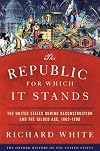
I'd been waiting for this book for years, and it lived up to expectations. First, the other books in the Oxford History of the US have been compelling and readable. Second, the era covered in this book -- 1865/1900, much of which was called "The Gilded Age" doesn't have as much coverage as a lot of the rest of our history. A lot has been written about Reconstruction, but it's hard to find valuable treatments of the whole period. No longer. This is an excellent survey of a critical period, show more during which the US changed from a nation of small farmers and entrepreneurs to an economic behemoth powered by massive corporations. But there were costs to many groups. I'd read a lot about the failure of Reconstruction, but the horrors of the Indian wars were much worse than I realized. The growing struggle between capital and labor, and the dramatic widening in income differentials are thorougly covered. That parallels the current day, as does the continuing restriction of the franchise in the late 19th century. The next big era, of course, was the Progressive Era. Will that pattern repeat itself? An interesting question, and an interesting read. show less
Lists
Awards


You May Also Like


Associated Authors
Statistics
- Works
- 17
- Also by
- 11
- Members
- 3,411
- Popularity
- #7,471
- Rating
- 3.7
- Reviews
- 45
- ISBNs
- 162
- Languages
- 3
- Favorited
- 3