
Edvard Radzinsky
Author of The Last Tsar: The Life and Death of Nicholas II
About the Author
Image credit: Edward Radzinsky, Moscow, in 1995
Works by Edvard Radzinsky
Stalin: The First In-depth Biography Based on Explosive New Documents from Russia's Secret Archives (1996) 589 copies, 5 reviews
Театр времен Нерона и Сенеки 1 copy
Беседы с Сократом 1 copy
Associated Works
Tsar: The Lost World of Nicholas and Alexandra (1995) — Contributor, some editions — 392 copies, 5 reviews
Read Russia!: An Anthology of New Voices — Contributor — 15 copies
Tagged
Common Knowledge
- Legal name
- Радзинский, Эдвард Станиславович
- Other names
- Radzinskiĭ, Ėdvard Stanislavovich
Radziński, Edward
רדזינסקי, אדורד - Birthdate
- 1936-09-29
- Gender
- male
- Education
- Moscow Archive Institute
Columbia University - Occupations
- popular historian
playwright
screenwriter
television presenter
biographer - Awards and honors
- Ordre du Mérite pour la Patrie (2006)
- Relationships
- Zimin, Alexander (Professeur)
Denisova, Yelena (3e épouse)
Doronina, Tatyana (2e Ex-épouse, 19 66 | 19 71)
Geraskina, Alla (1e Ex-épouse, 19 55 | 19 64)
Radzinsky, Oleg (Fils) - Nationality
- Russia
- Birthplace
- Moscow, Russia, USSR
- Places of residence
- Moscow, Russia
USA
France - Map Location
- Russia
Members
Reviews

Íme, a gáláns XVIII. század… suhognak a tafotaszoknyák a bálteremben, porzik a rizsportól a sok csinos paróka, de a háttérben már ott várakozik doktor Guillotin, hogy elvágja a mondat végét. Radzinszkij egy nagyobbacska és három kisregény segítségével végigkorzózik velünk a korszakon:
1.) Először egy drámaian szenvedélyes történetben bemutatja nekünk Erzsébetet, aki vagy az orosz trón várományosa, vagy a legügyesebb imposztor, aki valaha élt. De vajon show more méltó ellenfele lehet Katalin cárnőnek, aki maga is a cselszövők gyöngye, és egyben a legnagyobb manipulátorok egyike, aki valaha koronát viselt a fején?
2.) Megtekinthetjük a nagy nőcsábászt, Casanovát, akiért eljön a legrémesebb szörnyeteg, aki a nőcsábászokért eljöhet: az öregedés.
3.) Látjuk Mozartot és barátját, van Swieten bárót, aki úgy dönt, kihozza pártfogoltjából a lehető legtöbbet. És hogy lehet a művészből a legtöbbet kihozni? Hát úgy, hogy biztosítjuk számára a szenvedés lehetőségét.
4.) És ott állunk a vérpadon Sanson, a párizsi főhóhér mellett, aki rögtönzött történelemleckét ad nekünk a forradalom természetéről. És egyben az emberi természetről is, ami sajna olyan, hogy néha még a hóhér számít a humanizmus őrlángjának.
Radzinszkij számára a történelem csak alapanyag – a nevek és az események nagy vonalakban stimmelnek, de meglehetős szabadsággal kezeli őket. Számára ugyanis nem a tények betű szerinti igazsága a lényeg, hanem az, amit el akartak rejteni mögöttük. Nevezhetjük ezt pletykának, szófia beszédnek, vagy akár mítosznak, de Radzinszkij számára ez a mese üzemanyaga. A rejtély, amit úgy tár fel, hogy azért bőven maradnak benne homályos pontok – mert ugye a tökéletesen feltárt rejtély már nem rejtélyes, sokkal inkább unalmas. A látszólagos homályt pedig csak erősíti a nyelv, amit használ: a lüktető, pulzáló, szaggatott szöveg, ami magán viseli a drámaíró kézjegyét.
Kellemes olvasmány. Ha nem is hisszük minden szavát, de isszuk. show less
1.) Először egy drámaian szenvedélyes történetben bemutatja nekünk Erzsébetet, aki vagy az orosz trón várományosa, vagy a legügyesebb imposztor, aki valaha élt. De vajon show more méltó ellenfele lehet Katalin cárnőnek, aki maga is a cselszövők gyöngye, és egyben a legnagyobb manipulátorok egyike, aki valaha koronát viselt a fején?
2.) Megtekinthetjük a nagy nőcsábászt, Casanovát, akiért eljön a legrémesebb szörnyeteg, aki a nőcsábászokért eljöhet: az öregedés.
3.) Látjuk Mozartot és barátját, van Swieten bárót, aki úgy dönt, kihozza pártfogoltjából a lehető legtöbbet. És hogy lehet a művészből a legtöbbet kihozni? Hát úgy, hogy biztosítjuk számára a szenvedés lehetőségét.
4.) És ott állunk a vérpadon Sanson, a párizsi főhóhér mellett, aki rögtönzött történelemleckét ad nekünk a forradalom természetéről. És egyben az emberi természetről is, ami sajna olyan, hogy néha még a hóhér számít a humanizmus őrlángjának.
Radzinszkij számára a történelem csak alapanyag – a nevek és az események nagy vonalakban stimmelnek, de meglehetős szabadsággal kezeli őket. Számára ugyanis nem a tények betű szerinti igazsága a lényeg, hanem az, amit el akartak rejteni mögöttük. Nevezhetjük ezt pletykának, szófia beszédnek, vagy akár mítosznak, de Radzinszkij számára ez a mese üzemanyaga. A rejtély, amit úgy tár fel, hogy azért bőven maradnak benne homályos pontok – mert ugye a tökéletesen feltárt rejtély már nem rejtélyes, sokkal inkább unalmas. A látszólagos homályt pedig csak erősíti a nyelv, amit használ: a lüktető, pulzáló, szaggatott szöveg, ami magán viseli a drámaíró kézjegyét.
Kellemes olvasmány. Ha nem is hisszük minden szavát, de isszuk. show less
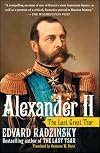
Edvard Radzinsky has taken advantage of perestroika and glasnost to rummage around in previously secret Russian state files and come up with some pretty interesting aspects of the life of the man he calls “the last great Tsar”. He’s also a playwright; hence the book has a lot of dramatic, novelistic qualities. And he’s also a Russia, with an appreciation for the stereotypes of national character.
Either a lot of Russian history was suppressed by the Soviet Union or Radzinsky is show more consciously writing for a foreign audience, because the first third of the book is a primer on Russian history that I think a normal Russian reader would be expected to know. It a nice elementary introduction and explains a lot to me. When he finally gets to his subject, it’s almost as if his style changes; sentences and paragraphs become more sophisticated.
Alexander II was the one who freed the serfs. This had an opposite effect to what you might expect; conservatives hated him, of course, but the liberal faction didn’t like him very much either. (Radzinsky explains this by theorizing that Alexander II didn’t give the serfs enough freedom; I wonder if it were also a “Nixon in China” thing, where liberals got upset because someone had co-opted their program). At any rate, shortly after the serfs were freed Alexander II began to suffer assassination attempts, until the final successful one in 1881.
Conservatives and religious leaders were also scandalized by Alexander II’s sex life. The Tsar, of course, was expected to mess around with ladies-in-waiting and serving maids now and then, but Alexander’s critics felt he carried this to excess (especially since the Tsarina had the reputation of being a secular saint). The final straw was when the Tsarina died of tuberculosis, Alexander married his long-time mistress Ekaterina Dolgorukaya and legitimized their children. It was one thing to have a mistress, but it horribly offended the nobility to marry her. (One of the ironies here is that the Romanov dynasty, by this time, was almost 100% German due to the tradition of Tsars and Tsareviches marrying minor German princesses. Ekaterina Dolgorukaya, on the other hand, was the first Russia to marry a Tsar since the 15th century).
This is where Radzinsky begins to spin a conspiracy theory. His proposal is that the conservatives (Radzinsky usually calls them “retrogrades”) essentially cooperated with the radical assassins – not directly, but by deliberately ignoring evidence of assassination attempts. Radzinsky has just enough evidence here to be intriguing. It certainly looks like the radicals had some sort of inside information on the Tsar’s plans, and that the secret police, despite having immense powers, showed stunning incompetence in dealing with the plots. In December, 1879, assassins had exact information on the route of the Tsar’s train and the car he was in, tunneled under the tracks from a convenient house, and detonated a cache of dynamite as the train went by. (What saved the Tsar here was that there were two trains, a baggage train and a passenger train; the baggage train normally went first but a minor accident had delayed it slightly and the Tsar’s train was now ahead. The bomb was detonated under the correct car but the wrong train). A short time afterward the radicals managed to smuggle 250 pounds of dynamite into the Winter Palace, which turned out to be not quite enough to collapse the State Dining room when detonated in the cellar two floors below. The final attack involved a suicide bomber who managed to get close enough to the Tsar to detonate, while the Tsar was inspecting the damage done by yet another bombing a few minutes earlier that killed one of his guards.
This resulted in Tsar Alexander III, who corresponded to everybody’s idea of what a Tsar should be. He was 6’5” tall, strong enough to twist a horseshoe with his bare hands, had the brains of that same horseshoe, and was firmly under the control of the conservatives. Radzinsky makes the interesting point that the previously inefficient secret police sudden became very effective, quickly arresting all the surviving radicals.
Radzinsky draws attention to an interesting coincidence – and speculates it might not be a coincidence at all. For the final, successful plot, the radicals operated out of a small apartment building in Moscow. Their next-door neighbor was Fyodor Dostoyevsky. Dostoyevsky, off course, had been on the scaffold waiting to be hanged for belonging to a subversive group when his sentence was commuted (by Alexander II’s father, Tsar Nicholas I) to exile in Siberia (resulting in Notes from the Underground and Dostoyevsky’s religious conversion). Did Dostoyevsky have any contact with the plotters? He had a stroke, ostensibly while trying to move some heavy furniture, while police were searching the apartment next door. Radzinsky speculates perhaps Dostoyevsky was expecting his own apartment to be searched and the stroke was actually brought on by his possession of incriminating papers.
Well written and a nice introduction to the Russian history of the time, as well as the character of Alexander II. I forgive Radzinsky for a little Russian chauvinism (I never realized the Russians invented the electric light before). show less
Either a lot of Russian history was suppressed by the Soviet Union or Radzinsky is show more consciously writing for a foreign audience, because the first third of the book is a primer on Russian history that I think a normal Russian reader would be expected to know. It a nice elementary introduction and explains a lot to me. When he finally gets to his subject, it’s almost as if his style changes; sentences and paragraphs become more sophisticated.
Alexander II was the one who freed the serfs. This had an opposite effect to what you might expect; conservatives hated him, of course, but the liberal faction didn’t like him very much either. (Radzinsky explains this by theorizing that Alexander II didn’t give the serfs enough freedom; I wonder if it were also a “Nixon in China” thing, where liberals got upset because someone had co-opted their program). At any rate, shortly after the serfs were freed Alexander II began to suffer assassination attempts, until the final successful one in 1881.
Conservatives and religious leaders were also scandalized by Alexander II’s sex life. The Tsar, of course, was expected to mess around with ladies-in-waiting and serving maids now and then, but Alexander’s critics felt he carried this to excess (especially since the Tsarina had the reputation of being a secular saint). The final straw was when the Tsarina died of tuberculosis, Alexander married his long-time mistress Ekaterina Dolgorukaya and legitimized their children. It was one thing to have a mistress, but it horribly offended the nobility to marry her. (One of the ironies here is that the Romanov dynasty, by this time, was almost 100% German due to the tradition of Tsars and Tsareviches marrying minor German princesses. Ekaterina Dolgorukaya, on the other hand, was the first Russia to marry a Tsar since the 15th century).
This is where Radzinsky begins to spin a conspiracy theory. His proposal is that the conservatives (Radzinsky usually calls them “retrogrades”) essentially cooperated with the radical assassins – not directly, but by deliberately ignoring evidence of assassination attempts. Radzinsky has just enough evidence here to be intriguing. It certainly looks like the radicals had some sort of inside information on the Tsar’s plans, and that the secret police, despite having immense powers, showed stunning incompetence in dealing with the plots. In December, 1879, assassins had exact information on the route of the Tsar’s train and the car he was in, tunneled under the tracks from a convenient house, and detonated a cache of dynamite as the train went by. (What saved the Tsar here was that there were two trains, a baggage train and a passenger train; the baggage train normally went first but a minor accident had delayed it slightly and the Tsar’s train was now ahead. The bomb was detonated under the correct car but the wrong train). A short time afterward the radicals managed to smuggle 250 pounds of dynamite into the Winter Palace, which turned out to be not quite enough to collapse the State Dining room when detonated in the cellar two floors below. The final attack involved a suicide bomber who managed to get close enough to the Tsar to detonate, while the Tsar was inspecting the damage done by yet another bombing a few minutes earlier that killed one of his guards.
This resulted in Tsar Alexander III, who corresponded to everybody’s idea of what a Tsar should be. He was 6’5” tall, strong enough to twist a horseshoe with his bare hands, had the brains of that same horseshoe, and was firmly under the control of the conservatives. Radzinsky makes the interesting point that the previously inefficient secret police sudden became very effective, quickly arresting all the surviving radicals.
Radzinsky draws attention to an interesting coincidence – and speculates it might not be a coincidence at all. For the final, successful plot, the radicals operated out of a small apartment building in Moscow. Their next-door neighbor was Fyodor Dostoyevsky. Dostoyevsky, off course, had been on the scaffold waiting to be hanged for belonging to a subversive group when his sentence was commuted (by Alexander II’s father, Tsar Nicholas I) to exile in Siberia (resulting in Notes from the Underground and Dostoyevsky’s religious conversion). Did Dostoyevsky have any contact with the plotters? He had a stroke, ostensibly while trying to move some heavy furniture, while police were searching the apartment next door. Radzinsky speculates perhaps Dostoyevsky was expecting his own apartment to be searched and the stroke was actually brought on by his possession of incriminating papers.
Well written and a nice introduction to the Russian history of the time, as well as the character of Alexander II. I forgive Radzinsky for a little Russian chauvinism (I never realized the Russians invented the electric light before). show less

How do you make a story suspenseful when everyone knows how it ends? Mr. Radzinsky solved this problem in The Last Tsar by writing a historical-detective tale. The death of Russia’s last tsar, along with that of his family, is told largely through actual documents: diaries and letters of the tsar and his wife, and painstakingly uncovered reports from the Soviet archives. In addition, there are interviews with people who contacted Mr. Radzinsky after he began publishing articles in Russia show more about the tsar’s execution.
The Soviet state was highly secretive and paranoid, and the details of the tsar’s death had been buried. So the public record on the execution was skeletal: the world knew the family had been killed, but that was about it. Mr. Radzinsky builds the story slowly, so that even on the last pages of this 400-page book the reader still learns new, fascinating details.
I was intrigued with the Soviet Union when I was younger. I spent six weeks in 1979 traveling through the western part of Russia; I could speak Russian at the time. I have studied Russian and Soviet history, but my attention when I read about the Russian revolution was always on the Bolsheviks. I had never read about this event from the tsar’s point of view.
What becomes clear is that the tsar and his wife were detached from reality. They traveled between their palaces, took trips on the royal yacht, and held balls. They lived in a dream world that they thought would never end, even though the warnings couldn’t have been clearer. The French Revolution was an obvious cautionary tale, but closer to home, Nicholas’ grandfather had been assassinated in 1881, and in 1905 there was a mini-Russian revolution. But because Nicholas and Alexandra were so oblivious in their dream world, they never stopped fighting the prospect of a constitution and a constituent assembly.
The tsaritsa was the worst. All she could think of was getting her son on the throne. The disaster of her relationship with Rasputin was her desperate attempt to keep the hemophiliac heir well enough to rule one day. In addition, she wanted him to have absolute power.
When the tsar and his family were arrested and sent to Siberia (Tobolsk), it’s hard to believe how thoroughly they were abandoned. It appears that no one tried to rescue them. It also seems that they could have escaped and didn’t, in part because there was no one who cared enough about them to help, and also because the tsar felt he belonged to Russia and couldn’t leave her. Not to mention their faith: God was on their side and whatever happened was His will.
If you’re interested in details about how the tsar lived you’ll have to look elsewhere. You also won’t learn much about the Soviet revolution—other than the fascinating detail that the Bolsheviks were close to losing power in 1918; they were almost defeated in the civil war that erupted after the Revolution. The executions took place a day or two before the White Russians took the town where the royal family had been held captive.
This isn’t an easy book, but if you like history it’s definitely worth the read. show less
The Soviet state was highly secretive and paranoid, and the details of the tsar’s death had been buried. So the public record on the execution was skeletal: the world knew the family had been killed, but that was about it. Mr. Radzinsky builds the story slowly, so that even on the last pages of this 400-page book the reader still learns new, fascinating details.
I was intrigued with the Soviet Union when I was younger. I spent six weeks in 1979 traveling through the western part of Russia; I could speak Russian at the time. I have studied Russian and Soviet history, but my attention when I read about the Russian revolution was always on the Bolsheviks. I had never read about this event from the tsar’s point of view.
What becomes clear is that the tsar and his wife were detached from reality. They traveled between their palaces, took trips on the royal yacht, and held balls. They lived in a dream world that they thought would never end, even though the warnings couldn’t have been clearer. The French Revolution was an obvious cautionary tale, but closer to home, Nicholas’ grandfather had been assassinated in 1881, and in 1905 there was a mini-Russian revolution. But because Nicholas and Alexandra were so oblivious in their dream world, they never stopped fighting the prospect of a constitution and a constituent assembly.
The tsaritsa was the worst. All she could think of was getting her son on the throne. The disaster of her relationship with Rasputin was her desperate attempt to keep the hemophiliac heir well enough to rule one day. In addition, she wanted him to have absolute power.
When the tsar and his family were arrested and sent to Siberia (Tobolsk), it’s hard to believe how thoroughly they were abandoned. It appears that no one tried to rescue them. It also seems that they could have escaped and didn’t, in part because there was no one who cared enough about them to help, and also because the tsar felt he belonged to Russia and couldn’t leave her. Not to mention their faith: God was on their side and whatever happened was His will.
If you’re interested in details about how the tsar lived you’ll have to look elsewhere. You also won’t learn much about the Soviet revolution—other than the fascinating detail that the Bolsheviks were close to losing power in 1918; they were almost defeated in the civil war that erupted after the Revolution. The executions took place a day or two before the White Russians took the town where the royal family had been held captive.
This isn’t an easy book, but if you like history it’s definitely worth the read. show less
This book was a much a memoir of the author as it was a biography of Tsar Nicholas II of Russia. Written shortly after the fall of the Soviet Union, Radzinsky includes details he collected through decades of interviewing those with memories of pre-revolutionary Russia and especially those connected with the murder of the tsar and his family. These details and memories are what set this book apart from other histories which cover similar territory. However, I disliked the author's habit of show more including things like Nicholas II's internal thoughts and motivations without documentation, which gave parts of the narrative a novel-like feeling. An interesting read, although one written before some of the more recent discoveries concerning the Romanov graves. show less
Lists
Awards


You May Also Like


Associated Authors
Statistics
- Works
- 27
- Also by
- 2
- Members
- 2,853
- Popularity
- #8,987
- Rating
- 4.0
- Reviews
- 44
- ISBNs
- 122
- Languages
- 16
- Favorited
- 4


