
James R. Moore (2) (1972–)
Author of Darwin: The Life of a Tormented Evolutionist
For other authors named James R. Moore, see the disambiguation page.
About the Author
Image credit: By Siawase at English Wikipedia - Transferred from en.wikipedia to Commons by Richard001 using CommonsHelper., Public Domain, https://commons.wikimedia.org/w/index.php?curid=4875392
Works by James R. Moore
Darwin's Sacred Cause: How a Hatred of Slavery Shaped Darwin's Views on Human Evolution (2009) 258 copies, 5 reviews
The Post-Darwinian Controversies: A Study of the Protestant Struggle to Come to Terms with Darwin in Great Britain and America, 1870-1900 (1979) 35 copies
Associated Works
God and Nature: Historical Essays on the Encounter between Christianity and Science (1986) — Contributor — 200 copies
Tagged
Common Knowledge
- Birthdate
- 1972
- Gender
- male
- Occupations
- historian
biographer
Members
Reviews
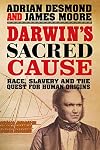
Desmond and Moore's earlier biography, "Darwin", is one of my favourite books, so I was really looking forward to reading "Darwin's Sacred Cause". But I have to say that I am not convinced by the central thrust of this book.
Charles Darwin was very strongly opposed to slavery, and he argued, quite rightly, that all human beings are of one species with a common ancestry. He was very critical of the mistaken theory that the different "races" of humans came into existence separately as separate show more species.
What Desmond and Moore claim is that Darwin's theory of common HUMAN origins inspired the development of his view that ALL LIFE is related by common descent through evolution. The "sacred cause" of opposition to slavery inspired Darwin's science.
But in his autobiography, which was initially written for private, family consumption, Darwin nowhere says anything about his anti-slavery views influencing his evolutionary theories. In fact Darwin explicity says that it was the distribution of fossil and living species which he encountered on the Beagle voyage that first got him seriously thinking about evolution. (Though I suppose that Desmond and Moore would say there was an underlying, unstated influence.)
There is also the fact that even if Darwin's anti-slavery views influenced his theory of the common origins of all life, it certainly was not a factor in inspiring him to come up with his theory of natural selection as the mechanism for evolution. It was natural selection that was Darwin's most important idea, and both he and, later, Wallace were inspired to come up with the theory by reading Malthus on population. (It is ironic that Malthus could be so reactionary and wrong about human population and society, and yet inspire a correct theory of natural selection.)
I find it quite plausible that Darwin's anti-slavery views were ONE influence on his evolutionary theory of life's common ancestry. But Desmond and Moore are overstating their case when they argue that it was THE influence on his theory.
In their earlier biography Desmond and Moore did a wonderful job of putting Darwin in the context of Victorian society. In this book they have homed in on one aspect of Darwin's social and political world, made a lens out of it, and then looked at everything through that lens, thus giving a distorted picture of a more complex reality.
This book is certainly worth reading - but with a critical eye. And for an alternative view of how Darwin's ideas developed, I recommend Niles Eldredge's book, "Darwin: Discovering the Tree of Life". show less
Charles Darwin was very strongly opposed to slavery, and he argued, quite rightly, that all human beings are of one species with a common ancestry. He was very critical of the mistaken theory that the different "races" of humans came into existence separately as separate show more species.
What Desmond and Moore claim is that Darwin's theory of common HUMAN origins inspired the development of his view that ALL LIFE is related by common descent through evolution. The "sacred cause" of opposition to slavery inspired Darwin's science.
But in his autobiography, which was initially written for private, family consumption, Darwin nowhere says anything about his anti-slavery views influencing his evolutionary theories. In fact Darwin explicity says that it was the distribution of fossil and living species which he encountered on the Beagle voyage that first got him seriously thinking about evolution. (Though I suppose that Desmond and Moore would say there was an underlying, unstated influence.)
There is also the fact that even if Darwin's anti-slavery views influenced his theory of the common origins of all life, it certainly was not a factor in inspiring him to come up with his theory of natural selection as the mechanism for evolution. It was natural selection that was Darwin's most important idea, and both he and, later, Wallace were inspired to come up with the theory by reading Malthus on population. (It is ironic that Malthus could be so reactionary and wrong about human population and society, and yet inspire a correct theory of natural selection.)
I find it quite plausible that Darwin's anti-slavery views were ONE influence on his evolutionary theory of life's common ancestry. But Desmond and Moore are overstating their case when they argue that it was THE influence on his theory.
In their earlier biography Desmond and Moore did a wonderful job of putting Darwin in the context of Victorian society. In this book they have homed in on one aspect of Darwin's social and political world, made a lens out of it, and then looked at everything through that lens, thus giving a distorted picture of a more complex reality.
This book is certainly worth reading - but with a critical eye. And for an alternative view of how Darwin's ideas developed, I recommend Niles Eldredge's book, "Darwin: Discovering the Tree of Life". show less
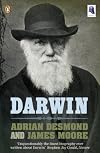
Desmond & Moore's hefty 1991 biography of Charles Darwin was a landmark book linking the history of a major scientist with wider social and political change in mid-nineteenth century Britain. Some contemporaries were irritated by this interest in the times as much as the life but not this reader.
The book is nearly 680 pages long. Perhaps the more casual reader might have liked some cuts to make it more manageable but the length is justified by the authors interweaving of three closely show more related stories - that of a personality, that of a scientist and thinker and that of his times.
The personality is fascinating in its own right but what comes across as equally interesting is the subversion of his own class - that of the well-heeled but capable gentleman naturalist - by his alliance with the new men of professional science, self made and seeking 'jobs' in institutions.
This is where personality ties in with wider social change. What drove this rather timorous man with a life time of seriously unpleasant psychosomatic illnesses to defy convention at some social risk and, quite late in the day, allow the publication of his radical thoughts on evolution and natural selection?
Although Desmond and Moore do not quite answer this question directly, a personality that could do nothing but investigate and think on what it investigated - a classical case of scientific curiosity as core to personality - eventually had to break ranks to express its 'truth'.
His biography (excepting a rather unprepossessing country gent early life and the last days of being lionised and loving every minute of it) can be roughly broken down into three phases - the days on 'The Beagle', those living his theory discreetly in the country and those once his theory was in play.
The first phase is of a very young man with a considerable capacity for hard work who built up sufficient reputation from his specimen collecting to become accepted as part of a family of naturalists and scientists exploring the difficult terrain between nature and revealed religion.
The second phase has him highly respected within a respectable world but finding that his 'thinking' was taking existing evolutionary thought and extending it into something that could and would 'in the wrong hands' completely undermine the very social order on which he and his family depended.
We have to remember that Darwin was never in want of funds. He was connected to both the Darwin and Wedgewood dynasties and the valuation of his estate at £250,000 (roughly £23m in today's money) at the end of his life did not arise from his writings or scientific work.
This was a man from a comfortable Whig family. It may have been in class opposition to aristocratic Tory squires and parsons but it was, like Labour and Tory today, essentially part of a struggle in which both sides competed for advantage within a system they both maintained as 'sound'.
During this second phase (as the book makes clear) Darwin's 'thinking' led him into troubled waters because its logic was that of a challenge to the very ideological fundamentals that held the mob at bay in the years following the Chartist threat to property.
Working and middle class radicals were very interested in evolution for ideological reasons although they preferred the ideas of Lamarck, a preference of the Left that was to prove highly problematic in the Soviet Union under Stalin.
To undermine the ideology of God's grace creating a perfectly structured and benign nature (as proposed by the Anglican Paley) with the 'truth' of an evolutionary natural order with God (if present at all) very distant could imply that radical solutions to social problems were potentially correct.
The secret to Darwin's triumph lies not in him being 'right' (which he mostly was) but in what he proposed arriving at just the right time to buttress rising social forces that endorsed a new imperial order that, in turn, buttressed the order of property more effectively than religion.
The trigger of course was that Darwin could see that his ideas were in danger of being trumped with the less experimental or consistent thought of others, notably by the younger socialist (in a confused sort of way) Alfred Russell Wallace. He had to publish or lose his edge.
It should be made clear here though that Darwin and Wallace were not competing as scientific equals and that Darwin had earned the right to leadership in the field. Darwin never treated Wallace badly and Wallace never regarded Darwin as having done so.
Darwin is a complex character. The biography restores emotion to the Victorians but, for all the usual faults that lie in the character of the time (his imperialism, his casual racism, his patronising attitudes to the working class), he was by mid-Victorian lights ethical and broadly compassionate.
So, Darwin has to publish to be the one who gets credit for a truth that is brutal in its vision of nature as a war of all against all in the battle of survival and of the survival of those who are fittest. These then, it seems, go on to drive species, racial and all other forms of 'progress'.
We can see straight away how useful this was to the rising middle class professionals in the scientific community but also to a new imperial society being born out of the expansion of trade and industrialisation. It 'explained' hegemony. It 'countered' socially radical alternatives.
'Property' (all things being equal) might have been happy to continue with the old Tory paternalist ideology of a settled and benign Nature and of traditionalist values that placed everyone in their assigned role and relied on squires to protect the poor and parsons to comfort them.
Science was always going to unsettle this view because science is what it is - the truth of the matter. Unfortunately, Nature is actually mindlessly brutal with God increasingly (if he even exists) pushed further back by reality into being little more than the designer of general laws.
The initial challenge had come from two equally opposed sources. We have mentioned the radical challenge which became a socialist one in due course. This emphasised the possibility of social improvement on Lamarckian lines but the more important challenge at this point was the Whig one.
Whig intellectuals took up Malthus which led, after the 1832 Reform Act, to the cruelest triumph of Liberal Progressivism - the Poor Laws. Prior to Darwin's publications over a quarter of a century later, 'existential struggle' was already being brutally imposed on the working classes.
It is part of the centre-left myth of its own trajectory that Victorian Liberalism was a good thing and the Tories were a bad thing but nothing is so simple. For totally different reasons, yet both thinking in compassionate terms, Tories and radicals challenged the Malthusian ideology of this new elite.
Victorian Liberalism was intent on a form of managed revolution in the interests of its own class alliances - wealthy industrialists and dissenters, evangelical Christians, Malthusians, the new professional class, self-made men, the first propertied feminists.
This was a culture of trade and empire and of assumptions of worth epitomised by the Self-Help doctrine of Samuel Smiles. The way to handle too many working people was to force them to export themselves to colonies where the imperial authorities subjugated inferior peoples to fit them in.
In a weak form, these are attitudes about cultural superiority, social control, ideological conformity and the handling of the working class that are still embedded in American progressives and what was once called 'New Labour'. It is the ideological original sin of the Anglosphere Centre-Left.
Darwin straddled this main ideological divide. He was of free-thinking stock where the money had been made in industrial enterprise. He was 'liberal' in the best sense in his dealings with people but, on the other hand, he was also a village country squire and responsible for a parish and good order.
The third phase in his life and in the book is what happens when he deals with his internal conflicts and publishes 'The Origin of Species' (1859) and later 'The Descent of Man' (1871) (as well as very many other works) dropping a lighted match into the oil dump of elite ideological tensions.
Darwin's work becomes the weaponry to be used by a self-consciously engaged network of 'professional' (or aspirantly professional) elite scientists actively seeking to overturn the old order and transform the existing 'gentlemanly' institutions of the scientific community.
Darwin's technique is interesting. He knows what he is doing and he wants to promote the scientific revolution but he also wants to retain his aura of respectability. He does this by standing back and providing the guns and bullets for his shock troops but avoiding the front line himself.
His health shifts from being the psychosomatic result of intense stress at the potential revolution that he might create to its being the excuse for not engaging in revolutionary acts by attending events and for not commenting on the ideological, social or political ramifications of his theories.
He sits like a spider at the centre of an ideological web as Huxley in particular (but not only Huxley) takes on those who refuse to abandon religion as the core of Victorian ideology (men such as Bishop Wilberforce and the Duke of Argyll) and builds up a shock troop of like-minded scientists.
This is why the book is so valuable. It not only gives us an insight into Victorian elite society at a key point in its history between the troubles of the 1840s and the High Imperialism of the 1880s but it helps to explain why change happened and suggests how change might happen today or tomorrow.
By the time of Darwin's death in 1882, the 'revolution' is completed. The thesis of Tory Anglicanism and the antithesis of Liberalism are synthesised into the sanctimonious hypocrisy of Darwin's interment in Westminster Abbey (fixed by Huxley and the gang).
As Desmond and Moore indicate, Darwin had become a secular saint but his interment in the Abbey as provider of a neat indirect justification of British imperial superiority ('survival of the fittest') was a symbolic negation of the alternative of his interment in a family vault as local patriarch.
In essence Gladstonian Imperial Liberalism 'won' and old-style Tory Paternalism lost but the Anglican Church was vouchsafed a place in maintaining social order and the Lamarckian socialists were 'dished' by the weight of evidence that Darwin had provided.
Alongside the British story there is, of course, the story of 'Darwinism' (the -ism helps indicate the ideological aspect of this new way of seeing the world) as both Social Darwinism (a more overt ideological system with no serious evidential base) and as its reception overseas.
Darwin cannot entirely be absolved of responsibility for Social Darwinism although he did not actively promote it or anything like it. It emerged as, if you like, its own 'bourgeois necessity'. However, he shared the baseline thinking - the struggle for existence with winners and losers in life's race.
What becomes interesting is the rapid German intellectual adoption of Darwinism with an enthusiasm and excitability that sometimes comes across as at the edge of comical if we were not reminded of some of the eventual darker consequences of its adoption in the next century.
The authors are only interested in how the Germans related to Darwin personally but we can see the lineaments of an interpretation that is similar to that we have seen in relation to the British Empire - an idea, strengthened by its apparent truth, met a newly necessary ideological need.
This is the Germany of Bismarck. The defeat of 'effete' France by Prussia saw most of the British elite preferring modernising Germany to France with its perceived tin pot Napoleon III. Germany looked dynamic, the fittest, both to itself in potential and to the wider world.
With Haeckel playing the role of Huxley, Darwinism appealed because it weakened the role of the churches in restricting the authority of the State and it suggested ideas of natural selection that were not uninfluential on philosophers like Nietzsche.
As my mentor at university, the late Norman Stone, pointed out to me, national socialism was the consequence of a lot of young people being taught half-baked ideological theories by half-educated schoolmasters in small towns. Darwinismus would have been part of their tool kit.
One day the path by which two decent men's ideas (those of Darwin and Marx who only interacted briefly in writing once) becomes socially transmuted away from their actual intentions into mass murder and genocide will be traced with more insight than we have seen to date.
From this perspective, Desmond (who was an historian of evolution prior to the 'Origin of Species') and Moore (whose previous work was on the controversies in Victorian London triggered by Darwin's work) provide important material on the ideologisation of 'truth' and the role of intellectuals.
We should add here that the authors concentrate as much if not more on the man as on his ideas and environment. This makes the book, based on deep research into available letters and papers, extremely readable as a human life that unfolds over more than seventy years.
There are two critical death scenes (of Darwin's daughter Annie and of Darwin himself) that should move anyone - in both cases the available evidence gives us scenes of horror that few biographies tend to provide. It is important to understand what death entailed for Victorians.
Similarly the account of the Voyage of the Beagle is a deft summary of Darwin's own writings that allows us to picture a young sea sick man prepared to put up with a great deal of hardship and risk to find out how the world might work and do his job of collecting specimens for home.
For all the social and ideological aspects and consequences of the case, Darwin comes across as a basically decent human being who loved his family and especially his long-suffering wife Emma, was loyal and supportive to his friends and worked immensely hard because that is who he was.
His 'genius' was not based on one just idea or the books for which most people remember him but on a major body of research work involving demanding and committed experimentation and the ability to worry at a problem and follow the logic of his experimental discoveries.
How his material was used was not really his fault because he was only telling the truth as he saw it. His truth almost entirely (with the odd speculation overtaken by history) stands up as exceptional science that just happened to be very convenient to powerful people who then weaponised it.
Fortunately we have long since moved past the ideological accretions. Scientists eventually returned to the science and built on it. One hopes that, at some stage, the same can be done with those aspects of the work of Marx that still hold 'truths' that it has now become all too convenient to deny. show less
The book is nearly 680 pages long. Perhaps the more casual reader might have liked some cuts to make it more manageable but the length is justified by the authors interweaving of three closely show more related stories - that of a personality, that of a scientist and thinker and that of his times.
The personality is fascinating in its own right but what comes across as equally interesting is the subversion of his own class - that of the well-heeled but capable gentleman naturalist - by his alliance with the new men of professional science, self made and seeking 'jobs' in institutions.
This is where personality ties in with wider social change. What drove this rather timorous man with a life time of seriously unpleasant psychosomatic illnesses to defy convention at some social risk and, quite late in the day, allow the publication of his radical thoughts on evolution and natural selection?
Although Desmond and Moore do not quite answer this question directly, a personality that could do nothing but investigate and think on what it investigated - a classical case of scientific curiosity as core to personality - eventually had to break ranks to express its 'truth'.
His biography (excepting a rather unprepossessing country gent early life and the last days of being lionised and loving every minute of it) can be roughly broken down into three phases - the days on 'The Beagle', those living his theory discreetly in the country and those once his theory was in play.
The first phase is of a very young man with a considerable capacity for hard work who built up sufficient reputation from his specimen collecting to become accepted as part of a family of naturalists and scientists exploring the difficult terrain between nature and revealed religion.
The second phase has him highly respected within a respectable world but finding that his 'thinking' was taking existing evolutionary thought and extending it into something that could and would 'in the wrong hands' completely undermine the very social order on which he and his family depended.
We have to remember that Darwin was never in want of funds. He was connected to both the Darwin and Wedgewood dynasties and the valuation of his estate at £250,000 (roughly £23m in today's money) at the end of his life did not arise from his writings or scientific work.
This was a man from a comfortable Whig family. It may have been in class opposition to aristocratic Tory squires and parsons but it was, like Labour and Tory today, essentially part of a struggle in which both sides competed for advantage within a system they both maintained as 'sound'.
During this second phase (as the book makes clear) Darwin's 'thinking' led him into troubled waters because its logic was that of a challenge to the very ideological fundamentals that held the mob at bay in the years following the Chartist threat to property.
Working and middle class radicals were very interested in evolution for ideological reasons although they preferred the ideas of Lamarck, a preference of the Left that was to prove highly problematic in the Soviet Union under Stalin.
To undermine the ideology of God's grace creating a perfectly structured and benign nature (as proposed by the Anglican Paley) with the 'truth' of an evolutionary natural order with God (if present at all) very distant could imply that radical solutions to social problems were potentially correct.
The secret to Darwin's triumph lies not in him being 'right' (which he mostly was) but in what he proposed arriving at just the right time to buttress rising social forces that endorsed a new imperial order that, in turn, buttressed the order of property more effectively than religion.
The trigger of course was that Darwin could see that his ideas were in danger of being trumped with the less experimental or consistent thought of others, notably by the younger socialist (in a confused sort of way) Alfred Russell Wallace. He had to publish or lose his edge.
It should be made clear here though that Darwin and Wallace were not competing as scientific equals and that Darwin had earned the right to leadership in the field. Darwin never treated Wallace badly and Wallace never regarded Darwin as having done so.
Darwin is a complex character. The biography restores emotion to the Victorians but, for all the usual faults that lie in the character of the time (his imperialism, his casual racism, his patronising attitudes to the working class), he was by mid-Victorian lights ethical and broadly compassionate.
So, Darwin has to publish to be the one who gets credit for a truth that is brutal in its vision of nature as a war of all against all in the battle of survival and of the survival of those who are fittest. These then, it seems, go on to drive species, racial and all other forms of 'progress'.
We can see straight away how useful this was to the rising middle class professionals in the scientific community but also to a new imperial society being born out of the expansion of trade and industrialisation. It 'explained' hegemony. It 'countered' socially radical alternatives.
'Property' (all things being equal) might have been happy to continue with the old Tory paternalist ideology of a settled and benign Nature and of traditionalist values that placed everyone in their assigned role and relied on squires to protect the poor and parsons to comfort them.
Science was always going to unsettle this view because science is what it is - the truth of the matter. Unfortunately, Nature is actually mindlessly brutal with God increasingly (if he even exists) pushed further back by reality into being little more than the designer of general laws.
The initial challenge had come from two equally opposed sources. We have mentioned the radical challenge which became a socialist one in due course. This emphasised the possibility of social improvement on Lamarckian lines but the more important challenge at this point was the Whig one.
Whig intellectuals took up Malthus which led, after the 1832 Reform Act, to the cruelest triumph of Liberal Progressivism - the Poor Laws. Prior to Darwin's publications over a quarter of a century later, 'existential struggle' was already being brutally imposed on the working classes.
It is part of the centre-left myth of its own trajectory that Victorian Liberalism was a good thing and the Tories were a bad thing but nothing is so simple. For totally different reasons, yet both thinking in compassionate terms, Tories and radicals challenged the Malthusian ideology of this new elite.
Victorian Liberalism was intent on a form of managed revolution in the interests of its own class alliances - wealthy industrialists and dissenters, evangelical Christians, Malthusians, the new professional class, self-made men, the first propertied feminists.
This was a culture of trade and empire and of assumptions of worth epitomised by the Self-Help doctrine of Samuel Smiles. The way to handle too many working people was to force them to export themselves to colonies where the imperial authorities subjugated inferior peoples to fit them in.
In a weak form, these are attitudes about cultural superiority, social control, ideological conformity and the handling of the working class that are still embedded in American progressives and what was once called 'New Labour'. It is the ideological original sin of the Anglosphere Centre-Left.
Darwin straddled this main ideological divide. He was of free-thinking stock where the money had been made in industrial enterprise. He was 'liberal' in the best sense in his dealings with people but, on the other hand, he was also a village country squire and responsible for a parish and good order.
The third phase in his life and in the book is what happens when he deals with his internal conflicts and publishes 'The Origin of Species' (1859) and later 'The Descent of Man' (1871) (as well as very many other works) dropping a lighted match into the oil dump of elite ideological tensions.
Darwin's work becomes the weaponry to be used by a self-consciously engaged network of 'professional' (or aspirantly professional) elite scientists actively seeking to overturn the old order and transform the existing 'gentlemanly' institutions of the scientific community.
Darwin's technique is interesting. He knows what he is doing and he wants to promote the scientific revolution but he also wants to retain his aura of respectability. He does this by standing back and providing the guns and bullets for his shock troops but avoiding the front line himself.
His health shifts from being the psychosomatic result of intense stress at the potential revolution that he might create to its being the excuse for not engaging in revolutionary acts by attending events and for not commenting on the ideological, social or political ramifications of his theories.
He sits like a spider at the centre of an ideological web as Huxley in particular (but not only Huxley) takes on those who refuse to abandon religion as the core of Victorian ideology (men such as Bishop Wilberforce and the Duke of Argyll) and builds up a shock troop of like-minded scientists.
This is why the book is so valuable. It not only gives us an insight into Victorian elite society at a key point in its history between the troubles of the 1840s and the High Imperialism of the 1880s but it helps to explain why change happened and suggests how change might happen today or tomorrow.
By the time of Darwin's death in 1882, the 'revolution' is completed. The thesis of Tory Anglicanism and the antithesis of Liberalism are synthesised into the sanctimonious hypocrisy of Darwin's interment in Westminster Abbey (fixed by Huxley and the gang).
As Desmond and Moore indicate, Darwin had become a secular saint but his interment in the Abbey as provider of a neat indirect justification of British imperial superiority ('survival of the fittest') was a symbolic negation of the alternative of his interment in a family vault as local patriarch.
In essence Gladstonian Imperial Liberalism 'won' and old-style Tory Paternalism lost but the Anglican Church was vouchsafed a place in maintaining social order and the Lamarckian socialists were 'dished' by the weight of evidence that Darwin had provided.
Alongside the British story there is, of course, the story of 'Darwinism' (the -ism helps indicate the ideological aspect of this new way of seeing the world) as both Social Darwinism (a more overt ideological system with no serious evidential base) and as its reception overseas.
Darwin cannot entirely be absolved of responsibility for Social Darwinism although he did not actively promote it or anything like it. It emerged as, if you like, its own 'bourgeois necessity'. However, he shared the baseline thinking - the struggle for existence with winners and losers in life's race.
What becomes interesting is the rapid German intellectual adoption of Darwinism with an enthusiasm and excitability that sometimes comes across as at the edge of comical if we were not reminded of some of the eventual darker consequences of its adoption in the next century.
The authors are only interested in how the Germans related to Darwin personally but we can see the lineaments of an interpretation that is similar to that we have seen in relation to the British Empire - an idea, strengthened by its apparent truth, met a newly necessary ideological need.
This is the Germany of Bismarck. The defeat of 'effete' France by Prussia saw most of the British elite preferring modernising Germany to France with its perceived tin pot Napoleon III. Germany looked dynamic, the fittest, both to itself in potential and to the wider world.
With Haeckel playing the role of Huxley, Darwinism appealed because it weakened the role of the churches in restricting the authority of the State and it suggested ideas of natural selection that were not uninfluential on philosophers like Nietzsche.
As my mentor at university, the late Norman Stone, pointed out to me, national socialism was the consequence of a lot of young people being taught half-baked ideological theories by half-educated schoolmasters in small towns. Darwinismus would have been part of their tool kit.
One day the path by which two decent men's ideas (those of Darwin and Marx who only interacted briefly in writing once) becomes socially transmuted away from their actual intentions into mass murder and genocide will be traced with more insight than we have seen to date.
From this perspective, Desmond (who was an historian of evolution prior to the 'Origin of Species') and Moore (whose previous work was on the controversies in Victorian London triggered by Darwin's work) provide important material on the ideologisation of 'truth' and the role of intellectuals.
We should add here that the authors concentrate as much if not more on the man as on his ideas and environment. This makes the book, based on deep research into available letters and papers, extremely readable as a human life that unfolds over more than seventy years.
There are two critical death scenes (of Darwin's daughter Annie and of Darwin himself) that should move anyone - in both cases the available evidence gives us scenes of horror that few biographies tend to provide. It is important to understand what death entailed for Victorians.
Similarly the account of the Voyage of the Beagle is a deft summary of Darwin's own writings that allows us to picture a young sea sick man prepared to put up with a great deal of hardship and risk to find out how the world might work and do his job of collecting specimens for home.
For all the social and ideological aspects and consequences of the case, Darwin comes across as a basically decent human being who loved his family and especially his long-suffering wife Emma, was loyal and supportive to his friends and worked immensely hard because that is who he was.
His 'genius' was not based on one just idea or the books for which most people remember him but on a major body of research work involving demanding and committed experimentation and the ability to worry at a problem and follow the logic of his experimental discoveries.
How his material was used was not really his fault because he was only telling the truth as he saw it. His truth almost entirely (with the odd speculation overtaken by history) stands up as exceptional science that just happened to be very convenient to powerful people who then weaponised it.
Fortunately we have long since moved past the ideological accretions. Scientists eventually returned to the science and built on it. One hopes that, at some stage, the same can be done with those aspects of the work of Marx that still hold 'truths' that it has now become all too convenient to deny. show less
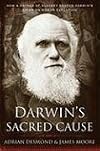
The power of Darwinism fascinates. The theory of evolution through natural selection devastated every secular and sacred shibboleth held tightly for millennia. What has most impressed me is the utter victory of naturalism over super naturalism and, as logic inevitably demands, the complete redefinition of man's place in the universe. Even 150 years after its arrival on the intellectual stage the controversy rages, not among scientists certainly, but in the desperate and fragile efforts to show more disparage it by proponents of creationism and intellectual design. To my mind, the reality of naturalistic origins does not allow any foot hold for supernatural first causes. But, to me, this does not lead us to nihilism, but suggests a path of optimism for the future of the planet.
In On the Origins of Species, Darwin was cautious about explicitly expressing the implications of his theory on the matter of man's place in existence. He was certainly aware that such a conclusion would immediately be drawn and most certainly it was. Even such a stalwart scientific supporter as Asa Gray could not abandon the anchor of divinity as the ultimate first cause.
This fascinating book focuses on the relationship of Darwin's work to his strong abolitionist beliefs and to the debate raging on the morality of slavery. Darwin, his family and circle were among the staunchest abolitionists in England, advocating vigorously for emancipation in the Commonwealth and the Americas. Darwin's scientific logic compellingly supported the notion that the races of human kind had a unitary ancestor and were not distinct species. The so-called polygenisists held that the races were created separately and as species distinct from each other could be placed in a hierarchy of superiority without moral qualms. Great store was placed on the discernible differences among the races, but Darwin's work said these were not species differentiation but rather variations caused by environmental factors. The most obvious evidence for species commonality was the success of inter-racial reproduction.
In the context of the intense and ugly racism of the 19th century, Darwin's view was scorned by other scientists and polemicists who were determined to prove the racial superiority of Caucasians and, hence, the morality of subjugating the lesser species, principally blacks. America's renowned scientist, Louis Agassiz, was the foremost of the scientists making this claim. The aura of this pseudo science was eagerly grasped by those who sought to counter the growing intensity of moral opposition to slavery. This inevitably led its adherents down the primrose path of ascribing to genetic differences the futility of the "lessor" races ever being able to achieve the lofty heights of culture and progress achieved by the Anglo-Saxon race.
Thus to Darwin we owe another debt of gratitude. By impelling us to accept our less than divine status he has opened up the potential for diminishing the effects of our hubris on the earth. Recognizing the commonality of all humans points us toward a moral stance that best positions the perpetuation of our species. After all, isn't morality a successful and highly important evolutionary trait? show less
In On the Origins of Species, Darwin was cautious about explicitly expressing the implications of his theory on the matter of man's place in existence. He was certainly aware that such a conclusion would immediately be drawn and most certainly it was. Even such a stalwart scientific supporter as Asa Gray could not abandon the anchor of divinity as the ultimate first cause.
This fascinating book focuses on the relationship of Darwin's work to his strong abolitionist beliefs and to the debate raging on the morality of slavery. Darwin, his family and circle were among the staunchest abolitionists in England, advocating vigorously for emancipation in the Commonwealth and the Americas. Darwin's scientific logic compellingly supported the notion that the races of human kind had a unitary ancestor and were not distinct species. The so-called polygenisists held that the races were created separately and as species distinct from each other could be placed in a hierarchy of superiority without moral qualms. Great store was placed on the discernible differences among the races, but Darwin's work said these were not species differentiation but rather variations caused by environmental factors. The most obvious evidence for species commonality was the success of inter-racial reproduction.
In the context of the intense and ugly racism of the 19th century, Darwin's view was scorned by other scientists and polemicists who were determined to prove the racial superiority of Caucasians and, hence, the morality of subjugating the lesser species, principally blacks. America's renowned scientist, Louis Agassiz, was the foremost of the scientists making this claim. The aura of this pseudo science was eagerly grasped by those who sought to counter the growing intensity of moral opposition to slavery. This inevitably led its adherents down the primrose path of ascribing to genetic differences the futility of the "lessor" races ever being able to achieve the lofty heights of culture and progress achieved by the Anglo-Saxon race.
Thus to Darwin we owe another debt of gratitude. By impelling us to accept our less than divine status he has opened up the potential for diminishing the effects of our hubris on the earth. Recognizing the commonality of all humans points us toward a moral stance that best positions the perpetuation of our species. After all, isn't morality a successful and highly important evolutionary trait? show less
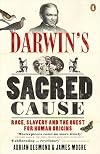
Fascinating account of Darwin's intellectual milieu and motivation. I knew of the Malthus stimulus and of Wallace's nearly scooping him, but the case here is that slavery was the driver. His family Unitarian background and first-hand experiences on the Beagle trip combined to form his thinking throughout. So the point was to prove mankind's origin was singular not plural, so "all men are brothers". Seems odd to think anything else, but there are still those who do.
The story is fascinating show more and detailed, including why he spent so much time on barnacles and pigeon-breeders, as well as why he left "Man" out of the Origin. the simultaneous US Civil War makes a dramatic part of the context. Sometimes a little hard to follow with its huge cast of twitcher-clerics, propagandists and profs. But well worth the effort.
Carlyle comes out as a prize s*** as well as such an awful prose-writer. For some reason he kept a place at the fringe of Darwin's circle despite being a rabid "niggerology" firebrand. show less
The story is fascinating show more and detailed, including why he spent so much time on barnacles and pigeon-breeders, as well as why he left "Man" out of the Origin. the simultaneous US Civil War makes a dramatic part of the context. Sometimes a little hard to follow with its huge cast of twitcher-clerics, propagandists and profs. But well worth the effort.
Carlyle comes out as a prize s*** as well as such an awful prose-writer. For some reason he kept a place at the fringe of Darwin's circle despite being a rabid "niggerology" firebrand. show less
Lists
Awards


You May Also Like


Associated Authors
Statistics
- Works
- 9
- Also by
- 2
- Members
- 1,140
- Popularity
- #22,523
- Rating
- 3.9
- Reviews
- 13
- ISBNs
- 48
- Languages
- 5