
Kenneth C. Davis (1)
Author of Don't Know Much About History
For other authors named Kenneth C. Davis, see the disambiguation page.
About the Author
Kenneth C. Davis is an American popular historian, best known for his Don't Know Much About... series. Born in Mount Vernon, New York, Davis attended Concordia College, Bronxville in New York, and Fordham University at Lincoln Center, New York City. Davis's second book, Don't Know Much About show more History, spent 35 consecutive weeks on The New York Times bestseller list and sold nearly 1.5 million copies. This unexpected success launched the Don't Know Much About... series. (Bowker Author Biography) show less
Series
Works by Kenneth C. Davis
Don't Know Much About the Bible: Everything You Need to Know About the Good Book but Never Learned (1998) 1,250 copies, 9 reviews
Don't Know Much About Geography: Everything You Need to Know About the World but Never Learned (1992) 1,216 copies, 11 reviews
Don't Know Much About the Civil War: Everything You Need to Know About America's Greatest Conflict but Never Learned (1996) 971 copies, 4 reviews
Don't Know Much About Mythology: Everything You Need to Know About the Greatest Stories in Human History but Never Learned (2005) 918 copies, 12 reviews
America's Hidden History: Untold Tales of the First Pilgrims, Fighting Women, and Forgotten Founders Who Shaped a Nation (2008) 731 copies, 23 reviews
Don't Know Much About the Universe: Everything You Need to Know About the Cosmos but Never Learned (2001) 444 copies, 1 review
In the Shadow of Liberty: The Hidden History of Slavery, Four Presidents, and Five Black Lives (2016) 307 copies, 15 reviews
A Nation Rising: Untold Tales of Flawed Founders, Fallen Heroes, and Forgotten Fighters from America's Hidden History (2010) 290 copies, 4 reviews
Don't Know Much About Anything Else: Even More Things You Need to Know but Never Learned About People, Places, Events, and More! (2008) 81 copies
The Hidden History of America at War: Untold Tales from Yorktown to Fallujah (Don't Know Much About) (2015) 81 copies, 1 review
More Deadly Than War: The Hidden History of the Spanish Flu and the First World War (2018) 79 copies, 2 reviews
Space 1 copy
Tagged
Common Knowledge
- Other names
- Davis, Ken C.
- Birthdate
- 20th Century
- Gender
- male
- Occupations
- Editeur
- Short biography
- Kenneth C. Davis who wrote "Don't Know Much About History" and others graduated from Concordia College and Fordham. He lives in New York City
- Nationality
- USA
- Birthplace
- Mount Vernon, New York, USA
- Places of residence
- New York, New York, USA
Dorset, Vermont, USA
Mount Vernon, New York, USA - Associated Place (for map)
- New York, USA
Members
Reviews
Don't Know Much About the Bible: Everything You Need to Know About the Good Book but Never Learned (Don't Know Much About Series) by Kenneth C. Davis
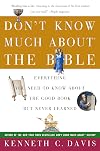
I read this for the first time when I was maybe fifteen. I was gonna tell people about this book and have everyone questioning everything in droves. I was an arrogant teenager who was loud about my extremely non-Christian beliefs, and tended to irritate or even enrage people who wanted me to believe what they did. I've never believed in Jesus and have no interest in the worldviews that accompany such. I read this book again recently, and was happy to have found it. As a devout Jewish adult show more with a lot more life experience, all I can think is: how did I read this book in one sitting originally? This is a dense, information-packed tone. Reading it as an adult took me over a week. A lot of it I remembered. Some of it had me raising my eyebrows in light of other information about vaguely related things: oh, those two are connected. Look at how it shows up, type thing. I've never believed the Bible was written by G-d. I've always insisted it was by people, probably different men, some of whom were good at storytelling. I'd be so curious about what an updated version of this book would look like. I was reading other books about real-life influences at the time I originally read this, and I'm pondering on starting on them again after a bit. I'm glad I got to read this again. show less
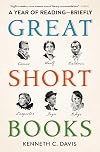
Why isn’t more attention given to short books? Davis suggests they’re the literature equivalent to stand-up comedian Rodney Dangerfield’s signature line. They get no respect.
LibraryThing colleagues who have perused my reviews know I have a penchant for shorter books. I’ve lost count of the number of times I’ve critiqued works in the 350-to 500-page tier by suggesting that a word-slashing editor could have dramatically improved the final product. Hence, it’s no surprise that I show more thoroughly enjoyed Davis’ thumbnail summaries of 58 short books — most of them under 200 pages.
Of course, there were some predictable entries (“The Great Gatsby,” “Animal Farm,” “The Stranger,” etc.) There are also a handful of classics I’ve long viewed as over-rated (Sorry, Ernie, “The Old Man and the Sea” was a total slog — even in its brevity).
Although, I wish the author had included more works, his efforts helped me to compile a list of nearly a dozen recommended reads. They include “Sula,” “The Ghost Writer,” “The Lathe of Heaven” and “Agostino.”
While I agree with some who suggest that Davis’ summaries are a bit dry, I loved the book’s user-friendly format. Each entry, organized alphabetically, begins with the first lines of the book, serves up a plot summary, shares details about the author and has a section titled “Why You Should Read it.” Each entry ends with suggestions on what to read next.
Speaking of endings, my time is up. Writing a long review about a tome that touts the virtues of short books would border on hypocrisy. show less
LibraryThing colleagues who have perused my reviews know I have a penchant for shorter books. I’ve lost count of the number of times I’ve critiqued works in the 350-to 500-page tier by suggesting that a word-slashing editor could have dramatically improved the final product. Hence, it’s no surprise that I show more thoroughly enjoyed Davis’ thumbnail summaries of 58 short books — most of them under 200 pages.
Of course, there were some predictable entries (“The Great Gatsby,” “Animal Farm,” “The Stranger,” etc.) There are also a handful of classics I’ve long viewed as over-rated (Sorry, Ernie, “The Old Man and the Sea” was a total slog — even in its brevity).
Although, I wish the author had included more works, his efforts helped me to compile a list of nearly a dozen recommended reads. They include “Sula,” “The Ghost Writer,” “The Lathe of Heaven” and “Agostino.”
While I agree with some who suggest that Davis’ summaries are a bit dry, I loved the book’s user-friendly format. Each entry, organized alphabetically, begins with the first lines of the book, serves up a plot summary, shares details about the author and has a section titled “Why You Should Read it.” Each entry ends with suggestions on what to read next.
Speaking of endings, my time is up. Writing a long review about a tome that touts the virtues of short books would border on hypocrisy. show less

Kenneth C. Davis, far better known for his later Don't Know Much About series of popular-history compilations, proves himself a capable practitioner of original historical research in this study of the rise of the paperback-book industry in America. Published nearly forty years ago, it remains the only book-length history of the subject that I'm aware of. Thankfully, it's a good one.
Two-Bit Culture is, despite its title, first and foremost a history of paperback publishing as a business. Its show more nearly 400 pages of text chronicle the rise and fall of companies, imprints, marketing strategies, and editors. The text is stuffed with names, dates, facts, and figures (press runs, sales figures, cover prices, money paid for reprint rights, and money advanced to authors). For the period the book covers -- the eve of World War II to the first Reagan administration -- the book covers what must be every significant development in the industry. If you want to trace the history of Pocket Books, Ballentine, New American Library, or Avon, this is the book you want. If you want to learn about E. L. Doctorow's early career as an editor, or Ian Ballentine's industry-changing arc through the business, you'll find it here.
Davis doesn't neglect the cultural impact of the paperback, by any means--there are interesting discussions of Dr. Benjamin Spock's Baby and Child Care (the first paperback-original bestseller), the legal battle over publication of an unexpurgated paperback edition of Lady Chatterly's Lover, and the role of paperbacks in bringing the work of African American authors to mass audiences--but his coverage of such issues is scattered rather than sustained. They're well-developed pauses in the central narrative of changing business practices, rather than a parallel narrative of their own.
The book's greatest drawback is Davis's patent lack of respect for paperback originals that -- in his view -- lack seriousness and literary value. Paperbacks are, for Davis, a conduit of getting cheap reprints of "good literature" and serious non-fiction into the hands of the general public. He treats anything short of that mission with disinterest or barely concealed disdain. That high-mindedness leads him to unforced factual errors (having John D. MacDonald's Travis McGee series begin in the mid-50s, rather than 1964), and shallow, unsatisfying treatments of the paperback's role in the evolution of science fiction and hard-boiled mysteries. His treatment of Harlequin and other "category" romances is a few pages long, and every paragraph of it drips with contempt. The paperback original's relationship to pulp magazines, episodic television, and similar forms of genre storytelling go entirely unmentioned.
Two-Bit Culture is unlikely to be bettered as a history of the paperback industry, but after forty years it's long past time for a new, deeper, and less judgemental history of the paperback as a cultural phenomenon. show less
Two-Bit Culture is, despite its title, first and foremost a history of paperback publishing as a business. Its show more nearly 400 pages of text chronicle the rise and fall of companies, imprints, marketing strategies, and editors. The text is stuffed with names, dates, facts, and figures (press runs, sales figures, cover prices, money paid for reprint rights, and money advanced to authors). For the period the book covers -- the eve of World War II to the first Reagan administration -- the book covers what must be every significant development in the industry. If you want to trace the history of Pocket Books, Ballentine, New American Library, or Avon, this is the book you want. If you want to learn about E. L. Doctorow's early career as an editor, or Ian Ballentine's industry-changing arc through the business, you'll find it here.
Davis doesn't neglect the cultural impact of the paperback, by any means--there are interesting discussions of Dr. Benjamin Spock's Baby and Child Care (the first paperback-original bestseller), the legal battle over publication of an unexpurgated paperback edition of Lady Chatterly's Lover, and the role of paperbacks in bringing the work of African American authors to mass audiences--but his coverage of such issues is scattered rather than sustained. They're well-developed pauses in the central narrative of changing business practices, rather than a parallel narrative of their own.
The book's greatest drawback is Davis's patent lack of respect for paperback originals that -- in his view -- lack seriousness and literary value. Paperbacks are, for Davis, a conduit of getting cheap reprints of "good literature" and serious non-fiction into the hands of the general public. He treats anything short of that mission with disinterest or barely concealed disdain. That high-mindedness leads him to unforced factual errors (having John D. MacDonald's Travis McGee series begin in the mid-50s, rather than 1964), and shallow, unsatisfying treatments of the paperback's role in the evolution of science fiction and hard-boiled mysteries. His treatment of Harlequin and other "category" romances is a few pages long, and every paragraph of it drips with contempt. The paperback original's relationship to pulp magazines, episodic television, and similar forms of genre storytelling go entirely unmentioned.
Two-Bit Culture is unlikely to be bettered as a history of the paperback industry, but after forty years it's long past time for a new, deeper, and less judgemental history of the paperback as a cultural phenomenon. show less
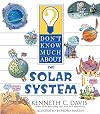
I sought refuge in this book recently while desperately trying to gain background knowledge on a first grade solar system unit I'm creating from scratch. The first few pages of this book taught me a lot-- AND reminded me of what I already knew and forgot. The format is very kid- and user-friendly (written in Q and A format). A lot of it is humorous ("Why is Earth like Baby Bear's porridge?") The facts are also written in simple, child- (and novice science teacher) friendly language. If the show more budget allows, I will be ordering this for my science classroom and/or library. The language of the facts, the format, and the colorful illustrations make the daunting topic of outer space and astronomy very fun and unintimidating. show less
Lists
Awards


In the Shadow of Liberty: The Hidden History of Slavery, Four Presidents, and Five Black Lives (*Fourteen and Older, Information Books, History – 2017)


You May Also Like


Associated Authors
Statistics
- Works
- 39
- Members
- 15,612
- Popularity
- #1,455
- Rating
- 3.6
- Reviews
- 160
- ISBNs
- 341
- Languages
- 6
- Favorited
- 1
