
Andrew Martin (1)
Author of The Necropolis Railway
For other authors named Andrew Martin, see the disambiguation page.
Series
Works by Andrew Martin
How to Get Things Really Flat: The Man's Guide to Ironing, Dusting and Other Household Chores (2008) 64 copies, 3 reviews
Flight By Elephant: The Untold Story of World War Two's Most Daring Jungle Rescue (2014) 25 copies, 2 reviews
Associated Works
Tagged
Common Knowledge
- Legal name
- Martin, Andrew John
- Birthdate
- 1962-07-06
- Gender
- male
- Education
- University of Oxford (Merton College)
- Occupations
- novelist
journalist - Nationality
- UK
- Birthplace
- York, Yorkshire, England, UK
- Places of residence
- London, England, UK
- Associated Place (for map)
- England, UK
Members
Reviews

How, HOW, is this anybody's book of the month, let alone the Times' Historical Fiction Book of the Month? Leaving aside the historical inaccuracies - going on the Grand Tour in 1799? I don't think so - the whole novel is just so dry that I fell asleep numerous times, at one point leaning on my Kindle and skipping a fair few pages, which I didn't bother to retrace. Fletcher Rigge - a lead character written without any actual character - is borrowed from debtor's prison to find out who killed show more Matthew Harvey, a maker of 'shades' or silhouettes. I literally have no idea if he succeeded because the words refused to lodge any meaning in my brain, except from when they belonged to the nineteenth century and not the eighteenth (Andrew Martin sounds like Charles Dickens lite, so I'm not sure why he didn't set the story a hundred years later anyway, but hey ho). Not even York could save this exercise in pretentiousness (maybe that's why The Times loves it so much). show less
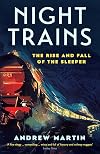
I’ve travelled on both British night trains, the Caledonian Sleeper and the Night Riviera because why would you not, so I imagined at the very least I would be able to read-create these journeys, but in fact neither of these feature in this book of European sleepers. I am very, very far from a train fanatic but there is something exciting and captivating about having a bed with crisp linen sheets on a train; the disappearance of these grand wagon-lits is a huge loss to anyone for whom the show more journey is part of the adventure. Even though this was written just a few years ago, I am quite sure most of these journeys no longer exist and European travel is the worse for it.
This is a thoroughly entertaining read, as the author makes several journeys we get to share a compartment with him and the people he meets. I laughed out loud several times, clearly we share a similar sense of humour. When I read bits aloud no one else seemed to find them quite as entertaining so perhaps there’s just a handful of us. I was also happy to see Ian Nairn quoted on several occasions, another outspoken and astutely funny man, and I can’t help thinking what an excellent journey it would be for the three of us to have dinner in a restaurant car and I could watch them drink far too much while we dine on oysters and game, before retiring to our seperate berths to wake up in Istanbul. show less
This is a thoroughly entertaining read, as the author makes several journeys we get to share a compartment with him and the people he meets. I laughed out loud several times, clearly we share a similar sense of humour. When I read bits aloud no one else seemed to find them quite as entertaining so perhaps there’s just a handful of us. I was also happy to see Ian Nairn quoted on several occasions, another outspoken and astutely funny man, and I can’t help thinking what an excellent journey it would be for the three of us to have dinner in a restaurant car and I could watch them drink far too much while we dine on oysters and game, before retiring to our seperate berths to wake up in Istanbul. show less

Fletcher Rigge is in debtors prison in York. His father gambled away his estates and then committed suicide, Fletcher is clever but without money or support. Then a mysterious proposition is made. Fletcher will be released from gaol, his debts paid for one month, he must solve a murder and if he does so his debts will disappear forever. This benefactor is Captain Harvey son of the late victim, an artist who specialised in silhouettes, or shades as they are known. Fletcher realises that the show more clues to the orders identity lie in the last set of shades that Harvey created and so he is thrown into society in York and latterly London.
This is a clever book, written in the form of different notes or papers and with a number of different narrators. All of this means that the plot is not quite as clear cut as it could have been with a more straightforward single narrator. However, this is to the book's benefit, as one of the strengths is the complexity of the plot and the way that no single narrator is completely truthful, different perspectives of the same events are interpreted in different ways. In this way the metaphor about shades continues through the story. I loved the descriptions of life in Georgian York and the little details about the different characters added such a depth to the novel. show less
This is a clever book, written in the form of different notes or papers and with a number of different narrators. All of this means that the plot is not quite as clear cut as it could have been with a more straightforward single narrator. However, this is to the book's benefit, as one of the strengths is the complexity of the plot and the way that no single narrator is completely truthful, different perspectives of the same events are interpreted in different ways. In this way the metaphor about shades continues through the story. I loved the descriptions of life in Georgian York and the little details about the different characters added such a depth to the novel. show less

To be clear, this is not a book about Martians, or even girls. The central character is a woman in her late thirties, Jean Beckett, a writer who lives in today's London. She is writing a one-woman play -- later it becomes a novel -- about a young woman named Kate French who lived in London a century earlier, and performed on stage as "The Martian Girl". There are clear parallels in the lives of the two women, particularly in the men who are central to those lives and who turn out to be (no show more spoilers here) real jerks. This is a brilliant novel, with well-drawn characters, and an acute knowledge of London now and as it was at the end of the 19th century. It's about writing, and research, and deception, and fear and love. Andrew Martin is an accomplished writer of historical mysteries, but this is the first of his that I've read. It will not be the last. show less
Lists
Awards

You May Also Like


Associated Authors
Statistics
- Works
- 22
- Also by
- 3
- Members
- 2,284
- Popularity
- #11,239
- Rating
- 3.4
- Reviews
- 107
- ISBNs
- 256
- Languages
- 3
- Favorited
- 4

