

Joy Kogawa
Author of Obasan
About the Author
Joy Kogawa was born in Vancouver, British Columbia in 1935 and graduated from high school in Coaldale, Alberta where her family was sent after WWII. Kogawa was made a Member of the Order of Canada. From 1983 to 1985, she worked with the National Association of Japanese Canadians to help those show more Japanese who had lost their land and possesions under the War Measures Act in 1942. Kogawa went on to study education at the University of Alberta and taught elementary school in Coaldale for a year. She then studied music at the University of Toronto followed by studies at the Anglican Women's Training College and the University of Saskatchewan. Kogawa has won awards for her book Obasan, including the Books in Canada, First Novel Award, the Canadian Authors Association, Book of the Year Award, the Periodical Distributors of Canada, Best Paperback Fiction Award, the Before Columbus Foundation, and The American Book Award (Bowker Author Biography) show less
Series
Works by Joy Kogawa
Gently to Nagasaki: A Spiritual Pilgrimage, An Exploration Both Communal and Intensely Personal (2016) 14 copies, 1 review
The Splintered Moon 1 copy
Kogawa, Joy (About) 1 copy
Associated Works
Charlie Chan Is Dead: An Anthology of Contemporary Asian American Fiction (1993) — Contributor — 169 copies, 3 reviews
Breaking Silence: An Anthology of Contemporary Asian-American Poets (1983) — Contributor — 30 copies, 1 review
Premonitions: The Kaya Anthology of New Asian North American Poetry (1995) — Contributor — 27 copies
Tagged
Common Knowledge
- Legal name
- Kogawa, Joy Nozomi
- Birthdate
- 1935-06-06
- Gender
- female
- Occupations
- poet
novelist - Awards and honors
- Order of British Columbia (2006)
Order of Canada (1986)
Order of the Rising Sun (2010) - Nationality
- Canada
- Birthplace
- Vancouver, British Columbia, Canada
- Places of residence
- Toronto, Ontario, Canada
Coaldale, Alberta, Canada - Associated Place (for map)
- Canada
Members
Reviews
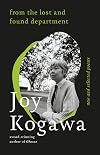
CW // Animal abuse (145)
Death of a pet (296)
This is the longest book of poetry I've ever read. I've been reading a lot of short (100-200 page) books, so this was refreshing.
I spent a lot of time rereading poems and contemplating them. There's a lot of imagery that lit up my mind. There's two poems that are long—a few pages—and I glossed over the first one, but I enjoyed parts of the second.
There was only one poem I truly didn't like (page 145). The poem on page 296 is touching on the show more common sorrow of losing a pet, but it can still be triggering for people so you might want to skip both if you don't like reading sad animal things.
She does have some poems about her father and that trauma. I looked it up and was disturbed by what her father and the Anglican Church did. I haven't yet decided if I wanted to read her books dealing with that topic, but I am interested in reading more from her!
Her poems are about all moments in life, big and small. She speaks about the Canadian internment camps, motherhood, marriage, walks in the park, train rides, birds, everything you can imagine. I really did enjoy reading a large body of one person's work. Her language and flow are all very beautiful. I wish this was taught in high school, I would have loved poetry if I had been shown Kogawa over the heavily white, male, American poets I read when I was in school.
I picked this last year as I was reading a lot of Korean and Japanese books. Can't I Go Instead by Lee Geum-yi does speak about the camps in America. So this was interesting—and heartbreaking—to read a Canadian point of view on the same atrocities that happened. I can only imagine what her novels are like. This is definitely going up as one of my Staff Picks for Asian and Pacific Islander Heritage month in May! show less
Death of a pet (296)
This is the longest book of poetry I've ever read. I've been reading a lot of short (100-200 page) books, so this was refreshing.
I spent a lot of time rereading poems and contemplating them. There's a lot of imagery that lit up my mind. There's two poems that are long—a few pages—and I glossed over the first one, but I enjoyed parts of the second.
There was only one poem I truly didn't like (page 145). The poem on page 296 is touching on the show more common sorrow of losing a pet, but it can still be triggering for people so you might want to skip both if you don't like reading sad animal things.
She does have some poems about her father and that trauma. I looked it up and was disturbed by what her father and the Anglican Church did. I haven't yet decided if I wanted to read her books dealing with that topic, but I am interested in reading more from her!
Her poems are about all moments in life, big and small. She speaks about the Canadian internment camps, motherhood, marriage, walks in the park, train rides, birds, everything you can imagine. I really did enjoy reading a large body of one person's work. Her language and flow are all very beautiful. I wish this was taught in high school, I would have loved poetry if I had been shown Kogawa over the heavily white, male, American poets I read when I was in school.
I picked this last year as I was reading a lot of Korean and Japanese books. Can't I Go Instead by Lee Geum-yi does speak about the camps in America. So this was interesting—and heartbreaking—to read a Canadian point of view on the same atrocities that happened. I can only imagine what her novels are like. This is definitely going up as one of my Staff Picks for Asian and Pacific Islander Heritage month in May! show less

"Long ago in the Land of Morning, which is known today as Japan, a beautiful cherry tree grew. Each spring, lilting pink blossoms danced into view and filled the air like popcorn. And as the flowers fell in a snowy cloud, children joined hands and sang and skipped around the tree."
And so begins Joy Kogawa's quiet but powerful tale of a Japanese-Canadian family, their love for one another and for their heritage, and their sorrow when war divides and uproots them, separating them from all show more they know. Cultivated from a seed brought to Canada by her grandmother, the cherry tree in Naomi's yard is both friend and guardian: a symbol of friendship, love and roots; a marker and assurance of continuity and safety. Every night "Naomi looked out her bedroom window, at the tree sleeping in the moonlight," and knew that "all was well."
"But the world changed." The war came, and with it separation, exile and death. With Mama visiting relatives in Japan at the outbreak of hostilities, and unable to return home, and Naomi, her brother Stephen, and her father uprooted and sent to an internment camp for Japanese-Canadians, nothing would ever be the same. Home and the cherry-tree were left behind, never to be regained. Or were they...?
Although I have read many clever picture-books, and looked at many beautiful illustrations, I cannot say that I am often moved by them, on any deep emotional level. Naomi's Tree is one of those rare exceptions. I do not know if it was Joy Kogawa's lyrical prose, so understated and yet so compelling, or Ruth Ohi's soft pencil and watercolor art, but I found myself weeping by the end of this book. I can readily believe that this story is based upon Kogawa's own childhood experience: it has the unmistakable ring of truth. show less
And so begins Joy Kogawa's quiet but powerful tale of a Japanese-Canadian family, their love for one another and for their heritage, and their sorrow when war divides and uproots them, separating them from all show more they know. Cultivated from a seed brought to Canada by her grandmother, the cherry tree in Naomi's yard is both friend and guardian: a symbol of friendship, love and roots; a marker and assurance of continuity and safety. Every night "Naomi looked out her bedroom window, at the tree sleeping in the moonlight," and knew that "all was well."
"But the world changed." The war came, and with it separation, exile and death. With Mama visiting relatives in Japan at the outbreak of hostilities, and unable to return home, and Naomi, her brother Stephen, and her father uprooted and sent to an internment camp for Japanese-Canadians, nothing would ever be the same. Home and the cherry-tree were left behind, never to be regained. Or were they...?
Although I have read many clever picture-books, and looked at many beautiful illustrations, I cannot say that I am often moved by them, on any deep emotional level. Naomi's Tree is one of those rare exceptions. I do not know if it was Joy Kogawa's lyrical prose, so understated and yet so compelling, or Ruth Ohi's soft pencil and watercolor art, but I found myself weeping by the end of this book. I can readily believe that this story is based upon Kogawa's own childhood experience: it has the unmistakable ring of truth. show less
Obasan by Joy Kogawa
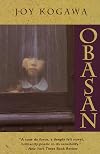
A heartbreaker, but beautifully written, and such an eye-opener about how Canada treated its citizens of Japanese ancestry. Really horrifying—I knew about the U.S. and the internment camps, but this was a bit of a surprise, though I suppose it shouldn't have been, with second- and third-generation Japanese-Canadians forced to give up all their possessions and their homes, and relocate to shantytowns to perform forced labor. Kogawa was originally a poet, and it shows. Recommended.
Obasan by Joy Kogawa
Joy Kogawa's novel, OBASAN, first published nearly forty years ago, has become a minor Canadian classic. Its narrator, Naomi Nakane, a school teacher, looks back thirty years at her childhood spent in a desolate Japanese-Canadian internment camp near the tiny "ghost town" of Slocan during WWII, remembering the racism and discrimination and the quiet stoicism of her grandmother and uncle, who raised her and her older brother, Stephen. The family comes together again when her uncle dies, and show more the dark secrets of what happened to her parents in those years are revealed. But perhaps the most startling part of Kogawa's story for me is how the Canadian government continued to discriminate against its Japanese-Canadian citizens AFTER the war, denying them the opportunity to return to their homes in the west, instead pressing them to either move east or "repatriate" back to Japan. Naomi's family lived in a shed on a sugar beet farm in Alberta and worked like slaves for years.
Of course, the U.S. has its own shameful history of its treatment of Japanese-Americans during the war. I remember reading FAREWELL TO MANZANAR many years ago - another book that has attained that status of minor classic.
OBASAN is a sad, disturbing, and beautifully written little book. Very highly recommended.
- Tim Bazzett, author of the memoir, BOOKLOVER show less
Of course, the U.S. has its own shameful history of its treatment of Japanese-Americans during the war. I remember reading FAREWELL TO MANZANAR many years ago - another book that has attained that status of minor classic.
OBASAN is a sad, disturbing, and beautifully written little book. Very highly recommended.
- Tim Bazzett, author of the memoir, BOOKLOVER show less
Lists
THE WAR ROOM (1)
AP Lit (1)
Awards


You May Also Like


Associated Authors
Statistics
- Works
- 16
- Also by
- 9
- Members
- 2,001
- Popularity
- #12,871
- Rating
- 3.8
- Reviews
- 40
- ISBNs
- 57
- Languages
- 3
- Favorited
- 1