
Gary S. Cross
Author of An All-consuming Century: Why Commercialism Won in Modern America
About the Author
Gary S. Cross is distinguished, professor of modern history at Pennsylvania State University and the author or coauthor of many books, most recently Packaged Pleasures: How Technology and Marketing Revolutionized Desire, also published by the University of Chicago Press.
Works by Gary S. Cross
Kid's Stuff 2 copies
Integrating science and language: a literacy guide for Pan-Canadian science place, grade 4-6. (2000) 1 copy
Un monde à conserver 1 copy
Associated Works
DK Eyewitness Travel Guides: Brussels, Bruges, Ghent & Antwerp (2000) — Illustrator, some editions — 269 copies
Work, community, and power : the experience of labor in Europe and America, 1900-1925 (1983) — Contributor — 6 copies
Tagged
Common Knowledge
- Canonical name
- Cross, Gary S.
- Other names
- Cross, Gary Scott
- Birthdate
- 1946-09-25
- Gender
- male
- Education
- University of Wisconsin, Madison (PhD|1977)
University of Wisconsin, Madison (AM|1973)
Harvard University (MDiv|1972)
Washington State University (AB|1968) - Occupations
- historian
university professor
Members
Reviews
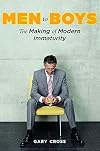
'in a recent study, 55% of American men aged eighteen to twenty-four were found to be living at home with their parents, and 13% between twenty-five and thirty-four years of age still live at home, compared to only 8% of women... And this is hardly unique to Americans. Up to half of Italian men between the age of twenty-five to thirty five still live with their parents.'
Here's a fascinating read showing the evolution of our ideas of manhood over three generations: the Greatest Generation, show more the Boomers, and Generation X. I, in any case, found it fascinating because, although Gary Cross is a Boomer and I am a Millennial, we share the same bewilderment facing the triumph of so-called boys-men.
Thing is, personally I don't think I fit in. Unlike many men of my generation, I left the nest to go abroad and find work instead of carrying on living with mummy; I first became a dad at 23 whereas most other men delay having children until late in their thirties if they have kids at all; I strongly believe marriage and fatherhood to be fulfilling when most prefer the shallowness of casual relationships, and avoid parental responsibilities and what child rearing entails; and, well, I am not addicted to video games, as I think there are more constructive ways to spend your time. Actually, it baffles me that men my age still overplay games they used to play at 20, 15, 12, 8, like kids who never learnt how to outgrow a toy! Sorry, guys, for being condescending, but I don't see grown up women playing dolls for hours on end and be addicted to it! Ha, but I don't see grown up women still living at mummy and daddy while in their twenties and thirties either...
See, manhood used to be about character. It used to be about adhering to an ethos -ambition, success, hard work, responsibility, caring and providing for a family. Sure, feminism's successes and the empowerment of women has (rightly!) led to challenges of the obsolete patriarchal model, and women too now came to embrace such ethos. This is more than welcome, and if manhood is no longer being stupidly opposed to womanhood (unless you're an insecure sexist, but that's another issue!) you would expect, at least, to still have manhood opposed to childhood. Well, not so fast...
Manhood is now not only about appearances, with the modern men more concerned about their look (the triumph of the metrosexual man, as vain and shallow as his bimbo female equivalent...) than about character, but, also, the self-indulgence and hedonism of grown ups, who would rather spend hours on end playing video games (again!) than actually, well, start families and get on with being responsible and independent. In a nutshell, you'll be hard pressed to define when childhood/ adolescence ends and manhood starts.
You don't have to look far to see evidence of such a phenomenon. The author, here, in fact focuses a great deal on popular culture (movies and TV sitcoms especially) to show how the image of manhood has evolved ever since the 1930s up to now. Movies are telling. Sure, it's easy to dismiss the westerns of grandpa as silly escapism into a romanticised Far West -yet such movies used to portray men as being tough, self-reliant, and protectors of the weak against all sort of villains. Sure, it's also easy to see through the political propaganda of action and war movies from the 1950s onward, whereas heroic Americans were fighting evil terrorists and baddie regimes -yet these movies reflected the moral imperative of the times, from patriotism to fighting against Nazis and Communists in the name of liberties. Now, what do we have? Just have a look at our recent blockbusters! On the one hand, comedies and shows indulging in toilet and bellow the belt humour, and where men always are portrayed as gooffies, jerks, useless and immature; and, on the other hand, action movies which are just senseless and graphic violence, with absolutely zero character depth or maturation. How did it come to that? How did men who were depicted four generations ago through the stern stoicism of a John Wayne now came to be portrayed as being as ridicule as an Homer Simpson or a Rambo? Gary Cross is unto something, for example when dealing with the crass and vulgar comedies now invading our screens:
'toilet humour, for all its apparent daring, is a cop out, because it avoids taking on sacred cows in real life (political or religious, for example). Hollywood's seeming outrageousness really is a ruse, but it works because it appeals to the mentality of he who wouldn't know a taboo if he saw it -the little boy.'
Little boy indeed, and he applies the same reasoning to contemporary action movies -they are successful not despite of their silly puerility but because of it. What you see on the screen is what you would expect when a little boy is playing with his action figurines, dreaming of big muscles and big weaponries and big fast packed actions high on stunts and pyrotechnics and big bad words and, well... nothing else. You wouldn't expect a child to have some depth, would you? That's the point: the audience of such stupidity truly are little boys at heart. There is no men anymore, but boys-men.
It would be easy to dismiss such book as the rant of a Boomer. This would be terribly unfair, because the author does precisely the opposite: he doesn't mock or blame or attack, but, explain. And, he explains in light of his generation. In fact, he offers an historical background in an attempt to come to grip in understanding how the boys-men of today came to be in the first place. More, and maybe most importantly, he does not look back to a past ideal of manhood. Actually, here too he does exactly the opposite -showing how the inadequacies and revolt of past generations were justified somehow, even if they fuelled the boys-men mentality of today. Here's the thing: my elders can easily accuse my generation (Millennials) of being self-entitled snowflakes; yet we just took their mindset and values to the next level. There is nothing new under the sun.
In fact, there is nothing new in how history is displayed in here either. Whose who, like me, sympathise with Conservative writers keen on blaming Boomers for being the root cause of the self indulgence, hedonism, hyper-consumerism, and all in all perpetual childishness of today's youth, will here nod more than once. The author, himself a Boomer, actually acknowledges the accusation too:
'I don't want to reduce 1960s radicalism to an oedipal crisis (it certainly was much more about political and social change). Still, my generation gained more pleasure from rejecting elders and revelling in our youth than in creating a better meaning of maturity.'
Or, again, writing about the Hippy generation:
'there was a lot about its challenges to our elders that suggest not so much a New Man as an unhinged boy.'
And indeed, there's a lot to thank his generation for; after all, they embodied the Civil Rights era and so contributed a great deal to make society less oppressive and more tolerant (even if such political heritage also includes identity politics and its divisive derives). But, like with the Beat generation which had influenced them, if rejecting the stuffiness and responsibilities of a conformist society for the spontaneity and carelessness of a Bohemian life was all very well in terms of self-indulgence and narcissism, what did such hedonism had to offer as a new model of a manhood? Nothing. Hippies may have been great junkies and swingers, but they were barely responsible men to look up to to care and provide for a family! Their self-absorbed hedonism actually translated into the hyper-consumerism of our days, as now men consume for themselves on themselves instead of for their families. In other words, buying video games and digital gadgets replaced buying family car and family houses and the appliances going with it. The counter-culture of the 60s were not so much about rejecting capitalistic materialism (well, a lot has been written and said about the hypocrisy of the Hippies!) than about a new consumerism.
It's a sharp coming to term, but this is not about reverting to a pre-Boomers era; the age of the men idealising cowboys in movies, let alone the, god forbid!, Victorian patriarchy that preceded them long before! Such models were indeed inadequate, this is why men revolted against them to start with:
The status of provider-ship often kept the father at work and away from the family and made him a slave to a job he could hate.'
Retracing how fatherhood had been redefined, starting with the 'pal dad' of the 1950s, the author brilliantly shows that in such changes were the seed to the immaturity of today's boys-men. His analyse of the culture of hobbies and its consequences makes for a thought provoking read (although I find him here severe and quite unfair). His appraisal of adolescence emerging as a market also drives a point home when it comes to explaining, in part, the obsession with youth across generations. But, beyond history, what does this book has to offer?
Again, this is not the rant of a boomer against the new generation. The author actually defends it as the expected product of the past ones. This is not, either, a call to revert back to a view of manhood entrenched in bygone era, and, surely, idealised and caricatural. At its core, it's merely an observation; a state of things as they came to be.
Manhood is no longer the opposite of childhood but an extension of it. Men refuse to let go of their boyishness. Their humour is toddler's humour, their idea of entertainment is a quest for thrills ranging from addictive video games to gawking in front of shallow action movies with no substance. They are kids trapped in grown up bodies, but it's ok since they can still live with their parents and delays what for previous generations were expected milestones in terms of maturing (settling down, starting a family). The shallowness expands even to fashion and appearance -whereas men used to embrace ageing as a sign of maturity, they now fear losing their hair to indulging in using Botox. The culture of cool has replaced refinement in taste, and, there seem to be nothing left but 'slaves of instant gratification and in rebellion against an adulthood that doesn't exist'. Should we worry? That's a question this book won't answer. show less
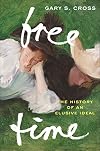
Intriguing History Of The Concept. Straight up, this is an academic writing this book... and the typical academic leftist anti-capitalist themes are quite prominent throughout the text. So rather than defenestrate the book (as some will very much want to do) and to save the author some 1* reviews that are nothing more than "this was just anti-capitalist trash!!!!!"... if you can't at least accept that this is the position the author comes from... this may not be the best book for you.
As far show more as the overall history and presentation goes, it is actually rather intriguing. Cross's examinations of "high culture" and "genteel" Victorian leisure ideals vs "low culture" entertainment of the masses is quite extraordinary in just how detailed he gets in showing the stark differences here. When Cross begins to get more into the 20th century and showing the mass increases in productivity and the intricate tradeoffs of using the surplus productivity for more income (what American society ultimately came to) vs for more leisure time (what other societies came to), it really is truly intriguing. As someone with an interest and at least a modicum of training in both history and economics myself, it is rather interesting to consider the ramifications if other choices had been made through these struggles and decisions as Cross lays them out here.
As with most any book of its kind, once Cross ends the historical illumination and switches over into more proscriptive social commentary on where believes society should go from our present position... meh, this is the typical section of "Your Mileage May Vary", and that is certainly the case here.
Still, with a bibliography hitting the 20% mark, this is a reasonably well documented examination of the topic, and the way Cross presents it really is stimulating. Very much recommended. show less
As far show more as the overall history and presentation goes, it is actually rather intriguing. Cross's examinations of "high culture" and "genteel" Victorian leisure ideals vs "low culture" entertainment of the masses is quite extraordinary in just how detailed he gets in showing the stark differences here. When Cross begins to get more into the 20th century and showing the mass increases in productivity and the intricate tradeoffs of using the surplus productivity for more income (what American society ultimately came to) vs for more leisure time (what other societies came to), it really is truly intriguing. As someone with an interest and at least a modicum of training in both history and economics myself, it is rather interesting to consider the ramifications if other choices had been made through these struggles and decisions as Cross lays them out here.
As with most any book of its kind, once Cross ends the historical illumination and switches over into more proscriptive social commentary on where believes society should go from our present position... meh, this is the typical section of "Your Mileage May Vary", and that is certainly the case here.
Still, with a bibliography hitting the 20% mark, this is a reasonably well documented examination of the topic, and the way Cross presents it really is stimulating. Very much recommended. show less

Set in NZ. Lucas is dared to go near the old “haunted house”. There is a rumour that a man went mad there and killed his children – their bodies were never found. He climbs up a tree and through the window notices a fantastic mural painted on all 4 sides of a child’s bedroom. Then suddenly something hideous jumps straight at the window and he falls out of the tree scared to death. Enter Rosie who comes to stay with her parents and discovers the hideous truth about her Uncle Silo & show more what is hiding in the mural.p.1 from “Five minutes shy of midnight” to p.6 “lived” show less
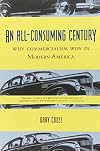
Narrative of the development of consumer culture in the US, with a look at the 60s counterpush and the 80s reversal of hesitation.
Lists
You May Also Like


Associated Authors
Statistics
- Works
- 38
- Also by
- 3
- Members
- 422
- Popularity
- #57,803
- Rating
- 4.0
- Reviews
- 4
- ISBNs
- 73
- Languages
- 1
