
A. Cleveland Coxe (1818–1896)
Author of Ante-Nicene Fathers. Volume 3. Latin Christianity: Its Founder, Tertullian. Three Parts: I. Apologetic; II. Anti-Marcion; III. Ethical
About the Author
Image credit: Courtesy of the NYPL Digital Gallery (image use requires permission from the New York Public Library)
Series
Works by A. Cleveland Coxe
Ante-Nicene Fathers. Volume 3. Latin Christianity: Its Founder, Tertullian. Three Parts: I. Apologetic; II. Anti-Marcion; III. Ethical (1978) — Editor — 470 copies, 5 reviews
Ante-Nicene Fathers. Volume 4. Fathers of the Third Century: Tertullian, Part Fourth; Minucius Felix; Commodian; Origen, Parts First and Second. (1988) — Editor — 438 copies, 6 reviews
Ante-Nicene Fathers. Volume 5. Fathers of the Third Century: Hippolytus, Cyprian, Caius, Novatian, Appendix (1886) — Editor — 417 copies, 6 reviews
Ante-Nicene Fathers. Volume 6. Fathers of the Third Century: Gregory Thaumaturgus, Dionysius the Great, Julius Africanus, Anatolius and Minor Writers, Methodius, Arnobius (1886) — Editor — 405 copies, 3 reviews
Ante-Nicene Fathers. Volume 7. Fathers of the Third and Fourth Centuries: Lactantius, Venantius, Asterius, Victorinus of Pettau, Dionysius of Corinth, Apostolic Constitutions,… (1886) — Editor — 392 copies, 3 reviews
The Ante-Nicene fathers : translations of the writings of the fathers down to A.D. 325. Volume 8 (1886) — Editor — 383 copies, 2 reviews
The Daily round: Meditation, prayer, and praise adapted to the course of the Christian year 8 copies
Thoughts on the services; designed as an introduction to the liturgy, and an aid to its devout use (1868) 7 copies
Christian ballads 3 copies
Halloween: A Romaunt 2 copies
The Genesis of the American Prayer Book: A Survey of the Origin and Development of the Liturgy of the Church in the United States (1893) 2 copies
The Ante-Nicene fathers : translations of the writings of the fathers down to A.D. 325 [Vol. 1-8] 1 copy
Associated Works
Ante-Nicene Fathers: The Gospel of Peter, The Diatesseron of Tatian, The Apocalypse of Peter, The Visio Pauli, The Apocalypses of the Virgin and Sedrach, The Testament of Abraham,… (1896) — Editor, some editions — 316 copies, 4 reviews
Tagged
Common Knowledge
- Canonical name
- Coxe, A. Cleveland
- Birthdate
- 1818-05-10
- Date of death
- 1896-07-20
- Gender
- male
- Education
- University of the City of New York (1838)
- Short biography
- Arthur Cleveland Coxe (1818-1896)
- Nationality
- USA
- Birthplace
- Mendham, New Jersey, USA
- Associated Place (for map)
- New Jersey, USA
Members
Reviews
THE ANTE-NICENE FATHERS: The Writings of the Fathers Down to A.D. 325 Volume IV Fathers of the Third Century -Tertullian Part 4; Minucius Felix; Commodian; Origen by Alexander Roberts
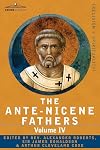
Although the entire Ante-Nicene Fathers series is terrific and a must-own/must-read for anyone with more than a passing interest in early Christianity and the Church Fathers, this volume in particular is a gem. It is filled from beginning to end with some of the most fascinating works of two of the most fascinating figures of early Christianity, Tertullian and Origen, as well as the lesser-known but nonetheless very interesting Minucius Felix. The book begins with the final portion of show more Tertullian's works and we watch, with sadness and simultaneous captivation, as he completes his downward spiral into heresy. We then are treated to a record of a wonderful conversation between a Christian and a pagan, and we watch as the latter comes to embrace Christ. Finally, we receive the greatest reward of all: Origen's amazing treatment of Scriptural exegesis and of the "hard questions" of Christian Faith in his "First Principles" and his absorbing answer to Celsus. A pure delight throughout. show less
THE ANTE-NICENE FATHERS: The Writings of the Fathers Down to A.D. 325 Volume III Latin Christianity: its Founder, Tertullian -Three Parts: 1. Apologetic; 2. Anti-Marcion; 3. Ethical by Alexander Roberts
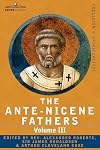
Tertullian is by far the most sarcastic and sardonic of the early Christian authors -- in short, he was a jerk, and that's why I love him! His constant plays on words and jabs at his pagan and heretical opponents make his writings a delight to read. There aren't many ancient authors that modern folks can laugh out loud at, but Tertullian is certainly one of them. After reading this large volume of his works, I felt as if I'd gotten to know the man himself, as so much of his writing gives show more personal insight into his own life and personality. He's such an enjoyable read, one can't help but feel regret for Tertullian's own eventual lapse into heresy. I recommend reading this volume if you're ready for a thorough soaking in the thought of one of Christianity's greatest early thinkers -- and THE greatest smart-alec of Christian history. show less
Latin Christianity: Its Founder, Tertullian; I. Apologetic; II. Anti-Marcion; III. Ethical (The Writings of the Fathers Down to A.D. 325: Ante-Nicene Fathers, Volume 3) by Alexander Roberts
Thus far, the more interesting and insightful of the previous two volumes. In this third volume of the ante-nicene fathers of the early Christian Latin community, Tertullian handles the doctrines thoroughly and in minute details; there is much meat in Tertullian to chew on and digest and there seems to be nothing left unsaid in his teachings here recorded, and also in his many refutations of the various heresies that were disseminated in his day.
This is not at all a quick read (718 pages not show more including indexes); read it superficially and you won't fully benefit from the insights he provides that may also be relevant for today. I did notice a few of his arguments against heresy were sort of silly, but that's just from a present day perspective; trying to mold my mind to that of a 2nd-century Christian, I can see where it might make sense and be understood as a solid argument.
In any case, 131 pages, comprising of sections one and three, Tertullian discuss general Church doctrines, e.g idolatry, the defense of the Christian and his faith, entertainment (which in that day were the violent gladiator games), repentance, prayer, baptism, etc.
In the second section, comprising of 468 pages, which is the majority of the book,, Tertullian refutes various heresies, e.g. Marcion, Hermogenes, Valentinian, and on subjects like the flesh and resurrection of Christ, the Trinity, humanity of Christ, death etc.
For anyone who is truly interested in the theological thoughts of the early Christian community, Tertullian gives a glimpse, if even from a Latin perspective. show less
This is not at all a quick read (718 pages not show more including indexes); read it superficially and you won't fully benefit from the insights he provides that may also be relevant for today. I did notice a few of his arguments against heresy were sort of silly, but that's just from a present day perspective; trying to mold my mind to that of a 2nd-century Christian, I can see where it might make sense and be understood as a solid argument.
In any case, 131 pages, comprising of sections one and three, Tertullian discuss general Church doctrines, e.g idolatry, the defense of the Christian and his faith, entertainment (which in that day were the violent gladiator games), repentance, prayer, baptism, etc.
In the second section, comprising of 468 pages, which is the majority of the book,, Tertullian refutes various heresies, e.g. Marcion, Hermogenes, Valentinian, and on subjects like the flesh and resurrection of Christ, the Trinity, humanity of Christ, death etc.
For anyone who is truly interested in the theological thoughts of the early Christian community, Tertullian gives a glimpse, if even from a Latin perspective. show less
The fourth part of Tertullian's works, a tractate by Minucius Felix, Commodian, and a couple of the works of Origen - Against Celsus and De Principiis.
It took me a long time to finish the whole edition; nothing to do with the edition itself, per se, but more about how I would read short amounts over long periods of time...so memory is a bit hazy.
This part of Tertullian's works are definitely in his later, more cantankerous, Montanist-esque stage. He will not go down in history as a show more feminist...but it is a portrait of Christianity in North Africa in the early third century.
Minucius Felix wrote some good stuff.
Origen can be a challenge anyway, but especially in De Principiis, since it's mostly preserved only in Rufinus' Latin translation, and there's always the question of how much Rufinus would have "adapted" in order to make Origen seem less heretical. Against Celsus has short chapters but many, many of them; Origen's apologetic game is strong.
A good exploration into patristic literature. show less
It took me a long time to finish the whole edition; nothing to do with the edition itself, per se, but more about how I would read short amounts over long periods of time...so memory is a bit hazy.
This part of Tertullian's works are definitely in his later, more cantankerous, Montanist-esque stage. He will not go down in history as a show more feminist...but it is a portrait of Christianity in North Africa in the early third century.
Minucius Felix wrote some good stuff.
Origen can be a challenge anyway, but especially in De Principiis, since it's mostly preserved only in Rufinus' Latin translation, and there's always the question of how much Rufinus would have "adapted" in order to make Origen seem less heretical. Against Celsus has short chapters but many, many of them; Origen's apologetic game is strong.
A good exploration into patristic literature. show less
You May Also Like


Associated Authors
Statistics
- Works
- 25
- Also by
- 2
- Members
- 3,089
- Popularity
- #8,263
- Rating
- 4.3
- Reviews
- 38
- ISBNs
- 73