
Michelle Markel
Author of Brave Girl: Clara and the Shirtwaist Makers' Strike of 1909
About the Author
Works by Michelle Markel
Tomfoolery! Randolph Caldecott and the Rambunctious Coming-of-Age of Children's Books (2023) 87 copies, 7 reviews
Tagged
Common Knowledge
- Gender
- female
- Education
- University of Southern California (B.A.|French literature)
University of California, Los Angeles (M. A.|French literature)
California State University, Northridge (B. A.|Journalism) - Occupations
- journalist
children's book author
teacher - Organizations
- Children's Authors Network
- Agent
- Olswanger Literary
- Nationality
- USA
- Places of residence
- Culver City, California, USA
West Hills, California, USA - Associated Place (for map)
- California, USA
Members
Reviews

As someone who has a great interest in the history of children's literature, and who has done some research into the earlier centuries of that history, I was quite excited to discover that there was a picture-book biography of John Newbery, the eighteenth-century British publisher who did so much to popularize books for the young, and for whom the Newbery Medal is named. Unfortunately, almost everything about the book - with the notable exception of Nancy Carpenter's expressive and amusing show more illustrations - was a disappointment to me. From the title on - no, Michelle Markel, Anglophone children's books did not have their birth with John Newbery or his contemporaries - I found myself irritated by the tone here, and by some of the author's underlying assumptions about early children's books and how they were received. In the end, I concluded that although the topic here was worthy, the book itself was sufficiently misleading to give a wholly incorrect impression of early English children's literature. Given that this is so, I simply cannot recommend it.
One of the classes I enjoyed most, during the course of completing my masters, was devoted to early English children's literature, stretching from the Puritan period through the late eighteenth century. When reading such works as James Janeway's 1671 A Token for Children: Being an Exact Account of the Conversion, Holy and Exemplary Lives, and Joyful Deaths of Several Young Children it is easy for the contemporary reader to conclude, as Markel does, that children were forced to read "religious texts that made them fear that death was near." What readers coming from such a perspective fail to understand about the historical and cultural context of such works, is that in a time when infant mortality was incredibly high, and most children would have experienced the loss of multiple siblings before reaching the age of ten, the idea of deceased youngsters finding a better life in the hereafter would have offered, not fear, but great comfort. This is but one example of how Markel misreads her subject, too enmeshed in her contemporary viewpoint to really understand the texts she has (one hopes?) read.
Markel's statement that there were no books for children in the early 18th-century isn't simply factually incorrect, it is self-contradictory, given her subsequent (misguided) statements about the nature of those earlier books. Her claim that the exciting books being produced in the period weren't shared with children is also a misreading. It ignores the fact that social mores about the appearance of children in public would have been different at that time than those we observe today, assuming that because children were not permitted in such institutions as lending libraries, the books sold there were not shared with young people. In point of fact, many works were written explicitly to be shared in the family circle, and were intended, if not solely for children, at least partially for them. Markel mentioned John Locke in her afterword, which I find ironic, given that it was his statement in his 1693 Some Thoughts Concerning Education about the suitability of The History of Reynard the Fox as children's literature that first inspired me to examine three centuries of children's retellings of that tale in my masters dissertation. Needless to say, quite a few versions of Reynard predate John Newbery and his influential Little Goody Two-Shoes, discussed by Markel in her text.
I recognize that my interests and training are not those of many other readers approaching this picture-book - something that can be seen by the almost universal praise heaped on Balderdash!: John Newbery and the Boisterous Birth of Children's Books by other online reviewers - but I feel they do give me the ability to pick out the subtle but persistent inaccuracies to be found therein. That so many, even in the world of children's literature studies, continue to believe some of the canards presented here is a cause of concern to me, but given that Markel explicitly set out to research the subject, I expected something a little more nuanced and accurate from her. I do think Newbery and his story are worth telling, so it is with regret that I say: This one is not recommended. show less
One of the classes I enjoyed most, during the course of completing my masters, was devoted to early English children's literature, stretching from the Puritan period through the late eighteenth century. When reading such works as James Janeway's 1671 A Token for Children: Being an Exact Account of the Conversion, Holy and Exemplary Lives, and Joyful Deaths of Several Young Children it is easy for the contemporary reader to conclude, as Markel does, that children were forced to read "religious texts that made them fear that death was near." What readers coming from such a perspective fail to understand about the historical and cultural context of such works, is that in a time when infant mortality was incredibly high, and most children would have experienced the loss of multiple siblings before reaching the age of ten, the idea of deceased youngsters finding a better life in the hereafter would have offered, not fear, but great comfort. This is but one example of how Markel misreads her subject, too enmeshed in her contemporary viewpoint to really understand the texts she has (one hopes?) read.
Markel's statement that there were no books for children in the early 18th-century isn't simply factually incorrect, it is self-contradictory, given her subsequent (misguided) statements about the nature of those earlier books. Her claim that the exciting books being produced in the period weren't shared with children is also a misreading. It ignores the fact that social mores about the appearance of children in public would have been different at that time than those we observe today, assuming that because children were not permitted in such institutions as lending libraries, the books sold there were not shared with young people. In point of fact, many works were written explicitly to be shared in the family circle, and were intended, if not solely for children, at least partially for them. Markel mentioned John Locke in her afterword, which I find ironic, given that it was his statement in his 1693 Some Thoughts Concerning Education about the suitability of The History of Reynard the Fox as children's literature that first inspired me to examine three centuries of children's retellings of that tale in my masters dissertation. Needless to say, quite a few versions of Reynard predate John Newbery and his influential Little Goody Two-Shoes, discussed by Markel in her text.
I recognize that my interests and training are not those of many other readers approaching this picture-book - something that can be seen by the almost universal praise heaped on Balderdash!: John Newbery and the Boisterous Birth of Children's Books by other online reviewers - but I feel they do give me the ability to pick out the subtle but persistent inaccuracies to be found therein. That so many, even in the world of children's literature studies, continue to believe some of the canards presented here is a cause of concern to me, but given that Markel explicitly set out to research the subject, I expected something a little more nuanced and accurate from her. I do think Newbery and his story are worth telling, so it is with regret that I say: This one is not recommended. show less

Author/illustrator team Michelle Markel and Amanda Hall, who also collaborated on The Fantastic Jungles of Henri Rousseau, join forces again in this picture-book biography of surrealist artist Leonora Carrington. Born into a well-to-do English family, Carrington's parents had hopes that she would lead a conventional life, becoming a "proper" young lady. Instead, her unusual way of looking at the world, and her desire to create, evident from the time she was four, and would scribble on the show more walls, eventually led her to art school, and then into the circle of surrealist artists. Living for a time in Paris, she eventually fled to Mexico during WWII, here becoming friends with fellow woman surrealist Remedios Varo. Eventually, thanks to an art collector who arranged for a show in New York City, Carrington's work became more famous. She continued to create her fantastic paintings and sculptures all her life, eventually dying in Mexico City in 2011...
Remedios Varo is my absolute favorite, of all the surrealists, and Leonora Carrington, whose style is very similar, comes a close second, so when I saw Out of This World: The Surreal Art of Leonora Carrington, I was absolutely thrilled! I hadn't read the earlier book by this author/illustrator team (something I will have to rectify), so I had no expectations going in. What I discovered was a simple but engaging text and absolutely gorgeous artwork. Amanda Hall really manages to capture the enchantment, the eldritch charm of Carrington's work here. She mentions in her brief afterword that it was a challenge to create visuals that had the feeling of her subject's work, without simply reproducing any of the images from that work. I think she certainly has succeeded! I am so very glad to see this artist being presented to children - I wish there was a children's book about Remedios Varo! - and I appreciated the way that author Markel emphasizes the ways that these two artists' work addressed the woman's experience, within the surrealist field. Recommended to all young art-lovers, and to anyone looking for excellent new picture-book biographies. show less
Remedios Varo is my absolute favorite, of all the surrealists, and Leonora Carrington, whose style is very similar, comes a close second, so when I saw Out of This World: The Surreal Art of Leonora Carrington, I was absolutely thrilled! I hadn't read the earlier book by this author/illustrator team (something I will have to rectify), so I had no expectations going in. What I discovered was a simple but engaging text and absolutely gorgeous artwork. Amanda Hall really manages to capture the enchantment, the eldritch charm of Carrington's work here. She mentions in her brief afterword that it was a challenge to create visuals that had the feeling of her subject's work, without simply reproducing any of the images from that work. I think she certainly has succeeded! I am so very glad to see this artist being presented to children - I wish there was a children's book about Remedios Varo! - and I appreciated the way that author Markel emphasizes the ways that these two artists' work addressed the woman's experience, within the surrealist field. Recommended to all young art-lovers, and to anyone looking for excellent new picture-book biographies. show less
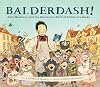
A fairly lively biography of one of the pioneers of children's literature should entertain children and adults.
John Newbery was a bookstore owner, publisher, and writer. He was quite the entrepreneur, i.e., including product placement for his health elixir in his books, pairing his books with toys to boost sales, cross-pollinating characters to create a shared universe – the sort of stuff we still see corporations doing today.
I wish the author had worked a few dates into the body of the show more story to better anchor the tale in history. show less
John Newbery was a bookstore owner, publisher, and writer. He was quite the entrepreneur, i.e., including product placement for his health elixir in his books, pairing his books with toys to boost sales, cross-pollinating characters to create a shared universe – the sort of stuff we still see corporations doing today.
I wish the author had worked a few dates into the body of the show more story to better anchor the tale in history. show less
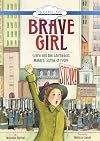
This is a thoroughly delightful historical picture book, beautifully told and filled with wonderful art that perfectly enhances the text.
Brave, young, energetic Clara Lemlich, a young immigrant sweatshop worker, was one of the driving forces behind the shirtwaist makers’ strike of 1909. At first her efforts were discounted because she was a woman, but she proved that determination and grit do not depend on gender. Because of Clara’s actions, the conditions of the sweatshop workers show more improved and many young women were both inspired and empowered to help make the workplace a safer and healthier environment for all.
Integral to Sweet’s artwork are images of fabric and stitchery, intertwining the art with the story of young women who spent endless hours at sewing machines.
A thorough afterword about the garment industry and an excellently chosen bibliography are included.
The book is highly recommended for ages 4-8 but may be useful, as well, for older children studying the history of the time. show less
Brave, young, energetic Clara Lemlich, a young immigrant sweatshop worker, was one of the driving forces behind the shirtwaist makers’ strike of 1909. At first her efforts were discounted because she was a woman, but she proved that determination and grit do not depend on gender. Because of Clara’s actions, the conditions of the sweatshop workers show more improved and many young women were both inspired and empowered to help make the workplace a safer and healthier environment for all.
Integral to Sweet’s artwork are images of fabric and stitchery, intertwining the art with the story of young women who spent endless hours at sewing machines.
A thorough afterword about the garment industry and an excellently chosen bibliography are included.
The book is highly recommended for ages 4-8 but may be useful, as well, for older children studying the history of the time. show less
Lists
Awards


You May Also Like


Associated Authors
Statistics
- Works
- 20
- Members
- 2,043
- Popularity
- #12,582
- Rating
- 4.1
- Reviews
- 188
- ISBNs
- 51
- Favorited
- 2
