
Alastair Reynolds
Author of Revelation Space
About the Author
Series
Works by Alastair Reynolds
Rivelazione /1 12 copies
Big Hello 4 copies
Ascension Day 4 copies
Collected Stories 2 copies
Belladonna Nights {short story} 2 copies
Arınma Geçidi 1 copy
H1: IRivelazione 1 copy
Night Passage 1 copy
Lune And The Red Empress 1 copy
Un-Collected Stories 1 copy
Unendliche Stadt : Roman 1 copy
Short Fiction Collected 1 copy
Different Seas {short story} 1 copy
Night Passage {short story} 1 copy
Stories 1 copy
A Map of Mercury (Novelette) 1 copy
Associated Works
The Year's Best Science Fiction: Twenty-Third Annual Collection (2006) — Contributor — 565 copies, 5 reviews
The Year's Best Science Fiction: Nineteenth Annual Collection (2002) — Contributor — 559 copies, 6 reviews
The Year's Best Science Fiction: Seventeenth Annual Collection (2000) — Contributor — 554 copies, 2 reviews
The Year's Best Science Fiction: Twentieth Annual Collection (2003) — Contributor — 526 copies, 1 review
The Year's Best Science Fiction: Twenty-Fifth Annual Collection (2008) — Contributor — 512 copies, 3 reviews
The Year's Best Science Fiction: Eighteenth Annual Collection (2001) — Contributor — 504 copies, 2 reviews
The Year's Best Science Fiction: Fifteenth Annual Collection (1998) — Contributor — 468 copies, 2 reviews
The Year's Best Science Fiction: Twenty-Fourth Annual Collection (2007) — Contributor — 456 copies, 6 reviews
The Year's Best Science Fiction: Twenty-Sixth Annual Collection (2009) — Contributor — 425 copies, 2 reviews
The Mammoth Book of Extreme Science Fiction: New Generation Far-Future SF (2006) — Contributor — 348 copies, 7 reviews
The Year's Best Science Fiction: Twenty-Eighth Annual Collection (2011) — Contributor — 328 copies, 3 reviews
The Year's Best Science Fiction: Twenty-Ninth Annual Collection (2012) — Contributor — 276 copies, 5 reviews
The Year's Best Science Fiction: Thirtieth Annual Collection (2013) — Contributor — 255 copies, 3 reviews
The Best of the Best, Volume 2: 20 Years of the Best Short Science Fiction Novels (2007) — Contributor — 235 copies, 10 reviews
The Year's Best Science Fiction: Thirty-Second Annual Collection (2015) — Contributor — 204 copies, 8 reviews
The Year's Best Science Fiction: Thirty-First Annual Collection (2014) — Contributor — 203 copies, 3 reviews
The Very Best of the Best: 35 Years of The Year's Best Science Fiction (2019) — Contributor — 180 copies, 1 review
The Year's Best Science Fiction: Thirty-Fifth Annual Collection (2018) — Contributor — 152 copies, 3 reviews
Shine: An Anthology of Near-future, Optimistic Science Fiction (2010) — Contributor — 147 copies, 7 reviews
The Year's Best Science Fiction: Thirty-Fourth Annual Collection (2017) — Contributor — 147 copies, 4 reviews
Solaris Rising: The New Solaris Book of Science Fiction (2011) — Contributor — 137 copies, 4 reviews
The Best Science Fiction of the Year: Volume 4 (2019) — Contributor; Contributor — 71 copies, 2 reviews
More Human Than Human: Stories of Androids, Robots, and Manufactured Humanity (2017) — Contributor — 62 copies, 2 reviews
The Year's Best Science Fiction Vol. 2: The Saga Anthology of Science Fiction 2021 (2021) — Contributor — 59 copies
The Best Science Fiction and Fantasy of the Year Volume Ten (2016) — Contributor — 59 copies, 3 reviews
The Best Science Fiction and Fantasy of the Year Volume Twelve (2018) — Contributor — 47 copies, 2 reviews
Celebration: Commemorating the 50th Anniversary of the British Science Fiction Association (2008) — Contributor — 37 copies, 1 review
The Year’s Top Ten Tales of Science Fiction 6 — Contributor — 1 copy
Tagged
Common Knowledge
- Legal name
- Reynolds, Alastair Preston
- Birthdate
- 1966-03-13
- Gender
- male
- Education
- Newcastle University (BS|1988)
University of St Andrews (Ph.D|1991) - Occupations
- astronomer
astrophysicist
science fiction writer - Organizations
- European Space Agency
- Awards and honors
- British Science Fiction Award for Best Novel (2001)
Locus Award for Best Young Adult Book (2017)
Sidewise Award for Alternate History (2010)
Seiun Award for Best Translated Short Story
Guest of Honour Odyssey (Eastercon) 2010 - Nationality
- UK
- Birthplace
- Barry, Wales, UK
- Places of residence
- Leiden, Netherlands
Cornwall, England, UK
Cardiff, Wales, UK - Map Location
- Wales, UK
Members
Discussions
[[Alistair Reynolds']] [Terminal World] in Science Fiction Fans (July 2011)
Reviews
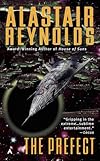
"Your skull is a stained-glass window, an open book revealing the processes of your mind": Nominally a kind of police procedural for those already familiar with Reynolds' Revelation Space setting (although it takes place during the Belle Epoque, long before the Machine Plague). Actually, it's something like an extended meditation on the possibility of democracy under conditions of extreme pluralism. It also explores the (unresolved, or perhaps unresolvable) tension between modes of show more democratic self-governance at a grand scale, on the one hand, and the blend of old aristocratism and new developments in machine intelligence, on the other hand. Can democracies of whatever scale survive their elites without a guardian class (the Prefects of the novel's original title)? Or maybe you really can't stop what's coming. show less
An epidemic of exploding heads, and a rabble-rousing demagogue trying to foment Space Brexit, are the two flies in the ointment of the Glitter Band, a swarm of space habitats whose citizens vote on everything, mostly without giving it a conscious thought, via brain implants. Charged with extracting said flies (could they by any chance be linked?) is Panoply, the light-touch police force whose day job is keeping the constant elections free and fair. Can grizzled noirish Detective (sorry, show more "Prefect") Dreyfus, aided by puckish rising-star deputy Thalia Ng and cynical hyperpig Sparver Bancal, unravel the mystery before the Utopian federation of the Glitter Band is wrecked by self-interested secessionists? And if they do, will any of its inhabitants still have an intact upper deck? Read this book to find out!
But only if your tolerance for comic book villains who explain their motives before offering someone a sadistic choice, disjointed pacing, and plots gummed up with procedural manoeuverings and too-long flashback sequences is greater than mine. It doesn't help that I'm way more into the kind of galaxy-spanning space opera Reynolds gives us in the Revelation Space trilogy than cop stories, but I still don't think this is a very good example of the latter. Noggins going nova will always be an exciting premise (although slightly less so when "beta-level" copies of their owners can be resurrected for evidential purposes) but none of the characters here are very interesting, least of all Space Brexit dude and the perma-harried top cop "Lady" Jane Aumonier whose main purpose is to trust the hunches of Dreyfus. And even then, we learn early on that the upper-limit for cranial detonations is like 2,000. Hardly the end of the world in a populace of tens of millions! show less
But only if your tolerance for comic book villains who explain their motives before offering someone a sadistic choice, disjointed pacing, and plots gummed up with procedural manoeuverings and too-long flashback sequences is greater than mine. It doesn't help that I'm way more into the kind of galaxy-spanning space opera Reynolds gives us in the Revelation Space trilogy than cop stories, but I still don't think this is a very good example of the latter. Noggins going nova will always be an exciting premise (although slightly less so when "beta-level" copies of their owners can be resurrected for evidential purposes) but none of the characters here are very interesting, least of all Space Brexit dude and the perma-harried top cop "Lady" Jane Aumonier whose main purpose is to trust the hunches of Dreyfus. And even then, we learn early on that the upper-limit for cranial detonations is like 2,000. Hardly the end of the world in a populace of tens of millions! show less
It’s the year 2080 and life on earth is all but gone, the soils sterile, the oceans empty. First to go were the insects, then green plants, marine life, all life; only a final dwindling generation of humans are left, half-starved and living on the last of the stored foods. So a project has taken shape, a single desperate attempt to save the day: the idea of Permafrost is to reach back through time more than half a century and retrieve the contents of one of the many seed-banks which still show more existed back in the 2020s, underground vaults dotted around the globe where the planet’s plant life, in effect, was being preserved. Something else that no longer exists by 2080 is countries (ahhh, if only… Much as I’d love a real-life time machine, “no countries” might actually do us a lot more good) and the only large-scale organisation left is World Health. They it is who are running the time-project from a base on the frozen rim of the Arctic Ocean where the great Siberian river Yenisei runs out into the sea.
Permafrost is tricky to follow early on; there are scenes involving the same characters and locations, but in different decades, before it’s really clear where (or when) any of them belong, and I read the thing through twice over. Also, the kind of time travel involved is unusual—no simple Time Machines or Time Tunnels here, but (full marks to the author) something more ingenious and less direct. It’s well worth the effort though as this is a very good read, particularly if, like me, you have a soft spot for time-travel stories anyway.
Admittedly there are (or may be…perhaps) a couple of inconsistencies in the structure: that fly for instance, for anyone who’s read it already, and those crows. Like many time-travel novels though, this one involves circles in time with events looping back around to alter themselves, and here time almost seems to have a mind of its own, gently shifting and settling to its simplest possible state to smooth away such paradoxes—even your memory of them. Which left me sitting here after my reread wondering if it had been exactly the same book second time around, or had altered in the meantime. I’ll never know. show less
Permafrost is tricky to follow early on; there are scenes involving the same characters and locations, but in different decades, before it’s really clear where (or when) any of them belong, and I read the thing through twice over. Also, the kind of time travel involved is unusual—no simple Time Machines or Time Tunnels here, but (full marks to the author) something more ingenious and less direct. It’s well worth the effort though as this is a very good read, particularly if, like me, you have a soft spot for time-travel stories anyway.
Admittedly there are (or may be…perhaps) a couple of inconsistencies in the structure: that fly for instance, for anyone who’s read it already, and those crows. Like many time-travel novels though, this one involves circles in time with events looping back around to alter themselves, and here time almost seems to have a mind of its own, gently shifting and settling to its simplest possible state to smooth away such paradoxes—even your memory of them. Which left me sitting here after my reread wondering if it had been exactly the same book second time around, or had altered in the meantime. I’ll never know. show less
This is a truly entertaining sequel to "Revenger," intelligent and compelling from the start. I like that this world Reynolds has created here is a very "lived-in" one, banged up around the edges with socioeconomic inequality, industrial junk cast about, and dialogue rife with idiom and slang (like real people use); really, there is a "Firefly" vibe to the 'verse here, and characters that also seem real and dynamic. The action is quick, there's no dumbing-down going on, and it's really hard show more to put this down.
I'm giving SC 4 stars rather than 5 because, unlike R, it can't work as a stand-alone novel and because it dwells a bit too long in an unsavory and limited gangster-run place, slowing down the movement so characteristic of R. It IS a Book Two, with a cheeky cliffhanger ending, but doesn't suffer from middle-book syndrome, and it most definitely answers lingering questions clarifying matters of history and of the nature of the worldlets comprising the Configuration.
This is a damned fine summer read. show less
I'm giving SC 4 stars rather than 5 because, unlike R, it can't work as a stand-alone novel and because it dwells a bit too long in an unsavory and limited gangster-run place, slowing down the movement so characteristic of R. It IS a Book Two, with a cheeky cliffhanger ending, but doesn't suffer from middle-book syndrome, and it most definitely answers lingering questions clarifying matters of history and of the nature of the worldlets comprising the Configuration.
This is a damned fine summer read. show less
Lists
Review 4 (1)
Murder Mysteries (1)
Which house? (1)
Awards


You May Also Like


Associated Authors
Statistics
- Works
- 141
- Also by
- 107
- Members
- 39,708
- Popularity
- #445
- Rating
- 3.8
- Reviews
- 1,199
- ISBNs
- 582
- Languages
- 18
- Favorited
- 195


