
Cyprian Ekwensi (1921–2007)
Author of Jagua Nana
About the Author
Image credit: Geography
Works by Cyprian Ekwensi
Associated Works
Tagged
Common Knowledge
- Legal name
- Ekwensi, Cyprian Odiatu Duaka
- Birthdate
- 1921-09-26
- Date of death
- 2007-11-04
- Gender
- male
- Education
- Government College (Ibadan)
Achimota College
School of Forestry (Ibadan)
Yaba Technical Institute
Chelsea School of Pharmacy of the University of London
Lagos School of Pharmacy - Occupations
- forestry officer
novelist
short story writer - Nationality
- Nigeria
- Birthplace
- Minna, Nigeria
- Places of residence
- Minna, Nigeria (birth)
- Associated Place (for map)
- Minna, Nigeria
Members
Reviews
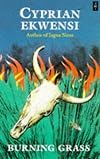
Ekwensi, a highly regarded Nigerian novelist, may have originally intended this as Young Adult fiction. The publisher certainly did and was startled when it became extremely popular with all ages. That it did so is no surprise, I think. The story follows Mai Sunsaye, a Fulani herder and chief of his village in northern Nigeria. A rival successfully casts a spell on him, afflicting him with sokugo, the wandering sickness. The plot follows Sunsaye as he travels under this spell, reuniting with show more his sons and other intriguing characters at the same time providing a wonderful picture of society and life in a particular place and time (the 1950s). Ekwensi is a great storyteller; it’s no accident that Chinua Achebe, the editorial advisor to Heinemann’s African Writers Series, included three of Ekwensi’s books among the first publications of that estimable collection. Indeed, this was the second volume in that series, following directly upon the publication of Achebe’s Things Fall Apart. It, too, has great interest as a work of social anthropology, but Ekwensi is too good a writer to pass ignore. Whether you read this or some of his other works, I’d urge you to seek him out. show less

If it was Easter Day on lock-down and this was the only book in the house it would pass a few hours, but if you have a second book, for God’s sake read that. This one is a car-crash.
Our hero is a chap called Wilson. He takes pride running his business, the Independence Pharmacy, but neglects Yaniya, his wife. Will Yaniya leave him? Will Wilson have to learn to cook for himself?
The political metaphor is delivered with such sledge-hammer subtlety that even I grasped it. Wilson is the show more Nigerian state and Yaniya is the people. We’d be heading into allegorical territory were the fabric of it not torn. You see, Wilson is also a politician, so we have a situation where the character is both a metaphor and the thing itself. You can’t have it both ways, but the whole novel is full of forced situations, unbelievable coincidences and factual inconsistencies. Yaniya too sits uncomfortably in her assigned metaphor. Take chapter 4 and the conversation between she and her boyfriend. Who talks like that? I actually wondered if Ekwensi had ever had a conversation with another human being.
I’m going to struggle to convey to you just how bad it is. I just wanted to shut Ekwensi up for his own good, but he just went on and on, making it worse for himself. Incompetence is one thing, but he also betrays some rather unpleasant social attitudes along the way. The whole thing reads like it was written by a randy 15 year old boy, every woman repeatedly described in sexual terms. You think I’m exagerating? Here’s one of the best:
“The roots of her breasts – sapling stems of sucklement- buried their thickness in two hefty ridges. Her bosom seemed to be divided into those two roots and nothing more, tossing up the lower edge of her blowse so that the midriff stood revealed.”
See? “Sapling stems of sucklement”, folks. I’ve taken one for the team reading this. show less
Our hero is a chap called Wilson. He takes pride running his business, the Independence Pharmacy, but neglects Yaniya, his wife. Will Yaniya leave him? Will Wilson have to learn to cook for himself?
The political metaphor is delivered with such sledge-hammer subtlety that even I grasped it. Wilson is the show more Nigerian state and Yaniya is the people. We’d be heading into allegorical territory were the fabric of it not torn. You see, Wilson is also a politician, so we have a situation where the character is both a metaphor and the thing itself. You can’t have it both ways, but the whole novel is full of forced situations, unbelievable coincidences and factual inconsistencies. Yaniya too sits uncomfortably in her assigned metaphor. Take chapter 4 and the conversation between she and her boyfriend. Who talks like that? I actually wondered if Ekwensi had ever had a conversation with another human being.
I’m going to struggle to convey to you just how bad it is. I just wanted to shut Ekwensi up for his own good, but he just went on and on, making it worse for himself. Incompetence is one thing, but he also betrays some rather unpleasant social attitudes along the way. The whole thing reads like it was written by a randy 15 year old boy, every woman repeatedly described in sexual terms. You think I’m exagerating? Here’s one of the best:
“The roots of her breasts – sapling stems of sucklement- buried their thickness in two hefty ridges. Her bosom seemed to be divided into those two roots and nothing more, tossing up the lower edge of her blowse so that the midriff stood revealed.”
See? “Sapling stems of sucklement”, folks. I’ve taken one for the team reading this. show less

This is the story of Amusa Sango, crime reporter and dance-band leader, in Lagos (unnamed in the book) in the early 1950s. According to the publisher (Heinemann), Sango eventually “comes to see that what he can do for the developing country in which he lives is more important than the considerable and varied personal pleasures he can find in the hectic life of the city.” That may have been Ekwensi’s intention…or the publisher’s hope but I was never convinced that Sango ever came to show more see that. He thinks about bigger issues, to be sure. He has moments when he feels guilty for pursuing his smaller pleasures as well as for failing to seize opportunities to act on his better instincts. But the book ends as it began, with no discernible (to me) change in his behavior. Ekwensi paints a vivid, convincing portrait of life in the big city but I was disappointed that several hundred pages later, Sango is acting no differently than he did at the outset. Of course, the book is significant enough that NYRB Books decided to reprint it in 2020, so perhaps my disillusionment is overstated. But I leave the final word to M.A. Orthofer (of The Complete Review) who summarized his thoughts this way: “There's enough to People of the City for it to be of interest—indeed, one of the problems with the book is that there is so much scattered in it, too little of which is followed-up or presented in sufficient depth. Ekwensi's writing is uneven and often rough, but there's some impressive color to it too; even where the story sputters, the writing mostly carries it through.” I agree. show less
"To the Fulani herdsman who has spent most of his time on the move, home was a cluster of huts anywhere from which no more movement was contemplated." Everything in "Burning Grass" wanders. The major figures are Fulani--the most successful herdsmen of West Africa--all spurred by diverse motives across a well-evoked natural landscape. Something about the pace and trajectories of the principal characters is made enchanting by everyone’s easy acceptance of life on foot. Sunsaye, father of show more three and Chief of Dokan Toro, is bewitched by a malicious rival into following anything that flies—a curse that disguises itself from him amidst the random missions that he sets himself. As soon as Sunsaye reaches one sought-after person, he departs in search of another. All the while, his social and family networks are trying to catch up with him because they need the guidance and security that his leadership provides. While he wanders—failing to properly oversee his offspring, his people and his cattle—his sons fall into various traps and forms of trouble, which necessitate further wandering on their father’s part.
“Burning Grass” stands out in the African Writers Series. There is no irritating and oppressive representative of white money and culture, the coming of age elements are played down, the juju is integrated quite naturally and without shame and everything moves. It’s a brisk and enjoyable story, almost mythic and almost too short. show less
“Burning Grass” stands out in the African Writers Series. There is no irritating and oppressive representative of white money and culture, the coming of age elements are played down, the juju is integrated quite naturally and without shame and everything moves. It’s a brisk and enjoyable story, almost mythic and almost too short. show less
You May Also Like


Associated Authors
Statistics
- Works
- 33
- Also by
- 3
- Members
- 579
- Popularity
- #43,292
- Rating
- 3.4
- Reviews
- 12
- ISBNs
- 81
- Languages
- 5