
Ngũgĩ wa Thiong'o (1938–2025)
Author of A Grain of Wheat
About the Author
Novelist, playwright, and essayist, Ngugi wa Thiong'o was born in Kenya on January 5, 1938. He received a B.A. in English from Makerere University College in Kampala, Uganda in 1963. He is Kenya's best-known writer and one of East Africa's most outspoken social critics. His first novel, Weep Not, show more Child (1964), was a penetrating account of the Mau Mau uprising (a tribal revolt that occurred in colonial Kenya) and was the first English-language novel by an East African. Two subsequent works, The River Between (1965) and A Grain of Wheat (1967), are sensitive novels about the Kikuyu people caught between the old and the new Africa. One of his major concerns has been the lack of reading materials in native African languages. In an attempt to bring literature to African peasants and workers, he wrote and produced the play I Will Marry When I Want (1977) in his native Kikuyu language. The play, which shows the exploitation of Kikuyu workers and peasants, attracted a large audience of poor Kenyans. It also led to Ngugi's arrest and imprisonment. After his release from prison, he went into exile and is currently living in the United States. His other works include Detained (1981); Decolonising the Mind: The Politics of Language in African Literature (1986); and Matigari (1987). He received the 2001 Nonino International Prize for Literature. In 2006, Random House published his first new novel in nearly two decades, Wizard of the Crow. (Bowker Author Biography) show less
Disambiguation Notice:
Ngũgĩ's name is not in the western form of last name, first name, because neither Ngũgĩ nor wa Thiong'o is his "last name" in the sense that is used in the west. He returned to the traditional Gikuyi form of his name, which roughly means Ngũgĩ son of Thiong'o, and is referred to on his own web site as Ngũgĩ.
Image credit: Photo by user 601TV / Flickr
Series
Works by Ngũgĩ wa Thiong'o
Writers in Politics: A Re-engagement with Issues of Literature and Society (Studies in African Literature) (1981) 36 copies
Penpoints, Gunpoints, and Dreams: Towards a Critical Theory of the Arts and the State in Africa (1998) 14 copies
Eén korrel graan (Dutch Edition) 2 copies
Afrika sichtbar machen: Essays über Dekolonisierung und Globalisierung (German Edition) (2021) 1 copy
නාඩන් දරුව 1 copy
En la Casa del Intérprete 1 copy
Mutiiri 1 copy
Ngũgĩ wa Thiongʾo of Kenya 1 copy
Nace un tejedor de sueños (Narración en Castellano): El despertar de un escritor (Ciclogénesis) (2020) 1 copy
Chmury i łzy 1 copy
Njia Panda 1 copy
Decolonising the Mind 1 copy
Usilie Mpenzi Wangu 1 copy
Associated Works
The Art of the Story: An International Anthology of Contemporary Short Stories (1999) — Contributor — 394 copies, 5 reviews
Other Voices, Other Vistas: Short Stories from Africa, China, India, Japan, and Latin America (1992) — Contributor — 213 copies, 2 reviews
Tagged
Common Knowledge
- Canonical name
- Ngũgĩ wa Thiong'o
- Legal name
- Ngũgĩ wa Thiong'o
- Other names
- Ngugi, James Thiong'o (birth name)
wa Thiongo, Ngugi - Birthdate
- 1938-01-05
- Date of death
- 2025-05-28
- Gender
- male
- Education
- Alliance High School, Kikuyu, Kenya
Makerere University (Bx)
University of Leeds (Bx)
Dramatiska Institute, Stockholm, Sweden - Occupations
- novelist
playwright
essayist
academic
editor
journalist (show all 7)
professor - Organizations
- University of Nairobi
Yale University
New York University
University of California, Irvine
Ngũgĩ Wa Thiong'o Foundation - Awards and honors
- Lotus Prize for Literature (1973)
American Academy of Arts and Letters (Foreign Honorary ∙ Literature ∙ 2003)
PEN/Nabokov Award for Achievement in International Literature (2022) - Relationships
- Achebe, Chinua (advocate, friend)
wa Ngũgĩ, Mũkoma (offspring)
wa Ngũgĩ, Wanjikũ (offspring)
wa Ngũgĩ, Ndũcũ (offspring) - Nationality
- Kenya
- Birthplace
- Kamiriithu, British Kenya
- Places of residence
- Kamiriithu, Kenya
Nairobi, Kenya
Irvine, California, USA
New York, New York, USA
New Haven, Connecticut, USA
Amherst, Massachusetts, USA - Place of death
- Atlanta, Georgia, USA
- Map Location
- Kenya
- Disambiguation notice
- Ngũgĩ's name is not in the western form of last name, first name, because neither Ngũgĩ nor wa Thiong'o is his "last name" in the sense that is used in the west. He returned to the traditional Gikuyi form of his name, which roughly means Ngũgĩ son of Thiong'o, and is referred to on his own web site as Ngũgĩ.
Members
Discussions
AFRICAN NOVEL CHALLENGE OCTOBER 2023 : NGUGI WA THIONG'O & SCHOLASTIQUE MUKASONGA in 75 Books Challenge for 2023 (November 2023)
Petals of Blood by Ngũgĩ wa Thiong'o in Author Theme Reads (January 2012)
Matigari by Ngũgĩ wa Thiong'o in Author Theme Reads (December 2011)
Introducing Ngũgĩ wa Thiong'o in Author Theme Reads (December 2011)
Weep Not, Child by Ngũgĩ wa Thiong'o in Author Theme Reads (December 2011)
The River Between by Ngũgĩ wa Thiong'o in Author Theme Reads (December 2011)
Devil on the Cross by Ngũgĩ wa Thiong'o in Author Theme Reads (November 2011)
Reviews
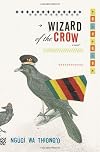
There are quite a few legends in this world. One of the oldest tells of how the people of Babylon decided to build a tower all the way up to Heaven. But to no one’s great surprise, The Lord disapproved, and not only did he tear the tower down but by making everyone speak different languages he also made sure that nothing like it would ever happen again.
Bah humbug, says the dictator of the compleeetely fictional African country of Aburiria (really, it has absolutely nothing to do with wa show more Thiong'o's native Kenya. Really.) He’s ruled the country with an iron fist almost since the day the English left, he’s both the ruler and the lord of everyone, and nobody’s going to tell him that there are limits to his power. No, he’s going to build a modern Tower of Babel and march all the way to the stars to show the world that Africa can do things the West can’t even imagine. All he needs to get it going is to a) use both whips and carrots to convince the people that this is much more important than nonsense such as democracy, jobs and food, and b) convince the World Bank to finance it since Aburiria doesn’t actually have much money of its own. How difficult can it be? Thanks to the English language there’s a common lingua franca again, just like back in the day, and in these neo-colonialist days borrowing money shouldn’t be a problem as long as you’re prepared to pay interest. As one character notes, it's funny how "independence" came to mean "dependence."
But of course, the Ruler hasn’t taken the wizard of the book’s title into account. Which is one of the few things he can be excused for, since the wizard hasn’t taken himself into account either; he’s just an out-of-work academic who, while running from the police together with a woman from the resistance, makes up a story based on an old folk tale to make himself scarier than he really is. But before he knows it, the legend of the magic of the crow has spread and everyone – politicians, businessmen and the huddled masses – want his help to get ahead in the world. And somewhere around that time the magic, which began as a hoax, starts to gather real power.
wa Thiong’o’s huge novel has enough dashes of magical realism and modern-day fairytale to be compared to both Márquez and Rushdie (as indeed it has), but for my part, I keep thinking that this is more like an African take on Bulgakov’s The Master And Margarita. It’s got the same wildly disrespectful and bawdy sense of humour, coupled with a pissed-off, clear-sighted social critique that seems to want to kick over the whole damn tower of power hunger, nepotism, sexism, racism and faceless structures, all set to notes of both ancient myths and modern thinking that sometimes collides wildly and sometimes fuses into something completely new.
For a parallel, consider this. A somewhat younger legend than the Tower of Babel concerns Great Zimbabwe, the very real and ancient stone city in Southern Africa, which the newly colonized Africans back in the day claimed to be have been built by their ancestors. Their new rulers, of course, laughed at this idea (even when their own archaelogists confirmed it); since the white race was superior, something this big must have been built by white people, ergo they were simply reclaiming their rights to rule Africa. The logic of the victorious can often seem a bit weird in hindsight, when all the evidence has been twisted to serve the purpose of the one with the power to enforce his interpretation on others.
Aburiria is clearly based on Kenya and the Ruler on Daniel Arap Moi, but Wizard of the Crow is bigger than that; it’s a furious satire on all sorts of oppression, whether based on political, economical or physical power, and the Ruler echoes both Pinochet, Honecker and Putin. The West uses Africa, whose dictators use the military and police to use the people, where the men turn to the only outlet that remains and use the women. Lick up, kick down, shit flows downhill. wa Thiong’o constantly plays around with language; hardly a surprise, since he was one of the first African writers to refuse to write in English and instead write in his native tongue – something which cost him a year in jail and eventually exile when the regime didn’t like what he wrote. The value of language seeps through everything here; all old sayings, Bible verses, and English platitudes are twisted by those in power until the language itself becomes a trap the powerless must find their way out of. (In one scene, our hero remembers an old girlfriend who told him the story of how Jesus asked his disciples to become fishers of men – only to spot her on a street corner in a miniskirt, wasting away from HIV, still fishing for men. On a lighter note, there’s a misquote of Descartes that eventually turns into a linguistic virus that almost overthrows the government by itself.) And the way out turns out to be through storytelling; the legend of the people’s wizard, who can hold up a mirror and change the world, causing those in power to panic and become ever more paranoid. Just like in Bulgakov everything turns upside down, roles reverse and re-reverse, laughter goes from the bitter to the uproarious and back. wa Thiong’o’s language is a fantastic mix of colourful folk tale and modern novel, complex without being too complicated, hilarious without dropping its serious undertone, and it’s one of the most rewarding novels I’ve read all year. At 768 pages it might be a bit longer than it needs to be, but even the bits that aren't strictly necessary are simply too much fun to want gone.
The world keeps creating new legends, and they don’t necessarily need to be true to be strong enough to tear down towers. One of the newest is about an African grass roots movement where men and women work as equals, unite old truths with education and new ideas and only demand to control their own future. I don’t know how true that one is or can be, but it makes a cracking good read. show less
Bah humbug, says the dictator of the compleeetely fictional African country of Aburiria (really, it has absolutely nothing to do with wa show more Thiong'o's native Kenya. Really.) He’s ruled the country with an iron fist almost since the day the English left, he’s both the ruler and the lord of everyone, and nobody’s going to tell him that there are limits to his power. No, he’s going to build a modern Tower of Babel and march all the way to the stars to show the world that Africa can do things the West can’t even imagine. All he needs to get it going is to a) use both whips and carrots to convince the people that this is much more important than nonsense such as democracy, jobs and food, and b) convince the World Bank to finance it since Aburiria doesn’t actually have much money of its own. How difficult can it be? Thanks to the English language there’s a common lingua franca again, just like back in the day, and in these neo-colonialist days borrowing money shouldn’t be a problem as long as you’re prepared to pay interest. As one character notes, it's funny how "independence" came to mean "dependence."
But of course, the Ruler hasn’t taken the wizard of the book’s title into account. Which is one of the few things he can be excused for, since the wizard hasn’t taken himself into account either; he’s just an out-of-work academic who, while running from the police together with a woman from the resistance, makes up a story based on an old folk tale to make himself scarier than he really is. But before he knows it, the legend of the magic of the crow has spread and everyone – politicians, businessmen and the huddled masses – want his help to get ahead in the world. And somewhere around that time the magic, which began as a hoax, starts to gather real power.
wa Thiong’o’s huge novel has enough dashes of magical realism and modern-day fairytale to be compared to both Márquez and Rushdie (as indeed it has), but for my part, I keep thinking that this is more like an African take on Bulgakov’s The Master And Margarita. It’s got the same wildly disrespectful and bawdy sense of humour, coupled with a pissed-off, clear-sighted social critique that seems to want to kick over the whole damn tower of power hunger, nepotism, sexism, racism and faceless structures, all set to notes of both ancient myths and modern thinking that sometimes collides wildly and sometimes fuses into something completely new.
For a parallel, consider this. A somewhat younger legend than the Tower of Babel concerns Great Zimbabwe, the very real and ancient stone city in Southern Africa, which the newly colonized Africans back in the day claimed to be have been built by their ancestors. Their new rulers, of course, laughed at this idea (even when their own archaelogists confirmed it); since the white race was superior, something this big must have been built by white people, ergo they were simply reclaiming their rights to rule Africa. The logic of the victorious can often seem a bit weird in hindsight, when all the evidence has been twisted to serve the purpose of the one with the power to enforce his interpretation on others.
Aburiria is clearly based on Kenya and the Ruler on Daniel Arap Moi, but Wizard of the Crow is bigger than that; it’s a furious satire on all sorts of oppression, whether based on political, economical or physical power, and the Ruler echoes both Pinochet, Honecker and Putin. The West uses Africa, whose dictators use the military and police to use the people, where the men turn to the only outlet that remains and use the women. Lick up, kick down, shit flows downhill. wa Thiong’o constantly plays around with language; hardly a surprise, since he was one of the first African writers to refuse to write in English and instead write in his native tongue – something which cost him a year in jail and eventually exile when the regime didn’t like what he wrote. The value of language seeps through everything here; all old sayings, Bible verses, and English platitudes are twisted by those in power until the language itself becomes a trap the powerless must find their way out of. (In one scene, our hero remembers an old girlfriend who told him the story of how Jesus asked his disciples to become fishers of men – only to spot her on a street corner in a miniskirt, wasting away from HIV, still fishing for men. On a lighter note, there’s a misquote of Descartes that eventually turns into a linguistic virus that almost overthrows the government by itself.) And the way out turns out to be through storytelling; the legend of the people’s wizard, who can hold up a mirror and change the world, causing those in power to panic and become ever more paranoid. Just like in Bulgakov everything turns upside down, roles reverse and re-reverse, laughter goes from the bitter to the uproarious and back. wa Thiong’o’s language is a fantastic mix of colourful folk tale and modern novel, complex without being too complicated, hilarious without dropping its serious undertone, and it’s one of the most rewarding novels I’ve read all year. At 768 pages it might be a bit longer than it needs to be, but even the bits that aren't strictly necessary are simply too much fun to want gone.
The world keeps creating new legends, and they don’t necessarily need to be true to be strong enough to tear down towers. One of the newest is about an African grass roots movement where men and women work as equals, unite old truths with education and new ideas and only demand to control their own future. I don’t know how true that one is or can be, but it makes a cracking good read. show less

“Ng’enda thi ndiagaga mutegi: that which is created by men can also be changed by men.” This sentence is one of many that stuck out for me in this amazing book by Ngugi wa Thiong’o. For me the sentence offers hope in the endless struggle of the poor majority against the rich minority, a theme with permeates Petals of Blood. It’s a theme that resonates with some of the things going on in the United States of America right now.
In the Kenya depicted here, the polarization and show more economic disparity are a direct result of European colonization. Even when Kenya became independent, for the poor and landless it seemed the same old story. As Thiong’o writes:
“This was the society they were building: this was the society they had been building since Independence, a society in which a black few, allied to other interests from Europe, would continue the colonial game of robbing others of their sweat, denying them the right to grow to full flowers in air and sunlight.”
And again:
“…all ways for the poor go one way. One-way traffic: to more poverty and misery. Poverty is sin. But imagine. It is the poor who are held responsible for the sin that is poverty and so they are punished for it by being sent to hell.”
I guess it was the expression of sentiments like this, however true, that led to the “liberal” government of Kenya taking the author into custody and holding him without charges or trial. He definitely paints a bleak picture of the effect of colonization and missionaries on the African people, as well as the repeated failures of their post-independence leaders to improve their lives.
The story follows four characters whose lives are intertwined in multiple ways that unfold layer after layer as the dialogue goes on. All four have been taken into custody for a triple murder, and it is the recollections and statements of the four that form the basis of the story.
We first meet the school teacher Munira, who comes to the sleepy rural town of Ilmorog to hide from life. Although he does seem to genuinely believe in educations at times, he also seems to just want to fly under the radar and not think to much. At one point he ponders his teaching:
“He now put the question to himself: what did the children really think of him? Then he dismissed it with another: what did it matter one way or the other? He had taught for so many years now—teaching ready-made stuff must be in his blood—and one did all right as long as one was careful not to be dragged into…into…an area of darkness…Yes…darkness unknown, unknowable…like the flowers with petals of blood and questions about God, law…things like that. He could not teach now: he dismissed the class a few minutes before time and went back to the house.”
Then we have the shopkeeper and (we later find out) Mau mau guerilla Abdulla who has also limped into Ilmorog with his one good leg, his donkey, and his son to try and forget his disillusionment with the bitter fruits harvested after their sacrifice in the fight.
Karega is the youngest and is still full of the fire of activism and outrage that Abdulla still possesses under the surface and even Munira possessed a small amount of at one time in his life. At first he is fired up and lectures the older men, telling them that
“The trouble with slogans or any saying without a real foundation is that it can be used for anything. Phrases like Democracy, the Free World, for instance, are used to mean their opposite. It depends, of course, on who is saying where, when and to whom.”
He hits one of the many lows in his rollercoaster of activism while sitting in the cell between his sometimes rough interrogations. Having plenty of time to think, he asks himself:
“What had he really expected from the struggle? His expectation had always taken the form of a beautiful dream, a hazy softness of promises, a kind of call to something higher, nobler, holier, something for which he could have given his life over and over again. It had fizzled out now and toward the end, in Ilmorog, the bright flames of his dreams had died and only ashes had remained.”
And finally, we have the beautiful and seductively magnetic Wanja, who has her own shameful secrets buried in her past. She brings the plight of African women fully into the frame of the story as she tries to find a create a new life for herself in Ilmorog. She is irresistible to the men of the story and is fully aware of her power over them but goes back and forth on whether she should use that power or not. She sums up the bleak options of women in this telling statement:
“Eat or you are eaten. If you have a cunt—excuse my language, but it seems the curse of Adam’s Eve on those who are born with it—if you are born with this hole, instead of it being a source of pride, you are doomed to either marrying someone or being a whore. You eat or you are eaten.”
All in all, Thiong’o does a great job of slowly but surely developing these four tormented characters as the story draws to it’s dramatic close. I found myself really wanting them to find a way to make life better for them and for Kenyans in general. Reading this and Thiong’o’s other book, Wizard of the Crow, has definitely added to my understanding of Africa and the African peoples. It’s very interesting to compare it to literature written from the white colonial perspective, like much of what you see in history books or in authors Elspeth Joscelin Huxley. But much of this story applies to other countries and other struggles. I saw many parallels with the situation here in the United States as well. I highly recommend you get to know this amazing author. show less
In the Kenya depicted here, the polarization and show more economic disparity are a direct result of European colonization. Even when Kenya became independent, for the poor and landless it seemed the same old story. As Thiong’o writes:
“This was the society they were building: this was the society they had been building since Independence, a society in which a black few, allied to other interests from Europe, would continue the colonial game of robbing others of their sweat, denying them the right to grow to full flowers in air and sunlight.”
And again:
“…all ways for the poor go one way. One-way traffic: to more poverty and misery. Poverty is sin. But imagine. It is the poor who are held responsible for the sin that is poverty and so they are punished for it by being sent to hell.”
I guess it was the expression of sentiments like this, however true, that led to the “liberal” government of Kenya taking the author into custody and holding him without charges or trial. He definitely paints a bleak picture of the effect of colonization and missionaries on the African people, as well as the repeated failures of their post-independence leaders to improve their lives.
The story follows four characters whose lives are intertwined in multiple ways that unfold layer after layer as the dialogue goes on. All four have been taken into custody for a triple murder, and it is the recollections and statements of the four that form the basis of the story.
We first meet the school teacher Munira, who comes to the sleepy rural town of Ilmorog to hide from life. Although he does seem to genuinely believe in educations at times, he also seems to just want to fly under the radar and not think to much. At one point he ponders his teaching:
“He now put the question to himself: what did the children really think of him? Then he dismissed it with another: what did it matter one way or the other? He had taught for so many years now—teaching ready-made stuff must be in his blood—and one did all right as long as one was careful not to be dragged into…into…an area of darkness…Yes…darkness unknown, unknowable…like the flowers with petals of blood and questions about God, law…things like that. He could not teach now: he dismissed the class a few minutes before time and went back to the house.”
Then we have the shopkeeper and (we later find out) Mau mau guerilla Abdulla who has also limped into Ilmorog with his one good leg, his donkey, and his son to try and forget his disillusionment with the bitter fruits harvested after their sacrifice in the fight.
Karega is the youngest and is still full of the fire of activism and outrage that Abdulla still possesses under the surface and even Munira possessed a small amount of at one time in his life. At first he is fired up and lectures the older men, telling them that
“The trouble with slogans or any saying without a real foundation is that it can be used for anything. Phrases like Democracy, the Free World, for instance, are used to mean their opposite. It depends, of course, on who is saying where, when and to whom.”
He hits one of the many lows in his rollercoaster of activism while sitting in the cell between his sometimes rough interrogations. Having plenty of time to think, he asks himself:
“What had he really expected from the struggle? His expectation had always taken the form of a beautiful dream, a hazy softness of promises, a kind of call to something higher, nobler, holier, something for which he could have given his life over and over again. It had fizzled out now and toward the end, in Ilmorog, the bright flames of his dreams had died and only ashes had remained.”
And finally, we have the beautiful and seductively magnetic Wanja, who has her own shameful secrets buried in her past. She brings the plight of African women fully into the frame of the story as she tries to find a create a new life for herself in Ilmorog. She is irresistible to the men of the story and is fully aware of her power over them but goes back and forth on whether she should use that power or not. She sums up the bleak options of women in this telling statement:
“Eat or you are eaten. If you have a cunt—excuse my language, but it seems the curse of Adam’s Eve on those who are born with it—if you are born with this hole, instead of it being a source of pride, you are doomed to either marrying someone or being a whore. You eat or you are eaten.”
All in all, Thiong’o does a great job of slowly but surely developing these four tormented characters as the story draws to it’s dramatic close. I found myself really wanting them to find a way to make life better for them and for Kenyans in general. Reading this and Thiong’o’s other book, Wizard of the Crow, has definitely added to my understanding of Africa and the African peoples. It’s very interesting to compare it to literature written from the white colonial perspective, like much of what you see in history books or in authors Elspeth Joscelin Huxley. But much of this story applies to other countries and other struggles. I saw many parallels with the situation here in the United States as well. I highly recommend you get to know this amazing author. show less
Decolonising the Mind: The Politics of Language in African Literature (0) (Studies in African Literature (Paperback)) by Ngũgĩ wa Thiong'o
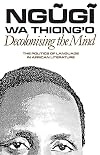
Ngũgĩ wa Thiong'o had already published four acclaimed novels in English when, in 1977, he gave up the language as a vehicle for fiction. A few years later he published this polemic, which he said would be his last writing in English in any genre.
Consequently, he's now probably even more famous among sociolinguists than students of literature, because Decolonising the Mind is a rare example of a top practitioner setting out a total rationale, complete with backstory and running examples, show more of the political and cultural implications of choosing one language over another.
It would be possible to argue on purely artistic grounds that a local language is simply better at describing certain things – the rhythms of daily life, say, or regional wildlife – than another. But what makes Ngũgĩ's argument so powerful is that his grounds are not artistic, but political. Writing in Kikuyu may give him access to new and interesting aesthetic effects, but that's not why he does it – he does it to resist cultural appropriation and to target a more primary audience.
There's always been a big irony in literature from former colonies that uses a colonial language – what Ngũgĩ calls ‘Afro-European’ literature, a useful term that I'm happy to adopt. Abroad, it's often praised in proportion to how well it shows us the details of different, alien lives, and yet it's obviously aimed at us, not them: the people described are often exactly those excluded from reading it. Chinua Achebe's descriptions of yam farmers in Nigeria will rarely be read by yam farmers in Nigeria, because most of them can't read English.
Ngũgĩ had a crisis about this after writing his third novel, A Grain of Wheat (still the only one of his that I've so far read).
I knew whom I was writing about but whom was I writing for? The peasants whose struggles fed the novel would never read it.
There's an obvious answer, of course, which is that people write in order to communicate ideas, and writing in a major world language communicates your ideas more widely than doing so in a small regional language. Six or seven million people speak Kikuyu, whereas four hundred million speak English natively and probably almost as many again as a second language. The implications of this are not just remunerative – though that's no small consideration – they're also practical, if you're interested in influencing bigger audiences.
Nevertheless, for Ngũgĩ this is an argument for having a better translation culture, not for the abandonment of a writer's native language. The attempt to wrangle African languages into English has been invigorating and transformative for English – one thinks of Amos Tutuola or Ben Okri – but, at the end of the day, why the hell should we be benefitting at the expense of other languages? ‘We cannot have our cake and eat it,’ he says.
Why, we may ask, should an African writer, or any writer, become so obsessed by taking from his mother-tongue to enrich other tongues?
It's a fair point. For Ngũgĩ, there's little difference between a postcolonial English enriching itself from African languages, and a colonial England enriching itself from African labour or resources. The problem is circular, because the lack of literatures in many smaller languages leads to an assumption, even from native speakers, that they are unable to support a literature, let alone a world literature. But if addressing that misconception is not the job of writers, whose job is it?
We African writers are bound by our calling to do for our languages what Spencer, Milton and Shakespeare did for English; what Pushkin and Tolstoy did for Russian; indeed what all writers in world history have done for their languages by meeting the challenge of creating a literature in them, which process later opens the languages for philosophy, science, technology and all the other areas of human creative endeavours.
As an English-speaker, one reads this book with, first of all, a renewed sense of gratitude that so many writers have in fact chosen to write in English, along with a troubling re-evaluation of why they felt it was necessary to do so. At the very least everyone should agree that more translated fiction should be out there, and not just coming from the major languages. Ngũgĩ is one of the few big writers putting his money where his mouth is by writing only in his native tongue, but even he's had to make concessions: his major work, Wizard of the Crow (Mũrogi wa Kagogo), was translated into English by Ngũgĩ himself, so he did actually write the text of the English novel that everyone's reading. If that's not having your cake and eating it, I'm not sure what is. show less
Consequently, he's now probably even more famous among sociolinguists than students of literature, because Decolonising the Mind is a rare example of a top practitioner setting out a total rationale, complete with backstory and running examples, show more of the political and cultural implications of choosing one language over another.
It would be possible to argue on purely artistic grounds that a local language is simply better at describing certain things – the rhythms of daily life, say, or regional wildlife – than another. But what makes Ngũgĩ's argument so powerful is that his grounds are not artistic, but political. Writing in Kikuyu may give him access to new and interesting aesthetic effects, but that's not why he does it – he does it to resist cultural appropriation and to target a more primary audience.
There's always been a big irony in literature from former colonies that uses a colonial language – what Ngũgĩ calls ‘Afro-European’ literature, a useful term that I'm happy to adopt. Abroad, it's often praised in proportion to how well it shows us the details of different, alien lives, and yet it's obviously aimed at us, not them: the people described are often exactly those excluded from reading it. Chinua Achebe's descriptions of yam farmers in Nigeria will rarely be read by yam farmers in Nigeria, because most of them can't read English.
Ngũgĩ had a crisis about this after writing his third novel, A Grain of Wheat (still the only one of his that I've so far read).
I knew whom I was writing about but whom was I writing for? The peasants whose struggles fed the novel would never read it.
There's an obvious answer, of course, which is that people write in order to communicate ideas, and writing in a major world language communicates your ideas more widely than doing so in a small regional language. Six or seven million people speak Kikuyu, whereas four hundred million speak English natively and probably almost as many again as a second language. The implications of this are not just remunerative – though that's no small consideration – they're also practical, if you're interested in influencing bigger audiences.
Nevertheless, for Ngũgĩ this is an argument for having a better translation culture, not for the abandonment of a writer's native language. The attempt to wrangle African languages into English has been invigorating and transformative for English – one thinks of Amos Tutuola or Ben Okri – but, at the end of the day, why the hell should we be benefitting at the expense of other languages? ‘We cannot have our cake and eat it,’ he says.
Why, we may ask, should an African writer, or any writer, become so obsessed by taking from his mother-tongue to enrich other tongues?
It's a fair point. For Ngũgĩ, there's little difference between a postcolonial English enriching itself from African languages, and a colonial England enriching itself from African labour or resources. The problem is circular, because the lack of literatures in many smaller languages leads to an assumption, even from native speakers, that they are unable to support a literature, let alone a world literature. But if addressing that misconception is not the job of writers, whose job is it?
We African writers are bound by our calling to do for our languages what Spencer, Milton and Shakespeare did for English; what Pushkin and Tolstoy did for Russian; indeed what all writers in world history have done for their languages by meeting the challenge of creating a literature in them, which process later opens the languages for philosophy, science, technology and all the other areas of human creative endeavours.
As an English-speaker, one reads this book with, first of all, a renewed sense of gratitude that so many writers have in fact chosen to write in English, along with a troubling re-evaluation of why they felt it was necessary to do so. At the very least everyone should agree that more translated fiction should be out there, and not just coming from the major languages. Ngũgĩ is one of the few big writers putting his money where his mouth is by writing only in his native tongue, but even he's had to make concessions: his major work, Wizard of the Crow (Mũrogi wa Kagogo), was translated into English by Ngũgĩ himself, so he did actually write the text of the English novel that everyone's reading. If that's not having your cake and eating it, I'm not sure what is. show less

Set on the eve of Kenyan independence, this covers events going back up to 15 years, to the aftermath of WW2 and the Mau Mau rebellion. It is set in and a round a cluster of villages and has a mostly black cast. They have varied experiences of the uprising and vastly different expectations of the outcome of independence. Some of the characters we meet have been involved in the independence struggle, others have been on the side of the whites. Some have spent time in detention camps and their show more actions have become mythologised over time. It felt that there were almost no characters who did not have at least some kind of mixed feelings of actions on their past that impacted on their current state. The rally for independence and the outcome of that reveals a truth that had been hidden for years, about the betrayal of a former freedom fighter. Who betrayed him is not what those involved expected and the outcome is worryingly left opaque. It seems that independence is not a wiping clean of the slate and that the same people now have to renegotiate their future while accepting their varied pasts. It didn't feel that the future was going to be plain sailing.
It is well written and the characters are fleshed out and feel real in both the present and the past. In several cases their lives have not turned out how they thought they would but they are doing what humans do, living one day at a time. show less
It is well written and the characters are fleshed out and feel real in both the present and the past. In several cases their lives have not turned out how they thought they would but they are doing what humans do, living one day at a time. show less
Lists
Translingualism (1)
1970s (1)
"We" narration (1)
1960s (1)
Revolutions (1)
A Novel Cure (1)
Reading Globally (2)
Africa (2)
Obama Reads (1)
. (1)
Writers at Risk (1)
Read These Too (1)
Black Authors (1)
1980s (1)
Big Jubilee List (1)
Awards


You May Also Like


Associated Authors
Statistics
- Works
- 71
- Also by
- 18
- Members
- 7,483
- Popularity
- #3,271
- Rating
- 3.9
- Reviews
- 146
- ISBNs
- 308
- Languages
- 21
- Favorited
- 20
