
Richard Henry Dana, Jr. (1815–1882)
Author of Two Years Before the Mast
About the Author
Disambiguation Notice:
Richard Henry Dana, Jr. (1815–1882)
American lawyer and author of Two Years Before the Mast, son of Richard Henry Dana, Sr. and father of Richard Henry Dana III.
Richard Henry Dana, Sr. (1787–1879)
American poet and author of The Idle Man, son of Francis Dana and father of Richard Henry Dana, Jr.
Works by Richard Henry Dana, Jr.
Associated Works
American Literature: The Makers and the Making (In Two Volumes) (1973) — Contributor, some editions — 25 copies
Classic Survival Stories: Thirteen Tales of Strength, Determination, and the Will to Live (2004) 19 copies
Tagged
Common Knowledge
- Canonical name
- Dana, Richard Henry, Jr.
- Birthdate
- 1815-08-01
- Date of death
- 1882-01-06
- Gender
- male
- Education
- Harvard University (BA|1837)
Harvard Law School (LL.B|1840) - Occupations
- author
lawyer
politician
sailor - Organizations
- Massachusetts State Bar (1840)
- Awards and honors
- Bowdoin Prize (1837)
- Relationships
- Dana, Richard Henry, Sr. (father)
Dana, Richard Henry, III (son)
Melville, Herman (friend)
Longfellow, Edith (daughter-in-law)
Longfellow, Henry Wadsworth
Dana, Elizabeth Ellery (daughter) (show all 7)
Emerson, Ralph Waldo (teacher) - Cause of death
- influenza
- Nationality
- USA
- Birthplace
- Cambridge, Massachusetts, USA
- Place of death
- Rome, Italy
- Burial location
- Protestant Cemetery, Rome, Italy
- Disambiguation notice
- Richard Henry Dana, Jr. (1815–1882)
American lawyer and author of Two Years Before the Mast, son of Richard Henry Dana, Sr. and father of Richard Henry Dana III.
Richard Henry Dana, Sr. (1787–1879)
American poet and author of The Idle Man, son of Francis Dana and father of Richard Henry Dana, Jr. - Associated Place (for map)
- Cambridge, Massachusetts, USA
Members
Reviews
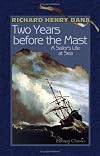
Delightful, just delightful. Started out thinking g I would tire of it as I still don’t truly follow the whole sails thing (which ones go up or down in a storm or get added or subtracted in which wind) but still enjoyed the enthusiasm of the descriptions. Then he hit the California coast and I had a blast reading the descriptions of the coastal “towns” (like San Francisco) in 1820….then it blew me away to read the epilogue where he returns in 1855 and sees all the huge changes of the show more gold rush…Truly fun read.. show less

Richard Henry Dana tells the story of his trip, subtitled "A Sailor's Life at Sea", in the brig Pilgrim out of Boston in 1834. Only 19 years old, the Harvard student signed on as a deck hand. For the next two years he experienced a sailor's rugged life, traveling around Cape Horn, visiting Mexico's California territory a full 15 years before it became a U.S. state, and returning home in 1836. The Pilgrim was 'a swearing ship', in which the brutal and choleric Captain Thompson imposed his show more discipline by bad language, and the Sabbath, normally a kind of token rest day for the crew, was never observed, except by the black African cook reading his bible all day alone in his galley. Apparently Captain Thompson was from the same mold as Herman Wouk's Captain Queeg in The Caine Mutiny.
The everyday details of his journey are surprisingly vivid. On their first week at sea, they spot a pirate ship, and must outrun it on a moonless night. Dolphins follow the ship as it heads for Cape Horn. The Captain's patience is tried by a lazy first mate who refuses to watch for icebergs. And when a man falls overboard, the captain must assure the crew that a thorough search was conducted. The discipline was brutal and flogging was cruel. The author did not attempt to oppose the Captain, but he did devote much of his subsequent life towards improving the conditions of seamen's lives aboard ship.
What made his story unique was that Dana chose to go "before the mast" and live the life of a real sailor unlike those narratives told by passengers on board ship. The edition I read included a glossary that was helpful since there were so many terms in the book unique to sailing. I found the book to be an exciting story made interesting by the well-educated young man who chose to go to sea as a shipmate 'before the mast' rather than a cabin passenger in the officers' quarters. show less
The everyday details of his journey are surprisingly vivid. On their first week at sea, they spot a pirate ship, and must outrun it on a moonless night. Dolphins follow the ship as it heads for Cape Horn. The Captain's patience is tried by a lazy first mate who refuses to watch for icebergs. And when a man falls overboard, the captain must assure the crew that a thorough search was conducted. The discipline was brutal and flogging was cruel. The author did not attempt to oppose the Captain, but he did devote much of his subsequent life towards improving the conditions of seamen's lives aboard ship.
What made his story unique was that Dana chose to go "before the mast" and live the life of a real sailor unlike those narratives told by passengers on board ship. The edition I read included a glossary that was helpful since there were so many terms in the book unique to sailing. I found the book to be an exciting story made interesting by the well-educated young man who chose to go to sea as a shipmate 'before the mast' rather than a cabin passenger in the officers' quarters. show less
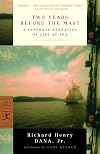
Two Years Before the Mast: A Personal Narrative of Life at Sea (Modern Library Classics) by Richard Henry Dana
I rarely enjoy historical fiction. I find that authors often don't do enough to forget prejudices and sensibilities of their present day and carry this baggage into the imaginary past they are trying to recreate. This time machine for language, notions, ideas, stereotypes is difficult to avoid for authors and might be easy to spot for readers. It is almost impossible to purge, to surgically remove all vestiges of now from a creating mind, something is bound to slip in unconsciously.
Why not show more read an account of an actual eyewitness then? Something written at the time of the events in question is certainly going to be free of the interferences from the future.
Ever since setting foot in the Golden State for the first time I was interested in one point in history of California - the time when it stood at the crossroads of possible futures, the time when it was an almost forgotten province on the outer reaches of newly independent Mexico, the time when Russians used it as a supply zone to access the riches of fur trade in Alaska, the time when no reliable passage overland was known to open it up for pioneer wagons from the East.
In comes Richard Henry Dana Jr, a Harvard student tired of his studies, so intense that they affected his eyesight, looking for adventure. In 1834 he is recruited as a common sailor on board of a brig Pilgrim bound for California. His two-year voyage spent on the open seas and on the desolate western coast forms a basis for this book, published to great acclaim in 1840.
In addition to giving a historical perspective on a far away land and accurately depicting miserable living and working conditions of sailors, the book had a significant influence on many a traveler to the West, sparking in imagination of the masses the comparative ease of making it in the fertile lands of California. Was Dana instrumental in determining the course of California's history by directing the stream of pioneers to the land of plenty years before gold was discovered there? That we cannot say with certainty, but we can surely be grateful to Dana for his contribution to literature, if not by his own writing, but as a person responsible for pushing Melville to write his own masterpiece.
Another interesting aspect of the book is that it can be read today as a postmodernist recount by an unreliable narrator. It is evident from a close reading how the author hides his own failures and shortcomings, trying to paint himself in a more favorable light than he likely deserves. He uses his influence in Boston to secure his own early return back home ahead of the rest of the crew, he hides from his duties with a toothache when things get too tough around Cape Horn, he recounts the cruel punishment of sailors by the captain but fails to stand up to the captain when he is clearly the only one in a position to do so. Dana's personal deficiencies are complemented by prejudices common to many if not all in his days. These are necessary to paint a complete picture of the time and place: repeated references to inferior nations and races (pretty much anyone who is not Anglo-Saxon), propagation of stereotypes of the day (lazy Native Americans, good natured but stupid Hawaiians, fat loving and also stupid Russians, unenterprising Spaniards, etc), an attitude of reverence to everything English, an unshakable belief in Protestant values as the only acceptable ones.
In summary, it's an entertaining book of dwindling importance as the values it promotes no longer rhyme with the modern understanding of humanity. I would recommend it for everyone interested in that period in history and specifically the history of California. I would suggest to skip the Concluding Chapter as its moralizing and preaching can get tiring very quickly. show less
Why not show more read an account of an actual eyewitness then? Something written at the time of the events in question is certainly going to be free of the interferences from the future.
Ever since setting foot in the Golden State for the first time I was interested in one point in history of California - the time when it stood at the crossroads of possible futures, the time when it was an almost forgotten province on the outer reaches of newly independent Mexico, the time when Russians used it as a supply zone to access the riches of fur trade in Alaska, the time when no reliable passage overland was known to open it up for pioneer wagons from the East.
In comes Richard Henry Dana Jr, a Harvard student tired of his studies, so intense that they affected his eyesight, looking for adventure. In 1834 he is recruited as a common sailor on board of a brig Pilgrim bound for California. His two-year voyage spent on the open seas and on the desolate western coast forms a basis for this book, published to great acclaim in 1840.
In addition to giving a historical perspective on a far away land and accurately depicting miserable living and working conditions of sailors, the book had a significant influence on many a traveler to the West, sparking in imagination of the masses the comparative ease of making it in the fertile lands of California. Was Dana instrumental in determining the course of California's history by directing the stream of pioneers to the land of plenty years before gold was discovered there? That we cannot say with certainty, but we can surely be grateful to Dana for his contribution to literature, if not by his own writing, but as a person responsible for pushing Melville to write his own masterpiece.
Another interesting aspect of the book is that it can be read today as a postmodernist recount by an unreliable narrator. It is evident from a close reading how the author hides his own failures and shortcomings, trying to paint himself in a more favorable light than he likely deserves. He uses his influence in Boston to secure his own early return back home ahead of the rest of the crew, he hides from his duties with a toothache when things get too tough around Cape Horn, he recounts the cruel punishment of sailors by the captain but fails to stand up to the captain when he is clearly the only one in a position to do so. Dana's personal deficiencies are complemented by prejudices common to many if not all in his days. These are necessary to paint a complete picture of the time and place: repeated references to inferior nations and races (pretty much anyone who is not Anglo-Saxon), propagation of stereotypes of the day (lazy Native Americans, good natured but stupid Hawaiians, fat loving and also stupid Russians, unenterprising Spaniards, etc), an attitude of reverence to everything English, an unshakable belief in Protestant values as the only acceptable ones.
In summary, it's an entertaining book of dwindling importance as the values it promotes no longer rhyme with the modern understanding of humanity. I would recommend it for everyone interested in that period in history and specifically the history of California. I would suggest to skip the Concluding Chapter as its moralizing and preaching can get tiring very quickly. show less
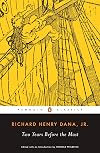
Two Years Before the Mast: A Personal Narrative of Life at Sea (Penguin Classics) by Richard Henry Dana
Loved this. Dana writes in a clear, straightforward style and in a down-to-earth tone. This book, more than many sea accounts of that period, showcases the contrast between life behind the mast (officers) and before it (the crew). Issues of class and dignity are central to this memoir, and Dana's first-hand experience of the work required of sailors gives his account a certain degree of weight. His concern for others is palpable throughout, and it's clear that his ideas of how to improve show more life at sea are the informed suggestions of one who has live that life. This book also serves as a sort of travelogue, as Dana describes the different places he visits and people he encounters. This was before California was part of the US, so much was different, and I appreciate the way that Dana breathed life into that time and place. Finally, I greatly enjoyed the portions about the sea journey itself. His account of Cape Horn was riveting, one of the most powerful and stunning passages I've read in any memoir. I was especially glad that Dana didn't try to over-simplify the technical aspects of sailing: his use of correct nautical terminology was a wise decision. To people who understand it, it makes perfect sense. To people who don't understand, it still conveys a sense of the amount of work involved, and the different elements connected to sailing. It also in no way hinders one's understanding of the narrative. On the contrary, it imbues it with a richness not to be found in many books of the sea. An afterward gives more details as to the changes out west and the fates of his fellow crew members. Brilliant, and not to be missed. show less
Lists
Unread books (1)
Best Sea Stories (1)
Awards


You May Also Like


Associated Authors
Statistics
- Works
- 20
- Also by
- 11
- Members
- 5,454
- Popularity
- #4,563
- Rating
- 4.0
- Reviews
- 67
- ISBNs
- 205
- Languages
- 7
- Favorited
- 2