
Michael Kaplan (2) (1959–)
Author of Chances Are . . .: Adventures in Probability
For other authors named Michael Kaplan, see the disambiguation page.
Works by Michael Kaplan
Tagged
Common Knowledge
- Birthdate
- 1959
- Gender
- male
- Relationships
- Kaplan, Ellen (mother)
Members
Reviews
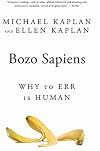
Authors Kaplan and Kaplan look at the various ways in which we fallible human beings are prone to errors of perception, memory, thought, and more.
I have somewhat mixed feelings about this book. To begin with, the authors have an inordinate fondness for allusions and quotations of varying degrees of relevance and obscurity, to the point where it sits right on the borderline between entertaining and annoying. And the first couple of chapters, while interesting enough, felt a bit disorganized show more to me. Discussions of different points tend to blur together slightly, with some ideas explored in detail complete with scientific evidence, others asserted without offering real support, and still others only mentioned in passing, leaving the reader to wonder what the full story behind them is. Then there's the penultimate chapter, which deals with how our evolutionary history as hunter-gatherers affects our current lives in such areas as romance, food, and child-rearing. These are relevant topics, but they seem a little too tangential to the main thrust of the book to receive such detailed treatment, and while I don't really disagree with most of it, I do think that particular chapter blends science, speculation, and the authors' personal views about modern society just a little too freely. (You could probably say the same, to a lesser extent, about the final chapter, which deals with morality, altruism, emotions, power, and how to get along with other people in human society. But I do think it also contains much that is worthwhile, and even somewhat inspiring.)
So, that's the (mildly) negative. On the positive side, the book is very readable, quote-happy tendencies aside. It contains a lot of interesting scientific information, some thought-provoking ideas, and a few really insightful thoughts. Those looking for a more focused take on the subject of how and why the brains that evolved to help us get laid and keep us from getting eaten by tigers aren't necessarily the most reliable tools for discovering the objective truth of the world might prefer something like Dan Ariely's Predictably Irrational. But Bozo Sapiens, with its broad view, its readable style, and its interest in social issues, does provide a worthwhile introduction to the topic. Which, by the way, is a topic that I firmly believe everyone should be introduced to. How can you possibly begin to understand the universe, after all, without understanding the limits of the brain with which you perceive and analyze the universe? show less
I have somewhat mixed feelings about this book. To begin with, the authors have an inordinate fondness for allusions and quotations of varying degrees of relevance and obscurity, to the point where it sits right on the borderline between entertaining and annoying. And the first couple of chapters, while interesting enough, felt a bit disorganized show more to me. Discussions of different points tend to blur together slightly, with some ideas explored in detail complete with scientific evidence, others asserted without offering real support, and still others only mentioned in passing, leaving the reader to wonder what the full story behind them is. Then there's the penultimate chapter, which deals with how our evolutionary history as hunter-gatherers affects our current lives in such areas as romance, food, and child-rearing. These are relevant topics, but they seem a little too tangential to the main thrust of the book to receive such detailed treatment, and while I don't really disagree with most of it, I do think that particular chapter blends science, speculation, and the authors' personal views about modern society just a little too freely. (You could probably say the same, to a lesser extent, about the final chapter, which deals with morality, altruism, emotions, power, and how to get along with other people in human society. But I do think it also contains much that is worthwhile, and even somewhat inspiring.)
So, that's the (mildly) negative. On the positive side, the book is very readable, quote-happy tendencies aside. It contains a lot of interesting scientific information, some thought-provoking ideas, and a few really insightful thoughts. Those looking for a more focused take on the subject of how and why the brains that evolved to help us get laid and keep us from getting eaten by tigers aren't necessarily the most reliable tools for discovering the objective truth of the world might prefer something like Dan Ariely's Predictably Irrational. But Bozo Sapiens, with its broad view, its readable style, and its interest in social issues, does provide a worthwhile introduction to the topic. Which, by the way, is a topic that I firmly believe everyone should be introduced to. How can you possibly begin to understand the universe, after all, without understanding the limits of the brain with which you perceive and analyze the universe? show less
 This review was written for LibraryThing Early Reviewers.
Wonderful, wonderful title (in a recent interview I was asked if I'd ever buy a book on the basis of title alone, and I said no, of course not, but I'd forgotten about this one); a shame about the actual book, really. What the Kaplans set out to do is explain the science behind why, individually and as a species, we're capable of such godawful stupidity: in the largest and wealthiest democracy in the world, there are people who in a few weeks' time will vote for someone who thinks scientists show more are transplanting human brains into mice. No one could more overwhelmingly subscribe to the worthwhileness of their aim; my difficulty was that very often I couldn't follow the Kaplans' arguments. Obviously I suspected (a) this might be my own failing, because I'm stupid, (b) the problem might be that the subject matter is too complex for me, (c) both. But then I recalled how I'd been able to wade through popularizations of far more complex scientific matters -- yer quantum, like -- and came to the conclusion the fault was perhaps not entirely mine. My guess is that people steeped in psychology may not have this problem. show less
This is a great book.
It is a fascinating amalgam of scientific facts which come together to tell different stories of why we are human. (Okay, the book is ostensibly about explaining why we, as humans, make errors – some obvious errors, but we still make them. However, let’s face it – that is being human, making errors.) It begins at the very basic, why we can’t seem to make rational decisions (including such classics as Maurice Allais’ paradox; the failures of economics when it show more meets reality, and why we buy), moves through such areas as how the brain really works and the psychology behind our comfort levels (including discussions of how one Soviet may have saved the world because he didn’t push the button as he was ordered to because it didn’t “feel” right vs. the Russian pilot who shot down a jet liner because he was “supposed to push that button” even though logic showed it was the wrong thing to do.) It then moves into our discomfort with “others”, then all the way into how are ancestors hard-wired us to react the ways we do. It then ends at the most esoteric end of the scale – how we are actually bred to try and be nice.
These quick notes do not do this book justice. Throughout it quotes studies and findings which weave a fascinating story of why we react the way we do. Extensive footnotes and notes are available to anyone who wants to know more.
What I want to know is where I can get more of the authors’ books. show less
It is a fascinating amalgam of scientific facts which come together to tell different stories of why we are human. (Okay, the book is ostensibly about explaining why we, as humans, make errors – some obvious errors, but we still make them. However, let’s face it – that is being human, making errors.) It begins at the very basic, why we can’t seem to make rational decisions (including such classics as Maurice Allais’ paradox; the failures of economics when it show more meets reality, and why we buy), moves through such areas as how the brain really works and the psychology behind our comfort levels (including discussions of how one Soviet may have saved the world because he didn’t push the button as he was ordered to because it didn’t “feel” right vs. the Russian pilot who shot down a jet liner because he was “supposed to push that button” even though logic showed it was the wrong thing to do.) It then moves into our discomfort with “others”, then all the way into how are ancestors hard-wired us to react the ways we do. It then ends at the most esoteric end of the scale – how we are actually bred to try and be nice.
These quick notes do not do this book justice. Throughout it quotes studies and findings which weave a fascinating story of why we react the way we do. Extensive footnotes and notes are available to anyone who wants to know more.
What I want to know is where I can get more of the authors’ books. show less
This review was written for LibraryThing Early Reviewers.Bozo Sapiens is a pretty good introduction to decision-making, how it can go wrong, and more importantly, *why* it can go so very wrong. The Kaplans start with basic logic and logical fallacies (don't panic, they don't go very deep!) and through a somewhat wandering approach go through brain physiology and evolutionary arguments to discuss error in thinking, both at the individual and group levels. A dash of humor and a few stories add spice to the discussion and keep us out of the realm of show more the dry and dusty textbook.
Bozo Sapiens is what I call a "nugget book". The material is presented in short segments that flow from one to the other as a winding almost-conversation on the subject at hand, usually ending up somewhere the reader doesn't expect. They do this reasonably well, but I did feel on occasion that the nuggets could have been a tad deeper - it's ok, after all, to present an overall description of major brain physiology in a book that purports to explain errors in thinking through discussion of brain function. Instead, the authors toss off a short description of, say, the segment of brain they're discussing, and leave the reader to do a bit of research if more is wanted. This isn't a big deal for the book, since they offer a good set of notes for further exploration. There's also surprisingly less discussion in the book of ways to compensate for imperfect decision-making than I thought there would be.
Anyone looking for a decent way to dip into the subject of thought processes and decision-making ought to check out Bozo Sapiens. It's a quick read, but packs a lot of information into such a small package. show less
Bozo Sapiens is what I call a "nugget book". The material is presented in short segments that flow from one to the other as a winding almost-conversation on the subject at hand, usually ending up somewhere the reader doesn't expect. They do this reasonably well, but I did feel on occasion that the nuggets could have been a tad deeper - it's ok, after all, to present an overall description of major brain physiology in a book that purports to explain errors in thinking through discussion of brain function. Instead, the authors toss off a short description of, say, the segment of brain they're discussing, and leave the reader to do a bit of research if more is wanted. This isn't a big deal for the book, since they offer a good set of notes for further exploration. There's also surprisingly less discussion in the book of ways to compensate for imperfect decision-making than I thought there would be.
Anyone looking for a decent way to dip into the subject of thought processes and decision-making ought to check out Bozo Sapiens. It's a quick read, but packs a lot of information into such a small package. show less
This review was written for LibraryThing Early Reviewers.You May Also Like


Associated Authors
Statistics
- Works
- 2
- Members
- 610
- Popularity
- #41,202
- Rating
- 3.5
- Reviews
- 32
- ISBNs
- 78
- Languages
- 5
