
Sue Hubbell (1935–2018)
Author of A Country Year: Living the Questions
About the Author
Sue Hubbell was born Suzanne Gilbert in Kalamazoo, Michigan on January 28, 1935. She received a bachelor's degree in journalism from the University of Southern California in 1956 and a master's degree in library science from Drexel University in 1965. She worked as a librarian at Trenton State show more College and as a periodicals librarian at Brown University. In 1972, she and her first husband moved to a farm in the Ozark Mountains of Missouri and took up beekeeping. To supplement the income from honey sales, she wrote freelance articles for The St. Louis Post-Dispatch, The New York Times, and The New Yorker. After they divorced, she continued to run the large beekeeping operation. She also wrote several books including A Country Year: Living the Questions, A Book of Bees: And How to Keep Them, Far-Flung Hubbell: Essays from the American Road, and Waiting for Aphrodite: Journeys Into the Time Before Bones. She suffered from dementia and decided to stop eating and drinking on September 9, 2018 because she did not want to eventually be placed under indefinite institutional care. She died on October 13, 2018 at the age of 83. (Bowker Author Biography) show less
Image credit: Robert Giard
Works by Sue Hubbell
White Man's Fly 1 copy
Associated Works
Sisters of the Earth: Women's Prose and Poetry About Nature (1991) — Contributor — 443 copies, 5 reviews
Tagged
Common Knowledge
- Other names
- Gilbert, Suzanne (birth name)
- Birthdate
- 1935-01-28
- Date of death
- 2018-10-13
- Gender
- female
- Education
- University of Michigan
Swarthmore College
Western Normal High School
University of Southern California (BA - Journalism)
Drexel University (MLS) - Occupations
- librarian
beekeeper
journalist
columnist
memoirist
essayist - Organizations
- Brown University
The New Yorker
The New York Times
The St. Louis Post-Dispatch - Relationships
- Gilbert, Bil (brother)
- Nationality
- USA
- Birthplace
- Kalamazoo, Michigan, USA
- Places of residence
- Washington, D.C., USA
Moorestown, New Jersey, USA
Philadelphia, Pennsylvania, USA
Trenton, New Jersey, USA
Providence, Rhode Island, USA
Missouri, USA (show all 7)
Milbridge, Maine, USA - Place of death
- Bar Harbor, Maine, USA
- Associated Place (for map)
- USA
Members
Reviews

It's been a while since I've read a book that felt so comfortable to absorb. Certainly some of it is the setting: a fairly isolated rural farm in the Ozarks. Plus, the author's expertise and keen interest in the natural life around her: bees, birds, deer, termites, you name it. And she is very much a fine wordsmith. But what set it truly apart for me is how she, as a "character" in her tale, blended so well with all those around her, keeping her distance brought on by individual differences show more while still finding and taking full advantage of the things that brought her together with them in mutually beneficial ways. She knows very well how to be her own self and still provide satisfactory links to others without letting her accounting of personal relations become out of balance. I am confident most readers would be as comfortable as I was spending time with her. show less
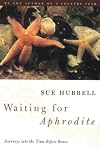
I like this memoir-style of writing about science - it puts the observer back in the picture, instead of pretending she doesn't exist. Waiting for Aphrodite is like an enriched field notebook - Hubbell starts out with the standard time, place and weather, but adds the story of how she came to be in Maine in her 60s, the kind of bicycle she rides to the beach, the geology of the northeastern coastline, and all sorts of other things which are fun to read. She goes on to a standard show more identification and cataloging of species found, which leads on a research flight of fancy from the Smithsonian to Brazil and back to Maine again.
In this book Hubbell writes one of the more lucid descriptions of evolution by natural selection, and also throws in one of the more compelling arguments for preserving biodiversity, all the while introducing the reader to a world of mussels and camel crickets and polychaetes and the people who study them. show less
In this book Hubbell writes one of the more lucid descriptions of evolution by natural selection, and also throws in one of the more compelling arguments for preserving biodiversity, all the while introducing the reader to a world of mussels and camel crickets and polychaetes and the people who study them. show less

Wonderful tone -- no attempt to be literary just a personal account of what makes living in the Ozarks and raising bees so irresistible. Although she's descriptive enough to make it clear that this is no picnic -- a lot of hard, manual labor for little profit -- she also makes it clear that if you really enjoy being with yourself, and have an inquisitive mind that can stay fascinated with an alien world (bees) that there can be exquisite enjoyment. Very fast read, and well worthy of having a show more successor. The kind of book that makes you want to have dinner with the author. show less
Every living thing on the planet has been genetically modified. Each generation forces changes on the next. Most of the time, this modification is natural and inevitable, but sometimes a helping hand intervenes. Ever since humans learned how to grow food, they have been selectively breeding crops that begat more and more resources. In Shrinking the Cat, Sue Hubbell looks at the history of genetic engineering through four species—the corn plant, the silkworm, the cat, and the apple—to get show more a better sense of the ethics and benefits of human tinkering.
Hubbell’s dubs the human race homo mutabilis: human that changes things. We cannot help but modify our environment to suit our needs, but so does every other animal (although not nearly on the scale that we have). Each living thing has found a way, at least for now, to sustain itself, grow, and proliferate. But human intelligence has allowed us to change more than just the environment; we can change the core of things. Hubbell’s look at a few modified organisms gives us a chance to step back and assess how those changes have affected the present. The hybridization and genetic modification of corn has led to disease-resistant strains and high-yield crops, but basically inaugurated the age of corn syrup. Breeding silkworms to produce a good amount of fiber kick-started trade between Asia and Europe.
Genetic engineering has been around for ages, but only now are we doing it more precisely and more deliberately. Those who oppose genetically-modified organisms will be hard-pressed to find something that isn’t modified in some way, but do have valid concerns about the possible side effects of said modifications. Hubbell’s book tries to create a more balanced picture of genetic modification by giving a deeper historical context and interesting connections to sociology, art, and anthropology. This book is short enough to keep your attention, but does well not to become a sermon on the “good of science.” All in all, quick and enlightening read. show less
Hubbell’s dubs the human race homo mutabilis: human that changes things. We cannot help but modify our environment to suit our needs, but so does every other animal (although not nearly on the scale that we have). Each living thing has found a way, at least for now, to sustain itself, grow, and proliferate. But human intelligence has allowed us to change more than just the environment; we can change the core of things. Hubbell’s look at a few modified organisms gives us a chance to step back and assess how those changes have affected the present. The hybridization and genetic modification of corn has led to disease-resistant strains and high-yield crops, but basically inaugurated the age of corn syrup. Breeding silkworms to produce a good amount of fiber kick-started trade between Asia and Europe.
Genetic engineering has been around for ages, but only now are we doing it more precisely and more deliberately. Those who oppose genetically-modified organisms will be hard-pressed to find something that isn’t modified in some way, but do have valid concerns about the possible side effects of said modifications. Hubbell’s book tries to create a more balanced picture of genetic modification by giving a deeper historical context and interesting connections to sociology, art, and anthropology. This book is short enough to keep your attention, but does well not to become a sermon on the “good of science.” All in all, quick and enlightening read. show less
Lists
Awards


You May Also Like


Associated Authors
Statistics
- Works
- 18
- Also by
- 5
- Members
- 1,806
- Popularity
- #14,251
- Rating
- 4.0
- Reviews
- 48
- ISBNs
- 59
- Languages
- 4
- Favorited
- 10